Below you can find a list of astrophysics-related projects, including their title, the name of the supervisor(s) and their e-mail address, and a project summary.
In your application, please clearly identify which project(s) you would like to apply for and note the studentship and programme codes given below.
1. Examining the Stability of Vortices in Planetary Atmospheres &
Oceans
Supervisor: Dr. Matthew Crowe (matthew.crowe2 “at” ncl.ac.uk)
Application Details: Studentship code: MSP113, Programme code: 8080F
Project Abstract
Vortices are regions of rotating fluid which occur across a wide range of scales in Astrophysics and Geophysics. Common examples include the ‘great red spot’ on Jupiter, atmospheric hurricanes and tornadoes, and convection-driven stellar vortices. Vortices are often referred to as ‘coherent structures’ as they can remain stable over very long times, allowing them to transfer mass and momentum over large distances. Vortices typically break down due to instabilities which can occur due to many different physical processes. While there has been much work on the vortex instabilities in general, some instabilities remain to be understood.
The goal of this project is to study the instabilities of planetary vortices resulting from the effects of planetary curvature, and determine the conditions under which these instabilities can occur. This work will use both theoretical analysis and numerical simulations. The student will undertake mathematical modelling, numerical analysis, and scientific writing; giving them a broad skill set and training across disciplines. Candidates should have a background in Physics or Applied Mathematics. Knowledge of fluid mechanics is strongly desirable.
2. The rapid growth of supermassive black holes at high redshift
Supervisors: Dr. Tiago Costa (tiago.costa “at” ncl.ac.uk)
Application Details: Studenshipt code: MSP114, Programme code: 8821F
Project Abstract
The discovery of massive black holes less than a billion years after the Big Bang remains
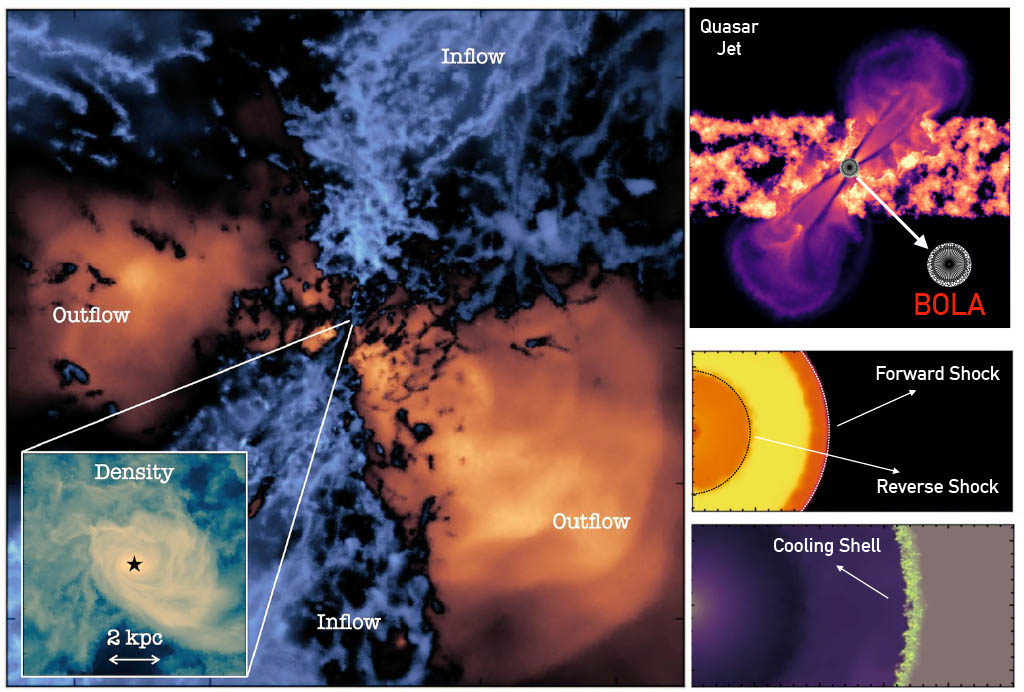
one of the most striking mysteries in astrophysics. JWST is now revealing populations of faint, heavily obscured AGN—including the puzzling “little red dots”—alongside extreme quasar-driven outflows and, paradoxically, unusually weak feedback in fainter AGN. Many early black holes also appear disproportionately massive compared to their host galaxies. These findings challenge our current models of how the first supermassive black holes emerged and grew. This project aims to develop new radiation-hydrodynamic simulations that incorporate improved treatments of black hole accretion, super-Eddington feedback, and radiative transfer in young, high-redshift galaxies. We will address four questions:
- Why do AGN-driven outflows appear weaker in the early Universe despite its gas rich environments?
- How common is super-Eddington accretion in early AGN, and under what conditions does it arise?
- How does energy released during these rapid growth phases influence both the black hole and its host galaxy?
- What physical processes produce “little red dots,” and what do they reveal about the origins of the first supermassive black holes?
An essential component of the project is the generation of mock observations from simulations to establish direct comparison with multi-wavelength data. By bridging simulations with observations, this project seeks to uncover how the Universe’s earliest black holes formed, grew, and shaped galaxies. This project is ideal for a student enthusiastic about computational astrophysics, high-performance computing, and connecting theory with frontier observations.
3. Dynamics of the subsurface oceans of icy moons
Supervisors: Dr. Céline Guervilly and Dr. Graeme Sarson (celine.guervilly “at” ncl.ac.uk, graeme.sarson “at” ncl.ac.uk)
Application Details: Studentship code: MSP115, Programme code: 8080F
Project Abstract
Subsurface oceans of liquid water are believed to exist beneath the ice shells of the large moons around Jupiter and Saturn, making these moons potential candidates for extraterrestrial life. The dynamics of these oceans play a crucial role in determining their habitability, yet little is known about the fluid motions within these environments. This project aims to investigate the global ocean circulation driven by convection, with a particular focus on double-diffusive convection resulting from mantle heat flux and the release of salts into the water. The upcoming Europa Clipper and JUICE missions will provide valuable new data on these icy moons in the coming years. The goal of this project is to understand how ocean dynamics influence key observables, such as ice shell thickness and magnetic signals. We will model the oceans of these moons using numerical magneto-hydrodynamic simulations based on an existing code. Since the dynamics are influenced by the moon’s rotation and are highly nonlinear, the project will require intensive parallel computations, which will be carried out on the high-performance computing facilities at Newcastle University.
4. Weak Gravitational lensing, neutral hydrogen and Dark Energy
Supervisor: Dr. Joachim Harnois-Deraps (joachim.harnois-deraps “at” ncl.ac.uk)
Application Details: Studentship code: MSP116, Programme code: 8821F
Project Abstract
Cosmic shear, or the gravitational lensing of background galaxy images by the foreground large scale structures, is one of the most accurate probe of cosmology. Recent dedicated surveys such as the Kilo Degree Survey and the Dark Energy Survey are able to constraint the abundance and clustering properties of dark matter with an unprecedented accuracy, and the new generation of new survey (LSST, Euclid, WFIRST) will improve our precision by more than an order of magnitude. In principle these maps of dark matter can be used in combination with radio data, in particular with the 21cm intensity maps from e.g. MeerKat, to significantly improve our understanding of the abundance and clustering of neutral hydrogen bias. However this measurement is made difficult due to the complexity of the radio data, and new simulation-based methods must be developed to exploit this next generation of data, which is at the heart of this PhD project.
The successful candidate will have significant experience in python and a keen interest in computational cosmology.
5. Dust in the Wind: exploring the interstellar medium in the central 100 pc of
nearby AGNs with JWST
Supervisor: Dr. David Rosario (david.rosario “at” ncl.ac.uk)
Application Details: Studentship code: MSP117, Programme code: 8821F
Project Abstract
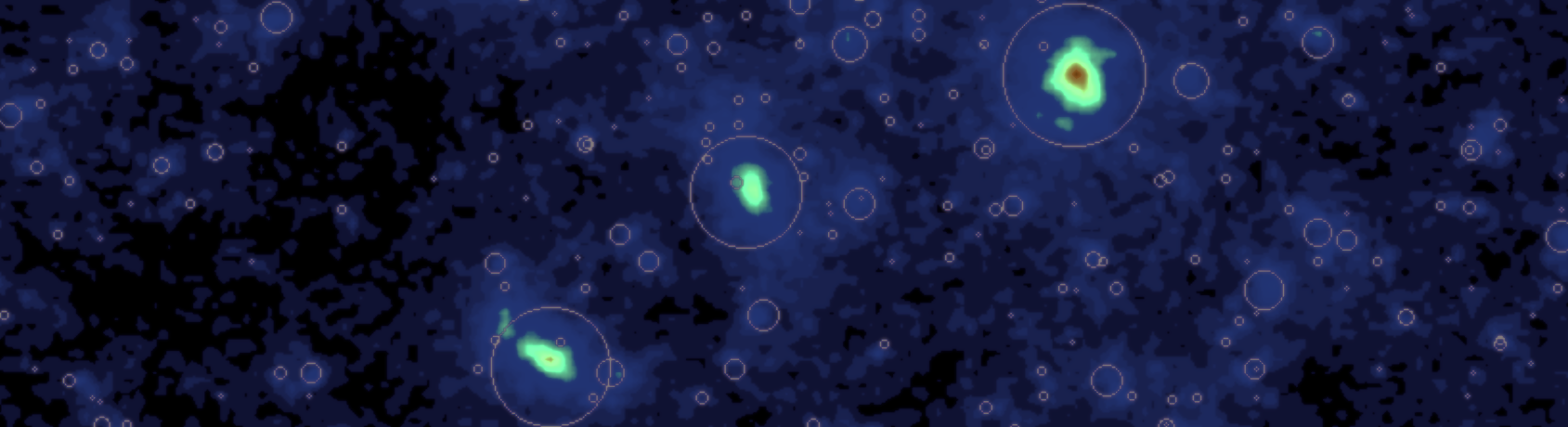
The central regions of galaxies with Active Galactic Nuclei (AGNs) mark the busy and complex interface between the intense energy liberated by supermassive black holes, and the larger galaxies that host them. Of much interest to researchers of both galaxy physics and compact objects, these regions have been targetted by some of the most advanced astronomical observing facilities. This project will use high-quality spectroscopic and imaging data of nearby AGNs from the James Webb Space Telescope (JWST) to explore the processes that heat and excite gas (the accretion disc, shocks, star-formation), and transfer energy into cold molecules and dust. A key part of this work will be the development of a spectral fitting pipeline for JWST spectroscopy of AGNs, as well as a modelling framework that captures the relevant astrophysics of the interstellar medium (ISM).
6. Hierarchical Models for Next-Generation Cosmology with LSST
Supervisor: Dr. Dani Leonard (danielle.leonard “at” ncl.ac.uk)
Application Details: Studentship code: MSP118, Programme code: 8821F
Project Abstract
The Rubin Observatory’s Legacy Survey of Space and Time (LSST) will deliver an unprecedented map of the sky, providing tens of billions of galaxies with which to probe the cosmological phenomenon of weak gravitational lensing. This dataset offers a unique opportunity to test the standard cosmological model with exceptional precision and to investigate potential new physics, including time-evolving dark energy and modifications to gravity.
Realising this scientific potential requires a rigorous treatment of the astrophysical processes that influence observed galaxy populations. This PhD project focuses on developing advanced hierarchical models that incorporate intrinsic alignments, the galaxy-halo connection, the effects of AGN feedback, and redshift-estimation uncertainties.
The successful candidate will apply these models to LSST data to obtain robust constraints on cosmological parameters, while simultaneously improving our understanding of galaxy population-level behaviour and its impact on cosmological inference.
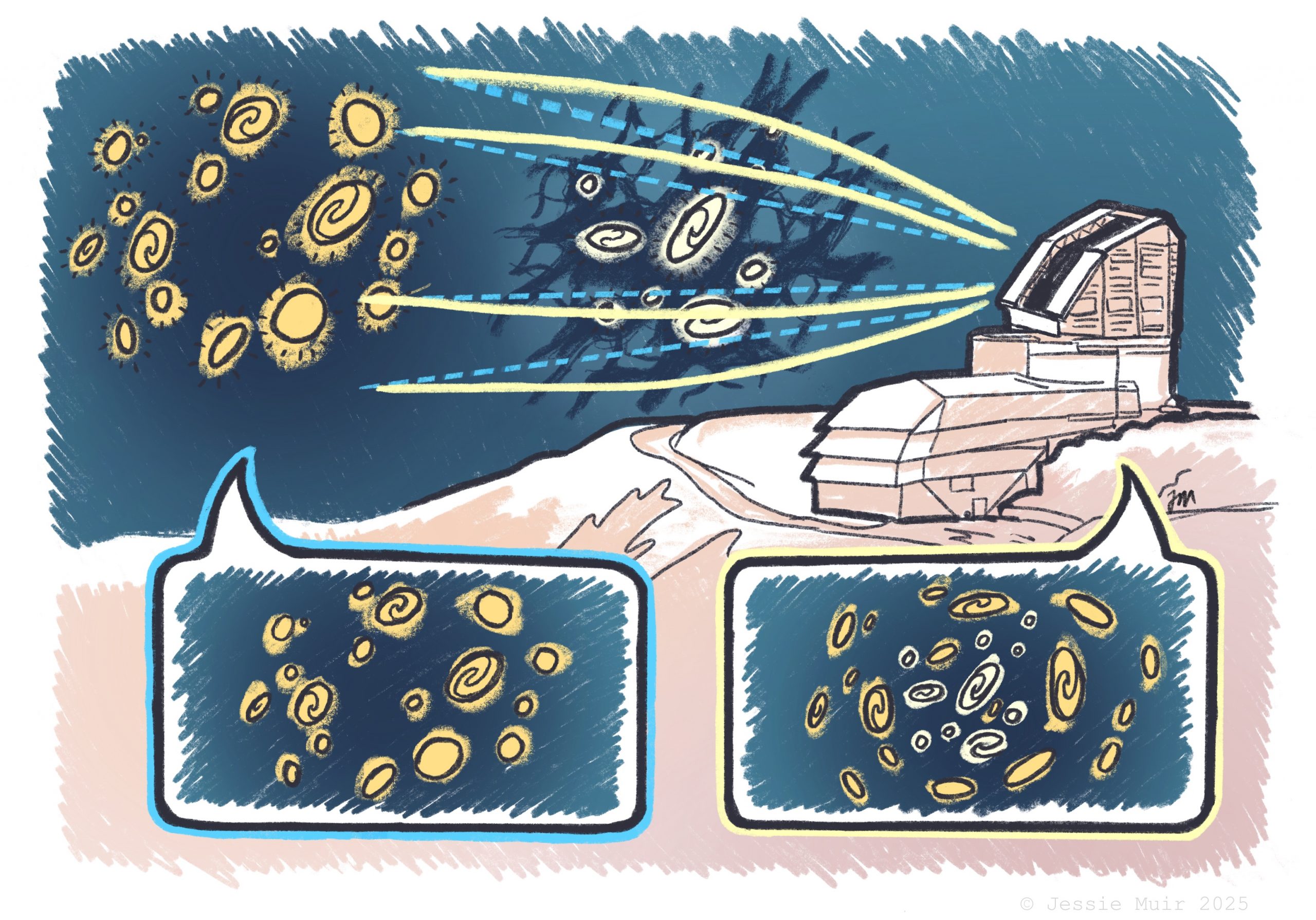 Image Credit: Dr. Jessie Muir
7. Bridging MHD simulations and space-telescope observations of stellar interiors
Supervisors: Dr. Dominic Bowman and Prof. Tamara Rogers (dominic.bowman “at” ncl.ac.uk, tamara.rogers “at” ncl.ac.uk)
Application Details: Studentship code: MSP119, Programme code: 8821F
Project Abstract
In recent years, we have experienced two paradigm shifts in stellar astrophysics: (i) the deluge of high-quality space-telescope data that facilitate asteroseismology – the study of stellar pulsations – and (ii) rapid expansion in the computing capabilities for calculating 3D magnetohydrodynamical (MHD) simulations of stellar interiors. Combined, these two active
research fields are highly complementary, and allow us to test and improve theories of rotation, mixing, and magnetic fields for stars across the Hertzsprung-Russell diagram. Therefore, we have entered the era in which there is great synergy and scientific potential for confronting MHD simulations directly to asteroseismic observations of stars. For example, pulsations are common among massive stars, which end their lives as supernovae and leave behind a neutron star or black hole remnant. Our predictive power of how and why this stellar evolution pathway occurs is limited by our understanding of the interior physics of the progenitor massive stars, including interior rotation, mixing, and magnetic fields. It is common to tackle this problem using 1D stellar evolution models, but stars are inherently 3D and the predictions for physical processes inside 1D models contain large uncertainties and remain largely uncalibrated. In this PhD project, you will learn to calculate 3D MHD simulations of stellar interiors and develop a new framework to directly compare their output to asteroseismic observations. Thus, you will constrain the rotation, mixing, and magnetic fields of massive stars.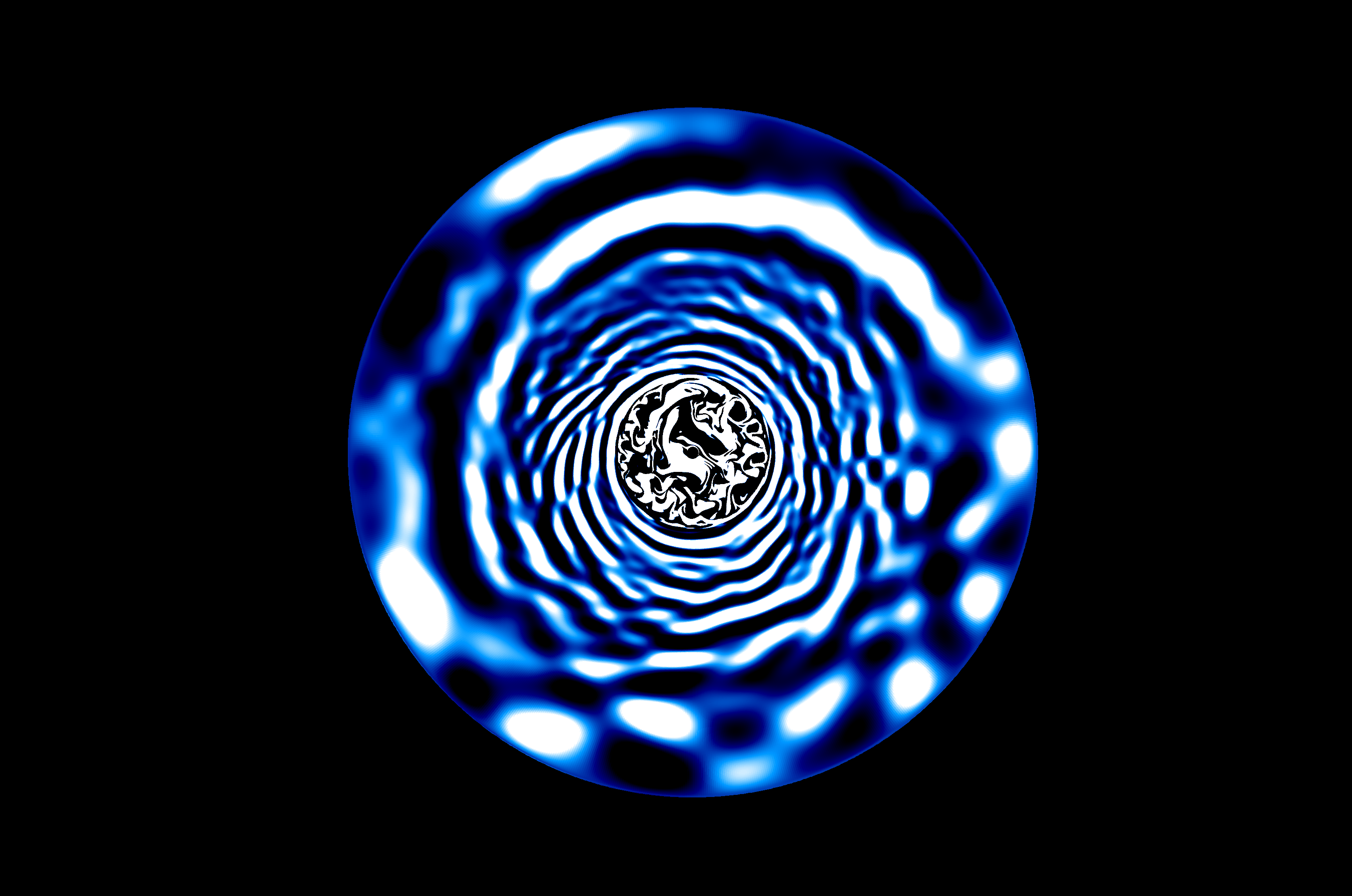
8. Magnetism in Hot Jupiters
Supervisor: Prof. Tamara Rogers and Prof. Paul Bushby (tamara.rogers “at” ncl.ac.uk, paul.bushby “at” ncl.ac.uk)
Application Details: Studentship code: MSP120, Programme code: 8080F
Project Abstract
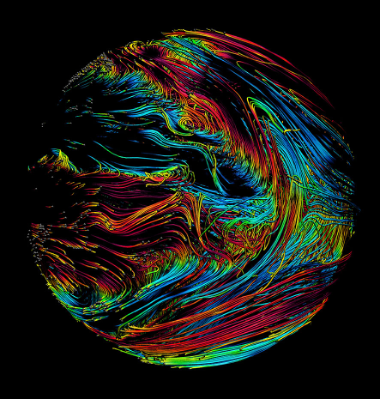
Hot Jupiters are Jupiter-like planets very close to their host stars. They are hot enough that significant parts of their atmospheres are ionised, which allows magnetic fields, generated in their deep interiors, to be coupled to their atmospheric dynamics. This coupling can lead to variations in atmospheric winds and can produce significant ohmic heating, which could “inflate” the planet. There is also the intriguing possibility of atmospheric dynamos in these planets. All of these behaviours can be linked to observations to help us understand hot Jupiter atmospheres and evolution. However, these fascinating dynamical phenomena have yet to be fully explored. This project will use primarily multi-dimensional numerical simulations, in conjunction with observational constraints to investigate the effects of magnetism on hot Jupiters.
9. Using Euclid to Detect Dark Matter Substructure through Strong
Gravitational Lensing
Supervisor: Dr. James Nightingale (james.nightingale “at” ncl.ac.uk)
Application Details: Studentship code: MSP121, Programme code: 8821F
Project Abstract
Observations of the Universe’s largest scales, such as the Cosmic Microwave Background, confirm with near certainty that dark matter (DM) consists of elementary particles formed in the early Universe. While the leading Cold Dark Matter (CDM) model accurately describes the large scale structure of the cosmos, its predictions on smaller, galactic scales remain untested. In particular, CDM predicts that galaxies are surrounded by vast numbers of invisible dark matter clumps, or subhalos, whose properties depend sensitively on the nature of dark matter itself. Detecting and characterising these subhalos therefore provides a powerful way to probe the fundamental physics of dark matter. Strong gravitational lensing, where the light from a distant background galaxy is distorted by the gravity of a foreground galaxy, offers a unique observational test of these predictions. Tiny distortions in lensed images can reveal the presence of otherwise invisible dark matter substructure.
This PhD project will use data from the ESA Euclid mission, which has now discovered over tens of thousands of new strong lenses, to perform the largest-ever search for dark matter subhalos. By developing and applying advanced modelling techniques, we will measure the abundance and properties of substructure across a large population of lenses. The results will provide one of the most stringent tests to date of the Cold Dark Matter paradigm and help determine whether alternative dark matter models are required to explain the small-scale structure of the Universe.
10. Instabilities in the solar interior
Supervisors: Dr. Toby Wood and Prof. Paul Bushby (toby.wood “at” ncl.ac.uk, paul.bushby “at” ncl.ac.uk)
Application Details: Studentship code: MSP122, Programme code: 8080F
Project Abstract
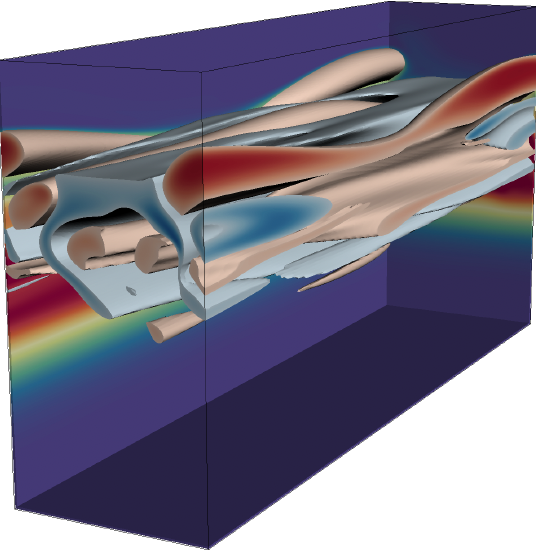
The surface of the Sun is characterised by a broad range of complex magnetic structures. The most prominent of these are sunspots, which form within (so-called) active regions. The distribution of active regions waxes and wanes, following a cyclic pattern with a period of approximately 22 years. It is believed that such regions are the surface manifestations of an underlying large-scale magnetic field that is buried deep within the solar interior, probably localised around the solar tachocline, where the magnetic field is subject to strong shearing motions. To understand the formation of active regions, we need to understand the evolution of the magnetic field in the solar tachocline. In particular, we need to understand the various competing magnetohydrodynamic instabilities that may be playing a role in this evolution. It is generally accepted that magnetic buoyancy plays a crucial role in this regard; it has been suggested more recently that the magnetorotational instability (which is driven by shearing motions) could also be an important factor, particularly at high latitudes.
This project will combine analytical theory with high-resolution numerical simulations, to determine how these instabilities shape the evolution of the solar interior. We will assume no prior knowledge of solar physics, but a good understanding of fluid dynamics is essential.
11. Turbulence, magnetic fields, cosmic rays and galaxy formation
Supervisors: Prof. Anvar Shukurov, Dr. Graeme Sarson and Dr. Fred Gent (anvar.shukurov “at” ncl.ac.uk, graeme.sarson “at” ncl.ac.uk, frederick.gent “at” aalto.fi)
Application Details: Studentship code: MSP123, Programme code: 8080F
Project Abstract
Spiral galaxies are among the most spectacular objects in the observable universe, and their formation and evolution are a subject of active research, both theoretical and observational. Their visual appearance is dominated by the formation of bright, hot, massive stars, a process much more active in younger galaxies. The most massive of the newly formed stars evolve rapidly (in a few million years) and die in a powerful explosion, to produce what is known as a supernova star. Supernova explosions heat and compress the interstellar gas, drive its intense random (turbulent) motions and galactic winds, and produce cosmic rays. In turn, interstellar turbulence amplifies magnetic fields at a wide range of spatial and temporal scales. Properties of the resulting complex system remain poorly understood, especially the role of magnetic fields and cosmic rays.
The goal of this project is to advance and use realistic numerical simulations of the interstellar gas driven by supernova explosions in young and evolving galaxies. The supervisors have rich experience of simulations of this kind. There are many interesting topics to study, including the structure of the interstellar gas in galaxies with exceptionally intense star formation, the effects of spiral arms on the turbulence and the interstellar gas structure, properties of turbulence in the galactic halos, its effects on the interstellar magnetic fields, etc.
This work will involve close contact with international groups of computational scientists and radio astronomers and will be based on intensive, state-of-the-art numerical simulations. Particular topic of research in this very wide and fascinating area can be selected according to the background and preferences of the student.