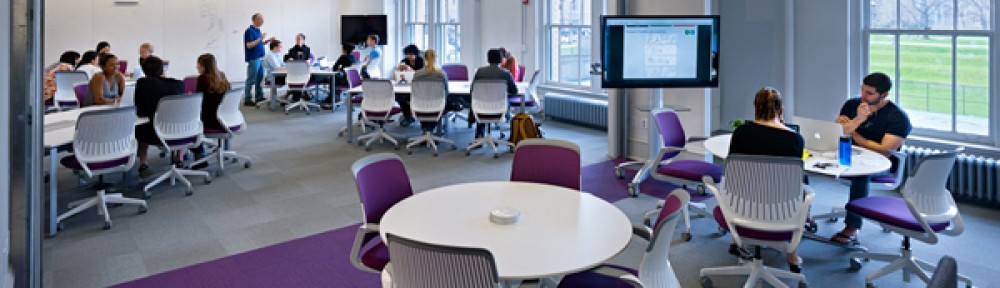
Our second workshop to explore the requirements of a flat floor learning space will be held in the Bedson room 2.51 from 2pm – 3.30pm. All academic and professional support staff are welcome and refreshments will be provided.
Following on from Workshop 1 held on 13th January 2015 we have developed a brief outline for the requirements for the space and translated this into some design options. We will table these options in the workshop to gather more detailed feedback and understand which schools and services could really benefit from this space.
The creations from Workshop 1 held on 13th January can be viewed by clicking the link on the tab above.
The brief we are working on is:
The University wish to create a large flat floor innovative learning space that would accommodate up to170 people. The space should be easily reconfigured to host exams, open days, conferences, inductions, social events and poster board presentations. It will also be used for large and small group learning, where large classes can be brought together for formal teaching and then split into smaller groups for activities or discussions. Creating this new facility will enable the University to explore the flipped classroom model providing team based learning space that is mediated by one or more facilitators and consideration should be given to innovative, even experimental, ways of learning and delivering teaching.
A quality professional environment is required as the space will be used for promotional events, external conferences and by different schools and services within the University. This would need to be balanced with the practical and functional elements demanded by the users. The acoustic environment should cope with multiple groups all working at once and allow whole group discussions and presentations. Technology will be required to support this. A small ‘kitchen’ that allows for the making of and serving drinks and buffet style lunches is required either within or adjacent to the space. Storage for furniture and equipment will also be required.
The space needs to be easily adaptable enabling the room users, rather than the porters, to quickly and easily change the layout, the furniture and technology to switch between uses. This includes change of use between the different events programmed into the room and changes to modes of learning and teaching within sessions. Maintaining this flexibility will be integral to the design of the space, including the services (power and data), furniture and equipment.