#bsf2012 Day 6: Digging the dirt, the edges of the universe… and a good old fashioned knees up!

And so it has come to the end of the festival. 6 whole days of science have passed in a blur and somehow I feel like I could happily just about do it all again. Anyway, I’m getting ahead of myself: what wonders awaited me on the last day of the programme…?

The Northern Past was a two hour delve in to the archaeological investigations currently taking place in the isolated Yup’ik region of Alaska. The team from Aberdeen University use a multitude of scientific tools to assess the ins and outs of human occupation in the region over the last Ice Age, and look in detail at the complex food webs formed by the human occupants and fauna in the Arctic. Working closely with a community in Alaska this ongoing project is a perfect example of great interdisciplinary working lending immense power to a scientific approach.

BBC favourite George McGavin presides over a lunchtime session discussing the new TV series on human origins he is due to co-present with Alice Roberts. The series will air later on this year, and as it is under press embargo (and I don’t want to spoil the surprise for anyone) all I’ll say is that the team have taken a very fresh approach to the topic and I’m really interested to see how it all falls together.

The Extreme Universe was my last proper science session of the festival, but by no means a reason to kick back and let the concentration levels drop. Covering such extreme events as Gamma Ray bursts, the speakers took us on a journey through the distant universe, asking how such unimaginably intense entities as black holes and neutron stars really behave. From observation to experiment, the speakers are all involved in observing distant and little-known phenomena, showing us how we can best hope to understand the true magnitude and oddity of their properties.

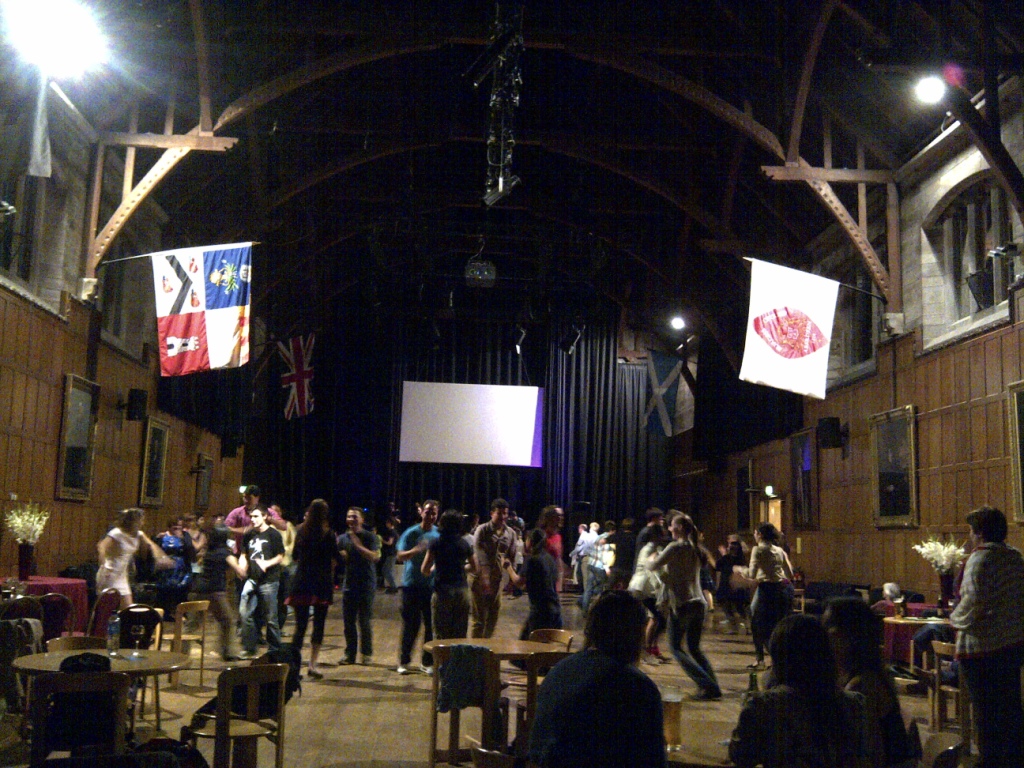
The Cultures Ceilidh was the fitting final party of the festival. Combining talks about Scottish and Celtic culture and heritage with frenetic ceilidh dancing, you’d never know everyone was utterly exhausted from a long week scientific discovery.  As the clock struck 9, powered by hearty helpings of stovies (a stew of potatoes, onion and meat – allegedly) the bsf2012 do-si-do-ed in to the night.
#bsf2012 Day 5: Social inequality, science spectacular and the End of the World

Not an easy topic for first thing on a Saturday morning, Deadly Divisions probably had a tough crowd but put on a great show of explaining the stark effects of social deprivation on health and longevity. The speakers hammer home the theories that not only do people suffer from more health problems when in economically challenging settings, but the health and well-being of whole societies appears to be skewed by the level of inequality between the top and bottom earners.

Feeding the 9 Billion took the form of a panel discussion, exploring the challenges and solutions surrounding feeding a growing world population using finite land and resources. We get a Scottish perspective on food production and consider the technical and ethical questions behind our future food supply.

The Victorian Science Spectacular was really just what it said in the tin! Delivered by scientists kitted out in dapper 19th Century fashions, the presenting team wove together two hours of tall tales with showcases of groundbreaking ‘new’ discoveries including the shockingly complex cinematograph. The talks were topped off with a thrilling show of chemical mischief, as we investigated the effects of various gases on a flame, and were treated to a selection of carefully constructed flashes and bangs!

The Story of the Continents with Iain Stewart was a laid-back stroll through the concept behind, and teaser clips of, Iain’s new TV series in which he explains the geology of our continents and investigates the geological processes which have formed them over deep-time. Iain is haphazard but unfailingly adorable in his presenting style, bringing his mischievous subtle injections of humour in to some of my favourite topics.

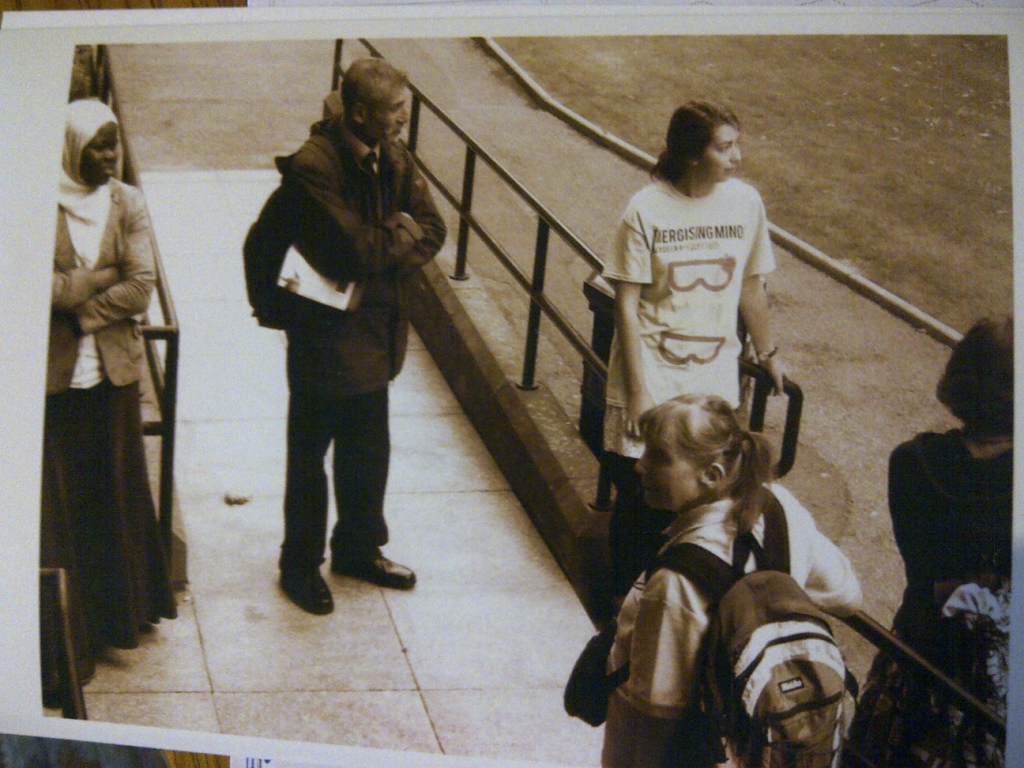
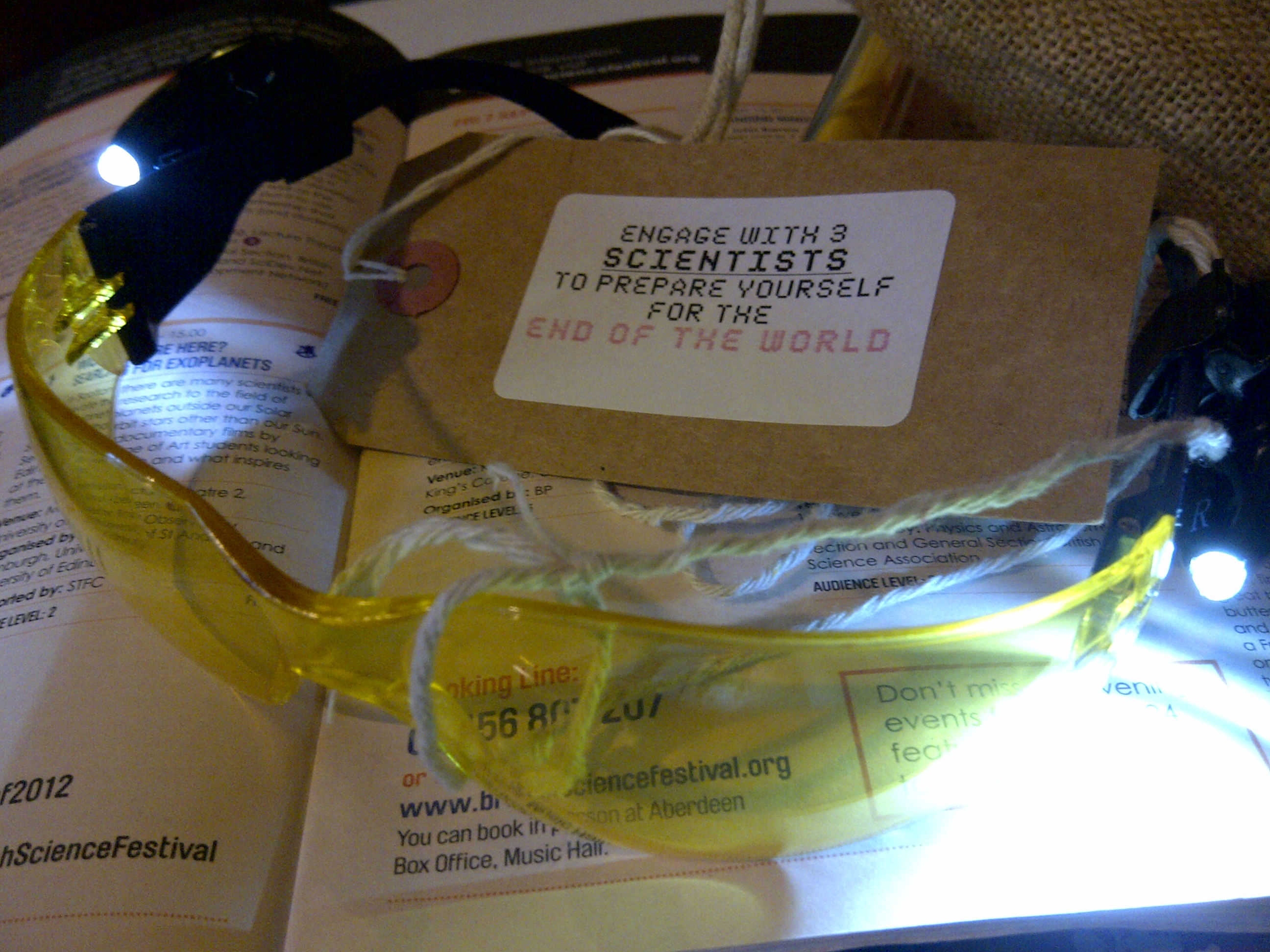
The End of the World Party rolled out before us like the apocalyptic rave it was intended to emulate: housed in a tunnel underneath Aberdeen city centre, accessed through ominous poly tunnels. Invitees were asked to don hazards suits and fashion suitable protection against deadly viruses, nuclear fallout and all of the other possible nasties which we may face over the evening. A heady mix of playdough modelling, experimental noise music and tinted lab goggles coalesced in to a suitably surreal night, proving scientists really do know how to party. (At least if the world were about to end…)

#bsf2012 Day 4: Habitats for life, Man or Machine and a lovely chat with The Brys

The halfway mark has been passed! Day four of the festival, and we’re now over the hump of our 6 days of science.

Life Down Below investigates the idea that many environments exist in our solar system, and most likely throughout our universe, which would be perfectly capable of supporting life in some form. We explore the strange and sublime life-forms which exist in the ‘deep biosphere’, the challenging subsurface environments of the earth, and consider how the presence of life in these extreme conditions may support the idea of life in other ‘difficult’ places. We pick out some likely targets in the solar system and consider the possibility that we really might not be alone after all.

The Charles Lyell award Lecture ‘What do dwarf elephants have to do with climate change?’ is the most fiercely participatory session I have seen yet! Around 20 people are coerced down from the safety of the stalls to assist in explaining the strange size-shifting of species in island environments. Thoroughly enjoyable, informative, and in parts completely hilarious.

Nowhere near as ‘doomy’ as you might imagine, The Real Doomsday 2012 was a collection of lectures looking at the myths, palaeo-evidence and planetary physics behind extinction. Richard Fortey presented a motley crew of unlikely biological survivors from the last few million years of evolution, from the small-island mammal species under threat by new predators to the stromatolites, which dominated the early biosphere but now appear in magnificent isolation in Shark Bay, Australia. Jocelyn Bell-Burnell brilliantly debunks the bizarre astronomical myths behind some of the doomsday 2012 predictions, and takes us on a tour to the real end of the world… in just a few billion years time!

The Turing Project was a surprisingly secretive little getup, where just four participants at a time were ushered in to a 1930s style briefing room to crack codes and determine whether the distress calls we were picking up from cleverly-rigged typewriter / headset getups were being generated by a real person or a machine. Let the word-association games begin!

A quick dash across town for An Audience with Bill Bryson, who it appeared had completely packed out the enormous Music Hall in the centre of Aberdeen. Material World presenter Quentin Cooper threw some across excellent questions about Bryson’s recent masterpiece ‘A Brief History of Nearly Everything’, asking how it felt to be taken in to the arms of the science community with such gusto, with Bill, as always, a picture of humour and humility.

#bsf2012 Day 3: Bright sparks, BGS and B. Cox

Day three of the festival and there is science royalty in town… the press tents are all ringing to the name of a certain physicist who will be gracing the stage later on this evening. Will we catch a rare glimpse…? Oh the excitement!

But back down to earth for now, a double whammy of alternative energy workshops open the day. In ‘Could Solar Energy Save the World?‘ the Solar Sparks get the audience in on the action, putting together some mini solar panels over the course of the session using titanium dioxide and fruit juice! The British Geological Survey are up next with The Heat Beneath Our Feet, bringing their bike powered heat pump to the stage to extol the benefits of ground source heat.

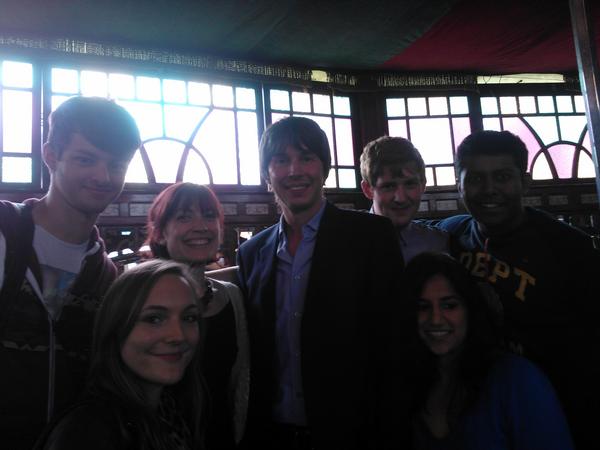
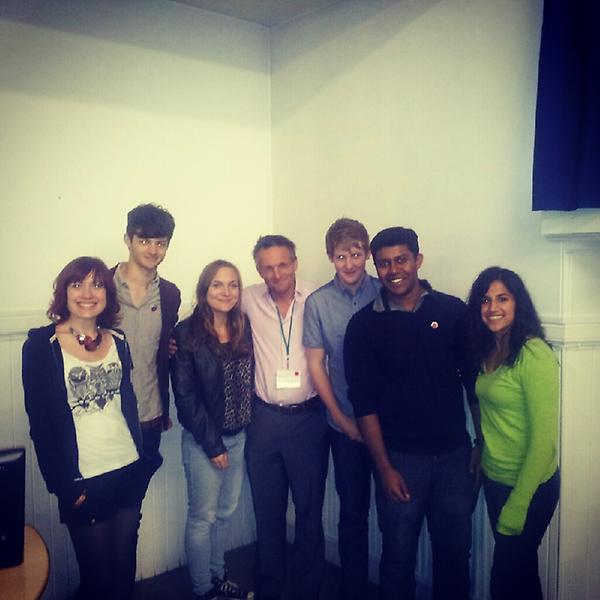
I catch some of Au Magazine’s editorial team for lunch to talk REACT magazine launch (much more on this later) and general festival excitement, before heading to the Xchange for a round up of the day’s best events. Somehow we manage to end up only metres away from the presenters table, with quite a lovely view of a certain Professor Cox. Lunch is spent marvelling over maths stand up and being confounded by quantum theory from Brian Cox and Jeff Foreshaw. Yet another glorious group photo is achieved.

Afternoon session Titanic Engineering was an intriguing insight in to the making of Channel 4 series ‘We Built the Titanic’ as two of the presenters / engineers took us through the challenges they faced in making replica components from the Titanic.

John Krebs Presidential Address ‘Doing the right thing’ was an intriguing discussion of the challenges surrounding the need for behavioural change to help solve global problems including sustainable development and obesity. Krebs summarised the political, economic and psychological perspectives which surround these issues, highlighting the need for a deeper understanding to enable people to ‘do the right thing’ in the real world. A great insight in to evidence-based policy making, and a interdisciplinary call to arms!

#bsf2012 Day 2: Branches, Bright Club and burning pigs

There’s nothing like writing a semi-regular blog to remind you why your teenage diaries will never be serialised. Everyday life is frequently not that noteworthy. Today was quite an exception though!

In my capacity as a committee member of the British Science Association North East England Branch I got to spend a lovely day in a room at the very top of Aberdeen Library (7 whole floors = awesome view) with other lovely BSA committee types, to talk about the exciting events that we have been running over the last year. Highlights included Aberdeen’s very successful programmes for National Science and Engineering Week events and Science London’s very intriguing new ‘dating game’, which sets out to combine science and, erm, speed dating, to great effect.

Nipping out in the lunch-break to ‘Behind the Scenes with Michael Mosley’, we were treated to a glorious hour of clips and commentary from shows Michael has been involved in producing, presenting and suffering physical torment in aid of. Burning pigs in blankets (literal ones, not the sort you get at a buffet. Unless you go to some very odd buffets) to test the ‘wick effect’ theory of spontaneous human combustion, and creating convincing pyroclastic surge images using domestos and a water tank were but two of the gems to marvel over. The Newcastle Uni delegation couldn’t help but try our luck for a post-talk interview and Michael was more than obliging, enthusiastically answering our questions despite a camera malfunction and mass invasion of personal space by 5 eager students. Hero.

Newcastle Uni Press Evening went with a resounding bang! I can claim to have given the keynote speech as this is hard to contest when you are, in fact, the only speaker. People seemed fully enthused – let’s hope we can keep that energy up for the next 12 months!

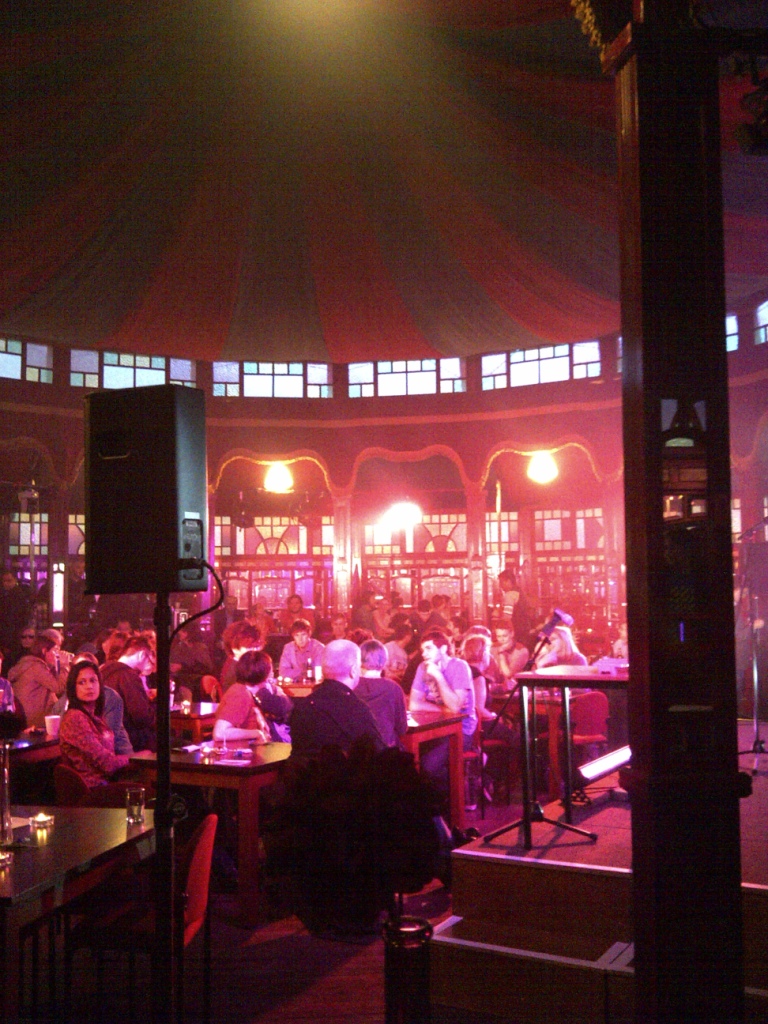
To top it all off Bright Club was as brilliant as always. Researchers chuckled through their projects in the stunning surroundings of the spiegeltent, taking us on a comic journey through forest management (fact: you can say ‘wood’ a LOT of times before it stops being funny), via joke-writing software and on to criminology research: gansta style.

Spiegeltent Aberdeen

#bsf2012 Day 1

And what a day 1 – attending five great events and squeezing in some great borderline sprinting between venues!

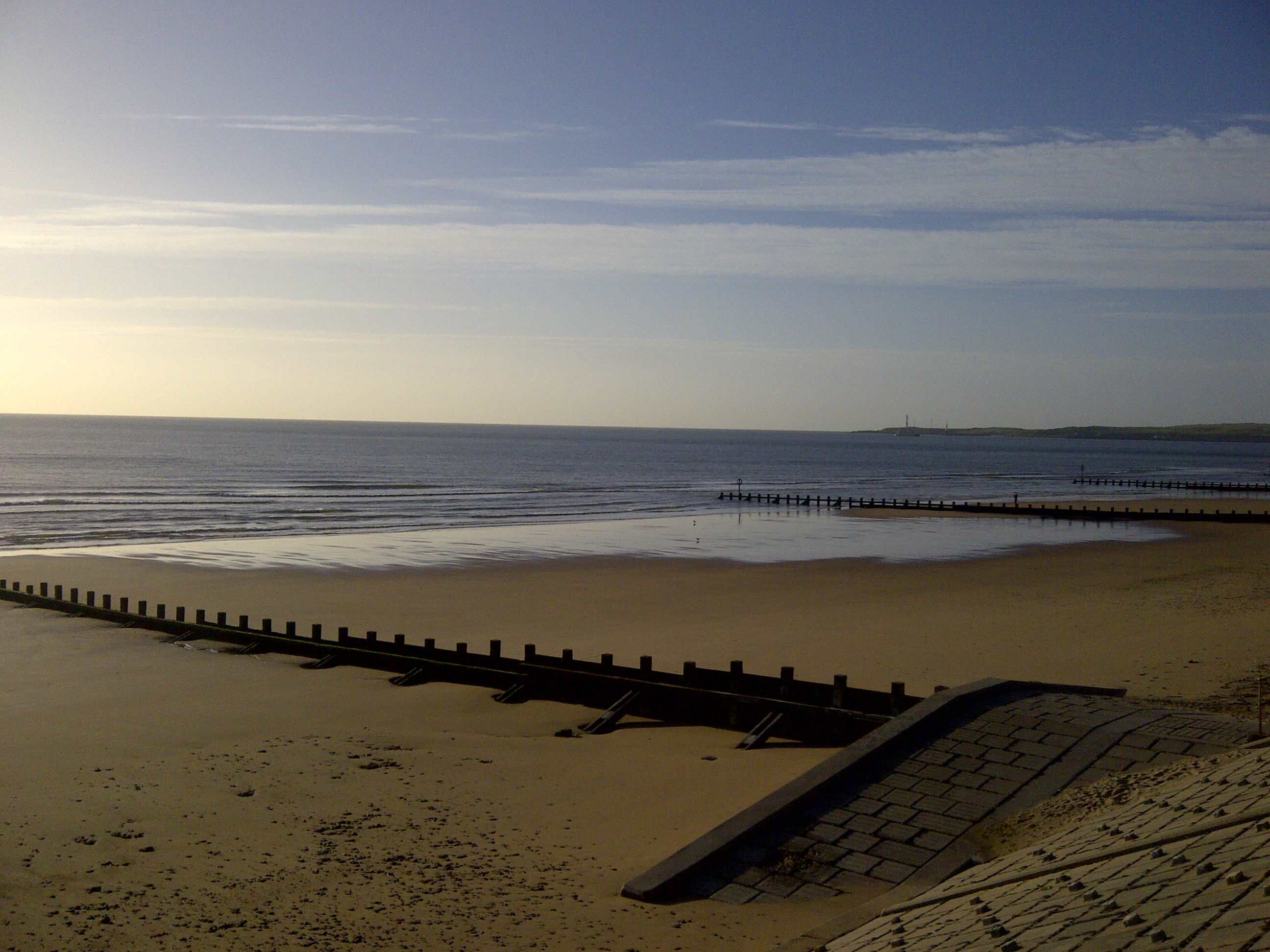
All good Science Festival days should start with a sunshiny run along the beach, this should be the inescapable law. Aberdeen today boasts plenty of beach and plenty of unseasonable sunshine.

First up on the programme today is the four-pronged discussion of contemporary neuroscience / psychology ‘How the body shapes the mind’. An exploration of mind-body interactions is given a particularly playful edge in the animated Arthur Glenburg’s final talk, which explores how physical embodiment of stories (complete with plastic play-farm) can improve childrens reading skills.

Ancient insects in technicolour’ was a whistle-stop tour of the world of palaeontology. With a healthy heping of audience participation we explored at the challenges behind reconstructing the true colour of fossil bugs, and the possible solutions to be found at the bottom of a concrete bunker in a machine usually used to compress rocks! http://www.royensoc.co.uk/sites/default/files/British_Science_Festival_fossil_insect_colour_event.pdf

Do we really need satellites?’ was a special one-off talk by Maggie Aderin-Pocock: part biography, part impassioned discussion of the importance of satellites (natural and artificial) to the smooth running of our everyday lives. Possibly the only talk in the programme to be partly co-presented by a toddler..?

A Noah’s ark for the 21st century’ sought to explore the importance we should be placing on the preservation of agricultural biodiversity. I now feel like a world expert on seed bank locations and also fully appreciate the difficulties of trying to keep the humble potato happy in a cold room scenario (although my kitchen cupboards could probably have provided me with a good hint)

Last, but by no means least, ‘Great ideas of biology’ with Nobel Prize winner Paul Nurse was an auspicious occasion, filling up the beautifully vaulted Kings College Conference Centre auditorium. Paul let us in on his ‘top 5’ great ideas (spoiler alert: evolution was definitely in there), including his thoughts on a possible direction for the future study of biology.

Annnnd relax.

Thunderbirds are go!

I am but moments away from running out of the door, laden with all the necessary paraphernalia for finding one’s way around a science festival (city map, festival programme, Percy Pigs).

British Sci Fest 2013 is but a mere 4 ½ hour train ride away, and the prospect of wandering around Aberdeen for 7 days is made only the more exciting by the prospect of bumping in to some of the UK’s best and brightest scientists whilst doing so!

——–

More (vaguely scientific) reasons to be excited:

The British Science Festival is one of Europe’s largest celebrations of science, engineering and technology! Thousands of people will be attending workshops, plays, exhibitions and lectures across the city over the next week.

Aberdeen is apparently nicknamed the ‘granite city’. Sounds like somewhere a geologist might grow to love…

And according to those lovely people at Wikipedia ‘Aberdeen is (climatically) far milder than one might expect for its northern location’. Hurrah! I might have a summer after all…

Mission: British Science Festival

When you hit a festival you’ve got to plan what you want to see with military rigour, right? Surely it takes all the fun out of it if you aren’t knackered from running between venues all week? In much the same way that I drive my friends crazy when we go to Glastonbury by insisting on colour coding the line-up with bands I’d love to see (green), and wouldn’t mind seeing if we happened not to be currently installed at one of the aforementioned slots (blue), my science festival picks have been booked and timed to the minute!

I’m happy to say that I’ve managed to score tickets for lots of my top picks for the festival this year: Prof. Iain Stewart’s recounting of the geological journey behind his new series ‘Story of the Continents’, Richard Fortey and Co. for their upliftingly titled scientific journey to the end of the world ‘The Real Doomsday 2012: Cataclysmic Events and Human Extinction’ and ‘An Audience with Bill Bryson’ (where I may attempt to make recompense with the Bry’s for my father accosting him for a photo op at my graduation ceremony some years back)

With the festival only a few days away now, expect rants, reviews and exclamations of general excitement to appear at any time!