Navigating the ‘Conventional Route’ into Clinical Psychology: A Step-by-Step Guide

If you’re interested in pursuing a career in clinical psychology, it’s essential to understand the typical route that many aspiring clinical psychologists take in the UK. This journey typically unfolds in three main stages, each building upon the last to equip you with the necessary skills, experience, and qualifications. Let’s break down each of these stages to clarify what lies ahead for you.

Stage 1: Obtain an Undergraduate Degree

The first step on your path to becoming a clinical psychologist is to earn a good undergraduate degree in Psychology. Generally, this means achieving at least a second-class upper division (2:1) or higher in an undergraduate program that has been accredited by the British Psychological Society (BPS).

Accreditation by the BPS is crucial because it ensures that your course covers the key areas needed and provides what is known as the Graduate Basis for Registration (GBR). This will be important for your future studies and practice, especially when later applying for doctoral training in Clinical Psychology (DClinPsy).

Many psychology programs also offer a sandwich course option, which includes a professional placement in a healthcare setting between your second and third years. This placement provides hands-on experience, allowing you to apply your theoretical knowledge in a real-world context. Not only will you gain practical skills, but you will also develop a clearer understanding of the role of a psychologist within the NHS or the private sector. It’s important to note that participating in the placement year is not mandatory; if you feel it isn’t the right fit for you at the time, you can choose not to complete it. However, having the option available can be reassuring and beneficial, as it provides flexibility in your educational journey.

Key Considerations:

  • Ensure your undergraduate program is BPS-accredited.
  • Consider if the programme being applied for offers you the chance to have a clinical placements or practical experiences in mental health.

Stage 2: Gain Relevant Experience

Once you have your degree, the next step is to acquire practical experience in clinical psychology settings. Many graduates begin working as Assistant Psychologists. These roles, however, are fiercely competitive, and are not the only sorts of work experience which will provide you with the knowledge, skills and experience needed to become a Clinical Psychologist. Below are a few suggestions on ways of gaining relevant experience not always advertised:

  • Healthcare Support Worker: Working as a healthcare support worker in mental health settings, such as hospitals or community clinics, involves providing direct care to patients, supporting therapeutic activities, and assisting nursing staff.
  • Mental Health Practitioner: Mental health practitioners work in various settings, including community mental health teams, offering support and interventions to individuals with mental health issues.
  • Research Assistant Roles: Research in psychology frequently intersects with mental health topics, as well as the understanding of the brain and human behavior. You would typically contribute to various aspects of the research process, including data collection, analysis, and the interpretation of findings, ultimately providing you with a solid understanding of research methodologies in clinical psychology and the development of clinical interventions. Positions for research assistants are often advertised at universities, within the NHS, or at private organisations.
  • Occupational Therapy Assistant: Working as an assistant in occupational therapy involves supporting occupational therapists in their work with patients to improve daily living skills and overall functioning
  • Social Work Roles: Roles here involve supporting individuals and families, including those dealing with mental health challenges with various aspects of life, including advocacy.
  • Relevant master’s Programs: Some graduates also opt to pursue a master’s degree in a related field, which can further enhance their qualifications and understanding of clinical practices.

Stage 3: Apply for Doctoral Programs

After gaining sufficient experience, you will need to apply for further training through the Doctorate in Clinical Psychology (DClinPsy). The application process typically involves using the Clearing House for Postgraduate Courses in Clinical Psychology, a centralised application system for doctoral programs across the UK. The DClinPsy program usually spans three years and integrates academic training with practical placements involving patients across the lifespan.

When applying you are asked to write a personal statement, allowing you to highlight your motivation, relevant experiences, and understanding of clinical psychology. You will also need to complete details about your academic qualifications and provide references from both a research perspective and a clinical viewpoint, which will support your application. Your application will then be screened based on academic qualifications, relevant experience, and the quality of your personal statement.

Finally, shortlisted candidates will be invited for interviews and/or assessments. These evaluations aim to assess your knowledge, skills, and suitability for the program. They may include role-play scenarios, problem-solving exercises, or other relevant tasks designed to gauge your readiness for clinical training.

Additional Resources

For further guidance and resources on pursuing a career in clinical psychology, consider exploring the following:

  • British Psychological Society (BPS): The BPS website offers extensive information on accredited programs, the GBR, and insights into clinical psychology as a career.
  • ClinPsy Forums and Clinical Psychology Facebook Pages: These online forums are an excellent resource for aspiring clinical psychologists. You can connect with others in your field, share experiences, and gain advice from those who have navigated the same path.
  • The Clearing House: This will give you further information about the selection process for DClinPsy, and what courses you are looking for with respect to relevant experience and degree qualification.

Good luck on your journey!
Anti-Racism Research Papers

Farooq, R., Oladokun, O., Al-Mujaini, R., & Addy, C. (2023). Unsettling the ‘master’s house’: A critical account and reflections on developing a clinical psychology anti-racism strategy. Psychotherapy & Politics International, 21(1 & 2), 1-17.

Farooq, R., Appiah, A., Abbas, S., & Addy, C. (2023). Making psychology ‘just’? The challenges and opportunities of delivering human rights based pedagogical & experiential teaching to trainee clinical psychologists. In Clinical Psychology Forum (Vol. 368, p. 23).

Farooq, R., & Appiah, A. (2021). The ‘bag of privilege’: Exploring power through participatory and experiential learning techniques with clinical psychologists in training. Journal of Critical Psychology, Counselling and Psychotherapy21(3), 12-21.

Thinking of Changing Career to Clinical Psychology?

Two Trainee Clinical Psychologists shared their experiences of changing career to Clinical Psychology.

What work were you doing previously?

Trainee 1: Working in engineering management with various roles including production manager, client account manager, operations manager

Trainee 2: Teacher, then education officer for Local Authority

Why did you change career?

Trainee 1: I had always wanted to work in a caring/helping role but had not gone to university out of school, so got side-tracked after getting a role in the engineering industry and my employer paying for me to study a relevant degree whilst working there.

Trainee 2: I was always interested in psychology and decided towards the end of my teaching career to study a four-year psychology BSc with the Open University. It was tough as I was teaching A-level and GCSEs at the same time but managed to study at weekends then attend summer schools in August every year. My first degree wasn’t psychology, so it meant a bit commitment to doing another one but at least with the Open University it was cheap, and I was able to earn money in my job.

When was the moment you decided to make the change?

Trainee 1: It was not really a moment as it was something I thought would always happen. I gradually became more disillusioned working in an industry that did not serve the greater good, though I enjoyed the day to day of working in a creative job for many years. I think as I got older and realised how misaligned it was to some of my more important values, I started to think about how I could change careers, and as soon as an opportunity came to take the first step in that process, I took it.

Trainee 2: I initially wanted to be an educational psychologist, so when I got my degree towards the end of my role as sendias officer working in Local Authority, I started to make enquiries and gain experience. However, it wasn’t until later that I did a MSc in Health Psychology and got experience in research and as an Assistant Psychologist before getting onto the course.

How did you choose your new career?

Trainee 1: I did a lot of research into different helping/caring roles and found what I thought most suited my interests and values. After a lot of reading up on different options, I was really drawn to clinical and community psychology. I was lucky to find a BSc which had a specific clinical and community psychology pathway and the rest is history (well, with a lot of steps in between).

Trainee 2: It felt like a good fit for me, and I knew it was something I eventually wanted to do. I was happy to take my time until getting a place on the doctorate, especially as I wanted to stay in Newcastle.

How did you go about making the shift?

Trainee 1: I researched every step I would need to go through at each stage of the process. I initially used my existing transferable skills in project management to gain employment in a somewhat relevant role in a healthcare research centre as a project admin. Once I had an understanding of the NHS and different roles within it, I just took every opportunity I could. I was promoted to project manager which involved leading on evaluation of the project. I reached out to any contacts I made along the way to help me on my next steps, which ended up getting me into research assistant roles. From there, I applied for relevant clinical roles I believed I could do, even if I did not tick all of the boxes! It took time (first healthcare-related role 2015, first research role 2017, first clinical role 2019, BSc 2016-2020, MSc 2021-2022, DClin 2022) but I think once you are prepared for that it actually flies by!

Trainee 2: As above. Perseverance!!!!

What help did you get?

Trainee 1: I did not get any official or formal help but some people I met along the way were really supportive and encouraged me to keep going for it and that made all the difference. For example, my manager in my project admin role really believed in me and gave me the project manager role, even though I had only been in healthcare six months. And someone I had met in that role was then working for another service doing some mental health related research and created a voluntary research assistant role for me, which became a paid permanent role. Even when I was applying for my BSc, the course I wanted to do was not actually available part-time, but the programme director was able to be flexible so that I could complete it whilst working.

Trainee 2: Just talking to other psychologists and my own resources.

What resources would you recommend to others?

Trainee 1: Clearing House, the clinical psychology forum website, Assistant Psychologist and DClin facebook groups are all really helpful for figuring out what the journey might look like and gathering as much information as possible to manage your own expectations.

Trainee 2: Reflection skills, resilience and a life other than just psychology.

What would you advise others to do in the same situation?

Trainee 1: If it is truly what you want, keep going for it, believe in yourself, and don’t be afraid to create your own opportunities! It takes hard work and determination, but it can be done. Also, be open to diversions on your path because sometimes they are the journeys that really build your skills and knowledge and can help you find your values and shape you into the clinician you want to be!

Trainee 2: Do it! Make the change, never too late, never too old! I think having a previous career outside of psychology is really beneficial. I think it makes you accept setbacks more and open to critical feedback. I think the prospect of having two careers in your life is very exciting and I would say give it a go. Don’t fixate on getting on the course straight away and rejection is all part of the process. Talk to others who have made career changes. You won’t regret it! You may have to accept that getting the degree to qualifying is a long long process, so make sure life is full and enjoyable as you progress.

POP Research Projects, Reports and Reading

Informal Student Caregivers: Balancing caregiving responsibilities and achieving academic success (Tucker et al., 2022)

“In Two Places at Once” was a research project led by Dr Emily Henderson and supported by the Warwick Research Development Fund and Institute for Advanced Studies: https://doi.org/10.31273/CES.06.2018.001

Experiences of unpaid carers from black and minority ethnic communities a summary report: https://carers.org/downloads/carers-trust-summary-english-final.pdf

Experiences of Unpaid Carers for someone with Dementia by Dr Tim Banks: https://carers.org/downloads/wales-pdfs/dementia-research-report-v3.pdf

Upcoming Student Wellbeing Events

Introduction to mindfulness Workshop:  Aims to introduce mindfulness and how this approach can enhance your well-being. The benefits of mindfulness are explored in a way that can help you identify and incorporate this approach into your life to make a meaningful difference.  

Dates:

An introduction to Self-Care Self-Compassion Workshop: What do you do to maintain good health and improve wellbeing? Do you know the importance of regular self-care? This workshop provides the opportunity to do a self-care inventory so you can consider your own self-care routine and where you can make changes. It also provides you with a range of tools and techniques for self-care, and practice these in the session.

Dates:  

Understanding how to attend stress and anxiety Workshop:  Designed to provide you with an understanding of what anxiety and stress are and how they naturally impact your ability to function, work and cope. You will also be given tools and techniques to help you decrease symptoms.  

Dates:  

Self-Compassion Workshop: How often are we kind and caring towards others and yet do not give the same compassion to ourselves? Our inner critic wreaks havoc, making us feel dreadful by labelling us as ‘not good enough; lazy; failures; we must work harder’… the list will go on…. This workshop has been designed to help you learn about and practice self-compassion.  

Dates:  

Anti Racism Spring Updates

  • Yinka joined as Anti-Racism Lead on the DClinPsy; part of role is to facilitate a reflective space for racially minoritised trainees every 6 weeks.
  • Our most recent workstream meeting was on 12 April 2024.
  • The final mentee workshop was on 21 June 2024 (2-4pm): included a keynote speaker talk on her journey into clinical psychology and coping with setbacks (Dr Denika Campbell-Lee); trainee psychologist talk on “ The tree of life: reflections on our journeys so far, self-care, and coping with setbacks” (Louise Ola and Chelsea Addy); and a facilitated reflective space (Dr Yinka Oladokun and Louise Ola).
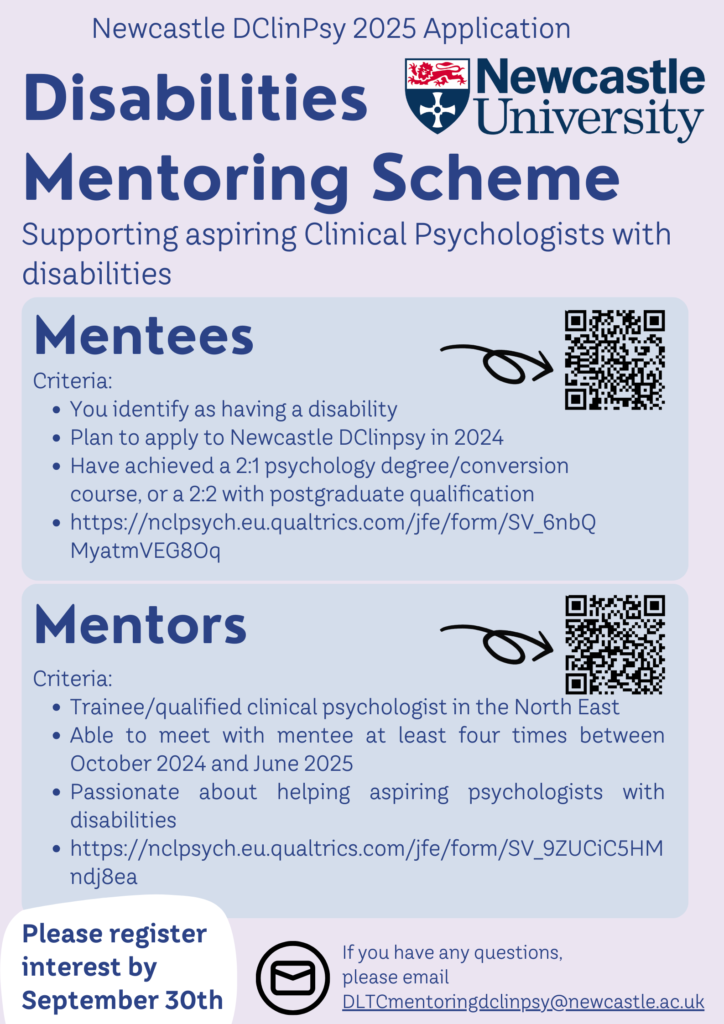
  • Plans for next round of mentoring arrange and criteria for mentees established:
    (1) Interest in applying to Newcastle, (2) Belonging to underrepresented racially minoritised group, (3) 2:1 in psychology or 2:2 plus additional post-graduate qualification, (4) Plan to submit application in November 2024.