Categories
More-Than-Human

The Audio Poster

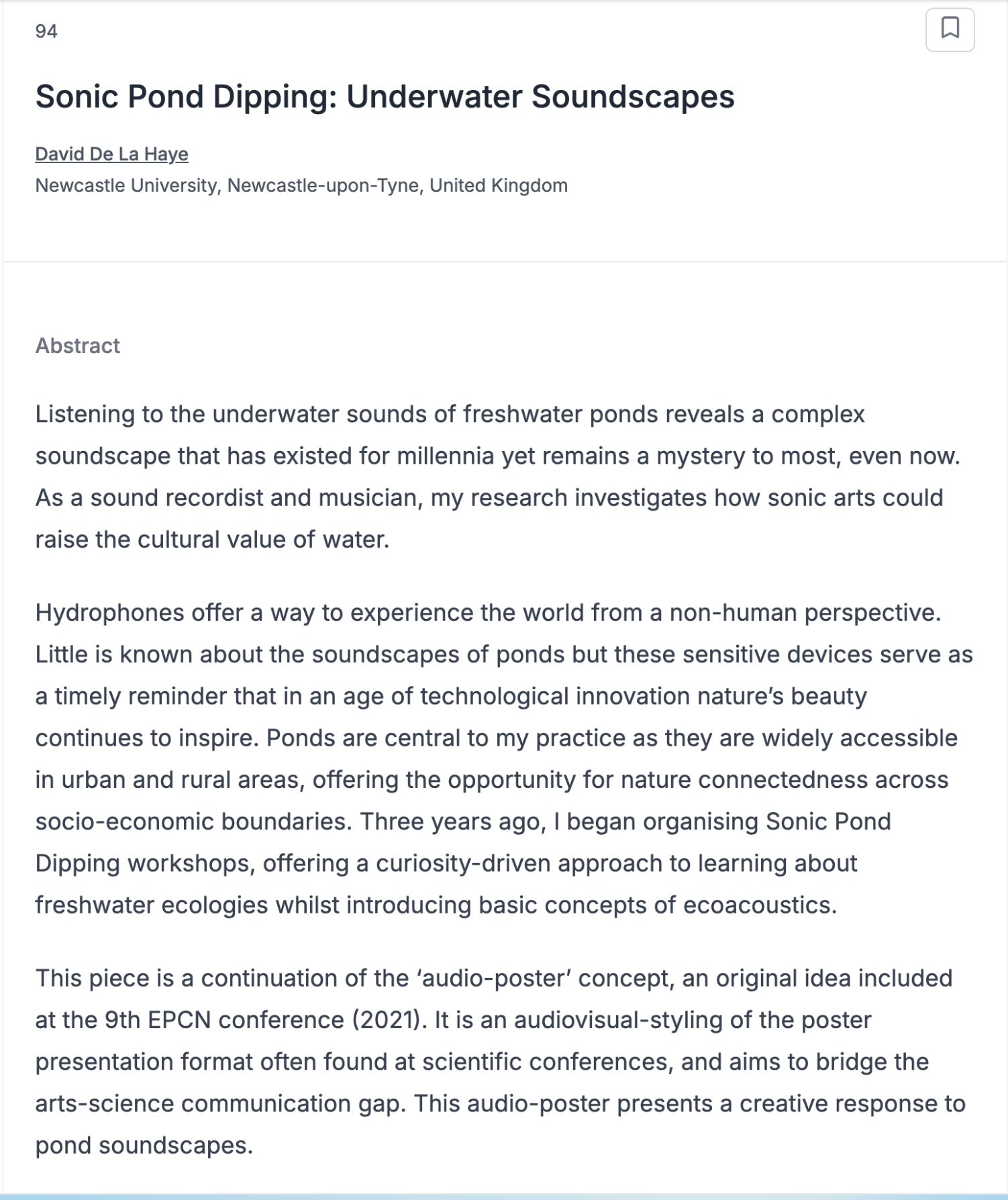
The International Pond Conference was held online during 12-13 November 2024 and my abstract, “Sonic Pond Dipping: Underwater Soundscapes”, was selected as an oral presentation. The full abstract can be read below. This was another chance to bring the arts into what is typically a science-heavy arena.

This piece would be a continuation of the ‘audio-poster’ concept, an original idea I premiered at the 9th EPCN conference in 2021. It uses the science-conference phenomenon of ‘poster presentations’, wherein new research is distilled onto a single, large poster format, but turns it into an AV experience. My intention is make research multi-sensory, and thus more accessible, whilst directly advocating sound as my primary medium.

It was announced that all presentations should be pre-recorded. Personally, I find online meetings impersonal enough without the additional separation introduced by a pre-recorded presentation. Often the presenter isn’t even, well, present! But the requirement to pre-record did offer the chance to get creative.

I produced a new video which introduces the concept giving a voice to nature through the practice of Sonic Pond Dipping. It incorporates B-roll footage from a video shoot from the UKRI’s ‘101 Jobs: Switching Sectors’ campaign [watch the video here] alongside underwater videos made during workshops. Rather than pre-record a standard oral presentation, I provide a voiceover.

As I say at the beginning of the video, the aim was to give much of my allocated ten minute slot over to “the most important delegate of all: the pond. Rather than talk for, or about them, this video offers them a chance to talk for themselves”. It is a deliberate attempt to personify the pond and change our relationship to these small waterbodies. After a short introduction, the bulk of the video is handed over to hydrophone recordings with accompanying underwater camera footage. This is protected time, allowing nature to speak for itself. Ponds are not made of water1 – there are many more interactions happening between the landscape, the aquatic inhabitants, the bacteria, the terrestrial species; and also their sonic fingerprint. Much as people talk about boreal forests of the northern hemisphere, or howling desert dunes, or windswept arctic tundra, ponds have their own sonic identity.

The idea of underwater filming came from early attempts to identify the strange and bewildering array of sounds out of sight but increasingly I find video creation becoming a part of my creative process. It further blurs the line between whether this practice is purely creativity-driven or a form of documentation. In any case, it aims to bridge arts-science communication gap.

Once again, I was surprised by the number of questions, especially as I was in the first session of the day. I usually expect to be on later, and hope that the unusual approach will be a pleasant break from the heavy dose of dialogue, data, and graphs. As has come to be expected, many enquire as to what is making the sound and to what extent the sounds have been processed, but increasingly people comment on the relaxing and meditative quality of the sounds and whether they might be used therapeutically. Blue spaces have much still to offer.

The International Pond Conference was organised by Ponderful and EPCN.
  1. Nicolson, A. (2021). The Sea is Not Made of Water: Life Between the Tides. Collins Press. ↩︎

Categories
Aquatic plants More-Than-Human

Why More-Than-Human Musicking Now?

On 24 and 25 October 2024, the inaugural symposium of the Study-Group-in-the-Making “Multispecies Sound and Movement Studies” took place in the International Council for Traditions of Music and Dance (ICTMD) at Nuremberg University of Music. I was invited to present ‘Sonic Pond Dipping: Collaborating With The Sounds of Aquatic Plants’.

It was delivered using my Sonic Pond Dipping workshops as a template; the idea was to take people on a journey through underwater sounds, starting with common marine recordings and leading, inevitably, to the pond. Scheduled to be the last presentation of the day I was surprised that, despite a varied programme, mine was the first to highlight more-than-human sounds which were distinctly ‘beyond human’ perception. Others tended to focus on communication between canines, cetaceans, and birds.

Sonic Pond Dipping workshops encourage participative intervention. They aim to defamiliarise the landscape, not by aesthetic manipulation, but by close observation [ref]1 . This has become a commonality between my listening and compositional practices. The hydrophone presents a focal point within the water which I have tended to offer ‘as is’ in the form of piece of living music, somewhere between documentation and composition. The audio is only subtly adjusted in EQ to highlight key tones and perhaps spatialised to provide definition. Perhaps it should more accurately be described as ‘arranging’ (flower arranging?!). The pond as a microcosm of sonic inspiration, echoing ecologist Stephen Forbes 1887 seminal paper: “The lake as a microcosm”2

Quantised Landscapes

Musical quantisation is the equivalent of straightening a river, offering a metaphor for disassociation with nature. Focussing on recordings made for the album With Ears Underwater, collected near Sunderland’s Nissan factories, I took Luigi Russolo’s claim that “if we overlook such exceptional movements as earthquakes, hurricanes, storms, avalanches and waterfalls, nature is silent”3 and proposed that his comment is a result of the growing anthropogenic noise and the Industrial Revolution’s desire for humans to separate themselves from nature.

Fast-forward a few decades and we find electronic/urban genres of music (including Industrial, of course) echoing the monotony of factory rhythms, the Kraftwerkian ‘Man-Machine’4 where quantised rhythms shift around grid-like patterns. Erase meanders and we delete a habitat in which species thrive. The fast-flowing waters that are channelled by the removal of ‘imperfections’ (read: ‘less-economical’) are not favoured by all. There is need to slow down. The news today reports flooding in Valencia, Spain5 where narrow streets became these fast-flowing channels resulting in major loss of life. Restoring river bends can help reduce risk of flooding. Does ‘humanising’ beats bring us closer to nature? (Should that be ‘non-humanising’ beats…?)

Listening to the glitchy complex rhythms of aquatic plants brings us back home, to the waters from which we first emerged. Do we have some rhythmic memory that was passed down from the pulsating beats of early macrophytes? Might the excitement people feel during loud rock concerts or overpowered club PA systems be traced right back to how we sensed beats with our body as vibrations passed through water? (To be continued…). Definitely asking more questions than answering them.

Symposium Link: https://www.hfm-nuernberg.de/en/news/detail/why-more-than-human-musicking-now

  1. Knickerbocker, S. (2012). Ecopoetics: The Language of Nature, the Nature of Language (referring to poet Elizabeth Bishop) ↩︎
  2. https://en.wikipedia.org/wiki/Stephen_Alfred_Forbes ↩︎
  3. Art of Noises, (1913) – https://www.italianfuturism.org/manifestos/the-art-of-noise/ ↩︎
  4. Kraftwerk. The Man-Machine – Kling Klang (1978) : https://en.wikipedia.org/wiki/The_Man-Machine ↩︎
  5. https://www.theguardian.com/world/2024/oct/31/spain-floods-valencia-death-toll-three-days-mourning [accessed Oct 31, 2024] ↩︎