
Implementing Curriculum change

Who is this blog post for: Current or emerging middle leaders and for senior leaders or Headteachers who are developing middle leaders.

Author:  Stephanie Bingham

Posted on: 14th November 2023

Keywords: Change; Prepare; Plan; Explore; Implementation; Enabling.

Introduction
 Case Study 

The teacher in this case study works in a Primary School serving a community with below average levels of deprivation. They are the leader of Modern Foreign Languages (MFL), and their change initiative aimed to improve the progress of disadvantaged pupils (DP) in upper Key Stage 2 (KS2) French and narrow the performance gap between them and their non-disadvantaged peers. The leader also sought to improve the practice of their non-specialist teachers and trainees. This first extract illustrates how they prepared for their change through exploring a variety of evidence: 

Extract 1 (click to expand)

Since I joined the school, there has always been an attainment gap between DP and non-DP pupils…… I observed that [in French] there was also a gap between male and female pupils, which led me to researching different strategies that could be used to improve standards and increase engagement in French.

I extensively researched into digital learning given that the evidence of the impact of this was very strong; however, the costs meant that this wasn’t possible. The purpose of learning a language is to communicate so I looked into Collaborative Learning (CL). This was supported as an interest by pupils during their initial pupil voice survey. Over 60% of pupils expressed a desire to work in groups. CL is something that I had experienced in a previous school and I knew the benefits that it could provide. Furthermore, “students who learn in small groups generally demonstrate greater academic achievement … than their more traditionally taught counterparts.” (Springer et al., 1999).

I also considered advice from Wang’s (2009) study that it was important for pupils to be apart from friendship groups and ultimately grouped in mixed-ability bubbles. Following this research, I was then able to include CL activities within my action plan with confidence.

To allow my team and me to monitor pupils’ progress closely, it was essential that pupils took a baseline assessment. All pupils were given a starting grade, which was not shared with pupils but was for staff use only. The rationale for this was to clearly show pupil progress and highlight concepts, knowledge and skills that they already knew as well as any misconceptions that they may have already had. This was a fantastic starting point and together with a pupil voice survey we were able to monitor progress throughout the project.

Each member of staff completed a self-audit. Curriculum plans were looked at and I met with teachers from other schools to ensure that our provision was satisfying the programme of study. It was agreed that the writing element of the curriculum was strong but more progress and emphasis needed to be placed on spoken French. This was supported by pupil voice, which collectively stated ‘there was too much written work’.

Following this extensive data gathering and exploration the leader was able to identify where the intervention should be focused using a proven model. The intervention has an inbuilt tool for monitoring the progress of the pupils, and the leader had a clear idea of the strengths and areas for development for their teaching team. They outlined the initial meetings that were held and the careful work done to ensure that the team feel involved and have ownership of the initiative:

Extract 2 (click to expand)

The action plan was shared with staff and the rationale was explained, including the research that I had undertaken through the EEF toolkit.

I used the visionary leadership technique outlined by Goleman (see Theory Blog post here) to develop and articulate my ideas and solicit the opinions of the members of my team.

The effect of this meant that my team agreed to adopt my initiative and move forward with it because they felt that they had contributed to the overall vision and pathway of the initiative.

Note that aside from data-gathering and triangulation, which all form part of the preparation stage, no implementation has yet taken place. This reflects both Sharples’ (2021) and Kotter’s (2012) emphasis on importance of the preparatory stage of implementation planning: they have investigated the school’s readiness for the change and they have ensured that they have support from their team. This leader also had conversations with an in-school coach who helped them to think through how they would manage their team and lead the change. This is also part of the preparatory stage: planning for potential difficulties before they arise, and understanding the different members of the team and how they will be most effectively led.

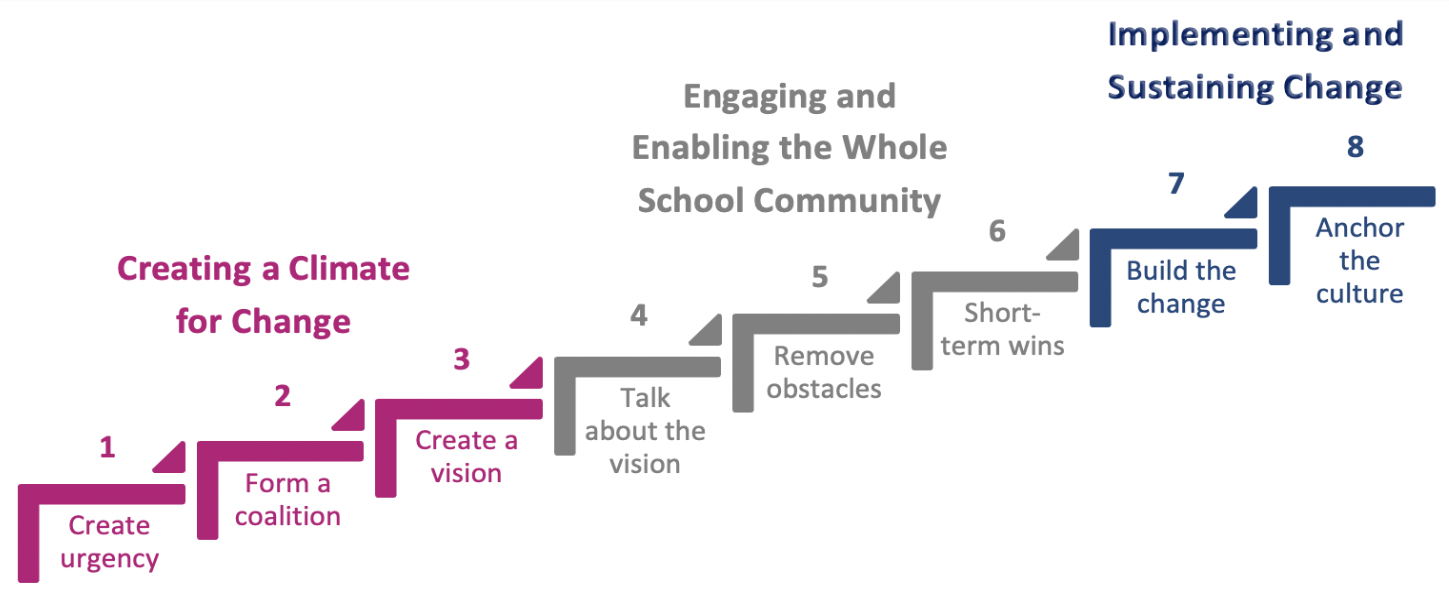
Once the data had been analysed and the potential curriculum models explored, a clear implementation model was adopted, which included monitoring points, delegation of responsibility, and provision for adaptation where needed. This is what the Education Endowment Foundation (EEF) Implementation process refers to as preparation (2021), and Kotter (2012) as creating a climate for change and engaging and enabling the whole school community:

Extract 3 (click to expand)

To manage change, I put an action plan in place with regular checkpoints. I used the idea of Brighouse and Woods (2013, p.19) to ensure that all of the components needed were in place to support the curriculum changes.

I shared my vision with my team in a formal meeting. I spoke to all staff individually to invite them to the first meeting. This was very important in order to set the scene and standards I allowed for certain aspects of the project to be discussed and I shared my lesson expectations with staff members. I also gained the trust of staff by delegating effectively to team members.

I designed an expectation sheet which outlined the basic expectations of a language lesson and gave this to all team members to try and minimise in-school variation. The project was designed to use teacher assessment grades which gave us the whole picture for each pupil. Ultimately, staff felt that they had sufficient opportunities to give feedback and that their feedback was listened to. Pupil voice feedback was used to shape the project.

I was able to identify risks that could have a detrimental effect on the project. I used the school’s risk management template and process in order to do this to ensure that I was able to put the correct measures in place for any risk identified………throughout the project I was able to keep check on the potential risks and update the risk register. This meant that most risks were taken into account and were mitigated.

Once the preparation stage was completed the leader and their team were ready to move into the delivery stage, which included regular monitoring of the impact on pupils and on staff practice: 

Extract 4 (click to expand)

Meetings that I held were well-planned and well-structured to ensure my team thought that they were meaningful and productive. Pupil voice panels were very useful and gave pupils the opportunity to share their views in a comfortable and safe environment. Lesson observations and book reviews also allowed me to manage the changes.

The impact of these change management techniques ensured that all staff members were aware of the plans and adapted to change effectively and without conflict.

More data was collected after each assessment so that we had maximum information on each child. This worked well as all data was centralised which meant I was able to manage and analyse effectively.

Pupils who were not on target received a personalised plan. For example, some pupils were given support frames to assist them with their work.

In light of the data, I was able to use Teachers C and D as teaching assistants for those pupils who were not making the required progress. They held 1-2-1 sessions with those pupils to accelerate their progress.

The impact on the pupils was maximised by the leader having built in data gathering and also plans for addressing individual pupil need. Because the data analysis included lesson observations, they were able to identify more accurately the cause and potential solutions to any problems. Pupil achievement data alone is not enough to enable staff to address pupil need.  

The intervention led to 88% meeting their target outcome, thus significantly narrowing the achievement gap between disadvantaged and non-disadvantaged pupils in French. In order for this impact to be sustained the leader made permanent many of the actions used in the initial initiative: 

Extract 5 (click to expand)

As leader of the French department, I have also been able to work effectively with language departments in other schools to ensure the continuation of a consistent and outstanding provision across the school. The impact of collaborative learning was evident in classrooms. The collaborative learning strategies have been well received by pupils and there seems to be a buzz in MFL classrooms.

We continue to monitor data regularly and use the methods we introduced to raise pupil achievement. I continue to use coaching with all members of my team and I delegate more tasks, something that I was often unwilling to do before. We have a bank of shared resources so that non-specialists don’t feel overwhelmed, and we continue to share successes and ideas in our weekly meetings. Staff feel confident to raise concerns and we have ongoing training to keep our lessons fresh.

Conclusion 

This case study illustrates that careful planning is at the heart of successful implementation. Both Kotter and Sharples emphasise the importance of the early stages of any initiative, and of preparing the ground before trying to implement change. Effective implementation can’t happen without being founded on strong evidence, which in turn needs to be shared with the team in such a way that they will share the vision and help to make it happen. This middle leader also understood the importance of ensuring that the change was sustained, putting in place an action plan with regular check points, and building in collaboration with other language teams to ensure the process remains live and dynamic. 

What educational model are you ‘sandwiched’ within?

Who is this blog post for: Current or emerging middle leaders and for senior leaders or Headteachers who are developing middle leaders.

Author:  Lisa Ramshaw 

Posted on: 24th March 2023

Keywords: model; transformative; formal; collegial; political; subjective; ambiguity; cultural; goals; organisational structure


Introduction

This blog post shares a range of theoretical models that may help you recognise how your school or your educational organisation is structured and led.

Tony Bush is a leading educational theorist*, and he writes, “if practitioners shun theory, then they must rely on experience as a guide to action” (2020, p.20). As stated in the introduction to this blog series, we would like to create links between the theory, research, practice and reflection of leadership, whilst effectively utilizing case studies as an experiential component. 

In the first reflection post of this series, it was prefaced that the two layers of the hierarchical structure can pull a middle leader in many directions; however, not all structures within an educational setting follow a particularly hierarchical model. This article aims to present six different theoretical models of educational management by Bush (2020), in order to provide different ways of viewing your institutional structure. Bush (2020, p.22) claims that “each theory has something to offer in explaining behaviour and events in educational institutions”.  

Recently, I facilitated a seminar that focused on these educational models and a school leader said to me – “I understand my own institution and how things work but an understanding of these models has now allowed me to put a ‘name’ to it and therefore understand the school structures and processes more deeply than I did before. I also now know the educational model I would like the institution to move toward. I feel like I have clarity on the institution’s development now”. 

So, let’s look at these models in more detail. In his book, Bush (2020) explains six educational models. Click the title below to view a summary of each model. 

Six Educational models (click to expand)
Formal The formal model depicts the most common hierarchical model that most of us would recognise in institutional structures, where there are clear positions and accountability.  
Collegial Collegial models are more about a collaborative approach whereby people agree on goals / shared views of values, in a more lateral structure. People work together in a collaborative manner and leadership is usually distributed effectively.  
Political In a political model, processes of negotiation and bargaining are common, and interest groups develop and form alliances or coalitions in pursuit of particular objectives. At times, conflict can emerge, and different forms of power can be used, including positional power; authority of expertise; personal power; control of rewards; coercive power. 
Subjective In this model, there is more interest in processes and relationships and the organisational structure tends to be an outcome of the interaction between people. The individual participant is at the heart of the organisation and should not be regarded simply as a cog within the institution. 
Ambiguity In an ambiguous model, institutions are characterised by fragmentation and ‘loose coupling’ – i.e., sub-units operating autonomously. Rules and regulations are unclear or disregarded and participation in decision-making is fluid. 
Cultural In a cultural model, there is a close link between culture and structure, and values and beliefs are expressed in the pattern of roles which underpin attitudes and behaviours. There is a development of shared norms and meanings: the ‘way we do things around here’ and these are expressed through rituals and ceremonies which support the beliefs and norms. 

Figure 1: Six Educational Models (Bush, 2020).

Reflection (click to expand)
  • What educational model do you think your institution reflects most based upon the above summary statements?

Now let’s reflect on each model a little more closely. The table in the drop-down section below sets out a number of reflective questions so that you can consider what model or models are most applicable within your context.

There is no hard and fast rule that only one model can be applicable to a particular context: there may be a combination of different models evident at any one time, based on the nature of the task or activity, so bear this in mind as you work through the reflective questions.

Reflective questions for each model (click to expand)
Model Organisational structure Leadership Goals 
Formal Is your institutional structure hierarchical and vertical? Are there clear role accountabilities? Is the structure defined by particular positions in the institution? Do leaders operate through a top-down approach? Do you feel leaders are pragmatic and clearly divide labour to meet particular goals and tasks? Are goals and direction set for you in the institution? Are there goals at multiple levels throughout the hierarchy?  
 Collegial Is your institution structure lateral and horizontal? Do you feel there is an equal right to determine policy? Is there authority of expertise, in that leadership is a collective endeavour, which may include peer leadership (for example) amongst teachers? Is leadership effectively distributed and shared? Do staff agree on goals and have a shared view of values? Is there a collaborative approach to such agreements? 
Political Has your institutional structure emerged from a process of negotiation and bargaining? Have ‘interest groups’ developed and formed alliances or coalitions in pursuit of policy objectives? Do you feel that the leadership is coercive? Do leaders use power within the institution? Is there a focus on goals of sub-units rather than the institution itself? Do these usually conflict with the wider goals of the organisation, and hence are unstable and contested? 
Subjective Are different meanings placed on organisational structure based on the perception of individuals (e.g., are senior leaders perceived by the Head as participative, but teachers feel they transmit knowledge one way)? Is there more interest in processes and relationships, than structure? Do those in leadership have their own separate values, beliefs and goals? Do situations arise that require an appropriate response from those best situated to address it (i.e., it doesn’t feel that there is clear leadership)? Do positional and personal power combined tend to command the respect of colleagues? Do you feel that individual staff are at the heart of the organisation and are not simply regarded as a cog within the institution? Do personal aims of individuals take precedence? Do organisational goals tend to reflect the personal aims of influential people? 
Ambiguity Is the organisation characterised by fragmentation and ‘loose coupling’ – i.e., sub-units operating autonomously? Are rules and regulations unclear / disregarded? Is participation in decision making fluid? Do leaders seem to have little or no control? Are objectives and processes unclear and not understood? 
Cultural Is there a loose link between culture and structure? Do staff work interdependently with each other? Are values and beliefs expressed in the pattern of roles which underpin attitudes and behaviours? Are shared norms and meanings developed: the ‘way we do things around here’? Are beliefs and norms expressed through rituals and ceremonies? Do heroes and heroines exist who embody the values and beliefs of the organisation? Is the culture expressed through goals? Are goals and values consistent with each other? Do the vision, mission and the goals align? Is there consensus amongst staff on these things? 

Figure 2: Reflective questions related to each model (modified from Bush, 2020).

Depending on how you answered the reflective questions above, you may feel that your institutional structure exemplifies more than one model. For example, you may feel that your institution has a hierarchical structure; however, there are tasks and teams that work together in a collegial way. 

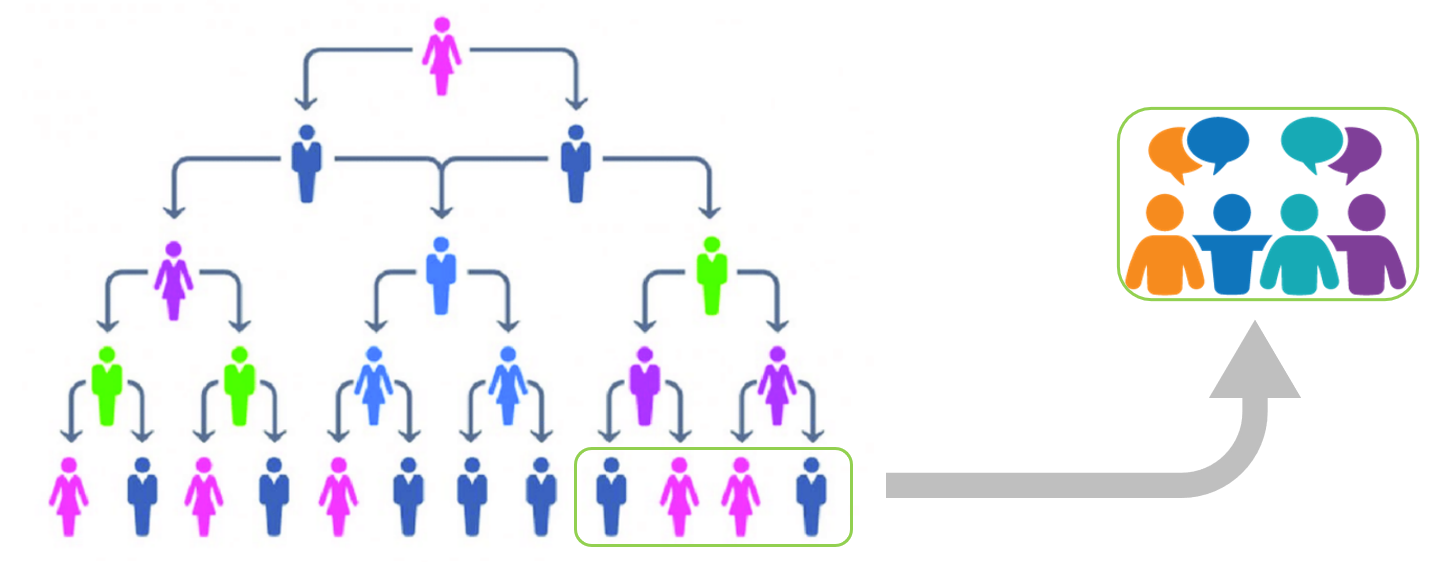
Figure 3: Formal and Collegial models combined.

Reflection (click to expand)
  • How is your leadership role / position influenced by the model your institution seems to have adopted?

As stated in the first reflection post of this series, middle leaders are often opportunistically positioned, or ‘sandwiched’, to be able to listen up, down, across or through the organisational model, in order to effectively implement, and this position could also allow middle leaders to influence and contribute to the wider goals and vision. How a middle leader capitalises on this opportunity could prove beneficial to the setting of more phase and subject-specific goals so that they positively impact change.    

Reflection (click to expand)
  • Despite your institution adopting a particular model, do you operate with a different model within your own department / team / section?
  • Would you like your institution to adopt or move toward a different educational model? If so, which one and why?

*At the time of writing this blog post, Tony Bush is a Professor of Educational Leadership at Nottingham, with responsibilities in the UK and Malaysia. He is President and a Council member of the British Educational Leadership Society (BELMAS) and has been the editor of the SSCI-listed international journal, Educational Management, Administration and Leadership (EMAL) since 2002. His previous experience includes professorial appointments at the universities of Leicester, Reading, Lincoln and Warwick. He was presented with the BELMAS Distinguished Service Award in 2008 and appointed as a Fellow of the Commonwealth Council for Educational Administration and Management (CCEAM) in the same year. He has been a consultant, external examiner, invited keynote speaker and research director in 23 countries, and has also authored a number of his own books focusing on educational leadership. 


References 

  • Bush, T. (2020) Theories of Educational Leadership and Management, London: Sage.

Applying pedagogy and andragogy for effective meetings

Who is this blog post for: Current or emerging middle leaders and for senior leaders or Headteachers who are developing middle leaders.

Author:  Lisa Ramshaw 

Posted on: 18th July 2023

Keywords: skills; pedagogy; andragogy; self-awareness; self-reflection; transition; transfer


Introduction 

How did you transition into a middle leader? More often than not, it was because you had demonstrated high skill as a teacher, teaching pupils. In my experience, senior leadership teams are usually willing to promote someone to a middle leadership position because they were effective in their teaching practice and were able to influence others in that process. However, it is important to consider how the skills of being an effective teacher can translate into the effective leadership of adults. 

As stated in the previous reflection post, leading and supporting adults has similarities to, but is also significantly different from, leading and teaching young people: this is pedagogy versus andragogy. Switching between the two sets of stakeholders, sometimes multiple times per day, is a skill that is constantly demanded of middle leaders. This is where understanding the difference between pedagogy and andragogy can be useful – knowing which hat to wear and when. 

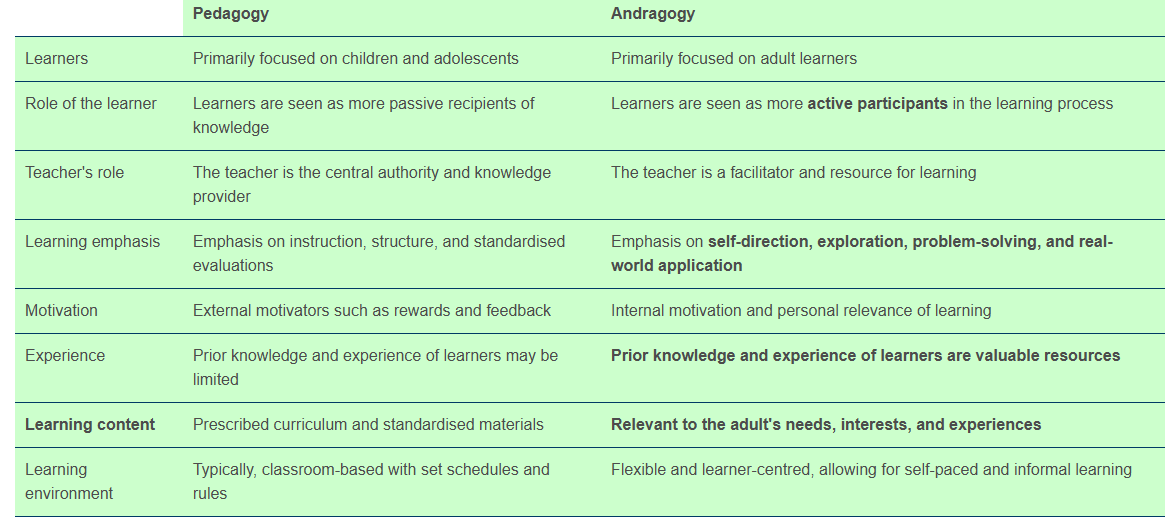
Pedagogy is predominantly focused on how children learn effectively, whereas andragogy is focused on how adults learn. The table below highlights the differences between pedagogy and andragogy: 

Differences between pedagogy and andragogy

Naturally, however, there is a sliding continuum between these two columns. If you are a Primary school teacher, teaching young children, the difference between pedagogy and andragogy is most likely more pronounced than a high school teacher, teaching young adults. If you get the opportunity, try to collaborate with middle leaders both vertically and horizontally within your school or group of schools, so you can gain a more nuanced understanding of the differences. 


Learning

As a senior leader in schools, I used to say often: ‘What we expect of our pupils, we should expect of our teachers, and what we expect of our teachers, we should expect of our leaders’. This layered model of expectations can be a powerful driving force as we consider the transition from teaching to leadership. 

As can be seen from the above table, one of those common expectations in both pedagogy and andragogy is learning. If we expect teachers and leaders to continue learning, as we expect of our pupils, and this is transparent to pupils, this modelling can promote a sustainable culture of powerful learning. 

Now let’s consider when teacher learning may take place. Usually, it is within a team meeting, or a specific professional development session. If we focus on how to lead effective meetings and how to create a culture of learning among team members, what skills should a middle leader possess and exhibit to promote teacher learning? The next two sections aim to consider the skills that can be transferred from your classroom into leading your team, and those skills that may need developing to be more adult-focused. 


Pedagogy 

In this next section, we consider aspects of pedagogy that could transfer directly into how you run effective meetings. 

Reflection (click to expand)
  • Do you consider establishing norms and agreements between you and your team, as you would with your pupils?
  • Do you have clear objectives or intentions for the meeting, as you would at the start of a lesson?
  • Do you promote learning activities that will meet the needs of all members of your team, as you would in a classroom?
Establishing norms and agreements 

Boudett and Lockwood (2019) state that shared agreements about how groups work together “can play a powerful role in eliciting the breadth of perspectives that is needed for a group of educators to tackle hard problems.” Being explicit about what you agree as a team can ensure all colleagues are working from the same page and therefore promote equitable and productive discussions. In addition, Boudett and Lockwood (2019) share that norms can also boost the “joy factor” in collaborative work and also remove you as the authoritarian in the room. If all team members create and agree on norms together, you’ll be amazed to see, as with your pupils, how team members then hold each other accountable, saving you that job in meetings! 

Clear objectives and intentions 

Pettersson and Briggs (2019) believe productive and efficient meetings are intentional in that every meeting has a clear purpose and an agenda. Colleagues can then understand their relevance in the meeting, and hence make commitments on how they will work together, clearly defining roles and responsibilities. As with norms and agreements, these don’t always have to be set by you. You could engage your colleagues in intention setting from one meeting to the next, so colleagues also have ownership for some of the agenda items. 

Learning activities 

People engage with learning in different ways and for different reasons, just as your pupils do in your class. There are a number of different theories relating to learning styles and preferences, and corresponding activities. In my experience, Honey and Mumford’s (1992) learning style theory has been effective when working with adults.  

Honey and Mumford (1992) identified four learning styles and terms used to describe a person – activist, pragmatist, reflector and theorist. Activists are those who learn by doing and action; pragmatists are those who learn when they perceive that their learning could be put into practice in the real world; reflectors are those who learn by observing others and taking time to reflect on the details of ideas or discussion points; and theorists are those who learn by understanding the theory behind something, i.e., the why.  

As we think about our role in team meetings, it is important to consider how we ensure there is action, application, reflection and evaluation, whilst ensuring there is also clear theoretical reasoning. This will depend on what our intentions are and what we are hoping to achieve as a team.  

I once delivered a professional development session on learning activities for adults, and it was wonderful to hear this ‘aha’ moment as a colleague reflected on their leadership practice:  

“I have been doing this wrong the whole time – I’ve always expected my team to think and behave like I do, and that’s just not the case!” 


Andragogy

Andragogy acknowledges that we as adults learn a little differently from children and this element needs to be respected as we move into leadership. Three of the standout features for me are: 

  • the role of adults as active participants, involved in decision-making; 
  • the emphasis on self-direction and choice – the ability to explore and problem-solve, whilst ensuring relevance and applicability; 
  • the need to ensure that the experience of adults is not only considered but used. 

In this next section, we consider these aspects of andragogy that could help drive how you run effective meetings. 

More often than not, meetings are run with the leader talking through each agenda item, whilst expecting a series of polite nods until the meeting ends. There may be some discussion sprinkled in, but ultimately the meeting is a passive occasion to most colleagues. I’m sure you have been in those meetings yourself, and they don’t necessarily feel like a good use of your time.  

What if we ensured that the purpose of every meeting was to learn from each other, share experiences and explore and solve problems that have immediate relevance to your own practice? 

All too often, teachers expect leaders to solve their problems and have all the solutions, and as a new middle leader that pressure to have all the answers can be felt, especially as we are so used to providing solutions to pupils. Before you know it, you are swamped with multiple queries every day from individual teachers. If you can develop practices whereby team members are able to support and develop each other, you can reduce the amount of queries that come your way and take up so much of your time.  

Collaboration is a practice of distributed leadership (Diamond, 2015; Gronn, 2002) and is defined as the “ability of a team to work well together in which team members can stay problem-focused, listen to and understand one another, feel free to take risks, and be willing to compensate for one another” (Northouse, 2016, p. 370). It is something I was passionate about modelling through meetings and professional development in the teams that I worked with. The meetings were mostly aligned to the organizational functions of the school and were used to review current programmes, products and practices, and I always ensured that I explained the ‘why’ of certain decisions, before we collaboratively agreed on the ‘how’, maintaining transparency. Transparency was one of our agreed norms.  

However, working in this manner also aided collective distribution in which leaders worked interdependently together, but were clear about what they needed to work on separately (Diamond, 2015), therefore it was also a practice that continued outside meetings. The multiple queries I used to get every day of “do you have 2 minutes” drastically reduced. 

Forward planning (click to expand)

How do you intend to:

  • ensure that your colleagues are active participants in your meetings, involved in decision making?
  • emphasise exploration and problem-solving, whilst ensuring relevance and applicability to colleagues’ roles?
  • ensure that the experience of your colleagues is not only considered but being used?

References: 

  • Boudett, K. and Lockwood, M., (2019). The power of team norms. Educational Leadership, 76 (9), pp.12-17. 
  • Diamond, J. (2015). What is distributive leadership? In Griffiths, D., & Portelli, J. (Eds.), Key Questions for Educational Leaders (pp.151-156). Burlington, Ontario: Word & Deed Publishing Inc. & EdPhil. 
  • Gronn, P. (2002). Distributed leadership as a unit of analysis. Leadership Quarterly, 13(20), 423-451.  
  • Honey P., and Mumford A. (1992) Setting the Scene for Learning Styles. The Manual of Learning Styles. Berkshire Peter Honey (1-4). 
  • Jeanes, E., (2021). A meeting of mind (sets). Integrating the pedagogy and andragogy of mindsets for leadership development. Thinking Skills and Creativity39, p.100758. 
  • Knowles, M. S. (1980). The modern practice of adult education: From pedagogy to andragogy. Association Press. 
  • Loeng, S. (2023). Pedagogy and Andragogy in Comparison – Conceptions and Perspectives. Studies in Adult Education and Learning, 1–14. https://doi.org/10.4312/as/11482 
  • Northouse, P.G. (2016). Leadership: Theory and Practice (7th ed.). Thousand Oaks, CA: Sage.   
  • Pettersson, H. and Briggs, K., (2019). The Meeting Is Dead, Long Live the Meeting. The Education Gadfly, 19 (34). 

Frameworks for successful implementation

Who is this blog post for: Current or emerging middle leaders and for senior leaders or Headteachers who are developing middle leaders.

Author:  Stephanie Bingham

Posted on: 18th July 2023

Keywords: Implementation; coalition; evidence; team; communication 


Introduction

In our last reflection post we outlined some of the pitfalls and complexities associated with implementation and invited you to reflect upon the experiences you have had of successful and less successful implementation. We also outlined the skills which effective teachers can transfer from their teaching to their leadership, and to implementation in particular.  

In this theory post, we will outline some of the evidence on successful implementation and share some models which should help you as you consider your leadership of change.

Key aspects of successful implementation 

There are hundreds of articles and research papers exploring the different aspects of implementation relating to contexts ranging from behavioural science to business management. This reflects, as we have stated above, how complex implementation is and should reassure you that if you have struggled with making change happen, you are not alone and the reasons will also be complex.  

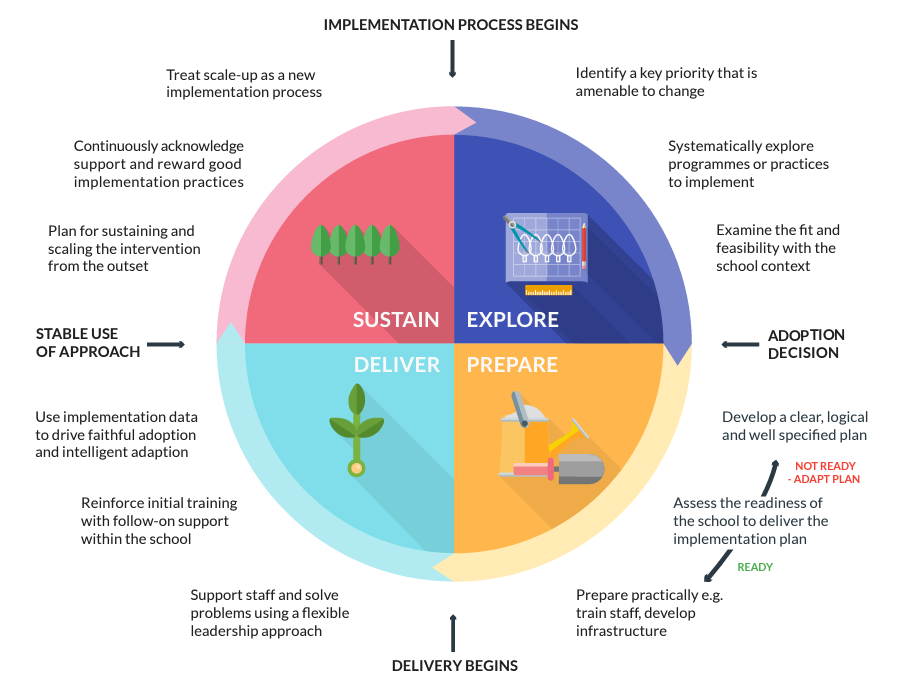
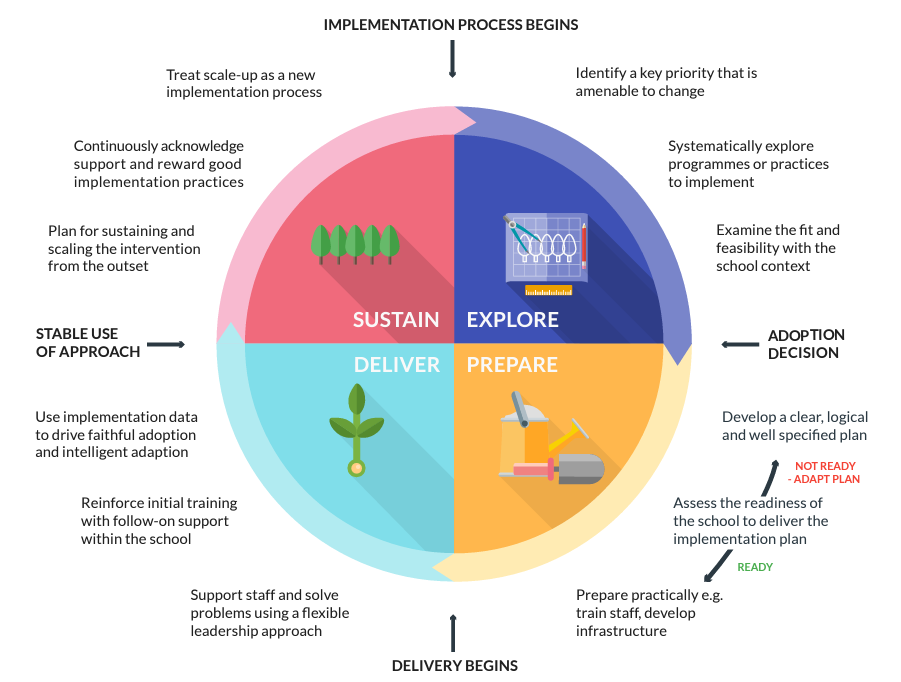
The EEF Guidance on Implementation recommends a four-stage approach to implementing change in a school: Explore, Prepare, Deliver, Sustain. This model was devised following an extensive review of the academic literature on implementation generally and in schools specifically. It provides a useful method for avoiding the pitfalls we have identified, and is a good demonstration of transferring the skills used in curriculum planning and delivery to the implementation of change within or across a school. 

The premise of the EEF report is that schools often rush at introducing new practice without carrying out adequate preparation. In it, the authors advise us to ‘treat implementation as a process, not an event; plan and execute it in stages’. Their four-stage approach, pictured above, provides a framework for planning for and embedding sustainable change which will have a lasting impact on teacher practice and student outcomes. They emphasise the importance of gathering evidence from within the setting as well as in relation to potential solutions, and of doing a significant level of preparation before starting on the change itself. This preparation is essential if the implementation is to succeed in the long term: far too many interventions in schools are short-lived due to a failure to plan beyond the initial stages. Monitoring and adjustment are key features of successful change, just as they are of effective classroom practice, and central to this is the regular gathering of data to inform decisions.

Reflection (click to expand)
  • Study the EEF model and note; a) which features have you seen used successfully? and b) which features have been missing when change has been introduced in your setting?
  • What do these observations teach you about the leadership of change in your setting?

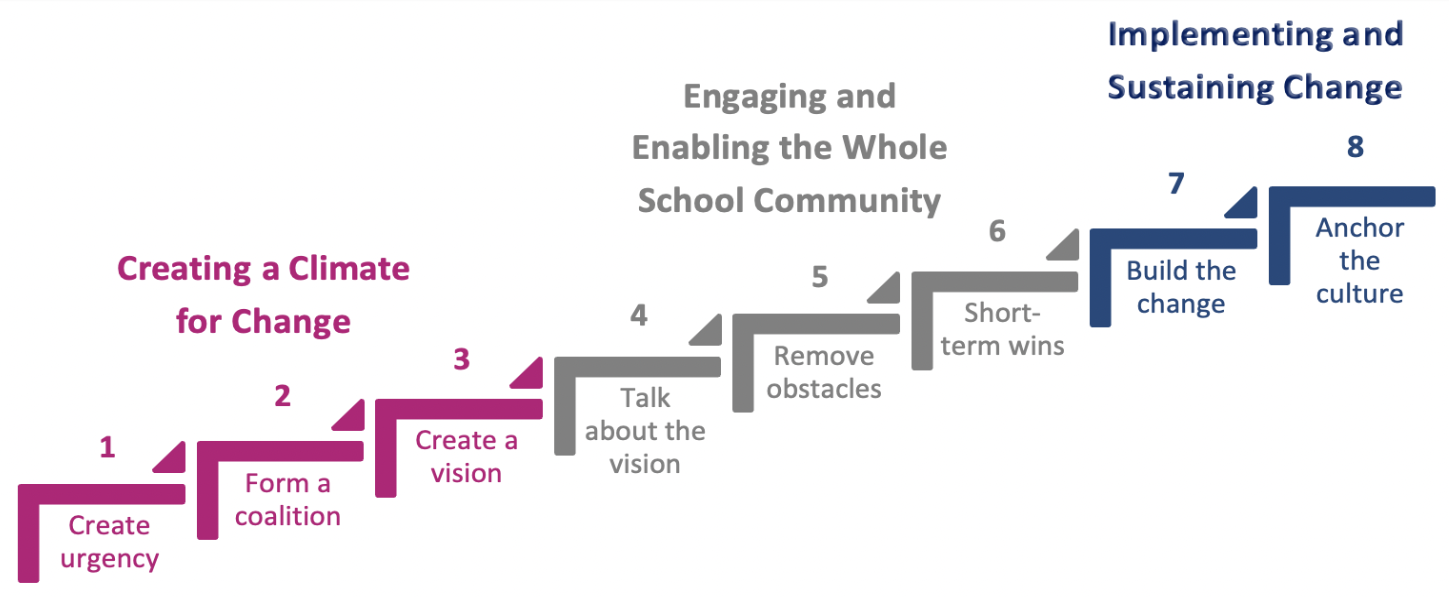
The EEF model reflects recommendations from other researchers such as John Kotter, whose 8 steps for change are pictured below: 

One of the important aspects of Kotter’s (1995) model for middle leaders to absorb is the acknowledgement that people are often one of the main barriers to successful implementation, but they are also the key to making things happen. Therefore, in addition to the research you do into the evidence for the proposed change, as stated in our reflection post on implementation it is crucial to communicate clearly and involve your team in the decision making. This is particularly the case in schools, where the majority of the workforce is likely to be working at capacity and within well-established routines and agreed practice: you will need to invest time into ‘building your coalition’. To be successful you need a group of colleagues who will assist, encourage and support the implementation of the identified change (the ‘coalition’) from the beginning – successful leadership is not about working top down or in isolation. As the plan progresses, the coalition should build and there will eventually be a more widespread enthusiasm for the change. As the EEF report stresses, it is much easier to gain support for a vision or plan if it is rooted in sound evidence and meets a known need in your school. Proposing to address the known need through an evidence-led solution is how you create what Kotter (1995) calls a ‘Sense of Urgency’: people will come with you if they identify with the need, not just the action, and if the evidence resonates with what they already know and observe in their classrooms. Note that this use of ‘urgency’ relates to the importance of the proposed change: it is different from the type of urgency alluded to in the EEF guidance and cited in the reflection post on Implementation, which equates with haste and rushing at change. 

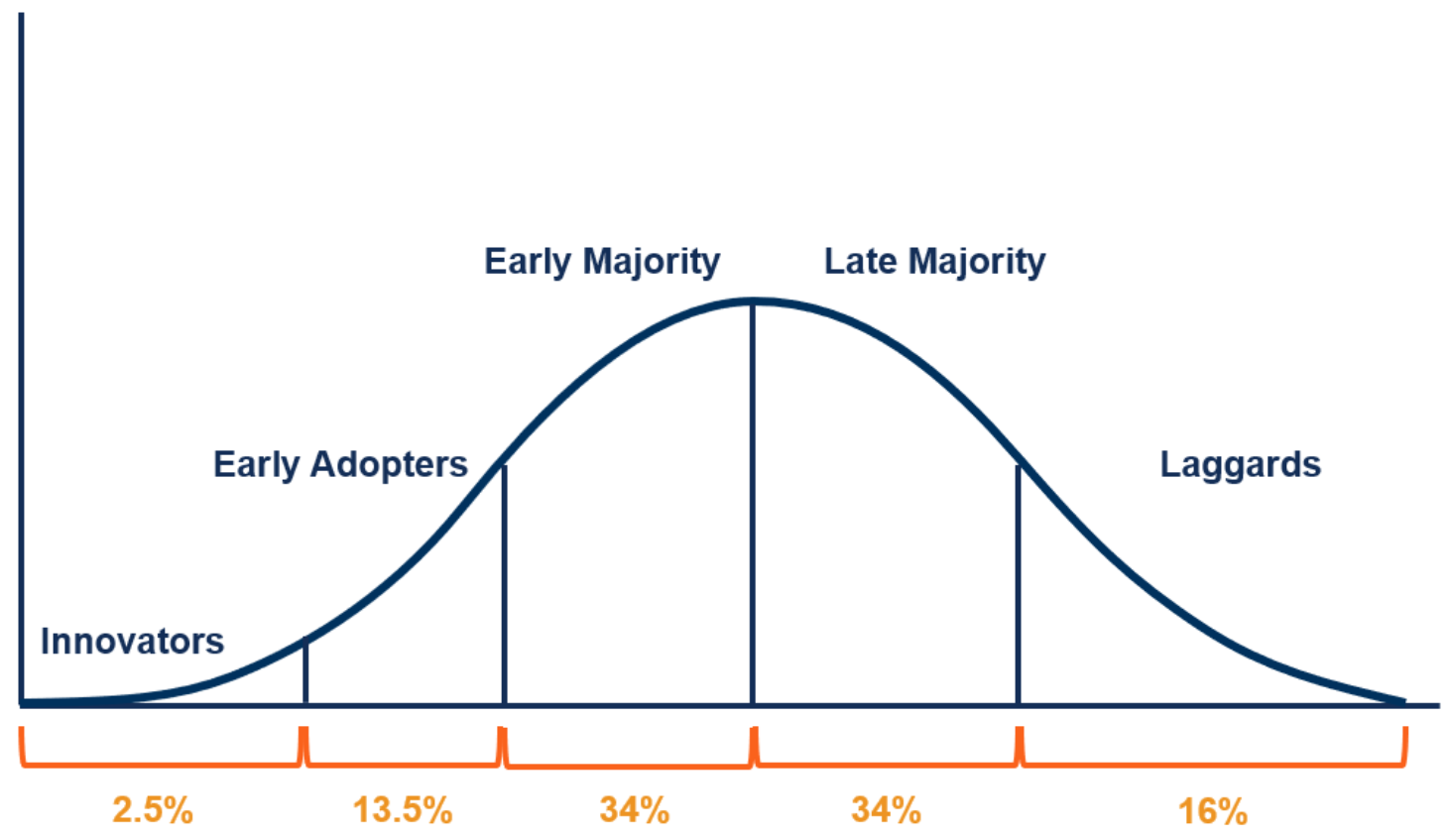
When reflecting on how to approach your team to propose a change in practice or a new intervention, Roger’s ‘Diffusion of Innovation Theory’ (1995) is worth considering. It includes a useful depiction of how quickly people are likely to adopt new ideas or practice and embed them in their own practice: 

Different people will adopt new practice or technology at different stages: knowing this in advance and factoring it into your planning will help you to succeed in embedding the change more effectively. Across our teaching and leadership journeys we have all expended so much energy trying to win over the group Roger (1995, 2003) calls the ‘laggards’, when the biggest impact is far more likely to come by working with the people on the early side of the median – your potential ‘coalition’. Both Kotter (1995) and Sharples et al. (2019) stress the need to support staff and remove barriers – sometimes this might include ignoring the few who actively or passively resist the change. 

Reflection (click to expand)
  • How familiar were you with the EEF implementation model, Kotter’s model and Roger’s curve?
  • How could either or both of these models help you to improve implementation in your role/setting?
  • Would it be beneficial for you to do further reading and or study regarding implementation?

References

  • Kotter, J. P. (2012). Leading change. Boston, Mass: Harvard Business Review.
  • Rogers, E.M. (2003) Diffusion of Innovations. Free Press, New York. 
  • Sharples, J., Albers, B., Fraser, S. and Kime, S. (2021) Putting Evidence to work: A school’s guide to implementation, Education Endowment Fund.

Putting your ‘toolbox’ into practice

Who is this blog post for: Current or emerging middle leaders and for senior leaders or Headteachers who are developing middle leaders.

Author:  Lisa Ramshaw 

Posted on: 14th November 2023

Keywords: Application; toolbox; situational; reflection; conscious; self-awareness.


In this blog post, we explore some of the scenarios that you may face in your middle leadership role and consider what Goleman leadership styles could be appropriate to deal with the scenario when selecting them from your leadership ‘toolbox’.  


Scenario 1 

Isha has been at the school for 16 years and is a member of the team that you lead. She is respected by parents and feared by many staff due to her abrupt manner and ‘to the point’ talking. She is extremely set in her ways and gets good results from the pupils. The school is trying to implement a more creative curriculum, but Isha doesn’t want to change her traditional style of teaching. Recently she has become very negative about all the changes and often expresses her views loudly in the staff room and has also been known to talk to the parents about her views of the new style curriculum. You have your team meeting coming up soon, where this is an agenda item, and you fear that Isha may create some discord within the team.  

Prompt questions 

  • As a middle leader, how would you plan to deal with this scenario? Where would you start and what step would you take? 
  • What leadership styles do you think would be most effective in this situation and why?

Before clicking the response below to reveal a suggested solution, reflect on what you would do to handle this situation and make some notes to capture your thinking.

Once you are ready click the button below

Response (click to expand)

Within this scenario, you seem to have the advantage of being aware of this situation before your team meeting. It could be useful to meet with Isha before this meeting to allow her to share her views. Approaching this from an affiliative point of view initially could be beneficial, so that Isha feels heard and her views shared. 

You may then switch to a more visionary (authoritative) style, as you share the reasons why this creative curriculum is being developed and implemented.  

Since Isha is an effective teacher of 16 years, you could then move to a more pacesetting style whereby you hone in on her experience and success and consider aspects of her practice that are of a high standard and would be needed to make sure such a new creative curriculum can be implemented effectively. Hopefully, this approach could make her feel valued, and she could then be a supportive advocate of the change to help coach other members of the team.  

Once in your meeting with all other team members, using the visionary (authoritative) style again to position the reasons for the creative curriculum could be useful to set the scene. Once the ‘why’ has been shared, adopting a democratic approach to draw out the opportunities and challenges as a collective team could be useful, so that you can democratically problem-solve any challenges that may exist to help move the project forward

Reflection

  • How does this suggested solution compare to your own thoughts and suggestions? 
  • Would you do anything differently? If so, what would that be and why?

Scenario 2 

You have a teacher on your team who is very keen and motivated; however, they consume a lot of your time by ‘running things by you’ and regularly catch you in the corridor to share what has happened in their day. The ‘two minutes’ they ask you for, always turns into twenty-two. This often puts a strain on your time, and you then have to stay later at work to finish off the things you needed to. 

Prompt questions 

  • The next time this scenario happens, as a middle leader, how could you deal with it differently, so that twenty-two minutes doesn’t progress to forty-two minutes? 
  • What leadership styles do you think would be most effective in this situation and why? 

Before clicking the response below to reveal a suggested solution, reflect on what you would do to handle this situation and make some notes to capture your thinking.  

Response (click to expand)

In this scenario, when someone is so keen, it is very hard as a leader to dismiss them or say that you are too busy. Most leaders always want to be accommodating and give time to others. However, it seems that this teacher has a dependency or a learned helplessness that you may be encouraging.  

For the benefit of the teacher themselves, you want to be able to develop their independence, so that they have the confidence to use their own initiative and be self-reflective. Therefore, the next time this happens, I would suggest that you as the leader are a little more assertive (with a smile!), using a commanding (coercive) approach – kindly. Share that you are very interested in what they have to say, but you are unable to chat right now. Ask them to email you to arrange a time when you can have a more focused conversation. This way, you have shown that you still have time for them, but it is going to be when it is more convenient to you. 

Once you arrange this meeting with that teacher, the coaching style could then be adopted. As long as you are the leader who is just verifying any query they have, they will always be dependent on you as they see you as their mentor. However, if you use coaching and develop their skills to be able to think for themselves and empower them to take their own initiative, you will develop their independence. I always find the GROW model is a simple and effective strategy when coaching and the results I have achieved have been very successful. Many teachers have thanked me for opening up their own minds to solutions they didn’t know they had.  

GROW is an acronym for Goal/s, Reality, Options, Way Forward.   

G – In the initial stage, start by asking what they want to achieve from the conversation, or what they would like to chat about, i.e., their goal or aim.  

R – Then move onto asking them what the current reality is, and why it is important to them – i.e., what is happening now.  

O – Once you have established this, the most substantial part of the conversation is about discussing and debating what the relevant options are to achieving the initial goal. Depending on the teacher, you may need to step in with some possible options, but I would always encourage you to provide a choice to the teacher, so they always feel that it is them who has made the decision and feels empowered.  

W – Finally, once all possible options are discussed, ask the teacher how they would like to proceed – i.e., what is the way forward from here? 

Hopefully, a few of those conversations will significantly reduce the amount of long-winded corridor conversations and move your teaching team from dependent to independent.

Reflection

  • How does this suggested solution compare to your own thoughts and suggestions?
  • Would you do anything differently? If so, what would that be and why?

Scenario 3

In the first reflection post of this series, it was prefaced that the two layers of the hierarchical structure can pull a middle leader in many directions, framed as ‘sandwich leadership’. Usually, middle leaders are sandwiched between senior leaders and their teams, therefore, there are also times when you need to ‘lead up’ and times when you need to follow their lead. The following scenario asks you to consider just that and reflect on what Goleman Leadership styles may be appropriate in this situation. 

After a recent meeting with your senior leader, you have been instructed to provide judgements for each one of teachers in your team. You have perceived your senior leader’s style to be quite commanding (coercive) in their request. However, you need to do this within two weeks, and you feel that you don’t have enough time to organise thorough learning walks or lesson observations to be able to make fair judgements of teachers. Since you are new to your middle leader role, you have not made judgements on teachers like this before, and although you have the teacher observation data from last year, you want to be able to make judgements based on teacher performance within this academic year.  

Prompt questions 

  • How would plan to deal with this scenario? 
  • Would you work within the parameters of the deadline, or would you meet with the senior leader again and try to negotiate? 
  • What leadership styles do you think would be most effective in this situation and why? 

Before clicking the response below to reveal a suggested solution, reflect on what you would do to handle this situation and make some notes to capture your thinking.  

Once you are ready click the response below

Response (click to expand)

With this scenario, it seems that you have two options or two directions you can go in. 

  1. Follow the initial instructions and work out the fairest way to provide teacher judgements as per the deadline.  
  2. Speak with the senior leader again and try to negotiate – i.e., Lead up. 
  3. Or, perhaps a third option – whereby you do 1. first to demonstrate compliance, and then follow up with 2. in an attempt to try and influence different future ways of working.  

I’m sure that you are already thinking of a specific senior leader, and you will know whether they are approachable for negotiation and whether they would be open to a further discussion. Equally, you will probably know whether their request is flexible, or whether it is due to an external request and is, therefore, not flexible. This is the relational aspect of being a middle leader within a school and working with people you are familiar with. There will be certain norms that have been established in the hierarchical leadership context, and you will be aware of how flexible these are, or not.  

However, the bottom line is, that in this scenario you don’t know why this data is needed within two weeks as the senior leader did not share that information with you. 

Therefore, let’s consider what leadership styles are most appropriate for option 2 – ‘Leading up’. 

Although the leader is perceived to be using a commanding style, you may wish to approach your leader in a more affiliative way. Perhaps share your own feelings about the request and ask if it would be possible to speak with the senior leader again. Sharing a degree of vulnerability should evoke a response from your senior leader, so they agree to meet with you again. It will be important to establish what the vision is with respect to the request (i.e., the why), encouraging your senior leader to adopt a more visionary style. Once you understand the vision, you could then request a coaching conversation in order to support you in this task and new role. Alternatively, you may request the senior leader to conduct some learning walks or lesson observations with you, so you know you are making the correct judgments. This way you are encouraging the senior leader to adopt a more pacesetting/mentoring role. Either way, you are encouraging a particular leadership style from your senior leader based on what you need, and effectively communicating how you would like to be led.  

With this approach, it is also important to consider your own integrity within the ‘sandwich leadership’ scenario and whether what you are asking of your senior leader, you would be willing to do for your team.

Reflection

  • How does this suggested solution compare to your own thoughts and suggestions? 
  • Would you do anything differently? If so, what would that be and why? 

As stated at the start if this blog post, we hope these scenarios have helped you reflect on different ways to deal with different scenarios, and how effectively your leadership toolbox can be employed.   

Should you have any specific scenarios you would like to speak with us about, or leadership training needs in your school, then please click the ‘Register your interest’ link below.  

References

  • Hieker, C. and Pringle, J. (2021) The Future of Leadership Development: Disruption and the Impact of Megatrends. Springer Nature. 
  • Goleman. D. (2000) Leadership that gets Results. In Harvard business review, 78 (2), pp. 78–90. Harvard Business School Publishing Corporation. 
  • Whitmore, J. (2010). Coaching for Performance: The Principles and Practice of Coaching and Leadership FULLY REVISED 25TH ANNIVERSARY EDITION. Hachette UK. 

How to transform learning in your context

Who is this blog post for: Current or emerging middle leaders and for senior leaders or Headteachers who are developing middle leaders.

Author:  Stephanie Bingham

Posted on: 24th March 2023

Keywords: process; transformative; vision; values; goals; influence; challenge; opportunity; modelling. 


Introduction 

In the first reflection post of this series we outlined some of the challenges but also the opportunities of middle leadership, with a particular focus on its transformational potential. 

In the following case study, we provide an empirical illustration of effective, transformational middle leadership. As you read, think about the pointers we provide and the ways in which you can transfer the learning into your own context. 

Case Study 

The teacher in the case study works in a small rural first school in the North East of England. They chose to lead an intervention to improve spelling, firstly in lower Key Stage 2 and later in Key Stage 1 and the Early Years. This first extract illustrates how their plan fitted with the strategic priorities of the school: 

The focus of my initiative was to improve overall spelling ability across Key Stage 1 and 2. I chose this focus as it was highlighted within my school data and school improvement plan as an area for development. It was also emphasised by Ofsted as a stand-alone weakness across our Key Stage 2 writing, despite overall good attainment in writing. 

Choosing an initiative which focused on a learner-centred school priority ensured support from the senior leaders in the school, combined with a strong imperative for the rest of the teachers involved. This is a good illustration of effective navigation of Middle Leadership as the teacher chose a focus which utilised the ‘sandwich’ nature of the middle leader’s position as an opportunity rather than a challenge. 

The setting of a phase or subject-specific vision and goals can therefore be very challenging; however, it can also provide a uniquely holistic perspective from vision to implementation. Middle leaders are therefore opportunistically positioned, or ‘sandwiched’, to be able to listen and influence up and down the hierarchy in order to effectively implement, and this position could also allow middle leaders to influence and contribute to the wider vision and goals. How a middle leader capitalises on this opportunity, could prove beneficial to the setting of more phase and subject-specific goals so that they positively impact change.   

I led the lower Key Stage 2 (KS2) teachers and a supporting level 3 teaching assistant initially, then integrated the Key Stage 1 (KS1) and EYFS staff into my initiative at a later date. All staff involved were responsible for facilitating a weekly verbal ‘Spelling Bee’, instead of a spelling test, as well as using specific spelling activities from a spelling programme – ‘Bee a Speller’ – three mornings a week. I also sent out an informative parents’ guide at the beginning of the school year to advise parents on the theory behind my ‘Spelling Bee’ programme and to demonstrate the best way to facilitate spelling practice at home with their child. As a result of the tailored spelling programme, the percentage of pupils achieving expected spelling standard across KS1 increased dramatically, with a rise of 35% compared to the previous academic year’s summative data. I am continuing to monitor this data and develop our approaches to suit our school as the pupil numbers grow. The level 3 teaching assistant involved in the project was quoted as saying that the changes “have put spelling on the map and made it fun for the children”. All members of our school team have seen an overall improvement in pupil attitudes as well as team spirit, perseverance and resilience which form some of our school values.  

As the initiative took shape the leader learnt some practical aspects of effective leadership – the operational aspects – but was also reflective about their own actions and those of their team. They remained focused on the long-term strategic goal, but also realised the importance of strong relationships and of leading individuals. They ensured there were opportunities to use the skills of the different team members, and saw the opportunities behind the initial challenge of the identified ‘barriers’. They used influence and modelling as they leant on their own pedagogical expertise to ensure there was a measurable impact on pupil progress and skills. This initiative is a clear example of someone combining their skills as a teacher with their developing leadership, and of leadership as a process. As a result of the initiative there was transformation for the leader, the team and the learners. 

At the beginning of my initiative I was goal focused and was particularly enthusiastic about promoting change and performance results. In reality there were some barriers, such as getting all members of staff on board to increase the capability of the team. Throughout my initiative, these barriers have developed how I plan collaboration as a middle leader and have helped me to have a self-awareness of my strengths and weaknesses that I have developed. I found that the leadership of my in-school initiative had to consider the implementation of routine teaching strategies within subjects and the careful planning and timetabling of teaching to consistently embed learning. I thoroughly planned my meetings to utilise my teams’ skillset to make positive improvements. As a result, I am more aware of the different personalities and skills of members of my team and how to support these to promote team work, cooperation and learner impact. 

 The improvement in spelling in the school was a result of strong, practical, goal-orientated and transformational leadership. As the leader themself states: 

My initiative has generally improved the capability of my team as it has drawn a greater focus and awareness of fun ways to teach spelling and how to inspire pupils to want to achieve in a frequently unpopular area of the curriculum.  

Another key feature of this leader’s initiative was the process of implementation. They understood the need to plan, and to start small and scale up. They also understood the need for some quick wins and for methods which would ensure the sustainability of the initiative. This included embedding new classroom practice, timetabling the activities across the curriculum, and using and then building on the skills of team members. Effective implementation is essential for any leader seeking to implement lasting change. 


Conclusion 

Aligning the focus to a school priority which itself was learner centred enabled the leader to bring their team ‘on board’ – as they put it – and ensured that the merits of the initiative were inarguable. Momentum is always easier to maintain if the planned change is purposeful and aligned to the teachers’ day-to-day priorities. Where a weakness has been highlighted as an area for development across the school, teachers will always be grateful for someone setting a clear pathway to achieve the improvement. 

In addition, leading any change will provide opportunities for the leader to learn and develop, and this benefits them, the team they lead and the school as a whole. 

Case studies can be a helpful tool for seeing how individual leaders implement change. They are useful for reflecting on how to transfer the learning from one kind of setting to another, in terms of both the operational and strategic aspects of leadership.

Reflection (click to expand)
  • What is the evidence for transformative impact in this case study?
  • What is the evidence for modelling?
  • How has the leader managed the balance between meeting the needs of the team and those of the senior leadership?
  • How could you transfer the learning from this case study to your own practice?

Implementing change: outlining the pitfalls and complexities

Who is this blog post for: Current or emerging middle leaders and for senior leaders or Headteachers who are developing middle leaders.

Author:  Stephanie Bingham

Posted on: 18th July 2023

Keywords: Implementation; plan; communication; complexity; pitfall; evidence; transferable skills.

Introduction

The focus of this article is another key aspect of middle leadership which can be daunting at first but which also presents opportunities for self-development, as well as the improvement of outcomes for learners and colleagues: implementation. Middle leaders are often required to implement change in order to raise attainment, to respond to government policy, or due to new school leadership. Successful implementation requires considerable skill. In our first reflection piece we said that ‘acknowledging that leadership requires new skills opens up the excitement of professional learning and growth’. In this post we will identify some of the pitfalls and complexities of implementation and give you the opportunity to reflect on what skills and knowledge you already have and where you need to develop and learn. In a future blog post we will introduce some implementation models and share some resources which will help as you engage with further professional learning. 

Reflection (click to expand)
  • Have you had to implement change?
  • How successful have you been?
  • Do you know why things were successful or unsuccessful?

Understanding the potential pitfalls and the complexity of implementation 

Pitfalls 

The decision to implement a change in a school or college environment often comes with an inbuilt sense of urgency, and it is easy to rush into it. This will rarely lead to a successful outcome, however, and is the first pitfall to avoid. Regardless of the sense of urgency, time spent planning is never wasted – as the authors of the Education Endowment Fund ‘Schools’ Guide to Implementation’ write: ‘In our collective haste to do better for pupils, new ideas are often introduced with too little consideration for how the changes will be managed and what steps are needed to maximise the chances of success’ (EEF, 2019, p.3). 

A second potential pitfall is poor communication. Implementation is rarely successful if the people involved and affected don’t understand what is being done or why, and if progress or problems are insufficiently shared. Poor communication can often be linked to the first pitfall since rushing in will rarely facilitate good communication. 

A third potential pitfall is trying to introduce too many changes at once. This often stems from the sense of urgency of the problem, or the enthusiasm to introduce something which has been successful elsewhere – and sometimes both.  

It is also still quite common to implement something which is not well supported by evidence or is not appropriate for the context. Successful practice in one setting won’t necessarily be appropriate for another and it is important to do the background preparation which confirms that this is the right initiative for the school’s priorities and context. In the first case study post in this collection, the spelling initiative was successfully implemented partly because it was addressing an identified need in a manner which was appropriate for the school community. Implementing an initiative which works somewhere else, and only for that reason, is unlikely to be successful.  

Leaders can also make the mistake of imposing change upon their team, requiring people to implement something without any consultation or any attempt to give them some ownership of or agency within the initiative. This links to the pitfall of poor communication, but it is separate from it in that leaders could communicate very clearly what is required but do so as an instruction or command. There is far less likely to be resistance and or resentment towards the proposed change if real consultation has also taken place. 

The final pitfall is inflexibility: whilst a plan is important, if it isn’t working there is no sense in sticking to it. Effective implementation includes monitoring the change and adapting when things aren’t working. 

Reflection (click to expand)
  • Which of these pitfalls have you encountered when implementing change?
  • Which of these pitfalls have you observed other leaders experiencing?

Complexities 

One of the complexities of implementing change is managing the people alongside the logistics.  However good the plans are, if the team members don’t understand, are unwilling, or overstretched, then implementation is unlikely to go well. This links with what we said in our first reflection post about the importance of leading the team well through transferring the skills of the classroom to the leadership of adults – pedagogy versus andragogy – which we explored in the previous practice post. 

Implementation is also complicated by the ongoing demands of the day to day: schools are busy and the work of a middle leader extends well beyond the implementation of one particular strategy. In addition to their teaching there will be significant operational demands, some of them at short notice, which mean that implementing the change cannot always be the main focus of activity. An effective implementation plan will take account of this. 

Another complexity of implementation for middle leaders is the ‘sandwich’ nature of their role, which we talk about in our first reflection post. The decision and planning may have come from senior leaders, who delegate local aspects of it. This adds many complications, not least the middle leader’s own potential sense of lack of ownership and agency. If the middle leader lacks ownership and agency in relation to a planned change, it will be even more the case for the team they lead. This can result in low motivation and additional challenges for the leader to overcome. The implementation models we explore in the next post emphasise the need to have a clear aim and shared imperative, which will help to remove these barriers.

Reflection (click to expand)


Applying the skills of the classroom to implementation  

As we mentioned in our first reflection post, one reason that highly effective teachers can become successful leaders is that many of the skills used in the classroom are transferable to leadership (explored further in practice post 1). 

Throughout the day effective teachers assess needs and adapt to the live situation in the classroom. There is continuous diagnosis, monitoring and evaluation, and plans are adapted or discarded as necessary. Appropriate responses are made to learners’ questions and behaviour, and communication is clear and pitched at the right level. This is possible if the knowledge and skills of the teacher are secure and the planning and preparation for a lesson and a sequence of learning have been done effectively, with the intentions for learning being fully understood. It is also possible if the teacher understands the learners and the relationships are strong. 

In teaching and in the leadership of implementation, the purpose needs to be shared and understood among all stakeholders so that resistance and or obstructions are minimised. Where learning needs to take place, pedagogical techniques can be adapted to suit the adult learners – this is called andragogy and is covered in practice post 1. 

All of these are transferable skills which can be adapted for all aspects of middle leadership, and especially implementation: diagnosing need and identifying a solution; planning for the short medium and long term; communicating clearly; adapting plans to suit the immediate situation; and building relationships to ensure success for all. Reflection

Reflection (click to expand)
  • Considering the pitfalls and complexities outlined above, which of your teaching skills could you apply to ensure effective implementation?

Selecting Goleman’s leadership styles

Who is this blog post for: Current or emerging middle leaders and for senior leaders or Headteachers who are developing middle leaders.

Author: Lisa Ramshaw

Posted on: 14th November 2023

Keywords: Emotional intelligence; leadership styles; situation-specific; toolbox.

Goleman’s Leadership Styles 

Do you play golf, enjoy cooking, or perhaps you’re handy with DIY? 

With any of those examples, you know you need to select the right club, utensil, or tool to be able to achieve the right outcome. Using leadership styles effectively works on the same principle. 

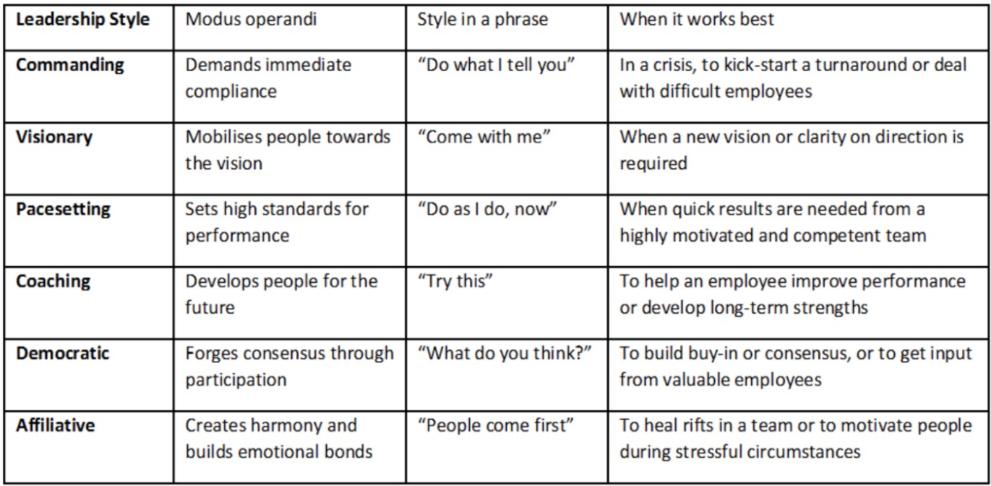
In 2000, Daniel Goleman wrote an article for the Harvard Business Review entitled ‘Leadership That Gets Results’, explaining six emotional leadership styles: Commanding (or Coercive); Visionary (or Authoritative); Pacesetting; Coaching; Democratic; and Affiliative. These are summarised in the table below.  


The article identified that the most effective leaders use a collection of leadership styles, each in the right measure, at just the right time. 

Reflection (click to expand)
  • What style do you think you use the most? Why do you think that is?
  • What style do you think you use the least? Why do you think that is?
  • What style would you like to use more of? Why?
  • Alternatively, what leadership styles have you experienced (i.e how have you been led), and how have these experiences influenced you as a leader?

Each style tends to have pros and cons, as there is no one style that is the ‘silver bullet’. However, if some styles are overused, or used to their extreme, they can be quite damaging to an individual, or to the organisational culture. Let’s take commanding style for example. If people need a top-down decision or for the leader to take charge, then this style is effective for providing confidence and direction. However, when used to try and get everyone to conform, this can create resistance, low morale, and discourage people. For that reason, commanding style is most likely used in the shorter-term, as longer-term use can create dissonance. Similarly, the pacesetting style should be used with caution. No doubt you are a middle leader because you were great at teaching, and you have shown high expectations and achievement within your career so far. Often, these high expectations and drive follow you into your leadership role and you expect everyone else to behave in the same way. However, all leaders have to learn that not everyone in their team will have the same priorities or drive as them. I know I learned this in the early stages of being a middle leader, when another teacher just burst into tears in front of me because I was making her anxious, of which I had no right to. When using the pacesetting style, ensure your team or the staff you are working with share the same values, goals and working patterns as you, so you can work together at pace. For those that may work differently, or they have different goals within their own roles, allow space and time to support their development. This may be when a more affiliative or coaching approach would be beneficial. These styles tend to develop greater harmony and longer-term professional development, respectively.  

Recently, I have created a new module that I teach at the university called the Future of Educational Leadership. Within this module, we look at megatrends from globalisation, to digitisation, to how demographics are changing, and how we need to adjust our leadership and leadership development accordingly. In Hieker and Pringle’s (2021) book, they share a study whereby MBA students undertook their own research on Goleman’s six leadership styles and asked millennial and Gen Z undergraduates which styles they preferred. They found that millennials and Gen Z found the coercive (commanding) and pacesetting leadership style the least effective, but preferred coaching to all other leadership styles (Hieker and Pringle, 2021, p. 16). Within a school environment, you are most likely working with people from a range of demographics, generations and cultures, ranging from students, to parents, to other staff, who all have their own set of expectations, preferences and needs. As a middle leader, you therefore need to always have your set of golf clubs, kitchen utensils or tools at hand, as you are required to adapt to each situation you are faced with. Being aware of a set of leadership styles was one of the best learning moments for me as a leader, as I was able to ‘choose’ how I responded (rather than reacted) to whatever the day brought.  

As stated in the previous reflection post, middle leaders move into their leadership role directly from teaching, often without acknowledgement of the different skills that are required for the role. Self-awareness is crucial here: in the busyness of a middle leadership role, it is important to engage in conscious self-reflection. Now that you have some knowledge of Goleman’s six leadership styles, I encourage you to be consciously aware when selecting a leadership style for a particular situation, and decide what right club, utensil, or tool would be the best to use. Then consciously reflect on whether it was the appropriate leadership style for that situation. If you keep doing that on a regular basis, you will be able to develop your own leadership repertoire, applying your leadership skills and styles more appropriately, and more often. 

Reflection (click to expand)
  • Consider a recent situation that you thought you handled well. What leadership style did you employ? How do you know it was the right one for that situation?
  • Now, consider a recent situation that did not go well. What leadership style did you employ? How do you know it was not the right one for that situation? What style would you employ should the situation arise again

References:

  • Hieker, C. and Pringle, J. (2021) The Future of Leadership Development: Disruption and the Impact of Megatrends. Springer Nature. 
  • Goleman. D. (2000) Leadership that gets Results. In Harvard business review, 78 (2), pp. 78–90. Harvard Business School Publishing Corporation. 
  • Pellitteri, J. (2021) Emotional Intelligence and Leadership Styles in Education. Psychology & its Contexts/Psychologie a Její Kontexty, 12(2).