

Applying pedagogy and andragogy for effective meetings

Who is this blog post for: Current or emerging middle leaders and for senior leaders or Headteachers who are developing middle leaders.

Author:  Lisa Ramshaw 

Posted on: 18th July 2023

Keywords: skills; pedagogy; andragogy; self-awareness; self-reflection; transition; transfer


Introduction 

How did you transition into a middle leader? More often than not, it was because you had demonstrated high skill as a teacher, teaching pupils. In my experience, senior leadership teams are usually willing to promote someone to a middle leadership position because they were effective in their teaching practice and were able to influence others in that process. However, it is important to consider how the skills of being an effective teacher can translate into the effective leadership of adults. 

As stated in the previous reflection post, leading and supporting adults has similarities to, but is also significantly different from, leading and teaching young people: this is pedagogy versus andragogy. Switching between the two sets of stakeholders, sometimes multiple times per day, is a skill that is constantly demanded of middle leaders. This is where understanding the difference between pedagogy and andragogy can be useful – knowing which hat to wear and when. 

Pedagogy is predominantly focused on how children learn effectively, whereas andragogy is focused on how adults learn. The table below highlights the differences between pedagogy and andragogy: 

Differences between pedagogy and andragogy
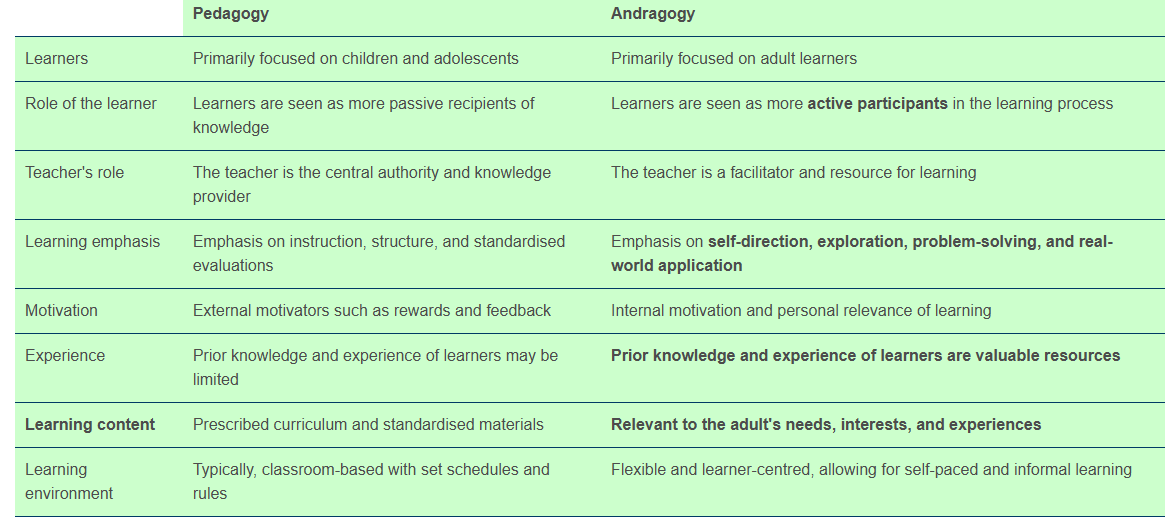
Naturally, however, there is a sliding continuum between these two columns. If you are a Primary school teacher, teaching young children, the difference between pedagogy and andragogy is most likely more pronounced than a high school teacher, teaching young adults. If you get the opportunity, try to collaborate with middle leaders both vertically and horizontally within your school or group of schools, so you can gain a more nuanced understanding of the differences. 


Learning

As a senior leader in schools, I used to say often: ‘What we expect of our pupils, we should expect of our teachers, and what we expect of our teachers, we should expect of our leaders’. This layered model of expectations can be a powerful driving force as we consider the transition from teaching to leadership. 

As can be seen from the above table, one of those common expectations in both pedagogy and andragogy is learning. If we expect teachers and leaders to continue learning, as we expect of our pupils, and this is transparent to pupils, this modelling can promote a sustainable culture of powerful learning. 

Now let’s consider when teacher learning may take place. Usually, it is within a team meeting, or a specific professional development session. If we focus on how to lead effective meetings and how to create a culture of learning among team members, what skills should a middle leader possess and exhibit to promote teacher learning? The next two sections aim to consider the skills that can be transferred from your classroom into leading your team, and those skills that may need developing to be more adult-focused. 


Pedagogy 

In this next section, we consider aspects of pedagogy that could transfer directly into how you run effective meetings. 

Reflection (click to expand)
  • Do you consider establishing norms and agreements between you and your team, as you would with your pupils?
  • Do you have clear objectives or intentions for the meeting, as you would at the start of a lesson?
  • Do you promote learning activities that will meet the needs of all members of your team, as you would in a classroom?
Establishing norms and agreements 

Boudett and Lockwood (2019) state that shared agreements about how groups work together “can play a powerful role in eliciting the breadth of perspectives that is needed for a group of educators to tackle hard problems.” Being explicit about what you agree as a team can ensure all colleagues are working from the same page and therefore promote equitable and productive discussions. In addition, Boudett and Lockwood (2019) share that norms can also boost the “joy factor” in collaborative work and also remove you as the authoritarian in the room. If all team members create and agree on norms together, you’ll be amazed to see, as with your pupils, how team members then hold each other accountable, saving you that job in meetings! 

Clear objectives and intentions 

Pettersson and Briggs (2019) believe productive and efficient meetings are intentional in that every meeting has a clear purpose and an agenda. Colleagues can then understand their relevance in the meeting, and hence make commitments on how they will work together, clearly defining roles and responsibilities. As with norms and agreements, these don’t always have to be set by you. You could engage your colleagues in intention setting from one meeting to the next, so colleagues also have ownership for some of the agenda items. 

Learning activities 

People engage with learning in different ways and for different reasons, just as your pupils do in your class. There are a number of different theories relating to learning styles and preferences, and corresponding activities. In my experience, Honey and Mumford’s (1992) learning style theory has been effective when working with adults.  

Honey and Mumford (1992) identified four learning styles and terms used to describe a person – activist, pragmatist, reflector and theorist. Activists are those who learn by doing and action; pragmatists are those who learn when they perceive that their learning could be put into practice in the real world; reflectors are those who learn by observing others and taking time to reflect on the details of ideas or discussion points; and theorists are those who learn by understanding the theory behind something, i.e., the why.  

As we think about our role in team meetings, it is important to consider how we ensure there is action, application, reflection and evaluation, whilst ensuring there is also clear theoretical reasoning. This will depend on what our intentions are and what we are hoping to achieve as a team.  

I once delivered a professional development session on learning activities for adults, and it was wonderful to hear this ‘aha’ moment as a colleague reflected on their leadership practice:  

“I have been doing this wrong the whole time – I’ve always expected my team to think and behave like I do, and that’s just not the case!” 


Andragogy

Andragogy acknowledges that we as adults learn a little differently from children and this element needs to be respected as we move into leadership. Three of the standout features for me are: 

  • the role of adults as active participants, involved in decision-making; 
  • the emphasis on self-direction and choice – the ability to explore and problem-solve, whilst ensuring relevance and applicability; 
  • the need to ensure that the experience of adults is not only considered but used. 

In this next section, we consider these aspects of andragogy that could help drive how you run effective meetings. 

More often than not, meetings are run with the leader talking through each agenda item, whilst expecting a series of polite nods until the meeting ends. There may be some discussion sprinkled in, but ultimately the meeting is a passive occasion to most colleagues. I’m sure you have been in those meetings yourself, and they don’t necessarily feel like a good use of your time.  

What if we ensured that the purpose of every meeting was to learn from each other, share experiences and explore and solve problems that have immediate relevance to your own practice? 

All too often, teachers expect leaders to solve their problems and have all the solutions, and as a new middle leader that pressure to have all the answers can be felt, especially as we are so used to providing solutions to pupils. Before you know it, you are swamped with multiple queries every day from individual teachers. If you can develop practices whereby team members are able to support and develop each other, you can reduce the amount of queries that come your way and take up so much of your time.  

Collaboration is a practice of distributed leadership (Diamond, 2015; Gronn, 2002) and is defined as the “ability of a team to work well together in which team members can stay problem-focused, listen to and understand one another, feel free to take risks, and be willing to compensate for one another” (Northouse, 2016, p. 370). It is something I was passionate about modelling through meetings and professional development in the teams that I worked with. The meetings were mostly aligned to the organizational functions of the school and were used to review current programmes, products and practices, and I always ensured that I explained the ‘why’ of certain decisions, before we collaboratively agreed on the ‘how’, maintaining transparency. Transparency was one of our agreed norms.  

However, working in this manner also aided collective distribution in which leaders worked interdependently together, but were clear about what they needed to work on separately (Diamond, 2015), therefore it was also a practice that continued outside meetings. The multiple queries I used to get every day of “do you have 2 minutes” drastically reduced. 

Forward planning (click to expand)

How do you intend to:

  • ensure that your colleagues are active participants in your meetings, involved in decision making?
  • emphasise exploration and problem-solving, whilst ensuring relevance and applicability to colleagues’ roles?
  • ensure that the experience of your colleagues is not only considered but being used?

References: 

  • Boudett, K. and Lockwood, M., (2019). The power of team norms. Educational Leadership, 76 (9), pp.12-17. 
  • Diamond, J. (2015). What is distributive leadership? In Griffiths, D., & Portelli, J. (Eds.), Key Questions for Educational Leaders (pp.151-156). Burlington, Ontario: Word & Deed Publishing Inc. & EdPhil. 
  • Gronn, P. (2002). Distributed leadership as a unit of analysis. Leadership Quarterly, 13(20), 423-451.  
  • Honey P., and Mumford A. (1992) Setting the Scene for Learning Styles. The Manual of Learning Styles. Berkshire Peter Honey (1-4). 
  • Jeanes, E., (2021). A meeting of mind (sets). Integrating the pedagogy and andragogy of mindsets for leadership development. Thinking Skills and Creativity39, p.100758. 
  • Knowles, M. S. (1980). The modern practice of adult education: From pedagogy to andragogy. Association Press. 
  • Loeng, S. (2023). Pedagogy and Andragogy in Comparison – Conceptions and Perspectives. Studies in Adult Education and Learning, 1–14. https://doi.org/10.4312/as/11482 
  • Northouse, P.G. (2016). Leadership: Theory and Practice (7th ed.). Thousand Oaks, CA: Sage.   
  • Pettersson, H. and Briggs, K., (2019). The Meeting Is Dead, Long Live the Meeting. The Education Gadfly, 19 (34). 

Putting your ‘toolbox’ into practice

Who is this blog post for: Current or emerging middle leaders and for senior leaders or Headteachers who are developing middle leaders.

Author:  Lisa Ramshaw 

Posted on: 14th November 2023

Keywords: Application; toolbox; situational; reflection; conscious; self-awareness.


In this blog post, we explore some of the scenarios that you may face in your middle leadership role and consider what Goleman leadership styles could be appropriate to deal with the scenario when selecting them from your leadership ‘toolbox’.  


Scenario 1 

Isha has been at the school for 16 years and is a member of the team that you lead. She is respected by parents and feared by many staff due to her abrupt manner and ‘to the point’ talking. She is extremely set in her ways and gets good results from the pupils. The school is trying to implement a more creative curriculum, but Isha doesn’t want to change her traditional style of teaching. Recently she has become very negative about all the changes and often expresses her views loudly in the staff room and has also been known to talk to the parents about her views of the new style curriculum. You have your team meeting coming up soon, where this is an agenda item, and you fear that Isha may create some discord within the team.  

Prompt questions 

  • As a middle leader, how would you plan to deal with this scenario? Where would you start and what step would you take? 
  • What leadership styles do you think would be most effective in this situation and why?

Before clicking the response below to reveal a suggested solution, reflect on what you would do to handle this situation and make some notes to capture your thinking.

Once you are ready click the button below

Response (click to expand)

Within this scenario, you seem to have the advantage of being aware of this situation before your team meeting. It could be useful to meet with Isha before this meeting to allow her to share her views. Approaching this from an affiliative point of view initially could be beneficial, so that Isha feels heard and her views shared. 

You may then switch to a more visionary (authoritative) style, as you share the reasons why this creative curriculum is being developed and implemented.  

Since Isha is an effective teacher of 16 years, you could then move to a more pacesetting style whereby you hone in on her experience and success and consider aspects of her practice that are of a high standard and would be needed to make sure such a new creative curriculum can be implemented effectively. Hopefully, this approach could make her feel valued, and she could then be a supportive advocate of the change to help coach other members of the team.  

Once in your meeting with all other team members, using the visionary (authoritative) style again to position the reasons for the creative curriculum could be useful to set the scene. Once the ‘why’ has been shared, adopting a democratic approach to draw out the opportunities and challenges as a collective team could be useful, so that you can democratically problem-solve any challenges that may exist to help move the project forward

Reflection

  • How does this suggested solution compare to your own thoughts and suggestions? 
  • Would you do anything differently? If so, what would that be and why?

Scenario 2 

You have a teacher on your team who is very keen and motivated; however, they consume a lot of your time by ‘running things by you’ and regularly catch you in the corridor to share what has happened in their day. The ‘two minutes’ they ask you for, always turns into twenty-two. This often puts a strain on your time, and you then have to stay later at work to finish off the things you needed to. 

Prompt questions 

  • The next time this scenario happens, as a middle leader, how could you deal with it differently, so that twenty-two minutes doesn’t progress to forty-two minutes? 
  • What leadership styles do you think would be most effective in this situation and why? 

Before clicking the response below to reveal a suggested solution, reflect on what you would do to handle this situation and make some notes to capture your thinking.  

Response (click to expand)

In this scenario, when someone is so keen, it is very hard as a leader to dismiss them or say that you are too busy. Most leaders always want to be accommodating and give time to others. However, it seems that this teacher has a dependency or a learned helplessness that you may be encouraging.  

For the benefit of the teacher themselves, you want to be able to develop their independence, so that they have the confidence to use their own initiative and be self-reflective. Therefore, the next time this happens, I would suggest that you as the leader are a little more assertive (with a smile!), using a commanding (coercive) approach – kindly. Share that you are very interested in what they have to say, but you are unable to chat right now. Ask them to email you to arrange a time when you can have a more focused conversation. This way, you have shown that you still have time for them, but it is going to be when it is more convenient to you. 

Once you arrange this meeting with that teacher, the coaching style could then be adopted. As long as you are the leader who is just verifying any query they have, they will always be dependent on you as they see you as their mentor. However, if you use coaching and develop their skills to be able to think for themselves and empower them to take their own initiative, you will develop their independence. I always find the GROW model is a simple and effective strategy when coaching and the results I have achieved have been very successful. Many teachers have thanked me for opening up their own minds to solutions they didn’t know they had.  

GROW is an acronym for Goal/s, Reality, Options, Way Forward.   

G – In the initial stage, start by asking what they want to achieve from the conversation, or what they would like to chat about, i.e., their goal or aim.  

R – Then move onto asking them what the current reality is, and why it is important to them – i.e., what is happening now.  

O – Once you have established this, the most substantial part of the conversation is about discussing and debating what the relevant options are to achieving the initial goal. Depending on the teacher, you may need to step in with some possible options, but I would always encourage you to provide a choice to the teacher, so they always feel that it is them who has made the decision and feels empowered.  

W – Finally, once all possible options are discussed, ask the teacher how they would like to proceed – i.e., what is the way forward from here? 

Hopefully, a few of those conversations will significantly reduce the amount of long-winded corridor conversations and move your teaching team from dependent to independent.

Reflection

  • How does this suggested solution compare to your own thoughts and suggestions?
  • Would you do anything differently? If so, what would that be and why?

Scenario 3

In the first reflection post of this series, it was prefaced that the two layers of the hierarchical structure can pull a middle leader in many directions, framed as ‘sandwich leadership’. Usually, middle leaders are sandwiched between senior leaders and their teams, therefore, there are also times when you need to ‘lead up’ and times when you need to follow their lead. The following scenario asks you to consider just that and reflect on what Goleman Leadership styles may be appropriate in this situation. 

After a recent meeting with your senior leader, you have been instructed to provide judgements for each one of teachers in your team. You have perceived your senior leader’s style to be quite commanding (coercive) in their request. However, you need to do this within two weeks, and you feel that you don’t have enough time to organise thorough learning walks or lesson observations to be able to make fair judgements of teachers. Since you are new to your middle leader role, you have not made judgements on teachers like this before, and although you have the teacher observation data from last year, you want to be able to make judgements based on teacher performance within this academic year.  

Prompt questions 

  • How would plan to deal with this scenario? 
  • Would you work within the parameters of the deadline, or would you meet with the senior leader again and try to negotiate? 
  • What leadership styles do you think would be most effective in this situation and why? 

Before clicking the response below to reveal a suggested solution, reflect on what you would do to handle this situation and make some notes to capture your thinking.  

Once you are ready click the response below

Response (click to expand)

With this scenario, it seems that you have two options or two directions you can go in. 

  1. Follow the initial instructions and work out the fairest way to provide teacher judgements as per the deadline.  
  2. Speak with the senior leader again and try to negotiate – i.e., Lead up. 
  3. Or, perhaps a third option – whereby you do 1. first to demonstrate compliance, and then follow up with 2. in an attempt to try and influence different future ways of working.  

I’m sure that you are already thinking of a specific senior leader, and you will know whether they are approachable for negotiation and whether they would be open to a further discussion. Equally, you will probably know whether their request is flexible, or whether it is due to an external request and is, therefore, not flexible. This is the relational aspect of being a middle leader within a school and working with people you are familiar with. There will be certain norms that have been established in the hierarchical leadership context, and you will be aware of how flexible these are, or not.  

However, the bottom line is, that in this scenario you don’t know why this data is needed within two weeks as the senior leader did not share that information with you. 

Therefore, let’s consider what leadership styles are most appropriate for option 2 – ‘Leading up’. 

Although the leader is perceived to be using a commanding style, you may wish to approach your leader in a more affiliative way. Perhaps share your own feelings about the request and ask if it would be possible to speak with the senior leader again. Sharing a degree of vulnerability should evoke a response from your senior leader, so they agree to meet with you again. It will be important to establish what the vision is with respect to the request (i.e., the why), encouraging your senior leader to adopt a more visionary style. Once you understand the vision, you could then request a coaching conversation in order to support you in this task and new role. Alternatively, you may request the senior leader to conduct some learning walks or lesson observations with you, so you know you are making the correct judgments. This way you are encouraging the senior leader to adopt a more pacesetting/mentoring role. Either way, you are encouraging a particular leadership style from your senior leader based on what you need, and effectively communicating how you would like to be led.  

With this approach, it is also important to consider your own integrity within the ‘sandwich leadership’ scenario and whether what you are asking of your senior leader, you would be willing to do for your team.

Reflection

  • How does this suggested solution compare to your own thoughts and suggestions? 
  • Would you do anything differently? If so, what would that be and why? 

As stated at the start if this blog post, we hope these scenarios have helped you reflect on different ways to deal with different scenarios, and how effectively your leadership toolbox can be employed.   

Should you have any specific scenarios you would like to speak with us about, or leadership training needs in your school, then please click the ‘Register your interest’ link below.  

References

  • Hieker, C. and Pringle, J. (2021) The Future of Leadership Development: Disruption and the Impact of Megatrends. Springer Nature. 
  • Goleman. D. (2000) Leadership that gets Results. In Harvard business review, 78 (2), pp. 78–90. Harvard Business School Publishing Corporation. 
  • Whitmore, J. (2010). Coaching for Performance: The Principles and Practice of Coaching and Leadership FULLY REVISED 25TH ANNIVERSARY EDITION. Hachette UK.