
What educational model are you ‘sandwiched’ within?

Who is this blog post for: Current or emerging middle leaders and for senior leaders or Headteachers who are developing middle leaders.

Author:  Lisa Ramshaw 

Posted on: 24th March 2023

Keywords: model; transformative; formal; collegial; political; subjective; ambiguity; cultural; goals; organisational structure


Introduction

This blog post shares a range of theoretical models that may help you recognise how your school or your educational organisation is structured and led.

Tony Bush is a leading educational theorist*, and he writes, “if practitioners shun theory, then they must rely on experience as a guide to action” (2020, p.20). As stated in the introduction to this blog series, we would like to create links between the theory, research, practice and reflection of leadership, whilst effectively utilizing case studies as an experiential component. 

In the first reflection post of this series, it was prefaced that the two layers of the hierarchical structure can pull a middle leader in many directions; however, not all structures within an educational setting follow a particularly hierarchical model. This article aims to present six different theoretical models of educational management by Bush (2020), in order to provide different ways of viewing your institutional structure. Bush (2020, p.22) claims that “each theory has something to offer in explaining behaviour and events in educational institutions”.  

Recently, I facilitated a seminar that focused on these educational models and a school leader said to me – “I understand my own institution and how things work but an understanding of these models has now allowed me to put a ‘name’ to it and therefore understand the school structures and processes more deeply than I did before. I also now know the educational model I would like the institution to move toward. I feel like I have clarity on the institution’s development now”. 

So, let’s look at these models in more detail. In his book, Bush (2020) explains six educational models. Click the title below to view a summary of each model. 

Six Educational models (click to expand)
Formal The formal model depicts the most common hierarchical model that most of us would recognise in institutional structures, where there are clear positions and accountability.  
Collegial Collegial models are more about a collaborative approach whereby people agree on goals / shared views of values, in a more lateral structure. People work together in a collaborative manner and leadership is usually distributed effectively.  
Political In a political model, processes of negotiation and bargaining are common, and interest groups develop and form alliances or coalitions in pursuit of particular objectives. At times, conflict can emerge, and different forms of power can be used, including positional power; authority of expertise; personal power; control of rewards; coercive power. 
Subjective In this model, there is more interest in processes and relationships and the organisational structure tends to be an outcome of the interaction between people. The individual participant is at the heart of the organisation and should not be regarded simply as a cog within the institution. 
Ambiguity In an ambiguous model, institutions are characterised by fragmentation and ‘loose coupling’ – i.e., sub-units operating autonomously. Rules and regulations are unclear or disregarded and participation in decision-making is fluid. 
Cultural In a cultural model, there is a close link between culture and structure, and values and beliefs are expressed in the pattern of roles which underpin attitudes and behaviours. There is a development of shared norms and meanings: the ‘way we do things around here’ and these are expressed through rituals and ceremonies which support the beliefs and norms. 

Figure 1: Six Educational Models (Bush, 2020).

Reflection (click to expand)
  • What educational model do you think your institution reflects most based upon the above summary statements?

Now let’s reflect on each model a little more closely. The table in the drop-down section below sets out a number of reflective questions so that you can consider what model or models are most applicable within your context.

There is no hard and fast rule that only one model can be applicable to a particular context: there may be a combination of different models evident at any one time, based on the nature of the task or activity, so bear this in mind as you work through the reflective questions.

Reflective questions for each model (click to expand)
Model Organisational structure Leadership Goals 
Formal Is your institutional structure hierarchical and vertical? Are there clear role accountabilities? Is the structure defined by particular positions in the institution? Do leaders operate through a top-down approach? Do you feel leaders are pragmatic and clearly divide labour to meet particular goals and tasks? Are goals and direction set for you in the institution? Are there goals at multiple levels throughout the hierarchy?  
 Collegial Is your institution structure lateral and horizontal? Do you feel there is an equal right to determine policy? Is there authority of expertise, in that leadership is a collective endeavour, which may include peer leadership (for example) amongst teachers? Is leadership effectively distributed and shared? Do staff agree on goals and have a shared view of values? Is there a collaborative approach to such agreements? 
Political Has your institutional structure emerged from a process of negotiation and bargaining? Have ‘interest groups’ developed and formed alliances or coalitions in pursuit of policy objectives? Do you feel that the leadership is coercive? Do leaders use power within the institution? Is there a focus on goals of sub-units rather than the institution itself? Do these usually conflict with the wider goals of the organisation, and hence are unstable and contested? 
Subjective Are different meanings placed on organisational structure based on the perception of individuals (e.g., are senior leaders perceived by the Head as participative, but teachers feel they transmit knowledge one way)? Is there more interest in processes and relationships, than structure? Do those in leadership have their own separate values, beliefs and goals? Do situations arise that require an appropriate response from those best situated to address it (i.e., it doesn’t feel that there is clear leadership)? Do positional and personal power combined tend to command the respect of colleagues? Do you feel that individual staff are at the heart of the organisation and are not simply regarded as a cog within the institution? Do personal aims of individuals take precedence? Do organisational goals tend to reflect the personal aims of influential people? 
Ambiguity Is the organisation characterised by fragmentation and ‘loose coupling’ – i.e., sub-units operating autonomously? Are rules and regulations unclear / disregarded? Is participation in decision making fluid? Do leaders seem to have little or no control? Are objectives and processes unclear and not understood? 
Cultural Is there a loose link between culture and structure? Do staff work interdependently with each other? Are values and beliefs expressed in the pattern of roles which underpin attitudes and behaviours? Are shared norms and meanings developed: the ‘way we do things around here’? Are beliefs and norms expressed through rituals and ceremonies? Do heroes and heroines exist who embody the values and beliefs of the organisation? Is the culture expressed through goals? Are goals and values consistent with each other? Do the vision, mission and the goals align? Is there consensus amongst staff on these things? 

Figure 2: Reflective questions related to each model (modified from Bush, 2020).

Depending on how you answered the reflective questions above, you may feel that your institutional structure exemplifies more than one model. For example, you may feel that your institution has a hierarchical structure; however, there are tasks and teams that work together in a collegial way. 
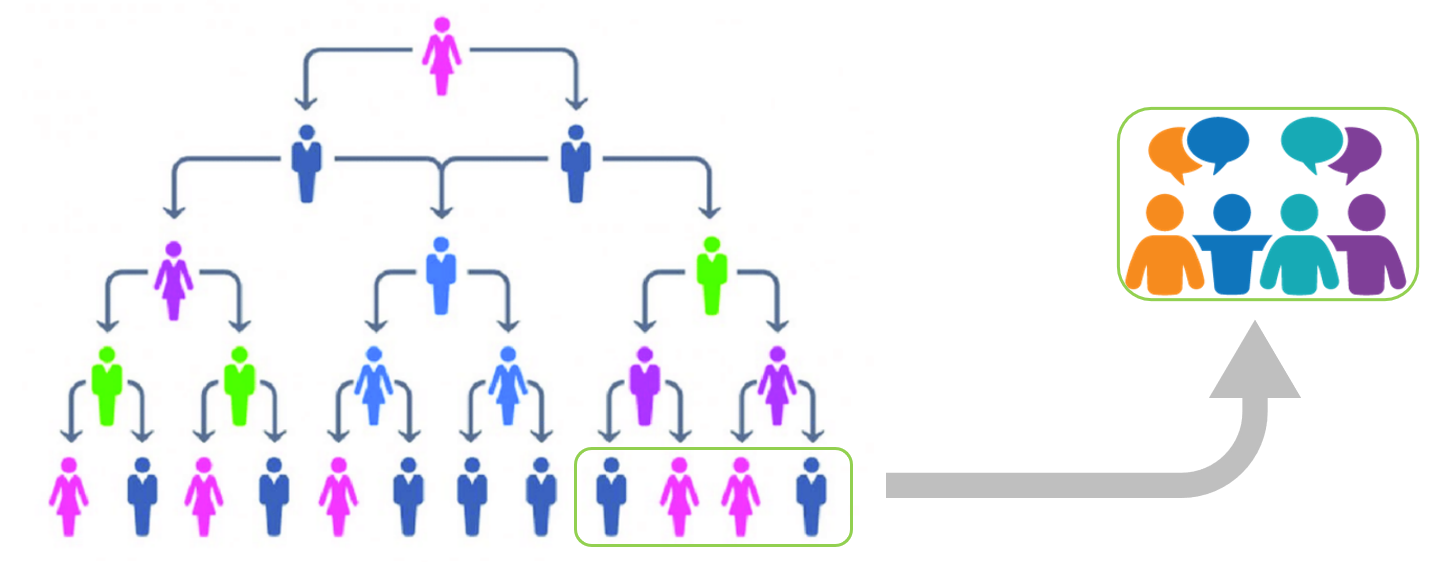
Figure 3: Formal and Collegial models combined.

Reflection (click to expand)
  • How is your leadership role / position influenced by the model your institution seems to have adopted?

As stated in the first reflection post of this series, middle leaders are often opportunistically positioned, or ‘sandwiched’, to be able to listen up, down, across or through the organisational model, in order to effectively implement, and this position could also allow middle leaders to influence and contribute to the wider goals and vision. How a middle leader capitalises on this opportunity could prove beneficial to the setting of more phase and subject-specific goals so that they positively impact change.    

Reflection (click to expand)
  • Despite your institution adopting a particular model, do you operate with a different model within your own department / team / section?
  • Would you like your institution to adopt or move toward a different educational model? If so, which one and why?

*At the time of writing this blog post, Tony Bush is a Professor of Educational Leadership at Nottingham, with responsibilities in the UK and Malaysia. He is President and a Council member of the British Educational Leadership Society (BELMAS) and has been the editor of the SSCI-listed international journal, Educational Management, Administration and Leadership (EMAL) since 2002. His previous experience includes professorial appointments at the universities of Leicester, Reading, Lincoln and Warwick. He was presented with the BELMAS Distinguished Service Award in 2008 and appointed as a Fellow of the Commonwealth Council for Educational Administration and Management (CCEAM) in the same year. He has been a consultant, external examiner, invited keynote speaker and research director in 23 countries, and has also authored a number of his own books focusing on educational leadership. 


References 

  • Bush, T. (2020) Theories of Educational Leadership and Management, London: Sage.

Frameworks for successful implementation

Who is this blog post for: Current or emerging middle leaders and for senior leaders or Headteachers who are developing middle leaders.

Author:  Stephanie Bingham

Posted on: 18th July 2023

Keywords: Implementation; coalition; evidence; team; communication 


Introduction

In our last reflection post we outlined some of the pitfalls and complexities associated with implementation and invited you to reflect upon the experiences you have had of successful and less successful implementation. We also outlined the skills which effective teachers can transfer from their teaching to their leadership, and to implementation in particular.  

In this theory post, we will outline some of the evidence on successful implementation and share some models which should help you as you consider your leadership of change.

Key aspects of successful implementation 

There are hundreds of articles and research papers exploring the different aspects of implementation relating to contexts ranging from behavioural science to business management. This reflects, as we have stated above, how complex implementation is and should reassure you that if you have struggled with making change happen, you are not alone and the reasons will also be complex.  

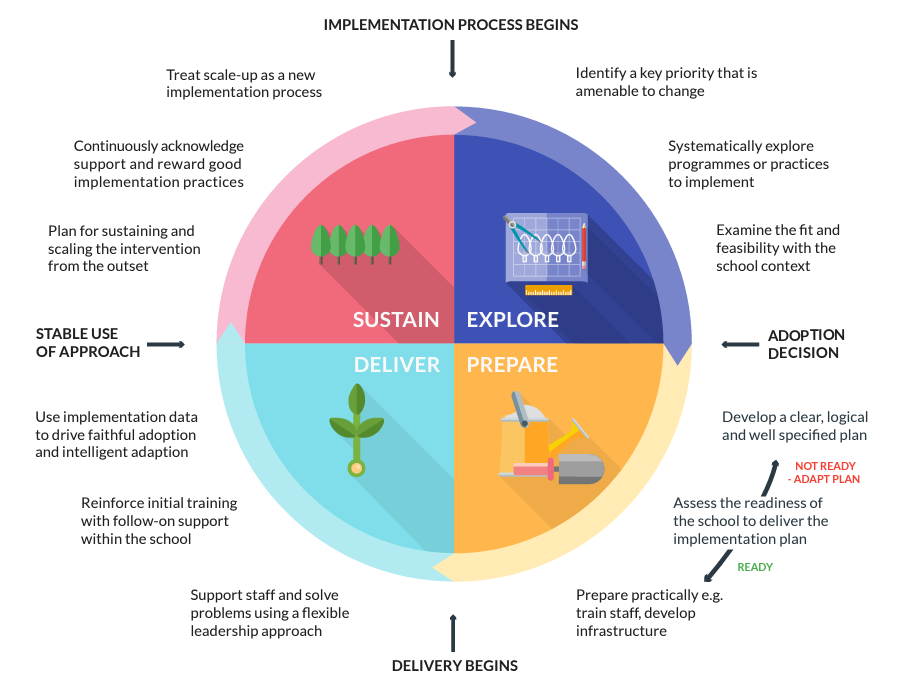
The EEF Guidance on Implementation recommends a four-stage approach to implementing change in a school: Explore, Prepare, Deliver, Sustain. This model was devised following an extensive review of the academic literature on implementation generally and in schools specifically. It provides a useful method for avoiding the pitfalls we have identified, and is a good demonstration of transferring the skills used in curriculum planning and delivery to the implementation of change within or across a school. 

The premise of the EEF report is that schools often rush at introducing new practice without carrying out adequate preparation. In it, the authors advise us to ‘treat implementation as a process, not an event; plan and execute it in stages’. Their four-stage approach, pictured above, provides a framework for planning for and embedding sustainable change which will have a lasting impact on teacher practice and student outcomes. They emphasise the importance of gathering evidence from within the setting as well as in relation to potential solutions, and of doing a significant level of preparation before starting on the change itself. This preparation is essential if the implementation is to succeed in the long term: far too many interventions in schools are short-lived due to a failure to plan beyond the initial stages. Monitoring and adjustment are key features of successful change, just as they are of effective classroom practice, and central to this is the regular gathering of data to inform decisions.

Reflection (click to expand)
  • Study the EEF model and note; a) which features have you seen used successfully? and b) which features have been missing when change has been introduced in your setting?
  • What do these observations teach you about the leadership of change in your setting?

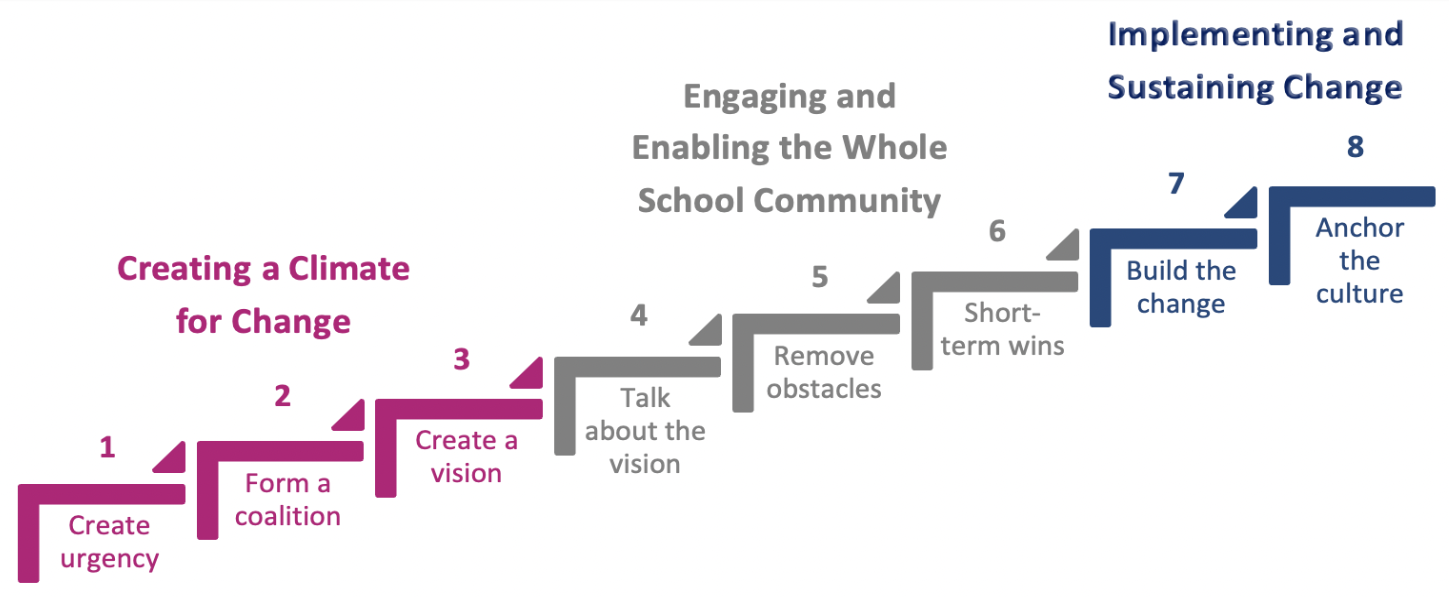
The EEF model reflects recommendations from other researchers such as John Kotter, whose 8 steps for change are pictured below: 

One of the important aspects of Kotter’s (1995) model for middle leaders to absorb is the acknowledgement that people are often one of the main barriers to successful implementation, but they are also the key to making things happen. Therefore, in addition to the research you do into the evidence for the proposed change, as stated in our reflection post on implementation it is crucial to communicate clearly and involve your team in the decision making. This is particularly the case in schools, where the majority of the workforce is likely to be working at capacity and within well-established routines and agreed practice: you will need to invest time into ‘building your coalition’. To be successful you need a group of colleagues who will assist, encourage and support the implementation of the identified change (the ‘coalition’) from the beginning – successful leadership is not about working top down or in isolation. As the plan progresses, the coalition should build and there will eventually be a more widespread enthusiasm for the change. As the EEF report stresses, it is much easier to gain support for a vision or plan if it is rooted in sound evidence and meets a known need in your school. Proposing to address the known need through an evidence-led solution is how you create what Kotter (1995) calls a ‘Sense of Urgency’: people will come with you if they identify with the need, not just the action, and if the evidence resonates with what they already know and observe in their classrooms. Note that this use of ‘urgency’ relates to the importance of the proposed change: it is different from the type of urgency alluded to in the EEF guidance and cited in the reflection post on Implementation, which equates with haste and rushing at change. 

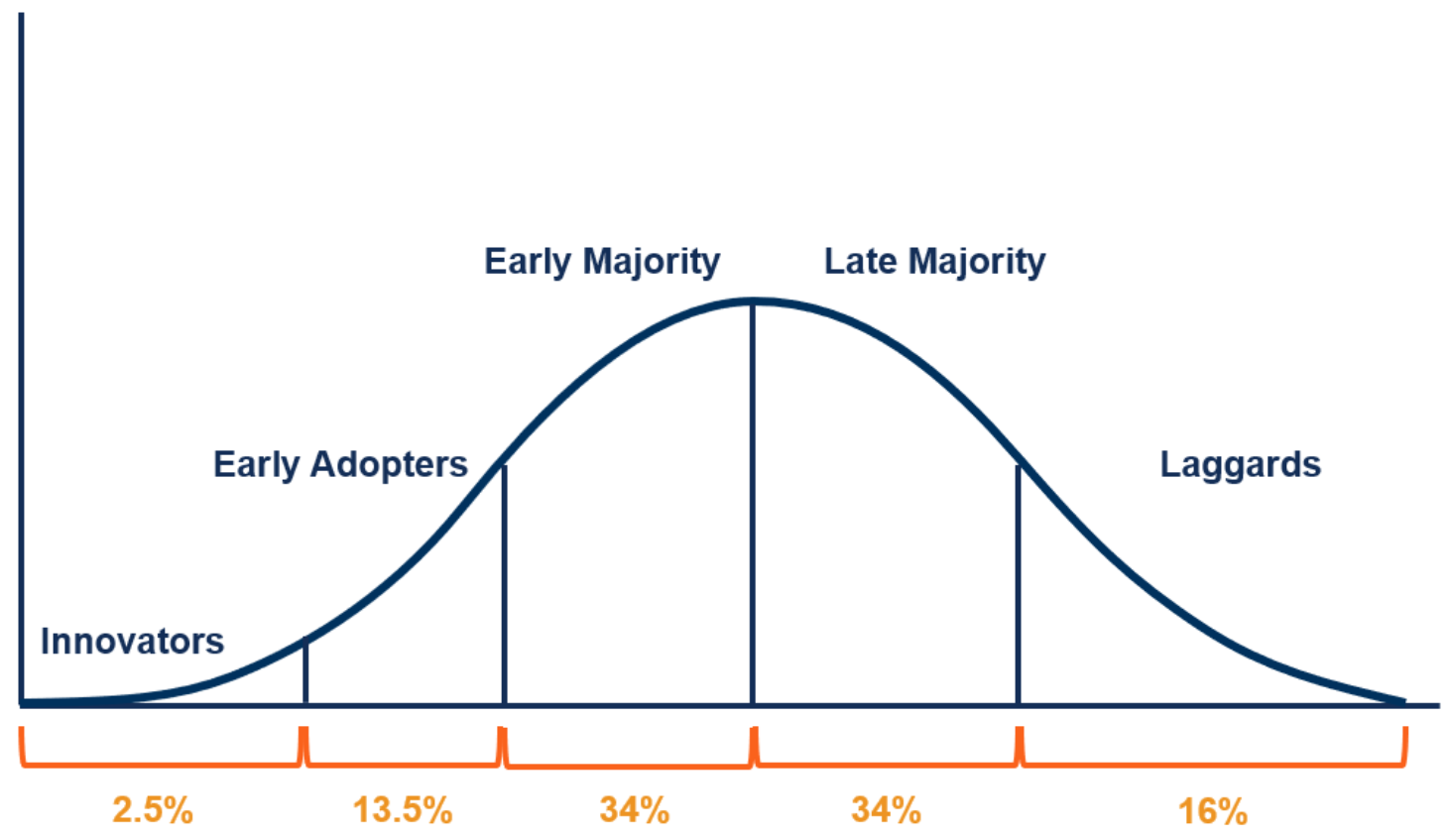
When reflecting on how to approach your team to propose a change in practice or a new intervention, Roger’s ‘Diffusion of Innovation Theory’ (1995) is worth considering. It includes a useful depiction of how quickly people are likely to adopt new ideas or practice and embed them in their own practice: 

Different people will adopt new practice or technology at different stages: knowing this in advance and factoring it into your planning will help you to succeed in embedding the change more effectively. Across our teaching and leadership journeys we have all expended so much energy trying to win over the group Roger (1995, 2003) calls the ‘laggards’, when the biggest impact is far more likely to come by working with the people on the early side of the median – your potential ‘coalition’. Both Kotter (1995) and Sharples et al. (2019) stress the need to support staff and remove barriers – sometimes this might include ignoring the few who actively or passively resist the change. 

Reflection (click to expand)
  • How familiar were you with the EEF implementation model, Kotter’s model and Roger’s curve?
  • How could either or both of these models help you to improve implementation in your role/setting?
  • Would it be beneficial for you to do further reading and or study regarding implementation?

References

  • Kotter, J. P. (2012). Leading change. Boston, Mass: Harvard Business Review.
  • Rogers, E.M. (2003) Diffusion of Innovations. Free Press, New York. 
  • Sharples, J., Albers, B., Fraser, S. and Kime, S. (2021) Putting Evidence to work: A school’s guide to implementation, Education Endowment Fund.

Selecting Goleman’s leadership styles

Who is this blog post for: Current or emerging middle leaders and for senior leaders or Headteachers who are developing middle leaders.

Author: Lisa Ramshaw

Posted on: 14th November 2023

Keywords: Emotional intelligence; leadership styles; situation-specific; toolbox.

Goleman’s Leadership Styles 

Do you play golf, enjoy cooking, or perhaps you’re handy with DIY? 

With any of those examples, you know you need to select the right club, utensil, or tool to be able to achieve the right outcome. Using leadership styles effectively works on the same principle. 

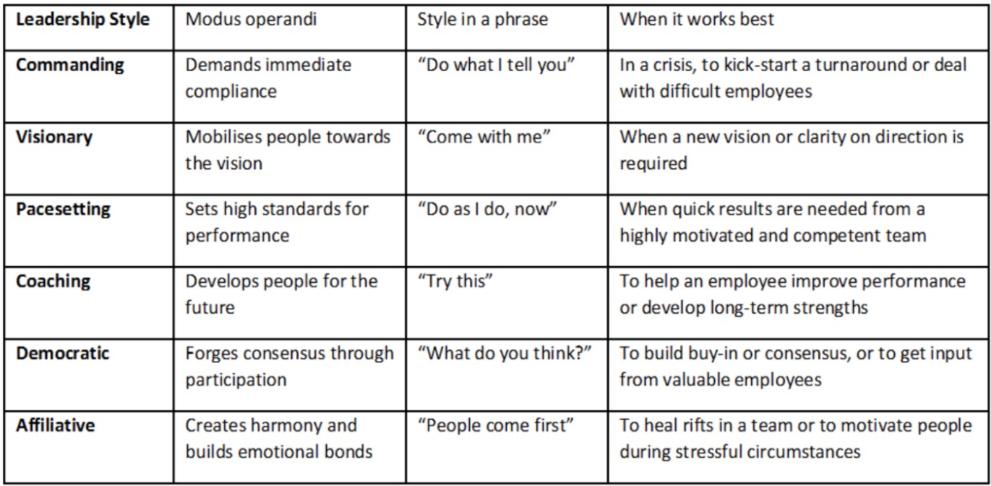
In 2000, Daniel Goleman wrote an article for the Harvard Business Review entitled ‘Leadership That Gets Results’, explaining six emotional leadership styles: Commanding (or Coercive); Visionary (or Authoritative); Pacesetting; Coaching; Democratic; and Affiliative. These are summarised in the table below.  


The article identified that the most effective leaders use a collection of leadership styles, each in the right measure, at just the right time. 

Reflection (click to expand)
  • What style do you think you use the most? Why do you think that is?
  • What style do you think you use the least? Why do you think that is?
  • What style would you like to use more of? Why?
  • Alternatively, what leadership styles have you experienced (i.e how have you been led), and how have these experiences influenced you as a leader?

Each style tends to have pros and cons, as there is no one style that is the ‘silver bullet’. However, if some styles are overused, or used to their extreme, they can be quite damaging to an individual, or to the organisational culture. Let’s take commanding style for example. If people need a top-down decision or for the leader to take charge, then this style is effective for providing confidence and direction. However, when used to try and get everyone to conform, this can create resistance, low morale, and discourage people. For that reason, commanding style is most likely used in the shorter-term, as longer-term use can create dissonance. Similarly, the pacesetting style should be used with caution. No doubt you are a middle leader because you were great at teaching, and you have shown high expectations and achievement within your career so far. Often, these high expectations and drive follow you into your leadership role and you expect everyone else to behave in the same way. However, all leaders have to learn that not everyone in their team will have the same priorities or drive as them. I know I learned this in the early stages of being a middle leader, when another teacher just burst into tears in front of me because I was making her anxious, of which I had no right to. When using the pacesetting style, ensure your team or the staff you are working with share the same values, goals and working patterns as you, so you can work together at pace. For those that may work differently, or they have different goals within their own roles, allow space and time to support their development. This may be when a more affiliative or coaching approach would be beneficial. These styles tend to develop greater harmony and longer-term professional development, respectively.  

Recently, I have created a new module that I teach at the university called the Future of Educational Leadership. Within this module, we look at megatrends from globalisation, to digitisation, to how demographics are changing, and how we need to adjust our leadership and leadership development accordingly. In Hieker and Pringle’s (2021) book, they share a study whereby MBA students undertook their own research on Goleman’s six leadership styles and asked millennial and Gen Z undergraduates which styles they preferred. They found that millennials and Gen Z found the coercive (commanding) and pacesetting leadership style the least effective, but preferred coaching to all other leadership styles (Hieker and Pringle, 2021, p. 16). Within a school environment, you are most likely working with people from a range of demographics, generations and cultures, ranging from students, to parents, to other staff, who all have their own set of expectations, preferences and needs. As a middle leader, you therefore need to always have your set of golf clubs, kitchen utensils or tools at hand, as you are required to adapt to each situation you are faced with. Being aware of a set of leadership styles was one of the best learning moments for me as a leader, as I was able to ‘choose’ how I responded (rather than reacted) to whatever the day brought.  

As stated in the previous reflection post, middle leaders move into their leadership role directly from teaching, often without acknowledgement of the different skills that are required for the role. Self-awareness is crucial here: in the busyness of a middle leadership role, it is important to engage in conscious self-reflection. Now that you have some knowledge of Goleman’s six leadership styles, I encourage you to be consciously aware when selecting a leadership style for a particular situation, and decide what right club, utensil, or tool would be the best to use. Then consciously reflect on whether it was the appropriate leadership style for that situation. If you keep doing that on a regular basis, you will be able to develop your own leadership repertoire, applying your leadership skills and styles more appropriately, and more often. 

Reflection (click to expand)
  • Consider a recent situation that you thought you handled well. What leadership style did you employ? How do you know it was the right one for that situation?
  • Now, consider a recent situation that did not go well. What leadership style did you employ? How do you know it was not the right one for that situation? What style would you employ should the situation arise again

References:

  • Hieker, C. and Pringle, J. (2021) The Future of Leadership Development: Disruption and the Impact of Megatrends. Springer Nature. 
  • Goleman. D. (2000) Leadership that gets Results. In Harvard business review, 78 (2), pp. 78–90. Harvard Business School Publishing Corporation. 
  • Pellitteri, J. (2021) Emotional Intelligence and Leadership Styles in Education. Psychology & its Contexts/Psychologie a Její Kontexty, 12(2).