New paper on the amplification of magnetic fields in collapsing clouds
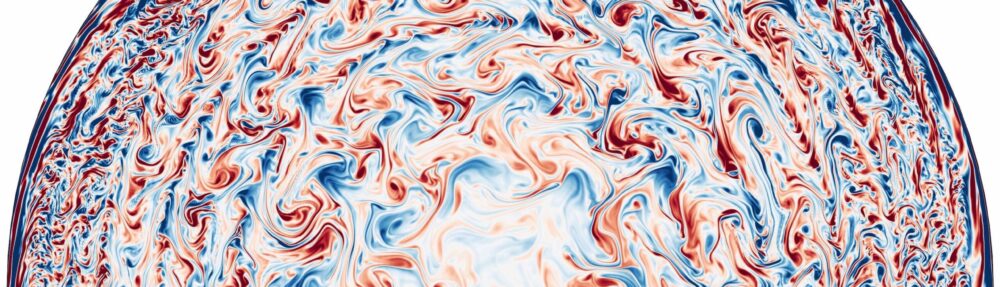
A new study on turbulent dynamos in a collapsing cloud co-authored by Anvar Shukurov has recently been published in Physical Review Letters. Anvar and his co-authors have discovered a powerful mechanism that could explain how early galaxies became as strongly magnetized as our own Milky Way during their formation. Existing theory for magnetic amplification called the turbulent dynamo theory, developed for a stationary environment, suggests that the emergence of strong, ordered magnetic fields in a turbulent plasma takes several billions of years. The research shows that during the violent gravitational collapse that forms stars and galaxies, the rapid shrinking of gas clouds acts as a massive energy injector. As the cloud collapses, the decreasing length scale and increasing speed lead to faster rotation of vortices in the flow. This reduction in the dynamical timescale accelerates the turbulent dynamo, allowing magnetic fields to reach a significant strength by the birth of these cosmic structures. This discovery provides fundamentally new opportunities to explain the magnetization observed in very young, distant galaxies.
Abstract
The amplification of magnetic fields is crucial for understanding the observed magnetization of stars and galaxies. Turbulent dynamo is the primary mechanism responsible for that but the understanding of its action in a collapsing environment is still rudimentary and relies on limited numerical experiments. We develop an analytical framework and perform numerical simulations to investigate the behavior of small-scale and large-scale dynamos in a collapsing turbulent cloud. This approach is also applicable to expanding environments and facilitates the application of standard dynamo theory to evolving systems. Using a supercomoving formulation of the magnetohydrodynamic (MHD) equations, we demonstrate that dynamo action in a collapsing background leads to a super-exponential growth of magnetic fields in time, significantly faster than the exponential growth seen in stationary turbulence. The enhancement is mainly due to the increasing eddy turnover rate during the collapse, which boosts the instantaneous growth rate of the dynamo. We also show that the scaling of final saturated magnetic field strength with density robustly exceeds the expectation from considerations of pure flux-freezing. Apart from establishing a formal framework for studying magnetic field evolution in collapsing (or expanding) turbulent plasmas, these findings suggest that during star and galaxy formation magnetic fields can become dynamically relevant much earlier than previously thought.
January 2026
New paper on the zonal flows in giant planets
Chris Jones has recently published a paper in Physical Review Fluids in collaboration with Laura Currie (Durham). The paper studies the attenuation of zonal flows with depth with applications to Jupiter.
Abstract
A mechanism by which the surface zonal flows of giant planets can be gradually attenuated with depth is explored. The zonal flow is driven by an imposed forcing in a thin layer near the surface. A meridional circulation is set up, analogous to the Ferrel-like cells observed in Jupiter’s atmosphere. Acting on a stably stratified thin surface layer, the meridional flow induces a horizontal temperature anomaly which leads to a gradual reduction of the zonal winds with depth, governed by the thermal wind equation. Our model is a Boussinesq plane layer, with gravity acting parallel to the rotation axis. A suite of fully three-dimensional time-dependent numerical simulations has been performed to investigate the model behavior. Below the forced stable layer, convection is occurring, typically in the form of tall thin cells. The fluctuating components of the three-dimensional flow can be driven by either the convection or the Reynolds stresses associated with the jet shear flow. When fluctuations are mainly driven by convection in the form of tall thin columns and the forcing is relatively weak, the horizontal temperature anomaly persists much deeper into the interior than when it is driven by shear flow. The zonal jets can therefore extend deep into the interior, consistent with the Juno gravity data.
Oct 2025
Postdoc opportunity in the group
Toby Wood and Paul Bushby are advertising a 3-year postdoctoral research position to work on the STFC-funded project “A solar-like dynamo driven by magnetic buoyancy”. The deadline for application is June 12, 2025.
Apr 2025
Postdoc opportunity in the group
Tami Rogers is advertising a 3-year postdoctoral research position to work on a STFC-funded project on stellar astrophysics. The deadline for application is July 1st, 2025.
Apr 2025
STFC grant success
The group has been awarded three grants in the STFC Small Award scheme to work on double-diffusive convection in planetary cores (project lead: Guervilly; project co-lead: Sarson), solar-like dynamos driven by magnetic buoyancy (project lead: Wood; project co-lead: Bushby), and magnetism in core convecting stars (project lead: Rogers).
Apr 2025
ICTW2025
Céline Guervilly is co-organising the 23rd International Couette-Taylor Workshop (ICTW2025) with colleagues from Durham, Northumbria, and Newcastle Universities. The workshop will take place at Durham University on 14-16 July 2025.
Apr 2025
New paper on the dominant length scale of rapidly-rotating convection
Céline Guervilly has recently published a paper in Geophysical Research Letters in collaboration with Emmanuel Dormy (ENS/CNRS, Paris). The paper looks at the transition from viscously-dominated to inertia-dominated rotating convection in numerical simulations using spherical and planar geometries.
Abstract
Convection is the main heat transport mechanism in the Earth’s liquid core and is thought to power the dynamo that generates the geomagnetic field. Core convection is strongly constrained by rotation while being turbulent. Given the difficulty in modeling these conditions, some key properties of core convection are still debated, including the dominant energy-carrying lengthscale. Different regimes of rapidly rotating, unmagnetized, turbulent convection exist depending on the importance of viscous and inertial forces in the dynamics, and hence different theoretical predictions for the dominant flow lengthscale have been proposed. Here we study the transition from viscously dominated to inertia-dominated regimes using numerical simulations in spherical and planar geometries. We find that the cross-over occurs when the inertial lengthscale approximately equals the viscous lengthscale. This suggests that core convection in the absence of magnetic fields is dominated by the inertial scale, which is hundred times larger than the viscous scale.
Apr 2025
New paper on reversals in geodynamo simulations
Chris Jones and Yue-Kin Tsang have recently published a paper in Physics of the Earth and Planetary Interiors on the polarity reversals of magnetic fields in geodynamo simulations with low inertia.
Abstract
Convection driven geodynamo models in rotating spherical geometry have regimes in which reversals occur. However, reversing dynamo models are usually found in regimes where the kinetic and magnetic energy is comparable, so that inertia is playing a significant role in the core dynamics. In the Earth’s core, the Rossby number is very small, and the magnetic energy is much larger than the kinetic energy. Here we investigate dynamo models in the strong-field regime, where magnetic forces have a significant effect on convection. In the core, the strong field is achieved by having the magnetic Prandtl number Pm small, but the Ekman number E extremely small. In simulations, very small E is not possible, but the strong-field regime can be reached by increasing Pm. However, if Pm is raised while the fluid Prandtl number Pr is fixed at unity, the most common choice, the Péclet number becomes small, so that the linear terms in the heat (or composition) equation dominate, which is also far from Earth-like behaviour. Here we increase Pr and Pm together, so that nonlinearity is important in the heat equation and the dynamo is strong-field. We find that Earth-like reversals are possible at numerically achievable parameter values, and the simulations have Earth-like magnetic fields away from the times at which it reverses. The magnetic energy is much greater than the kinetic energy except close to the reversal times.
Jan 2025
New paper on magnetic buoyancy in the solar tachocline
A new study led by former postdoc Craig Duguid in collaboration with Paul Bushby and Toby Wood has been published in MNRAS. The paper looks at shear-driven buoyancy in the solar tachocline.
Abstract
The details of the dynamo process that is responsible for driving the solar magnetic activity cycle are still not fully understood. In particular, whilst differential rotation provides a plausible mechanism for the regeneration of the toroidal (azimuthal) component of the large-scale magnetic field, there is ongoing debate regarding the process that is responsible for regenerating the Sun’s large-scale poloidal field. Our aim is to demonstrate that magnetic buoyancy, in the presence of rotation, is capable of producing the necessary regenerative effect. Building upon our previous work, we carry out numerical simulations of a local Cartesian model of the tachocline, consisting of a rotating, fully compressible, electrically conducting fluid with a forced shear flow. An initially weak, vertical magnetic field is sheared into a strong, horizontal magnetic layer that becomes subject to magnetic buoyancy instability. By increasing the Prandtl number we lessen the back reaction of the Lorentz force onto the shear flow, maintaining stronger shear and a more intense magnetic layer. This in turn leads to a more vigorous instability and a much stronger mean electromotive force, which has the potential to significantly influence the evolution of the mean magnetic field. These results are only weakly dependent upon the inclination of the rotation vector, i.e. the latitude of the local Cartesian model. Although further work is needed to confirm this, these results suggest that magnetic buoyancy in the tachocline is a viable poloidal field regeneration mechanism for the solar dynamo.
Oct 2024
Geophysical and Astrophysical Fluids and Dynamos Meeting
Graeme Sarson is co-organising the Geophysical and Astrophysical Fluids and Dynamos meeting at the University of Leeds in September 2024. The meeting is a celebration of the 75th birthday of Professor Chris Jones, who has made many outstanding contributions to GAFD and dynamo theory.
Sept 2024
New paper on the tearing instability
A new study led by Scott Hopper in collaboration with supervisors Toby Wood and Paul Bushby has been published in the Journal of Fluid Mechanics. The paper looks at the effects of stratification on the tearing instability and discuss the application to the solar tachocline.
Abstract
Resistive tearing instabilities are common in fluids that are highly electrically conductive and carry strong currents. We determine the effect of stable stratification on the tearing instability under the Boussinesq approximation. Our results generalise previous work that considered only specific parameter regimes, and we show that the length scale of the fastest growing mode depends non-monotonically on the stratification strength. We confirm our analytical results by solving the linearised equations numerically, and we discuss whether the instability could operate in the solar tachocline.
Aug 2024
New paper on the geomagnetic secular variation
Yue-Kin Tsang has recently published a paper in Geophysical Journal International on the timescale of the secular variation of Earth’s magnetic field in collaboration with Chris Jones (Leeds). The study looks at the time variation of the magnetic field in geodynamo simulations and whether measurements at the core-mantle boundary are representative of the dynamo inside the outer core.
July 2024
BAMC 2024
We are co-organising the British Applied Mathematics Colloquium (BAMC) at Newcastle in April 2024 in collaboration with the cosmology, quantum and mathematics of life and environmental science groups in the School (committee chair: Magda Carr).
Apr 2024
AMS80 conference
We are organising the “Mathematical Aspects of Geophysical and Astrophysical Fluid Dynamics” conference at Newcastle in January 2024 (committee chair: Paul Bushby). The conference celebrates the 80th birthday of Professor Andrew Soward FRS.
Jan 2024
PhD viva success!
Congratulations to John Moss, who successfully defended his PhD thesis. John’s thesis, on “Sound-proof models for magnetic buoyancy”, was supervised by Toby Wood and Paul Bushby. The examiners were David Hughes from the University of Leeds and Graeme Sarson (internal).
Dec 2023
PhD viva success!
Congratulations to Ryan Newman, who successfully defended his PhD thesis on “Geostrophic adjustment within a stratified fluid”. Ryan was supervised by Magda Carr, Andrew Aspden and Andrew Willmott. The examiners were Ted Johnson (UCL) and Céline Guervilly (internal).
Nov 2023
PhD viva success!
Congratulations to Sam Hartharn-Evans, who successfully defended his PhD thesis on “Experimental and Numerical Modelling of Boundary Effects on Internal Solitary Waves” supervised by Magda Carr. The examiners were Rob Hall (UEA), Dan Ratliffe (Northumbria) and Carlo Barenghi (internal).
Nov 2023