At a basic level, the current housing crisis represents short supply: insufficient homes of the right kind, in the right place, at the right price. But if we look beyond the ‘monitor and manage’ assessment of housing stock, to consider ‘how and where’ people live in relation to others and their local environment, it is clear that the current crisis far exceeds what is usually debated as the ‘housing question’. For those, like me, who reject what mainstream market models have to offer, there is growing optimism that civic groups are uniquely equipped to imagine and realise more ‘neighbourly neighbourhoods’ that embrace novel low-impact, collective and democratic alternatives. This is evident in the way that renewed interest in community-led housing directly engages with integrated aspects of social, economic and environmental sustainability: housing is viewed as a function of wellbeing and waste-reduction in situations where participatory practices challenge isolated cultures of privatised consumption.
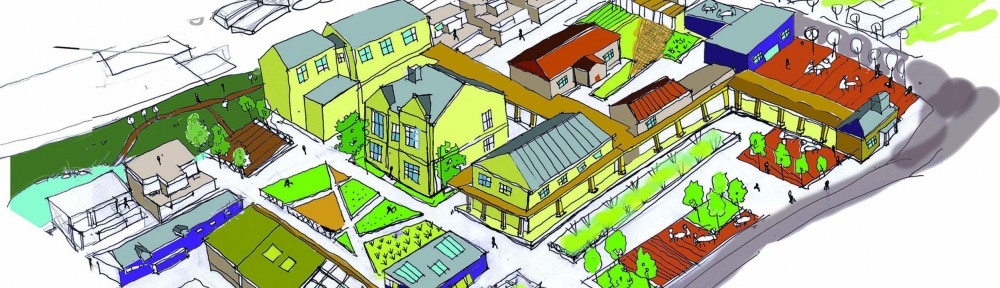
I am personally inspired by cohousing as a pragmatic approach to neighbourhood scale collaborative housing. The concept derives from Danish boflesskab (living-togetherness) and Swedish kollektivhus (collective housing) dating from the late 1960s but it captures the enduring ideals of a much longer communal imagination. In absolute terms, completed resident-led cohousing schemes are few in number (accommodating an estimated 9.5 thousand households in the USA; fewer than 500 in the UK), yet estimates of ‘forming’ groups suggest considerable unmet demand. A recent map of Kollektivhus in Sweden (shown below) indicates the potential ‘normalisation’ of cohousing when resident groups are able to form mutually beneficial alliances with non-profit housing providers. The defining features of cohousing include the clustering of smaller-than-average private residences; extensive shared outdoor space; common facilities for shared daily use; and consensus-based collective self-governance. Project construction can be resident led, developer led, or joint venture, but all projects typically adopt a process of participatory co-design. Typical clustering is illustrated below in North American cohousing.
The most exciting social and environmental gains arise in cohousing from a ‘soft infrastructure’ of sharing that would not routinely surface or be supported in a conventional street of private dwellings. This argument is made by Jarvis and Bonnett (2013) through a comparison of different forms of village-like housing and community arrangement. Straightforward examples of ‘saving space and sharing time’ include collectively owned and maintained domestic appliances, DIY and garden tools, and the routine ‘free-cycling’ of bulky household items (as illustrated below). In cohousing the aim is to strip all nonessential or infrequent space (and energy) uses out of the individual dwelling. Significantly, the way that space and amenities are collectively designed and managed routinely establishes social interactions and trust that rest with and replenish a shared mental outlook that is essential to this degree of sharing. This is best illustrated in the way cohousing neighbours regularly sit down to eat meals that they prepare and eat together in the common house. A flavour of the complex socio-spatial relations involved in collective living is provided by Richard Sennett (2012, x) who argues in his book Together that collaboration is a craft that ‘requires of people the skill of understanding and responding to one another in order to act together’.
Dr. Helen Jarvis
School of Geography, Politics and Sociology, Newcastle University UK
http://www.ncl.ac.uk/gps/staff/profile/helen.jarvis
http://experimentsincommunity.wordpress.com
Twitter @Communityvita
Download Jarvis, H. and Bonnett, A. (2013) Progressive Nostalgia in Novel Living Arrangements: A Counterpoint to Neo-traditional New Urbanism? Urban Studies, 50, 11, pp: 2349-2370