All posts by Kate Egraine

Doctor Faustus (1588-1592)

Key Themes: play-text versus performance; The Rose playhouse; forbidden knowledge

Studying Doctor Faustus has prompted me to re-examine how much agency we should give to a play-text. Until this week, I have felt like these texts are ‘finished’ in the same way that novels or poems are. However, the disparity between the A-text and the B-text of Doctor Faustus has heightened my awareness of the temporality of theatrical performance where what is captured on the page of the play-text can only be a benchmark for what is enacted on-stage. Plays exist only in the moment that they are performed, so play-texts can only try and capture these moments that are designed to be experienced, not read. If the text is merely a starting framework for performance as a necessarily collaborative art form, then there is no such thing as a ‘finished’ play-text. On reflection, I think this is a good thing because it encourages individual interpretation that leads to more varied productions through the creative freedom it inspires which, in turn, will provide us with a more comprehensive production history of Faustus to draw from, giving us different ways of examining his character.

Although the A-text (performed in the later 1580s at the Rose playhouse) may be closer to Marlowe’s own vision for the play, the later B-text of 1602 is an invaluable addition because it contributes to a kaleidoscopic image of Faustus’ character in performance, paving the way for other creatives to examine his character through a different lens. The result would be a wealth of material to draw from which, side by side, a comprehensive study of Faustus which is at once sympathetic and condemnable, fated to sin yet alluringly redeemable, spirit and human, would be amalgamated to reflect his complexity.

In light of these reflections, I have produced a design for the painted cloths that were typically used to adorn The Rose playhouse stage. Typically, they were decorated with biblical, mythological, or allegorical scenes, shaping the audience’s interpretation of the play by visually depicting its central themes (00:09:59-00:10:12) [1]. The Globe’s 2016 production of Doctor Faustus uses the central tapestry to depict the goddess Fortuna, her wheel of fortune acting as the symbol of the B-text’s Calvinist insistence on Faustus’ immutable, fated damnation [2]:
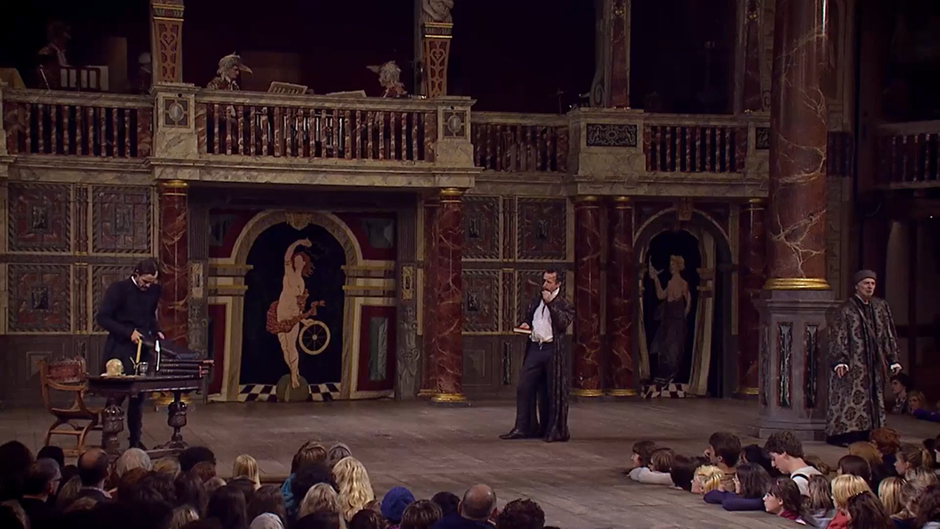
Still taken from 00:09:48.

For my tapestry design, I have chosen to depict the myth of Prometheus:
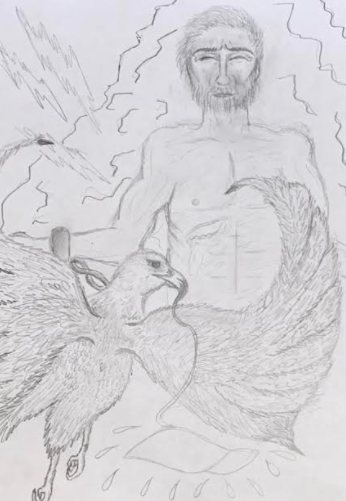
By anticipating many further ‘conflated’ productions of Faustus that merge the A and B texts, my tapestry accommodates a ‘liminal’ Faustus who is at once both a figure of pity and damnation. Like Faustus, Prometheus is a multifaceted scholar: on the one hand, he steals fire from the gods to create life, betraying them, but on the other, he shares his superpower with humankind. Whilst his betrayal of the gods to seek forbidden knowledge seals his fate, whether Prometheus is a martyr or a traitor is up to us – an association that, through this tapestry, the audience of Faustus would be interrogated with and demanded to answer according to their own interpretation of Faustus.

[1] Clegg, Roger and Eric Tatham. “4. The Rose playhouse, Phase 1 (1587-1591/2).” Reconstructing the Rose: 3D Computer Modelling Philip Henslowe’s Playhouse. De Montfort University, 2019, <https://reconstructingtherose.tome.press/chapter/the-rose-playhouse-phase-i-1587-1591-2/>[last accessed 23/03/22].

[2] Marlowe Christopher. “Doctor Faustus”, Globe on Screen, Shakespeare’s Globe on Screen (2008-2015). Drama Online. <https://www.dramaonlinelibrary.com/video?docid=do-9781350996786&tocid=do-9781350996786_4598127137001> [last accessed 23/03/22].
The Croxton Play of the Sacrament (1491)

Key themes: transubstantiation; stage violence versus real violence; crucifixion tableau; production and staging.

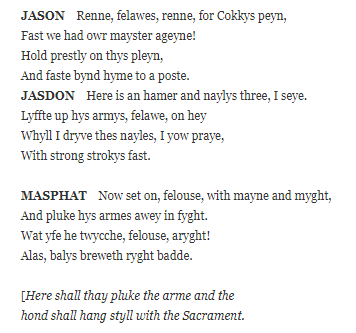
I think that we studied this play because its use of transubstantiation blurs the boundaries between acting and reality. I have learnt that the transubstantiation of the host would hold the same significance for both the world of (an increasingly Christian) audience after the Edict of Expulsion in 1290, and the world of the play itself. In both the audience’s reality and the play’s representation of its own reality, only the appearance of bread remains after the host has been consecrated as transubstantiation relies on the complete conviction that the bread has been converted into the body and blood of Christ. Therefore, the real and unreal blur in this unique scenario where theatricality relies on illusions that transubstantiation refuses. Where the host-as-prop holds an immutable significance in the audience’s reality, the actors’ staged reality demands a suspension of these beliefs. There is a problematic assertion of actual violence on the consecrated body of Christ through the staged violence on this particular ‘prop’. An example of such violence can be found in the tableau of the crucifixion between lines 504-516 where the host, attached to Jonathas’ hand, is nailed to a post [1]:

(Sebastian 504-516)

The text does not make it immediately evident how “a poste” becomes available on-stage for Jonathas to nail the host to, neither does it describe the effort to pull Jonathas free.

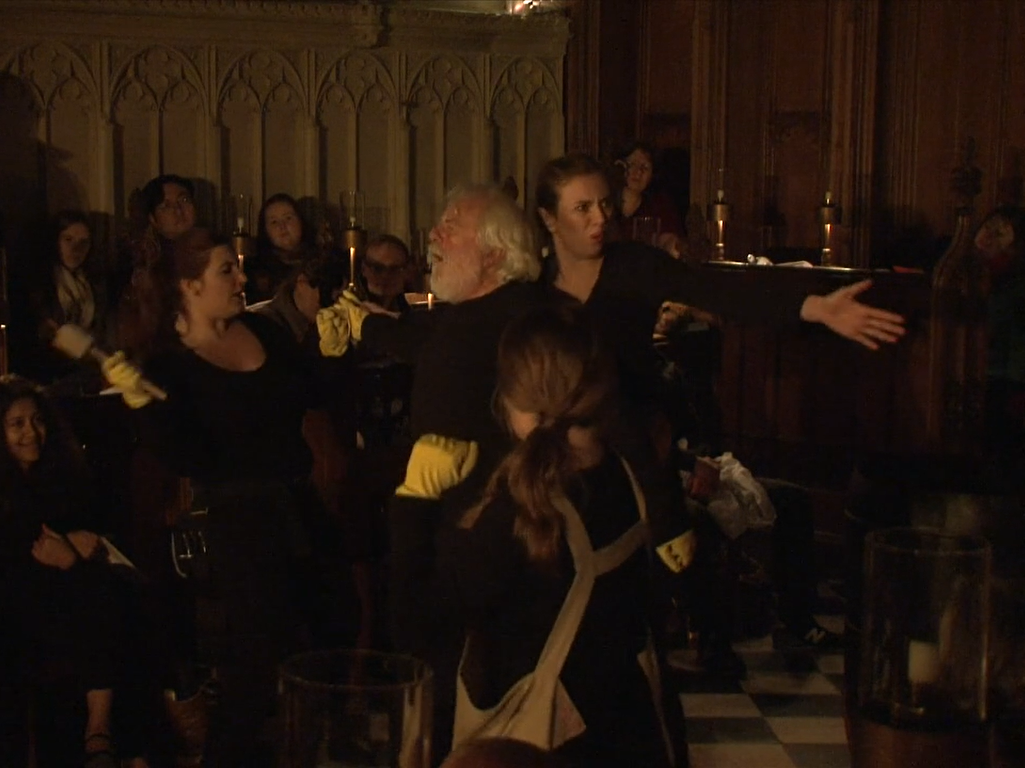
The Oxford production (2013), directed by Elisabeth Dutton, staged this tableau by ‘nailing’ the false hand to another character’s hand [2]. This allows whichever actor that is chosen to supplement the dismemberment of Jonathas’ hand to also use their body to signify the crucifix:

Still taken from 00:21:16

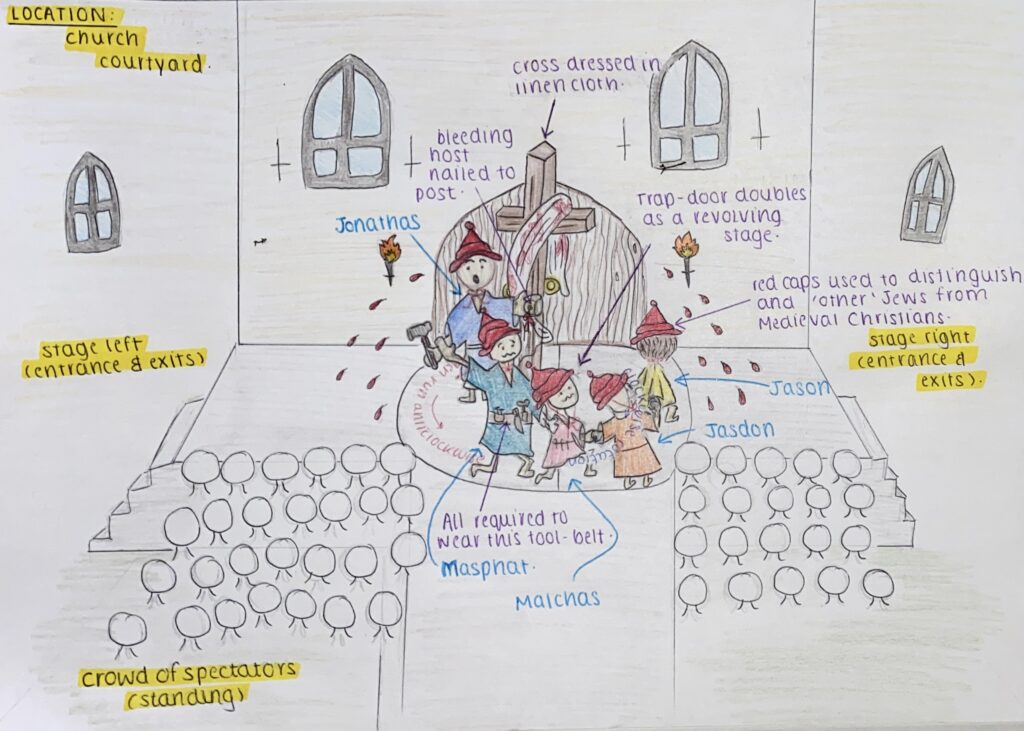
I would stage this tableau slightly differently. I like the Oxford production’s use of a religious space for the set. However, I would install a stage in a Church courtyard to maintain the outdoor tradition of plaice and scaffold theatre whilst also preserving the impression that a Christian space has been infiltrated.

I would also have the audience standing so that there is a collusion between Jonathas, Masphat, Malchus, Jasdon, Jason, and the audience. The ability of the audience to practically be on-stage themselves, whilst the actors also have the ability to enter from within the crowd of spectators and frequently re-join them, provides ample opportunity for audience interaction with the actors. This introduces the opportunity to create the illusion that they, too, have conspired to produce what happens on-stage.

I would propose that there is a trap door incorporated into a revolving stage. A crucifix stands in for the post and will ascend through the trap doors in parts that the team on-stage will assemble in front of the audience with the toolbelts that they wear. A cloth soaked in the blood of the host from the previous action will be draped over, to make the symbolism immediately clear. My concept for this piece follows:

A revolving stage with a runway would also be used to exploit the potential of this scene’s physicality where Jonathas would be pulled anti-clockwise, against the turn of the revolving stage to emphasise the force with which his body is tugged, shaping attention around the power of Christ and the cross to combat their strength. The actors could also make use of the stage space by flinging their bodies down the runway to complement the exertion of their strength on the fake hand.

I think the only way to resolve this difficulty of the play’s violence is to emphasise how the priest sanctifies the host before the play begins: the unperceived pre-history of the object can then introduce doubt as to whether this host in particular is the true embodiment of Christ or a ‘sanctified’ stage-Christ.

[1] Sebastian, John, editor. Croxton Play of the Sacrament. Medieval Institute Publications, 2012, https://d.lib.rochester.edu/teams/publication/sebastian-croxton-play-of-the-sacrament, Accessed 23 May 2022.

[2] Dutton, Elisabeth, dir. The Croxton Play of the Sacrament, Oxford, 2013.