Figure of Eight – or an Infinity Sign?

A corridor runs from my office – an open plan that holds up to 18 people – in the north east corner of the building all the way to the south east corner, ending at the door to the larger open plan office there.  And in that corridor I encountered a man with a mop and his supervisor who was teaching him.  She was telling him how to clean the tiled corridor floor most effectively and efficiently, “sweep the mop around in a figure of eight…” and encouraging him, “… that’s right…”  And his mop looped back and forth, overlapping, looping and repeating.

If I was making a spy movie… If I wanted to place a team in a corridor for a week, this kind of team would be the ideal cover because everyone just walks past the cleaner.  Even those of us who would usually stop to say hi, will not interrupt a “training session”.

But back to the mop that was looping on the floor in front of the man, the infinity sign which was not a figure of eight.

We can all mop.  My boys mop the floor of the church hall where they attend karate, before the lesson starts.  My husband and a friend mop the floor of the community centre before dancing starts every Wednesday.  They do it without training and I do wonder whether an efficient mopping pattern spontaneously arises or whether it is best taught?

My youngest son has been mopping floors on and off for some years.  There is something about the splashing that he likes.  For a long time I had to repeat the job after he had finished – I called it drying but really it was re-doing.  He resisted any training.  He probably felt that he was doing what he had seen done, that he was doing it correctly and therefore he had no further interest in doing the job any better or best.  He wanted to play with water and mop and bucket and floor.

Back to the trainee in the corridor. He was watched and given the direct line into how to do the job best.  A few days later I saw him receive training on the correct use of a vacuum cleaner for cleaning this long shiny dark grey corridor, which is also used by people attending talks and courses in the large meeting room.

Is training needed?  Does training remove creativity and novelty?  Is there any space left for doing a job that is nourishing to our humanity if all the variability has been trained out like a large hot steam iron?

I am not sure what the answer is because I like a clean floor, and I dislike stickiness underfoot. But surely there is not only one way to achieve a clean floor.  And in the infinite number or correct answer there will be more than one best way.
 

Proving the Concept

When I was baking bread; when I had mixed the flour and oil and water and salt and yeast and after kneading it I would leave the dough to rise, and I would refer to leaving the dough to prove.  Years later I discovered that it’s not the dough that proves.  Home bakers used to buy their yeast from shop bakers but you would not know that the yeast was alive and would work until it had been kneaded into the flour and the bread was rising.  When the dough rises, the yeast is proven.

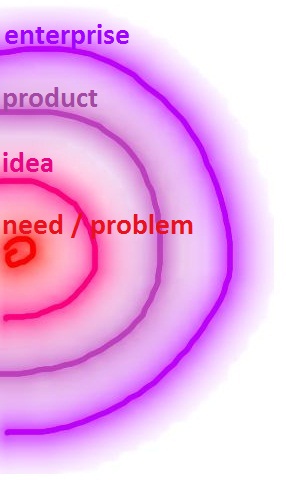
If I have an idea for a business or a social enterprise, how do I prove the idea?  Is it in fact the idea that allows the business to rise and grow?  This would be a poorly constructed blog if that were the case.  The idea fits into the business and they won’t work by themselves.  The idea becomes a product and the product or service is offered to people.  How do I have cool ideas?  Ideas come from problems or needs.

Need fits into idea, Idea fits into product and product fits into enterprise.

So if you bring me a product and say that you want to set up a business to sell this product I will ask you to think inward and describe the unmet need, talk through the problem that you are solving.  Starting from the product outward with market research for instance, puts the cart before coffee.

Pour a cup and pull up a chair.

Is the product based on something that people really need?  You may be spot on but maybe you are not.

There is an instinct involved here which you either have developed or can develop.  What does that instinct do?  That instinct notices that someone somewhere needs something, that there is an unsolved problem, an unmet need.  People are thirsty when out walking the hills. People doing workshops need to put pictures on walls and move them around and easily tidy up when they leave.  Staff working in emergency wards need to not prick themselves with sharp needles.  They need a cure for throat cancer.

The questing for an unmet need is most effective is when it is combined with knowhow.  I know how to bottle water or make bottles of juice drink or I have a friend who has just tested and capped a mineral water source on his hillside property.  I have a hobby in metal work or I did a holiday job in a plastics factory or I am a medical sciences postdoc who knows what the latest research can allow us to do.

In fact, paying attention to the problems that occur where you play, or volunteer, where you do your hobbies can be very fruitful.  You know how these places operate.

If the business rises and thrives then you know that the need was alive.