All posts by Lucille

Proving the Concept

When I was baking bread; when I had mixed the flour and oil and water and salt and yeast and after kneading it I would leave the dough to rise, and I would refer to leaving the dough to prove.  Years later I discovered that it’s not the dough that proves.  Home bakers used to buy their yeast from shop bakers but you would not know that the yeast was alive and would work until it had been kneaded into the flour and the bread was rising.  When the dough rises, the yeast is proven.
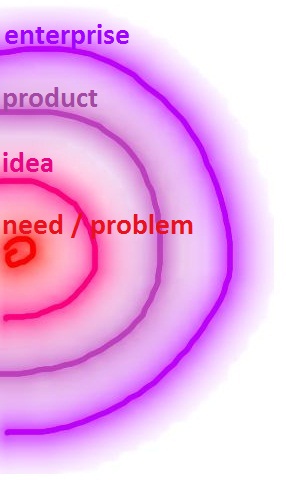
If I have an idea for a business or a social enterprise, how do I prove the idea?  Is it in fact the idea that allows the business to rise and grow?  This would be a poorly constructed blog if that were the case.  The idea fits into the business and they won’t work by themselves.  The idea becomes a product and the product or service is offered to people.  How do I have cool ideas?  Ideas come from problems or needs.

Need fits into idea, Idea fits into product and product fits into enterprise.

So if you bring me a product and say that you want to set up a business to sell this product I will ask you to think inward and describe the unmet need, talk through the problem that you are solving.  Starting from the product outward with market research for instance, puts the cart before coffee.

Pour a cup and pull up a chair.

Is the product based on something that people really need?  You may be spot on but maybe you are not.

There is an instinct involved here which you either have developed or can develop.  What does that instinct do?  That instinct notices that someone somewhere needs something, that there is an unsolved problem, an unmet need.  People are thirsty when out walking the hills. People doing workshops need to put pictures on walls and move them around and easily tidy up when they leave.  Staff working in emergency wards need to not prick themselves with sharp needles.  They need a cure for throat cancer.

The questing for an unmet need is most effective is when it is combined with knowhow.  I know how to bottle water or make bottles of juice drink or I have a friend who has just tested and capped a mineral water source on his hillside property.  I have a hobby in metal work or I did a holiday job in a plastics factory or I am a medical sciences postdoc who knows what the latest research can allow us to do.

In fact, paying attention to the problems that occur where you play, or volunteer, where you do your hobbies can be very fruitful.  You know how these places operate.

If the business rises and thrives then you know that the need was alive.

Entrepreneurs need to express character

BioBusiness and Beyond…. Roger Vaughan talking to Ian Shott CBE

paraphrased by me during the question and answer phase

Ian Shott CBE went from working at the international level for big chemical companies to taking over a spinout which he built up and sold.  He took companies tiptoeing on the edge of disaster and worked with them to strengthen governance, identify what is going well and do more of it.  These companies were returned to profitability and better, this was done without jobs being lost.  He currently advises the government and works on the board of the TSB and is a fellow of the Royal Academy of Engineering.  He is also involved with a double handful of companies in the fields of industrial biotech, pharmaceuticals/medtech, chemicals/materials, companies who came to him to assist them, to accelerate them into strong growth.  There is a one year old start-up, there are companies in the 10 year old sweet spot and there are companies in the more mature phase of their lives and they are in the.

When a company is on the brink of collapse nobody argues about whether change is needed.  Everyone is on board for change.

Of the 450 venture capitalists out there in the UK only 50 really venture anything.

We are moving toward a more balanced economy in the UK with more making and manufacturing going on, and government recognition or encouragement of this.

Entrepreneurs need to express character

Judgement – which is developed through using it.

Thoughtfulness –think about what you do and insert processes that support this

Be structured – governance is essential

START-UPS

Knowhow – to be successful one should have a handle on every part of the business.  Use your practical skills.

Understand the supply chain.

Plan the path to market.

When path to market is understood you can develop a business plan, as the latter is useless without the former.

Get to know people working in the field that you are interested in because it is who you know but also who knows you.

Make a list of problems as they come up and regularly choose which ones to solve.  Three is good but no more than 10.

ON-GOING

10 years after start-up is when technological businesses hit a sweet spot and can start to make real money.  It can also be a danger time when everyone is so tired that the enterprise collapses or is sold off.  If one can accelerate through, this is when the rewards for the hard work will be realised.

Dashboard:  On a one page dashboard one has an indicator for cash flow, profitability, and assessment of risk of new products or any new initiative. All the indicators – the life signs – of the business. Review this often.

Big meeting every three months that generate 3 things that must be done. Just three things.  Do them.

Make simple the complex.

Have a business description and identify the action areas.  What comes into the yellow box? This is what gets attention.

Refresh the business plan every year.  Along with the dashboard and the action areas.

There must be rigour.  Know where all the money goes, where it comes from and what everything costs.  Money is possible to know 100%.  Governance must support this.

Know where all the money goes, where it comes from and what everything costs.  Money is possible to know.

All other variables: accept that you will know 80% don’t hold out for 99% accuracy of information because that takes too long.  However, be very alert to failure from not knowing everything so that if things go in the wrong direction, you can stop!  Stop what is being done wrong and make changes, adjustments.

 If you attended the event, or if you want to attend future events of this nature… fill in my survey here, please. Right HERE.

Does the Maverick feel like a Maverick?

Mavericks, A Different Ordinary

Does a maverick wear a funny hat and clashing colours and walk through the turbulent waters upstream because he is trying to be different?  Does she try and fix a problem in a new way because she woke up that morning thinking oh goody I am going to wear my maverick heels today?

On the whole, probably not.

Mavericks just do things in their own ordinary ways, feeling ordinary; sometime that is not the same ordinary ways that were used before.  A different ordinary.  And if this is true, if mavericks don’t feel like mavericks, then people who do not consider themselves mavericks – could be.  You could be a maverick.

When I have watched young children playing each one of them will do, at minimum, one thing a day that is completely unexpected, out of the (sand) box, brilliant and maybe hilarious.  Even though I don’t always dare laugh.  If every child has maverick moments then every adult must have maverick moment.  The only difference with adults is that there is nobody watching, to say – what you did there was quite different, quite unexpected.  Everybody has maverick born into them.  This is curiosity, this is trial and error, and this is finding a way to get it right.  Whatever it is.

The question is not where we find the mavericks it is…

Where do I put myself to encourage my own inner maverick?

At hacker days at Facebook “The only real rule,” Zuckerberg has said, “is that you’re not allowed to work on the same thing that your day job is.” Hacker days are when staff come together to work on ANY idea they have had; and one is trying to produce a working product (maybe a minimum viable product) that shows whether the idea in practise is still a good idea, and then allow other people to participate in the new product.  What Zuckerberg does not say is that the other rule that precedes the only real rule is that you need to turn up for the hacker event.

You could set aside time to work on anything that is not part of your day job. And you could do it regularly.

This does not mean that you do not use your day job skills, of course, just that you are not researching your usual project, writing your usual reports. If you have a little bulletin board of ideas that you would have loved to dip into then this is when you spend half a day putting together a prototype or a collage.


It’s Boring to leave my ideas in an academic paper

 A Day at the Science Festival

Part 2

I watched a man make instant ice cream with milk and syrup and liquid nitrogen.  And when the clouds of Nitrogen dissipated (who would have thought that I could write that sentence outside of a novel about visiting Triton) it was ice cream and creamy and sweet.  The crystals were a little uneven but I imagine that this could be solved through more effective, high shear, agitation.

I loved the display of ancient books in a bright airy room off the gallery of the new library building and the mechanical devices and pictures of medieval pharmacopeia and botanical drawings all beautifully and informatively curated.

I could not for the life of me engage with that time honoured but completely boring thing which is the PhD student’s poster display… I walked past several with their attendant authors and graphs.  It feels like walking past a Big Issue seller.  In one of the courtyards Aberdeen University has a round enclosed pavilion.  Made of wood with a stage in the middle, space for chairs, booths and red velvety and high up stained glass windows all around.  Glorious Victorian structure.  They were offering some razzmatazz but I had to forgo the scientific can-can because I had booked myself onto…

I liked that they had fresh Jugs with water and cups for speakers, rather than bottles of mineral water.

 Lab bench to market….

Eleanor Mitchell, Commercialisation Director at Scottish Enterprise introduced their organisation and allowed two of their currently on-going successes to present their businesses.  Both had received proof of concept funding from Scottish enterprise for two years.

This is to help entrepreneurial academics commercialize their ideas.

I asked Eleanor… How do you find these academics, make them come forward, identify these ideas? Is there a large uptake?  She says that they do road shows, taking success stories such as the two who presented for us to present their work at universities.

The want to turn ideas into companies.  Look for a strong market opportunity and a real ambition to create a company……..

Proof of concept programme, Enterprise fellowships, Entrepreneurial support.  Technology entrepreneur helps.  Universities want their research to have Impact

 Harald Hass of PureVLC is working on turn Wi-Fi into Light-Fi.

Light frequency range is a lot bigger than radio range – they are using LED lights to up and download.

Insignia… Putting signalling dyes into food packaging.  Dyes that change colour when packaging is breached or when gas is released from rotting food.  Proof of concept was funded for 2 years. Then they started a spinout and almost immediately merged with a small company doing work in the area that they are working in.

Why did you decide to commercialise your idea, Harald? A jury went around German universities looking for 100 ideas that will change the world. Harald’s idea was one that was chosen and that was very enthralling.  He would simply be bored if his ideas are left in an academic paper.

Someone wanted to know – Why not just license? The answer is that the value would have gone off to multinationals – the commitment is that, if you take an investment from Scottish Enterprise, you will keep the business in Scotland.

So I was thinking….

In a country that has mines, that country is always being encouraged to refine and apply the mineral.  Beneficiation.  Iron ore into steel, steel into stainless steel and into pots and railway carriages and those little screws that they ship with my flat pack furniture.

Do we beneficiate research when we take the raw thoughts and heat them and discard the bad, publish the good in a four star journal.  Do we add value to knowledge when we commercialise our inventions?

The last talk that I attended was – for me – very light on science and heavy on a commercial plug and I didn’t enjoy it.  John Crossland’s program Let’s Think is a form of reflective learning, group sharing of ideas and physical activity based thinking for children which shares many elements of Philosophy for Children (P4C), and shares many of the same benefits.  In some way we repeat the embodiment ideas through activity and allowing children to have multiple experiences with physical objects – I would call it guided play – to accelerate cognition.  Successful learning is about feelings, then thinking processes and, finally, actions.

So I was thinking….

Does imagination and reading fiction improve the ability to think symbolically?

The train ride home was a direct one and, even though it stopped for twenty minutes on a dark black invisible stretch, uneventful.

Putting the Lick Pick Kick into Accounting

A Day at the Science Festival

part 1.

The newest vehicle on Mars is named for Curiosity, the impetus that fuels science – the new god is crawling on the face of the old god.

I set out to be curious about a festival of curiosity. The British Science Festival is still on-going, but I was in Aberdeen for the one day only.  My day started early and started with a coincidence. I caught the 06:25 train out of Newcastle and I had booked a seat.  Already seated, across the table from my seat was a fellow South African, a friend who I had not seen or met for over a year.

The first challenge that I encountered upon reaching Aberdeen was that I don’t know Aberdeen and didn’t know how to find the venues for the festival from the station. There was no big poster saying welcome, no immediate indication that I should take a number however-many-it-was bus.  And when I walked into the maritime museum because the sign said “Tourist Information” the very helpful lady did not know about the festival; she wanted to know which of the two campuses I was headed towards and I didn’t know.  We worked it out and I took the number 20 bus.

On the campus there were posters and numbers with arrows and a main office and lots of people with bright science festival t-shirts on.  Of course it was easy to find the venue for my first talk.

Embodiment.

I caught the last half hour of Arthur Glenberg http://psychology.clas.asu.edu/glenberg talking about neuroscience, embodiment and using these results to improve the teaching of reading.


Lick Pick Kick.  They measured brain activity of people reading words and noticed that when one reads a word the body-action-centre of the brain lights up. So read the words

Lick

Pick

Kick.

As the person reads the word Lick, what lights up is tongue licking action part of the brain.  Reading Pick lights up the moving fingers part.  Reading kick lights up the foot kicking part of the brain.  The supposition is that this embodiment is missing when children have difficulty learning to read and linking words to action can help children learn to read.

Children were given a large toy scene with furniture and animals and characters and straw and machines.  After sounding out a sentence the child identifies the characters and walks the animals through the actions and the meanings of the sentence.  Reading and comprehension improved markedly.


So I was thinking…..

Can we teach Accounting this way?  Any sort of teaching must be able to make use of this idea.  I have run a small business, I have worked in a shop, I have costed out massive software projects.  When I read the word accounting I get a clear picture, an association, a body memory of money in, paying for raw materials, regular bookkeeping.  I remember my business experience in many ways. I am told during my interviews of postdocs and PhD’s that they want tuition in the nitty gritty of doing business, and this starts with accounting. When they need to deal with accountants, it feels as though accountants deliberately mystify them with obfuscating jargon. While this may be true, it is also true that even Bioscience or medical sciences students receive tuition in basic accounting and more such tuition is available for them.  It’s almost as if the tuition has not stuck.

Maybe this is the same as a young child having difficulty learning to read.  If the person does not have an idea or a body memory or context or experience to base the teaching on, the words are not real and the concepts mean very little, and there is no sense to be made from the tuition. What will work?

What has worked is Role Play.  My interviews reflect that the single tool in the previous spinout teaching workshops that was appreciated more highly than the others was the role play. Is role-play then the equivalent of toys for children?  Case studies are also very effective but did not get as much of a – ahhh that made it all make sense – feeling.


Are writers entrepreneurs or business people? They are certainly inventors.

Writers are easily encouraged to be entrepreneurs.  And yet, if you asked them about it they would maybe look at you blankly…

Invention: First the writer invents a book, a most enthralling product which he or she loves.  It is the best book that they can imagine making.  Her mother reads it and says wow, his best friend says man you are going to be famous with this one.  Then they try to sell it.  They make a product.

Selling Self: You could self publish. Make a cover, do the layout, pay a printer to produce 200 or 2000 books.  Then they rest in boxes stacked up in his lounge and he sells them to friends, on the internet, to bookshops, at markets.  The probability of success is low.  This is the reason why self publishing can be referred to as vanity publishing.  These days self publishing is done more risk free on the internet.  Directly to Amazon or PDF.

Success?: successful self publishers to paper books or to e-books will tell you that one needs an editor, rigorous, repeated copy-editing, layout and cover design.  Because that means that you don’t get the basics wrong, that means that you do not alienate your reader/buyer with a product that jars.

The map for the road to success: Let’s presume the old model of book selling, where the author wants to publish a paper book. The author must work through an agent to who the writer submits the first 3 chapters of the completed manuscript which is then assessed.  The agent must like it and she must think that there is a market or a need for the book – then the agent asks to see the rest of the book.

The bollards in the roads to success: For every manuscript that the agent accepts, he or she will reject 20 or 50. If the agent rejects it the writer may discard the book entirely.  Does the writer resubmit the book unchanged to a different agent? At first, yes.  But after 5 or 10 or 20 rejections, probably not.  For every JK Rowling where resubmitting again and again will eventually lead to the manuscript’s genius being realised, there are hundreds of products for which there is no need.  These are books that really are just badly written or books for who the timing is wrong.  This is a big failure and the best advice is that you should put the book aside and start writing a new one.  This is difficult because you may have spent a year or two or more writing it.  But if nobody wants it, then nobody wants it.

Market analysis, focus groups: The agent contains all of these functions.  The agent attends publishing industry networking events, has friends who are publishers and acts on behalf of other published authors.  The agent is experienced in taking a product to market.  Where a book is accepted, it is almost certain that the writer will be asked to rewrite parts of the book.  The agent then sells the book to a publisher who will print and bind and make pretty and distribute and price and discount and sell.  The author does not receive the cover price, the author receives a minor percentage of the cover price.

Failure: Many published authors talk about the failures along the way, the first book that they could not get anyone to publish, a lot of rejection. It is a hard school to come through and writers cannot be thin skinned.  In fact, if you are at all a talented writer the probability is that you need to get the first book out of the way to make place for the second. There is more failure, failure to get the first version of a book accepted.  Failure to repeat the success of a published work.

Success: A book is just like any other invention.  Writers know this or rather most writers know this.  They can sell a book that people need; that readers want to read.

If there is an interest in ancient Greece spurred by happenings in the modern world, then a book about Greece – whether it features time travellers going to the ancient time, or historical romantic fiction – will have a much bigger chance of succeeding at the agent barrier, climb through the publisher barrier, and be sold.  Failure is a stage in the pathway to success.  It sometimes takes years to become an overnight success, when the book is accepted by an agent and then accepted by a publisher and eventually made into an actual book with a cover and chapters and a bar code.

That other success:  The writer loves writing, loves inventing.  Even when there is no commercial expectation or history of successful publication, writers write. That is the joy.


A Break in the Routine

Some mornings I break my routine but this is seldom a choice.  Usually, like today, it is the result of lots of little things.  My husband has to be at work, and so do I, and the children are on holiday and I have the whole day at the office tomorrow but for today I need to be here for a few hours.  I arrived at the office at 7:30.

The world is different.

The front doors of the building are not open.

The best bit is the weather today.  Outside my 8th floor window the mist swirls and I cannot see the Tyne River as I usually can and I am taken in my mind to moments.  My childhood in the Cape winter in the beautiful nothing of morning when nobody exists but me and wet oak leaves and my skin.  There is the morning in Lausanne when I was lost trying to find my way home from a bakery and the warm loaf was softening under my arm. Early morning in Cape Town with sea scented fog.  Mornings of a lifetime crowd around me.

It is not a choice, but I should not resist it. The side doors are open.  There is parking up the side road until 9:30.

The High Art of Common Sense

I ask questions and I am not alone in this, but I don’t think that enough people ask simple questions.  When headline earnings are declared or a company declares that an executive director has received (paid himself?) a bonus I want to understand the pathway that led to that number.  Not everything, but it has to make a little bit of sense.  I want common sense to be regarded as a high art, more valued than spin or shiny brochures.

If a business sells unnecessary insurance to a customer, is that bad business practise?

On the one hand the customer should check what they are buying and if they don’t need the insurance they should say no.  Why does the customer say yes?  The salesperson makes a compelling case, or presents the information in such a way that the default settings sound plausible.  Is this immoral?  The buyer may have real needs that go unfulfilled because they have bought this unnecessary product.  Should the seller aspire to a moral code of conduct or is this a case of buyer beware, and that is where the onus remains?

In a way this is the heart of the problem.  The seller is only able to do this mis-selling if the seller is a trusted entity.  The seller is only able to do this misspelling if the buyer is bamboozled by terminology that sounds complex and clever and by marketing material that holds together.

This would not happen if the trusted entity is in fact trustworthy i.e. acting morally.  In a world where some companies act morally and others do not the best defence is an enquiring mind, a confidently enquiring mind.  If large numbers of buyers ask simple questions until they understand what the seller is trying to sell, it does not even require training but it does require confidence.  Confidence in simple maths will always wash off the befuddlement that is conjured by a confident salesman.  And if the confidence is trickery it will break up and be exposed but if there is something sensible under it then that too will come to light.

So I repeat.  If a business sells unnecessary insurance to a customer, is that bad business practise?

If the customer remains forever under the illusion that the insurance was necessary, and feels reassured and happy then maybe the insurance was a good thing.  This could fall under the category of doing a bad thing for a good reason…. but.  But it will only remain good if the customer never finds out that things might have been otherwise, never discovers that he/she has been duped.

When the customer finds out that they have been lied to or cheated, stolen from, made out to be a fool, all happiness is gone.  The customer will probably not return any time soon.

Selling someone stuff that they don’t need is short-term-ism.  It is usually driven by corporate decree or by the type of measurement applied to the employee doing the selling and the incentives offered to such a person.  The employee is acting for short term gain.  By extension, the middle managers and the top executives are demanding this type of short term-ism.  This is a sort of Ponzi scheme that relies for continued success on a steady supply of fresh punters to be duped.

This is one part of the question.  The other follows.

For a company that sells shares on the stock exchange, sales numbers feed into the public numbers, the measures that are used by people who buy shares to gauge the health and profitability of a company.  When extreme short-term thinking feeds into the public numbers, the public numbers may look good but there is no easy way to for the share buyer to interrogate those numbers and determine whether the “growth is sustainable”.  And that is just the honest share buyers.  It is possible that the share buyers are aware of the share price – sales numbers – Ponzi scheme but they want to get in, and out again, and make a profit on the trade.

Very little exists within the scheme to encourage long term thinking or honesty and there is no way for me to change that.  But everyone who comes into contact with these numbers can be confident enough in their own native intelligence to ask why and how and for whose benefit.

Shared skills, reciprocal pressure.

My friends had gotten behind on “payments”.  This is the regular time investment that is required if a vegetable patch is going to deliver. Hip high nettles and weeds had colonised three out of six beds of our friends’ allotment.  Very little had been planted in the new season and my friends had pretty much decided to give it up.  It was too much work for them and their children hated going along.   They were just drifting sadly toward being kicked out because what they did not know was that they were also a few weeks away from getting The Letter, the one where the Secretary of the Allotments Association tells them that they have squandered their chance to have a patch and that they must make way for someone else.

We joined them almost on a whim.  I like gardening, having grown up on farms, with my dad growing a lot of our family’s vegetables.  My children and theirs are friends and we feel that we share a work ethic (not that everyone works hard, more that we work equally hard).  Sociable gardening.  Shared skills, reciprocal pressure.

Now, on Sundays, we usually spend a few hours at the allotment.  All of the beds have been slashed and weeded and raked over; edging planks hammered in.  Three types of beans are flowering white and red; some are winding up wigwam style bamboo poles, some sturdy as small trees.  And this week I planted a large batch of strawberries.

The potatoes had been in when we joined and they stand lush and green and bushy and perfect.  Until I get up close and realise that there is strangle weed slowly wrapping itself around the leaves and stems of half the potato plants.  The potatoes must be growing fat underground because the ground is lifting and cracking.  They can stay there for a while longer but then the weeds need to be controlled.  I disentangled, cleared, pulled.  I tried to do this without stepping on the potatoes and I remember that my dad once grew potatoes when we lived in cold places and he would leave wide pathways between rows, now I know why.  So that he can get in and weed without crushing the plants and the spuds.  I bring my potato experience.

Everything that we put in grows marvellously.  This week I picked some purple lettuce that would not look out of place underwater.  It was delicious.

In business terms, even though we have a good location and the right product, the people in the firm are overwhelmed, the bank is about to foreclose and the landlord is about to kick them out.  But all is not lost – this almost bankrupt business was much more valuable than nothing.  If they were to give it up, pull back and consolidate, getting a foot in the door again at a later stage would be very difficult.  By sharing the equity and the work and ultimately the fruits of our labour, this business can thrive.  We are restructuring, allowing fresh air to course through the lungs.


FREE CASH WITHDRAWALS

The traffic around St James’ Park football stadium has been blocked off for an Olympic football match between one of the Koreas and Mexico.  Or more broadly speaking, quiet and loud fans.  I was returning to my office and, before I reached the system of new gates and bollards that completely block access to the de facto pedestrianised roads around the stadium and surrounding the Newcastle University Business School, I passed though long throngs of fans.  They were singing and bellowing ME XI COOOOO!!!!!!!!!!!!!!!!!! I admit to crossing to the opposite pavement because I did not know how to join in with their fun, but that way I could photograph them as well.

Later St James will also host a game between Switzerland and Gabon and I wonder which of those two teams will have the loudest supporters.  Will the Swizz bring along vuvuzelas and pretend they are simply straightened alphorns?

The level of control that the Olympics exert over its environment is simply astonishing.  In addition to the gates and the hundreds of anti-terrorist bollards and the official program sellers and the stripping of branding off everything – up to and including blacking out the name of the bank on the ATM that lives in the wall of the stadium.  Now all that one can see is a slot and a screen and the words FREE CASH WITHDRAWALS.

Local workmen built the gates, as far as I could tell.  The security guys seem like local bouncers and the drafted in staff that are parading in their lilac and pink London 2012 outfits also sound local.  I would love to know how much money flows in through this and then, how much is siphoned straight out again.  I do know that it is not just a one way process.