Mini Project 3: Creating a Digital Record
Heritage and history are not necessarily akin, with heritage efforts generally being more susceptible to agenda, affecting the stories remembered and retold.[1] This is not inherently bad however, with many heritage projects highlighting histories often neglected from the mainstream narrative. Heritage projects can also democratise history by making it more accessible to the ordinary person, and can also help build or maintain community bonds in the present.[2] Most of Hull’s memorials and monuments are located across the western and central dockland, as well as in Old Town (penned in by Queen’s Gardens to the north, the river Hull to the east, Humber to the south, and Princes’ Quay-Hull Marina to the west); with newer heritage projects also appearing down Hessle Road in recent years. Figure 1 is a map displaying the location of all monuments recorded with docks (both in use and historical) highlighted in blue, and Hessle Road highlighted in pink. The legend can be found below, along with the associated digital record.
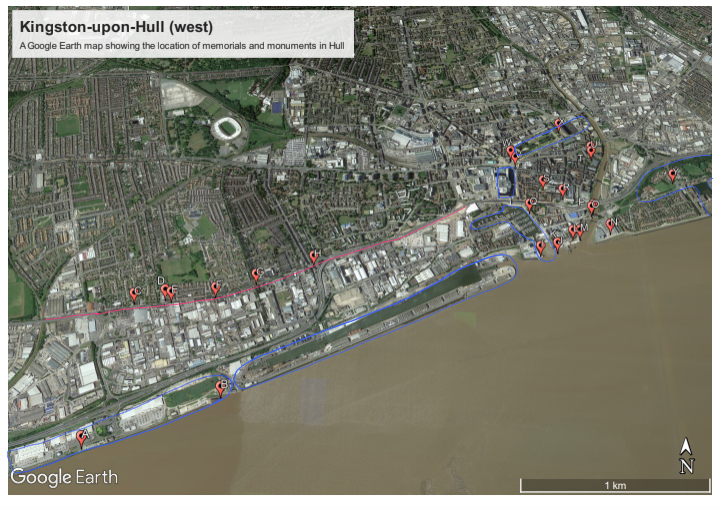
Whilst, naturally, sculptures of various intention exist outside of these areas in the city, the concentration which exists in regions with strong ties to a maritime history is apparent. This, along with monuments often being dedicated to seafaring – or more specifically fishing – suggests a strong will to centre this narrative in the city’s cultural heritage. As such, studying and recording what causes and events were considered important enough to be remembered through art can illuminate a deeper cultural understanding of the communities that advocated and funded them, as well as the impact history and heritage may have had on societies past and present.
[1] Rodney Harrison, “What is Heritage?” in Understanding the Politics of Heritage, ed. Rodney Harrison (Manchester: Manchester University Press, 2010), 10.
[2] Samuel Raphael, Theatres of Memory: Past and Present in Contemporary Culture (London: Verso, 2012), 152.