
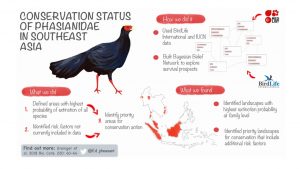
@JKRWard (https://twitter.com/JKRWard) made this brilliant graphical abstract for us
Our recent paper stemmed from a long collaboration with our colleagues at King Mongkut’s University of Technology Thonburi in Thailand. We have become increasingly concerned by a lack of records of some species of Phasianidae outside of well protected reserves in Southeast Asia.
We do not have much evidence about how species respond to human-driven threats, such as direct hunting and habitat destruction. In order to understand where the group is most threatened we created an expert elicited Bayesian Belief Network to explore survival prospects in the face of this uncertainty. We used publicly available data on IUCN extinction probability categories, proxies of threat (effects of hunting, forest loss and protected area effectiveness) and species geographic ranges to assess where the overall risk to survival was highest.
Western Myanmar, Central Indoburma (Thailand/Myanmar), the Annamite mountains and Central Vietnam lowlands, Peninsular Malaysia, Sumatra and Borneo are priorities for avoiding large numbers of extinctions. In order to reduce the level of uncertainty we need to focus research on understanding the intensity of hunting pressure across the region, and variation in species’ tolerance to human disturbance.