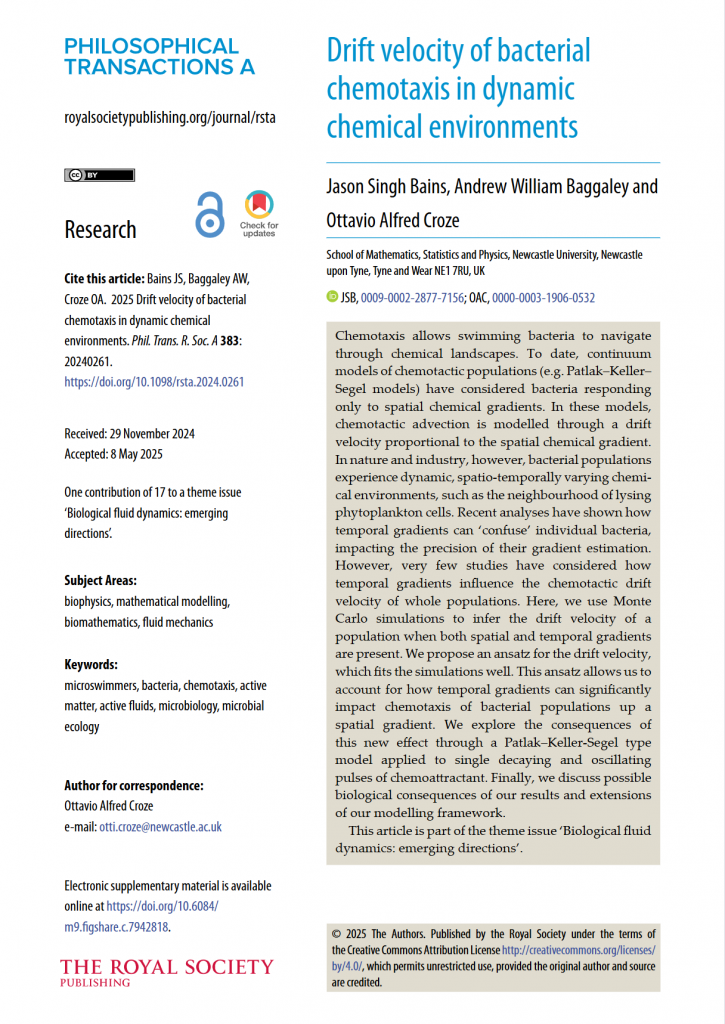
MoLES group members Jason Bains, Prof Andrew Baggaley and Dr Otti Croze have recently published a new model which allows large chemotactic bacterial populations to be simulated at low computational cost. While previous models how described how bacteria can respond to chemical changes in space, the new research shows that changes over time, such as like chemicals appearing or disappearing, can also affect how bacteria move. They use Monte Carlo simulations to infer the drift velocity of a bacterial population when both spatial and temporal gradients are present and explore the consequences of this new effect through a Patlak–Keller-Segel type model applied to single decaying and oscillating pulses of chemoattractant.
Read the Newcastle University Press Release here: New bacterial modelling cuts computational costs for researchers
And the academic publication here: Drift velocity of bacterial chemotaxis in dynamic chemical environments