INTRO –
Sacred areas refer to wider geographical spaces of religious significance, most often perceived as the area one covers on a sacred pilgrimage or areas where Buddhist mandalas have been projected. Where sacred sites are physical plots or structures, sacred areas refer more to an expanse where an individual has had an enlightening experience, and their subsequent relationship to that space. This concept emerged out of Shinto rituals and its interaction with Buddhism, during the Heian period it was common for aristocratic individuals to undertake such sacred pilgrimages. However, by the 12th century, these journeys were not just exclusive to the ruling elite and many normal citizens travelled these sacred areas.
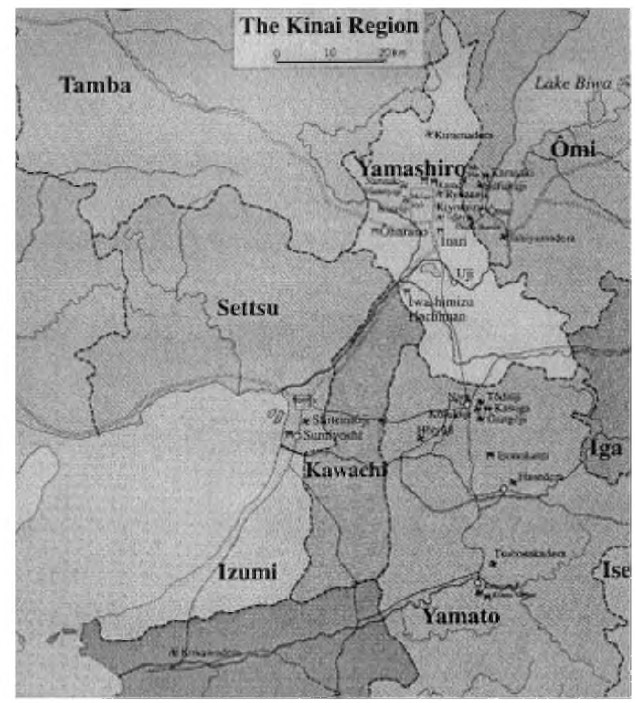
Above is an image of Heian-kyō and its peripheral area, this is just one example of an area containing multiple shrines and temples which would be visited during one’s sacred pilgrimage. These sacred pilgrimages were called Monomōde.
Furthermore, these areas became known as places where Buddahood could be realized; Esoteric Buddhism ‘proposed that Buddahood could be realized in this body, in this life, and in this world.’6 In this sense Sacred areas can be defined as the space where an individual has achieved Buddahood. Kūkai’s Buddhism proposes internal processes and awakenings which transform one’s own perspective and relationship to the world around them reconstruct these areas into sacred spaces. Therefore, these interior experiences shape our outer experience and create sacred areas. Pilgrimage was a hugely significant part of one’s enlightenment; it was viewed that as soon as one had left their home they were no longer tethered to a certain place or time, and their experiences whilst on the pilgrimage were then solidified by contact with the sacred site. This allowed the individual a physical space to engage with as a representation and connection to the metaphysical realm of the divinities.
“The practice of Pilgrimage is intimately related to the Buddhist notion that the religious experience was a process (ongoing practice) rather than simply the final goal of practice.”
Grapard, Allan G. “Flying Mountains and Walkers of Emptiness: Toward a Definition of Sacred Space in Japanese Religions.” History of Religions 21, no. 3 (1982): 205.
Another dimension of travelling to these Sacred Areas was the influence of the seasons; often journeys would take place in either spring or fall; this was for a multitude of reasons with these months being the most hospitable climate for journeys as well as the beauty of nature being at its peak during these months. As Barbara Ambros notes, ‘the splendor of blossoms or fall foliage made the site appear like a very manifestation of paradise.’7
The spread of Esoteric Buddhism and Shinto throughout Japan created a complex web of Temples and Shrines which occupied these sacred areas. The connecting of multiple shrines and temples within sacred areas spanning the entirety of Japan then bought into play the notion of Japan as a sacred nation – a notion we shall explore on the next page…
|||||||||||||||||||||||||||||||||||||||||||||||||||||||||||||||||||||||||||||||||||||||||||||||||||||||||||||||||||||||||||||||||||||||||||||||||||||||||||||
Footnotes:
6. Grappard, “Flying Walkers and Mountains of Emptiness,”202.
7. Barbara Ambros, “Liminal Journeys: Pilgrimages of Noblewomen in Mid-Heian Japan,” Japanese journal of religious studies, 24:3-4 (1997): 305.