INTRO –
The first form of sacred space we can identify within Medieval Japan is structured sites which are believed to be where a divinity resides and makes contact with the Earth or the ‘lower world’ of the profane. These are most often Temples and Shrines, found in places of natural beauty all around Japan.
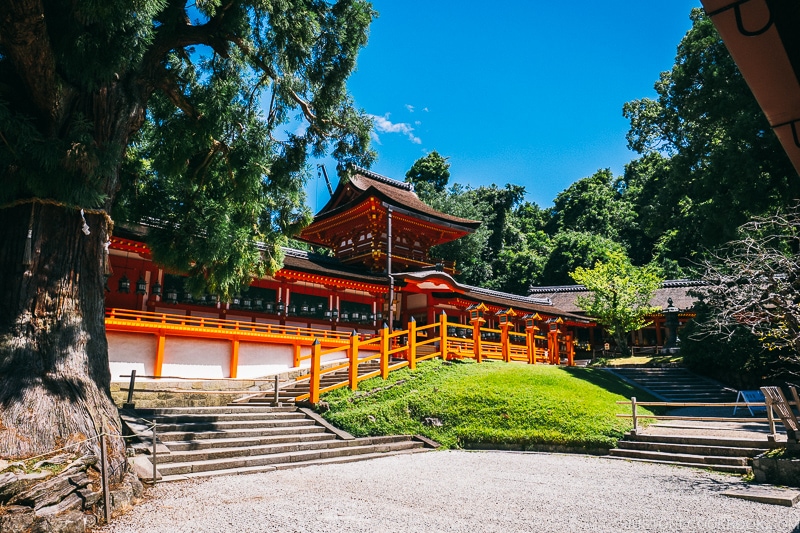
Kasuga Taisha Shrine, Nara.
Built in 768, this shrine was originally the tutelary shrine of the Fujiwara clan.
The Fujiwara clan were the most powerful family in Heian period Japan due to their relationship with the imperial family through successive marriages of Fujiwara daughters with Imperial sons (emperors).
These shrines were believed to be ‘cosmic centers’1 sacred spaces that were capable of summoning deities and connecting to the power of the divinity with the correct ritual practices. These practices included ritual purification before entering the sacred space, invocation of the divinity by incantations and the act of ritual binding, which was ‘seen as trapping the power of the divinity within the Sacred Space.’2. In binding the power of the divine in this sacred space, one could harness the power of the divine within oneself as well as express gratitude and the needs of the community before sending the divinity back.
RITUALS –
Sacred sites enter a pattern of organization whereby they are situated in beautiful and serene natural environments, often near bodies of water or mountains. The proximity of the site to water was significant not just for its natural beauty but because the water would be used in certain rituals.
In the Seven Shallows purification ritual for example, a human effigy would be bought to the ‘polluted’ emperor who would “symbolically fill it with his breath and rub his body with it front and back”3 , the effigy would then be bought to designated sites along the riverside and the Yin-Yang master would place it in the stream to wash away any defilement and impurities that had invaded the emperor’s body.4
Sacred Objects (Yorishiro) –
These sacred shrines would also contain a specific object; such as a sacred stone, tree or pillar which was believed to be a form of ‘support’ between the divinity and the Earth known as Yorishiro. Where the Sacred site (shrine or temple) was believed to be the residence of the divine; the Yorishiro’s were believed to be the linking component which enabled one to truly connect with the deity and bind it to this object for a time.
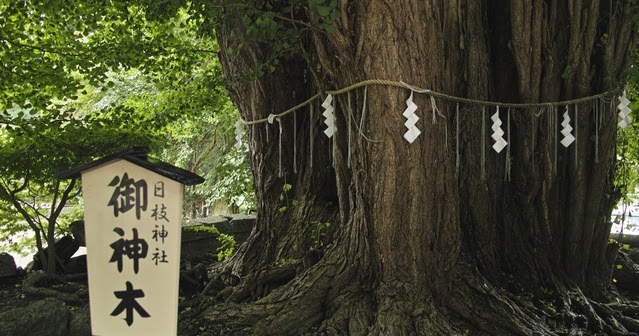
An example of a ‘Yorishiro’. A tree which acts as a support or connection between a Deity and Earth.
CLASSIFICATIONS OF SACRED SITES –
Not only are shrines and temples Sacred Sites but the concept of mountains as residences of divinities is also an aspect of Buddhist and Shinto belief. These mountains are either “regarded as the support or site of residence for the divine or as the actual body of the divinity or group of divinities.”5
- DISTANT SITES (Oku or Kuma) – On a mountain or consisting of the mountain itself
- CENTRAL SITES (Naka) – At the entrance of Valleys
- CLOSE SITES (Hotori) – Located on the plains
|||||||||||||||||||||||||||||||||||||||||||||||||||||||||||||||||||||||||||||||||||||||||||||||||||||||||||||||||||||||||||||||||||||||||||||||||||||||||||||
Footnotes:
- Alan Grappard, “Flying Mountains and Walkers of Emptiness: Toward a definition of Sacred Space in Japanese Religions,” History of Religions, 21: 3 (1982): 198.
- Grappard, “Flying Mountains and Walkers of Emptiness,”197.
- David T. Bialock, “Reimagining Late Heian and Early Medieval Space,” in Eccentric spaces, Hidden histories: narrative, ritual and royal authority from the chronicles of Japan to the tale of the Heike, ed. 1 (Stanford: Stanford University Press, 2007), 221.
- Bialock, “Reimagining Late Heian and Early Medieval Space”, 221.
- Grappard, “Flying Mountains and Walkers of Emptiness,” 199.