“Mandalization, an ultimate exercise in magical manipulation, is one of the most remarkable phenomena of medieval Japan.”
Grapard, Allan G. “Flying Mountains and Walkers of Emptiness”, 207.
Constructing Space within the individual –
In order for there to be polluted space there must then also be pure space. Esoteric Buddhism believes that pure space can be achieved by a process of interiorization, or looking deep within oneself to reach a space of pure thought and mind which is devoid of the ‘pollutions’ of passion and desire. This process is not one of change but simply reaching what was always/already inside.
Here we can see it is first important for the individual practising Buddhism to create a space within themself to allow the thought of Buddha to fill them up. The individual’s own body and mind become the space in which Buddha resides first and foremost, it is only then the person can reach true enlightenment. Separate from the delusions of the flesh, pure space can be achieved when one can ignore their own ego and desires.
In addition to this, the relationship between the body, speech and mind is important in achieving a pure space and field of thought.
“Correct positions and Mudras (body), correct utterance of the mantras (speech), and correct meditation (mind) are the substance of practice and the keys which open the residence of the Buddha within the practicioner.”
Grappard, “Flying mountains and walkers of emptiness,” 209.
Whilst internal space is a key element to practising Esoteric Buddhism, it is also worth mentioning space operates in a much more physical and straightforward way in Buddhist rituals. The positioning of ritual objects, Buddha images and even an individual’s physical body are all imperative to successful rituals.
As Heather Blair states, “Directional consciousness structured etiquette and ritual: the lord faced South, the subject North; the host faced East, the guest West.”9
Mandalization –
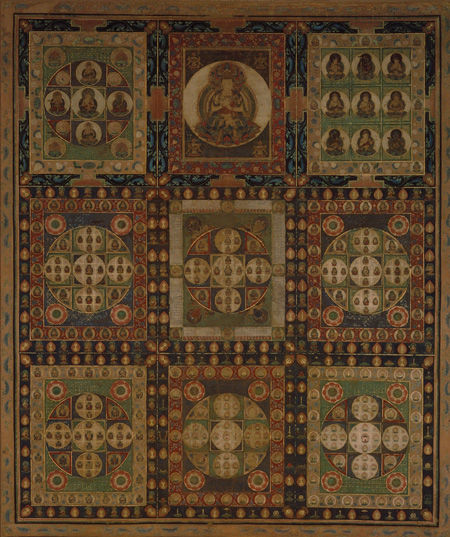
The Mandala represents the residence of the Buddha and is an impression of an ideal universe. The desired end result of an individual’s pilgrimage is the mandalization of space which is the interiorization of the Buddha within. These Mandala’s take the form of paintings on walls or scrolls and can be created from sand as well, they are used as a support in Buddhist Meditative practices and as a way of imagining or representing where the Buddha resides and the goal of a pure enlightenment.
The Mandala is a significant tool in Buddhist practice as it gives one an image to associate with when attempting to achieve rebirth within a celestial plane, where the Budda resides and may teach one eternal wisdom.
|||||||||||||||||||||||||||||||||||||||||||||||||||||||||||||||||||||||||||||||||||||||||||||||||||||||||||||||||||||||||||||||||||||||||||||||||||||||||||||
References:
9. Heather Elizabeth Blair, “Ritual Regimes” in Real and Imagined: the peak of Gold in Heian Japan, (Cambridge: Harvard University Press, 2015), 100.