Precision oncology increasingly relies on the interpretation of complex multi-omics data at the level of individual patients. Yet, existing visualization tools often provide limited support for integrated, clinically meaningful reasoning across genomic, transcriptomic, epigenomic, and computational evidence, particularly when data are uncertain, incomplete, or dependent on expert interpretation.
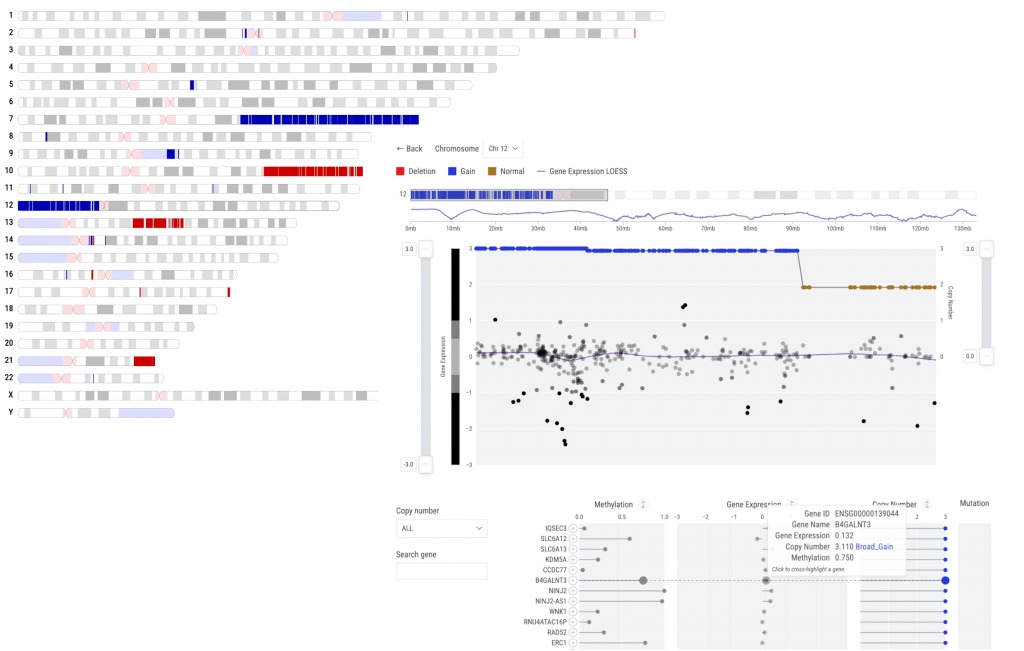
This PhD project investigates how human-centered visual analytics can support the trustworthy interpretation of multi-omics cancer data through three interconnected research questions. First, it examines the challenges of visualizing patient-level multi omics data in cancer and introduces OmiCan, an interactive web-based visualization system that integrates copy number alterations, gene expression, DNA methylation, and somatic mutations within a shared genomic coordinate frame. Developed through a design study with domain experts, OmiCan supports multi-scale exploration, linked views, and clinically oriented analysis of molecular patterns. Second, the project investigates how trust is formed when qualitative uncertainty is communicated through data hunches: expert-generated annotations that express subjective insights, assumptions, or concerns during visual analysis. It develops and empirically examines a multidimensional framework for evaluating trust in data hunches, considering factors such as clarity, justification, accuracy, creator credibility, receiver experience, perceived risk, and social influence. The findings show that trust is shaped by the interaction between the annotation content, the expertise behind it, the clinical stakes, and the viewer’s interpretive context. Third, the thesis extends this work toward explainable artificial intelligence for multi-omics drug response prediction, proposing a human-centered design approach for integrating model predictions and explanations into clinical visual workflows. Overall, this research contributes design knowledge, empirical evidence, and methodological guidance for developing visualization systems that support multi-omics interpretation, uncertainty communication, and trustworthy AI-assisted reasoning in precision oncology, with emphasis on transparency, usability, and collaboration between computational models and expert users.
Team
- Lama Alsmmahi (PhD student), Newcastle University
- Dr Sara Johansson Fernstad (main supervisor), Newcastle University
- Dr Daniel Williamson (co-supervisor), Newcastle University
- Dr Huizhi Liang (co-supervisor), Newcastle University