
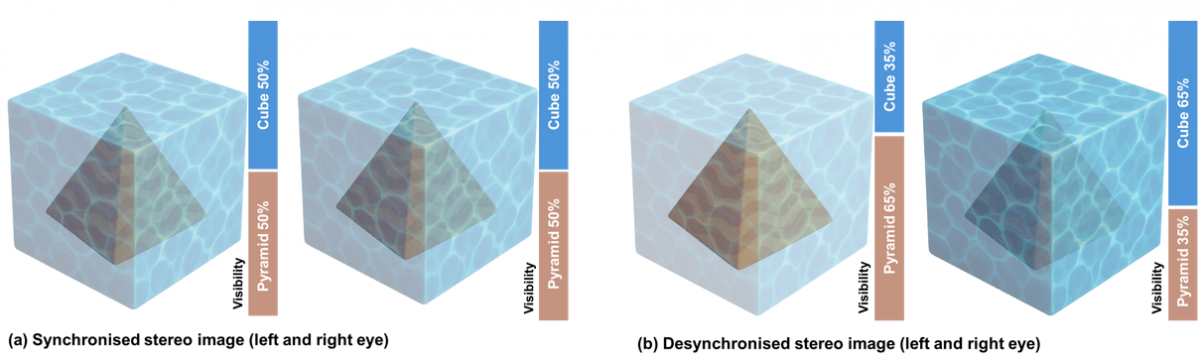
Immersive displays such as virtual and augmented reality offer perceptual capabilities that are not available on traditional flat screens. In particular, stereoscopic displays can present slightly different images to each eye, allowing the visual system to perceive depth and spatial relationships.
This project investigates how these perceptual mechanisms can be better understood and deliberately used to support the exploration of complex 3D data. Rather than treating immersion simply as a new way to display conventional visualisations, the research explores visual techniques that are unique to stereoscopic and immersive environments.
Dichoptic Opacity
A central part of the research is Dichoptic Opacity: a technique that presents different levels of transparency to each eye.
Transparency is often used to reveal information hidden behind other objects in a 3D scene. However, making an object transparent can also weaken important visual cues about depth, shape and spatial ordering. Dichoptic Opacity explores whether different information can instead be distributed across the two eyes, allowing the visual system to combine information about both the object in front and the object behind it.
The work forms part of a wider investigation into dichoptic presentation, what happens when the two eyes are deliberately given different visual information. Small differences can be fused into a single percept, as happens in stereoscopic vision, while larger differences can lead to phenomena such as binocular rivalry. Understanding the space between these perceptual behaviours creates opportunities for new visualisation techniques.
What are we investigating?
The project explores questions including:
- How can dichoptic presentation help us see information that would otherwise be hidden by occlusion?
- How much visual information can differ between the two eyes while still producing a coherent percept?
- How does dichoptic opacity affect the perception of depth and spatial relationships?
- How does it influence our ability to perceive the shape and structure of objects?
- What happens to fine visual detail when different transparency levels are presented to each eye?
- How do texture, colour, contrast and surface appearance affect dichoptic perception?
- Can dichoptic techniques preserve stereoscopic depth while making hidden information easier to perceive?
- How do binocular fusion and binocular rivalry influence the design of stereoscopic visualisations?
- Can similar perceptual principles be applied to graphical techniques such as dithering and image-quality enhancement?
- How well do these techniques work with increasingly complex forms of 3D and volumetric data?
Current work is developing controlled perceptual studies that examine visual detail and stereoscopic perception under different levels of dichoptic opacity, alongside investigations into how the technique can be applied to more complex datasets.
Beyond Dichoptic Opacity
The broader PhD asks how our understanding of perception can inform the design of immersive visualisations.
Alongside dichoptic presentation, the research considers how our perception and interaction with data changes depending on whether we view it from outside or from within, and how unfamiliar spatial representations such as spherical and hyperbolic geometries might be understood in immersive environments.
Together, these projects investigate a common question:
How can we design immersive visualisations around the way people actually see, perceive and understand information?
Interactive demonstration
An interactive demonstration of Dichoptic Opacity is also available, allowing the perceptual effect to be explored directly.
Explore the Dichoptic Opacity demo
Team
George Bell (PhD student), Newcastle University
Dr Alma Cantu (main supervisor), Newcastle University
Dr Gary Ushaw (co-supervisor), Newcastle University
Publications
-
Bell, G., & Cantu, A. (2025). Dichoptic Opacity: Managing Occlusion in Stereoscopic Displays via Dichoptic Presentation. https://doi.org/10.1109/VIS60296.2025.00078