
Careers and Celebrations

I was asked by a member of staff the other day, what the purpose is of our new school. Why bring these different sciences together and will they help our careers or hinder them ? As someone who has spent their whole working life working between the worlds of chemistry, biology and agriculture this multidisciplinary world is all I have ever known but I can understand the basis of the question. This conversation got me thinking….about careers, rites of passage, how we support new members of staff and how we celebrate and reward success. Those questions have been coming together in my mind and I thought I’d explain why.

We have some very bright and promising people coming along and it’s important we give them the opportunities they deserve. Times change and they won’t always take the plodding paths we did in our day, where promotion was about a minimum number of years of service and mysterious metrics relating to teaching and research. Having worked in other sectors, I’m keen we fast track people to take up posts at a higher level as quickly as is appropriate for their professional development.

These reflections were inspired in part by me having the opportunity to host Professor Sally Shortall’s inaugural lecture last week, and it reminded me of the thrill of presenting my own inaugural lecture at Durham in 2003. It felt like an important step on both a personal and a professional level, something that I was able to share with my family as well as with colleagues. Sally has achieved a great deal and for her too this was a significant moment, celebrating her appointment to the very prestigious Duke of Northumberland Chair of Rural Economy in CRE, and it was a pleasure to see how her family and friends, as well as her colleagues, were there to share her celebration, both at the lecture and afterwards at a dinner in the university. It was an extremely enjoyable evening and an opportunity for me to meet up with people I hadn’t seen for a while, including Professor Philip Lowe. We all had a great time.
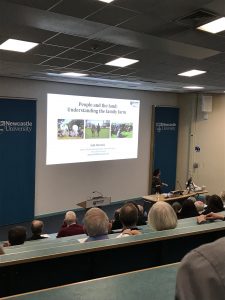
Of course, as well as a pleasant social event, an occasion such as an inaugural lecture provides an important opportunity for sharing your vision of the world – which is such an important aspect of one’s research. It’s an insight for others into what you do and why you do it. For me, as a biochemist, this lecture shone a light onto social science. I really hadn’t thought about some of the points Sally was making, in particular about farm accidents, and how agriculture being a macho industry may influence behaviour. Hearing about research that is so very different from the kind of lab work that I’m personally involved in, does make one see things with fresh eyes.

To go back to that original question about the purpose of our new School of Natural and Environmental Sciences, I’m not entirely sure I can yet give a complete answer – other purposes will emerge over the coming months and years, I am sure. But one answer is, just like me attending Sally’s lecture, that it does bring our different disciplines together in a way that can stimulate new perspectives on problems. It means some of us who are biochemists and plant scientists learning more about social science, having the opportunity of a fresh look at problems that affect the world. It means chemists working more closely with marine biologists, or soil scientists. It could mean any combination of expertise coming together to address challenges – and that is very much the way that both government and industry want us to work.

So I hope that is an important underlying purpose for the School. As I mentioned at the beginning of this blog, it’s also about our youngest members of staff, and what opportunities we offer them to work with all these colleagues across a range of different disciplines. That will be their route to success and those of us in more established roles have to be alert to their potential and ensure they have the networking opportunities and the support they need. We should be celebrating their achievements as they build their careers – I would certainly like to mark these much more publicly in the future. Rites of passage are extremely important, whether that’s a graduation ceremony, an inaugural lecture by a new professor or any of the many steps and achievements in between. They need to be acknowledged.

Being a good citizen as well as a good academic

Moving to a new organisation can mean engaging with a very different culture, particularly when it’s a move between the public and private sectors. I was reflecting recently on my first annual appraisal as a government agency chief scientist. At that appraisal I was ask to present my major achievements in my job role during that first year. Like a good academic I diligently wrote out a list of all the presentations, papers and grants I had spent my time on, in much the same way as I would have done when I was in university. I then went to meet my line manager, the then CEO of the agency, who had come the private sector. He examined the long list of worthy activities and asked “What’s this?” I explained it was an account of everything I had been doing during the year. “But what have you actually achieved that will take the agency forward?” he replied. In fact I had achieved a great deal, but I assumed that was just the job and all the academic outputs in some way demonstrated it. How wrong I was! I just hadn’t thought about accounting for my time as delivering outcomes of use to the organization rather than myself. It was a useful lesson and I have never made the same mistake subsequently.

As most of you will know, I have moved several times between academia, government service and the private sector during the course of my career, and I have seen something of all these worlds. I have great respect for academic achievement and I have always regarded academics as intelligent and creative people who can find solutions to global problems, so I was shocked to see how little respected we are in other sectors, particularly by some government ministers and civil servants. They often regard academics as self-indulgent individuals who are paid from the public purse, but who fail to listen to the needs of the country and the world, who indulge our own personal interests to further our own careers and are unwilling to take on responsibilities and functions beyond that. Sometimes it is difficult to deny that reality.

The truth is that the university system does tend to encourage such a culture. In industry, things are different. Although there are plenty of ambitious individuals, everyone will be working together for the good of the company. In universities there is great emphasis on an individual’s publication record, with much less concern about team working, responding to the needs of society or using this to shape our work. But lacking a sense of community and common purpose is weakening us. If we are each responding to our own needs rather than working for the benefit of the school, the university, the region and the country, we are going nowhere and we will fail.

It was while I was thinking about the academic workload allocation model that I was reminded of my own experience, back at that annual appraisal. Here at Newcastle I do find that there is an obsession with accounting for every small action we perform, rather than thinking about the benefits we have delivered. It’s important of course to ensure individuals are not overloaded, and that is often cited as the objective of the workload allocation model, while often we miss out the vital part about how the model should lead us to creating wider benefits.

So what I’m really urging here, is that we recognise that tools such as the workload allocation model are there, not simply to ensure nobody is unfairly overburdened, but to guide the outcomes of the work we do, and help everyone to contribute to the positive contribution made by the School of Natural and Environmental Sciences and Newcastle University. That really does mean working in a more collegiate fashion, pulling together rather than apart, and thinking about being good citizens as well as good academics. Those objectives should work together if we are to fulfil our obligations to society and it could involve taking on roles that reach beyond our teaching and research, and our own immediate interests. That’s what being a good citizen is about. Of course it’s not only a question for us as academics, but for the institutions that employ us and for the government. The current system does tend to drive an individualistic response, and perhaps it is time to question whether that approach can ensure academia provides what we now need as an institution. Certainly in the School of Natural and Environmental Sciences, it is my intention to actively reward “good citizenship” with my support. So I would urge you all to think beyond your personal interests and make a difference in the world, and how we can work together to achieve that.