
Tempus fugit, or where did that weekend go…?

I came into work on Monday wondering what happened to my weekend – or rather knowing that I spent it catching up on everything that really needed to be done by the end of last week. I even caught myself thinking that if only I had the time to do it I would go on a time management course.  I’m sure most of you know that feeling all too well.

It’s true that last week was particularly difficult in terms of workload. Just to give you a flavour of the urgent tasks coming over my desk in the latter part of last week, these included all the promotion cases for academics, work on the School Plan, rankings for staff appointments, completion of a patent refiling, responding to grant referees’ reports and revisions on a paper for resubmission to a journal.  At the same time I was giving a talk in Glasgow so needed to travel there and back – a normal part of our external research activity.  All of these tasks had to be completed within very short deadlines; there was no choice about it.

That is the price for being Head of School of course, but I know that most of you will be having the same experience, at least some of the time. In our larger and more diverse School there seem to be more deadlines to be met than ever before.  We all have to develop our own strategies for dealing with the pressure.   When time is tight I do try to prioritise according to what is really important for me to complete, and take into account what might/might not happen if I fail to meet particular deadlines.

Returning a grant proposal to an external funder by the deadline is obviously essential, otherwise it will simply fail. An internal deadline may be more negotiable, and if there is something I have to get done for Faculty, for example, I might contact the appropriate person and ask for a few days’ grace.  Breaking tasks down into more manageable chunks that I can either complete myself or delegate to someone else is another useful strategy – although I’m conscious that effective delegation isn’t something that always comes naturally to me and I have to work on it.

The reality is that we all have to address these challenges in our new School. Work life balance is an issue that we take seriously as an institution, but it can get lost day to day as we run to catch up with ourselves.  The danger then is that work begins to bleed into our home lives to an unhealthy extent.  The past week (and my “weekend”) reminded me of how difficult things can become – I think it exceeded anything I have experienced over the past decade.  That led me to think particularly about our younger staff and to wonder how they are coping.  Over the years most people do develop their own strategies but it can take time to do that, and to find ways of keeping problems in proportion.

First, I think it’s important for everyone, at all levels and in every type of job in the School to know that if they are feeling under pressure they aren’t the only ones and it isn’t a sign of weakness. Second, it is helpful to talk things through to begin to put everything into perspective – that could mean a discussion with your manager or another colleague, your partner or a friend.  Even quite minor problems at work can seem overwhelming, but it’s surprising how telling someone else can help you to see them differently.  And it goes without saying that your own health and that of your family should always take priority.

I’m now preparing to set off for Newcastle airport to catch a flight to Washington DC where I’ll be giving a talk, so you could say this is a case of do as I say, not as I do, but maybe I really will get around to doing that time management course one day.
2018 is breaking out all over

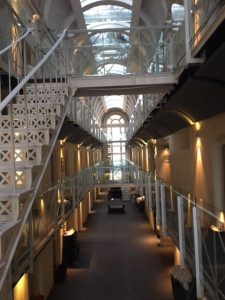
Happy New Year to you all. For me 2018 began with the Oxford Farming Conference where we were talking about one of my personal research interests, diagnostic technology for herbicide resistance.  You can see from the photo what happens when you annoy your secretary – she books you into a prison for your stay.  Fortunately a few mod cons have been added since Malmaison took it over, so I wouldn’t dare complain.

Looking further ahead, 2018 brings a new period for me personally. Over the past year my wife and I have had to sort out my parents in law’s estate following both their deaths in 2016.  It was quite a tumultuous time – both emotionally demanding and time-consuming – and it’s only now that we are able to look ahead more positively as a family.  For everyone in the School too, of course, it has been a time of change and challenges.  But now we are in a position to look to the future here too, and put together a new School plan that will capitalise on our strengths.  It’s a process that the School Executive Board will be leading, but I want many more of you to be involved in this than might have happened in the past.

We have been asked to produce a plan that aligns with the Faculty and University Plans, which feels like a good start. You may already be aware of the five themes:

  1. Education for life
  2. Research for discovery and impact
  3. Engagement for economic and societal benefit
  4. Creating inspiring places
  5. Influencing globally

I don’t want to pre-empt the process but I do think it’s worth sharing a few initial thoughts of my own about these themes, and how the School’s approach can key into, and benefit, from them.

Education for life prompts us to look afresh at what our students want and receive from their university experience, and how this aligns with the needs of a changing world when they move on to enter their careers. We have to be talking more regularly with government and industry so we are clear about what they are looking for in our graduates.

Research for discovery and impact highlights the growing need for us to consider the range of science at all levels, from basic science to its application. There is an increased emphasis on such an approach and it calls for strategic partnerships so we can make a real difference.  It is imperative that we ensure our research reaches the places and people who need it.

Engagement for economic and societal benefit, for me, means that it is time to move beyond a regional focus to raise our national and international profile. Our links with local government and other regional organisations and stakeholders have been a major strength and will continue to be important to us, but at the same time we should be making connections further afield.  This came over very strongly at the Oxford Farming conference – a forum where government policy is communicated and where the UK government takes soundings from industry and academia.  Newcastle has to be playing a significant role at this level.

Creating inspiring places prompts me to mention one of our most pressing objectives for 2018. As I mentioned in my blog before Christmas, all the opportunities offered to us come from outside, but lack of internal resources may prove to be a weakness.  I am aware that currently staff are not particularly well served by our estate, for example in respect of proper social space for interaction and creativity. This kind of space does tend to be forgotten as the needs of students understandably take precedence, but it is a vital resource if we are to exchange ideas and engage with colleagues across disciplines.

Influencing globally I have already touched upon in relation to engagement and societal benefit, but I think it’s worth noting that in a world where resources are always going to be finite, we have to be selective in our choice of partnerships and decide which links are going to be of greatest value to us. We should be targeting top class academic institutions, the movers and shakers of government, and globally important organisations when we are looking for alliances.  It is these partners that will bring best value in joint research initiatives, exchanges and fellowships.

These are my initial thoughts about how we can begin to position ourselves for the next couple of years. What can you do as members of staff at whatever level?  First, you can engage in the development of our strategic plan and I urge you to do that.  A plan that has engagement and contributions from all staff is much more likely to succeed in its objectives.  Second, when opportunities arise for representing Newcastle and the School, whether by teaching, research or engagement activities, please grasp those.  Publicity, talking about the work we do, and about the kind of organisation we aim to be, is always good.  As I mentioned in one of my first blogs as Head of School, our modern world needs more academics working across disciplines to solve problems.  In my conversations with people in government and in industry this is a recurring theme, and it’s exactly the approach we are well positioned to adopt.

As always in academia, our year is half way through as the new calendar year begins, but for us 2018 can prove to be a real turning point. We have the opportunity to shape our future so prepare to take part in that process.  Personally, I’m just relieved that they let me out of Oxford Gaol!