
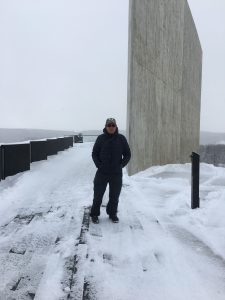
As you may remember, when I signed off on my last blog I was off to the US to give an invited talk at the Weed Science Society of America annual symposium,about our work in the UK on herbicide resistance. It was great to catch up with old friends in Arlington, then I had three days to myself, so I took the opportunity to drive through the snow and ice to up-state Pennsylvania. There was a site I particularly wanted to see, and it was well worth the drive because it had quite a profound effect on me. This was the memorial to Flight 93 and to a group of people who didn’t even know one another, but who did something remarkable. You will probably remember that Flight 93 was one of the aircraft hijacked by terrorists on 9/11 2001. It was heading towards Washington when the passengers brought the plane down by storming the cockpit and attacking the hijackers. The monument is a very evocative place, miles from any town or main road, and it is a reminder of the collective decision taken by a random group of individuals in the space of few minutes to take decisive action. They knew at this stage how the terrorists’ plan was unfolding and they actually voted as a group to take back control of the situation in any way they could, realizing that they had little chance of surviving the incident. In doing so they saved hundreds of lives in Washington. This is all on record in their final phone calls to loved ones.
Then it was back to work here at Newcastle on Monday, for discussions about the development of our research groups and how we can work together. Obviously nobody is being asked to make the kind of sacrifice I’ve been talking about, but seeing how by acting as one, a group of stangers to one another can make such a difference did make me think more deeply about the way we work together here in the School.
Both at School and Faculty level we are engaged in pulling together a new structure for how our gropus work that is intended to better support everyone and improve our performance. I’ve seen how that “role of groups” can polarise opinion amongst those involved. At one extreme we have a “corporate management” view that wants to concentrate on uniform procedures for PDRs, Work Allocation Models, Cost Centres etc etc, while at the other end of the spectrum there is the “maverick academic” tendency who want groupings to work simply as their own intellectual playground, without any need to take real responsibility for the nuts and bolts. Of course, neither of these is going to work to our advantage.
My personal opinion is that no single formula is going to work for every institution or situation. We encompass many varied disciplines with different cultures and it’s important for us to nurture those disciplines and their academic excellence. At the same time they have to act as launch pads for new and dynamic groupings that can address the global and multifaceted challenges we face.
Like those people on the aircraft, we are individuals with our varied concerns and aims but, at the same time, collectively we can be enormously powerful. In order to achieve that we are going to need to move from the extreme positions I mentioned above, to form research groupings that will function both effectively and creatively. That doesn’t mean giving up your disciplinary “home” or always agreeing with everyone in your group. Groups can be effective “critical friends” and they can also support new researchers and colleagues who are finding challenges of all kinds difficult. Criticism, debate and challenging what has gone before are all vital to academic life.
We need to be what I think of as “T” shaped people. By that I mean that we have a central pillar that is our own discipline, while at the same time we can reach across to other disciplines via horizontal “arms”. That ability is a specialism in itself, and it’s a skill everyone has to acquire. We aren’t seeking to develop hybrid researchers but people who understand and respect the skills and knowledge of colleagues from other disciplines, and are willing to speak their language too. I’m encouraged to see how many younger researchers in particular do seem eager to shift into this new gear and already understand the potential it offers.
The most effective ways of working in research groupings is a question being debated far beyond our School or Newcastle University. Discussions are going on all over the world about how scientists can work together more effectively – because it’s a world that is changing more quickly than ever before and the challenges are ever more complex. That’s why I urge you all to get involved in our meetings about the future of our research groups. If we get this right, we can be so much more than the sum of our parts. This will be good for our research and for our teaching and it could even help to change the world.