
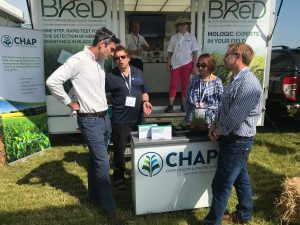
Oiling the wheels of industry

The past couple of weeks have been a whole new experience for me. I’ve been involved in research in both the academic and private sectors throughout my career, and I have worked in partnership with industry.  For around 20 years I’ve been involved in investigating herbicide resistance in black-grass but it’s only really over the past four years that we have been seriously looking at the commercialisation of the results.  So I’ve never taken part in a product launch before, but that’s what we were doing at Cereals 2018.

Some of you will know about the work we have been doing on black-grass. This is a pernicious weed of cereal crops and one that is developing resistance to the commonly used herbicides.  That poses serious problems for farmers. The device we have developed is a world first. It looks similar to a pregnancy test kit and farmers can use it to test any black-grass growing in their crop. It only takes 10-15 minutes to run the test.  Thus, they can quickly and simply obtain clear information on whether it is resistant, enabling them to make informed decisions on managing the problem.  This saves time and costs.

It’s a simple and effective device, but bringing it to market is probably the most difficult thing I’ve ever done and quite different from anything else I’ve experienced. There is so much involved: drafting numerous agreements about intellectual property, finance and marketing, and then getting out and selling the product, all within a very limited timescale.  I have found it very demanding but certainly rewarding, and a very good illustration of the way in which I think we should be approaching research.  Throughout my 30 year career as a researcher I have become more and more interested in the stage of the process – how we can bring all this work to fruition and make it relevant and accessible to people who need it.

I don’t think I realised quite how much persistence and attention to detail would be required but these kinds of achievements don’t happen by accident. Working with our industrial partners Mologic has been a very positive experience. They have stuck with us from the moment when we took the decision to develop this product through to full commercialisation.  For me, this has become the really significant phase of any research project, the point where impact happens.

When I was standing out in a field in Cambridgeshire, at Cereals 2018 with colleagues, promoting our new product and getting somewhat sunburnt in the process, I was also reflecting on how close this brought us to the original philosophy and aims of Armstrong College, and later King’s College, even before we became the University of Newcastle. The focus of these institutions was on Engineering, Medicine and Agriculture and their objective was to work with the community and with industry to achieve practical benefits for everyone.  By following the same principles and using our academic expertise in partnership with industry we can play a key part in addressing serious problems that challenge the world, and we can make a real difference.

Getting it right for our students

At this time of year the temperature rises (possibly), the pollen count is up and we can all remember the smell of the exam hall. As we see our first cohort of students from Natural and Environmental Sciences graduate, this will also mark the first anniversary of our new School.  For me June is also the beginning of the round of agricultural shows, which are important events for my own personal agricultural research interests.  So it’s a key moment for most of us in the cycle of the year.  The agricultural shows get me out and about to meet producers and people involved in the industry.  They also enable me to promote work we do here at Newcastle and I particularly welcome this opportunity.

For our graduating students, of course, this is a particularly significant and tumultuous period. They are having to cope with final exams while also thinking about jobs and prospects for the future. We all tend to look back at the past with rose-tinted spectacles but in some respects the uncertainty they are experiencing is not so different from when I graduated from Bath University in 1981.  The economy was depressed then and there weren’t a lot of job vacancies.  I suppose the certainties about jobs for life and an assured career path had disappeared by the early 1970s.  But since then the world has evolved more and more rapidly and our graduates now face a future of constant change.  It’s a reality they have already had to get used to, so perhaps they cope with it more successfully than we do.  For our part, we try very hard to equip them with the skills that employers are seeking for the future.  We work with the relevant industries to make this happen and our new Teaching and Learning Strategy underpins the process.  Keeping in touch with students is also very important.  We aren’t simply being intrusive when we ask them to update us on their contact details, but trying to gain a better understanding of where our students are being employed, how they are doing, how their careers are developing.  This all helps us to design courses that will match with industry needs and prepare future students for the real world.  We now live in a time when everyone has to be prepared to continue their education throughout their lives if they are to keep up with the pace of change.

But to focus on the next few weeks for a moment, graduation is such an important event in a young person’s life, when friends and family come together to see the results of so much hard work and commitment. It’s a moment of pleasure for staff too, I know, to see how their efforts have come to fruition.  Although this year has brought particular challenges because of industrial action, I know that you have all done your best to minimise the effects for our students and I appreciate that.  For me, I have to admit, the graduation ceremony brings delight but also some deep terrors.  Every year, as I read out the names of students from all over the world, I fear not only stumbling over unfamiliar pronunciations but even transforming a name into something quite rude, simply by my clumsy attempts at reading them out.  When people tell me that the slightest change in tone or emphasis in languages such as Chinese can alter the meaning completely, I begin to sweat.  I can all too easily imagine how an embarrassing slip might not only ruin the day for the graduate’s parents but be forever preserved on that inevitable video recording.

We will be giving some thought to all the complex strands that come together at this time of year, when we gather for our School meeting next week. I’ll be reflecting on the developments we have seen (both good and bad) during our first year as the School of Natural and Environmental Sciences and how we have coped.  We will be thinking about our current focus – exams and plans for graduation – and looking ahead to our outreach work over the summer.  And if you’ve got any useful hints about pronouncing graduating students’ names, they will be gratefully received.