
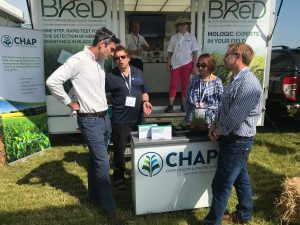
The past couple of weeks have been a whole new experience for me. I’ve been involved in research in both the academic and private sectors throughout my career, and I have worked in partnership with industry. For around 20 years I’ve been involved in investigating herbicide resistance in black-grass but it’s only really over the past four years that we have been seriously looking at the commercialisation of the results. So I’ve never taken part in a product launch before, but that’s what we were doing at Cereals 2018.
Some of you will know about the work we have been doing on black-grass. This is a pernicious weed of cereal crops and one that is developing resistance to the commonly used herbicides. That poses serious problems for farmers. The device we have developed is a world first. It looks similar to a pregnancy test kit and farmers can use it to test any black-grass growing in their crop. It only takes 10-15 minutes to run the test. Thus, they can quickly and simply obtain clear information on whether it is resistant, enabling them to make informed decisions on managing the problem. This saves time and costs.
It’s a simple and effective device, but bringing it to market is probably the most difficult thing I’ve ever done and quite different from anything else I’ve experienced. There is so much involved: drafting numerous agreements about intellectual property, finance and marketing, and then getting out and selling the product, all within a very limited timescale. I have found it very demanding but certainly rewarding, and a very good illustration of the way in which I think we should be approaching research. Throughout my 30 year career as a researcher I have become more and more interested in the stage of the process – how we can bring all this work to fruition and make it relevant and accessible to people who need it.
I don’t think I realised quite how much persistence and attention to detail would be required but these kinds of achievements don’t happen by accident. Working with our industrial partners Mologic has been a very positive experience. They have stuck with us from the moment when we took the decision to develop this product through to full commercialisation. For me, this has become the really significant phase of any research project, the point where impact happens.
When I was standing out in a field in Cambridgeshire, at Cereals 2018 with colleagues, promoting our new product and getting somewhat sunburnt in the process, I was also reflecting on how close this brought us to the original philosophy and aims of Armstrong College, and later King’s College, even before we became the University of Newcastle. The focus of these institutions was on Engineering, Medicine and Agriculture and their objective was to work with the community and with industry to achieve practical benefits for everyone. By following the same principles and using our academic expertise in partnership with industry we can play a key part in addressing serious problems that challenge the world, and we can make a real difference.