Category Archives: Uncategorised

We’re all going on a summer holiday, but before you go…

We are coming up to that time of year when a Head of School’s emails change in number and urgency. Holidays are approaching, and rather than slowing down the traffic, this increases the number of tasks that have to be completed before the end of the University’s financial year and also the paperwork that everyone wants to get off their desks and onto mine before they disappear for a few weeks.  But before we break out the suntan lotion, holiday shirts and sandals, I thought it also seemed like a good moment to take stock of the past year and how far we have come during that time.  As I said at the recent school symposium, we have embarked on a journey and we have a long way to go, but we are making progress. I don’t see this as a moment to want to review everything that has passed as if we have arrived at an end point, rather to reflect on what we have learned and what we can improve upon.

I think we can look forward to the next twelve months with greater optimism than we could have done at this time last year. On teaching, we will have the Teaching Excellence Framework (TEF), which has rumbled on for some time, coming to fruition and being given real teeth.  As a new, larger school, we are in a much better position to get positive results in the TEF.  We can bring together staff across subject areas to work to common teaching practices, we can avoid duplicating meetings and save your time and effort while achieving better results for our students.

We are also going to be in a better place for the next Research Excellence Framework (REF). Although I don’t think these external requirements should be dictating all our decisions they do help us to focus on getting things right – to identify what we are good at, to make the most of our assets, to decide where to concentrate our resources, to have a more joined up culture across disciplines and to plan more effectively for research impact.  Being under a common umbrella gives us greater capacity to achieve all of these things and to plan our future strategy more effectively.

Personally, when I look back at our progress, I can see very clearly how we have been able to bring five different ways of doing things together, and to draw on good practice from each. Inevitably there were anomalies, different interpretations of how rules should be applied and, at times, a lack of transparency in some areas.  The process of scrutiny that we have gone through to standardise processes has helped, I think, to ensure greater inclusivity, more consistent and fairer measures of individuals’ performance, and more positive approaches to equality and diversity.

I’m particularly pleased to see such positive and motivated research groups emerging across the new school. Increasingly we see communities of scientists coming together who can really make a difference by combining their expertise.  We also have the opportunity to give more attention to the needs of some groups who have too often been overlooked in the old structures.  I’m thinking particularly of our research associates, PhD students and early career researchers.  They are the future of the school and they deserve greater consideration and prominence.  We are working hard to ensure this happens.

Looking out of my window I see staff and students enjoying the sun, and in a few days we will be getting together for our school event in Exhibition Park. Everyone is feeling more relaxed and looking forward to summer holidays, so I’m sorry to finish the academic year with such a serious blog.  However, I don’t want to gloss over the inevitable pain that we have experienced over the past, rather bruising, year.  The first part of the journey – probably the hardest part – is over but there is still a way to go, and the new school is very much a work in progress.  But we can congratulate ourselves on what has been achieved so far.  Thanks to you who have helped make this happen.  I look forward to working with you all over the coming academic year to strengthen the school’s teaching and research base, and to ensure we make a positive and visible impact with both of these endeavours.  In the meantime, I want to wish you and your families a very restful and enjoyable summer.
Oiling the wheels of industry

The past couple of weeks have been a whole new experience for me. I’ve been involved in research in both the academic and private sectors throughout my career, and I have worked in partnership with industry.  For around 20 years I’ve been involved in investigating herbicide resistance in black-grass but it’s only really over the past four years that we have been seriously looking at the commercialisation of the results.  So I’ve never taken part in a product launch before, but that’s what we were doing at Cereals 2018.

Some of you will know about the work we have been doing on black-grass. This is a pernicious weed of cereal crops and one that is developing resistance to the commonly used herbicides.  That poses serious problems for farmers. The device we have developed is a world first. It looks similar to a pregnancy test kit and farmers can use it to test any black-grass growing in their crop. It only takes 10-15 minutes to run the test.  Thus, they can quickly and simply obtain clear information on whether it is resistant, enabling them to make informed decisions on managing the problem.  This saves time and costs.

It’s a simple and effective device, but bringing it to market is probably the most difficult thing I’ve ever done and quite different from anything else I’ve experienced. There is so much involved: drafting numerous agreements about intellectual property, finance and marketing, and then getting out and selling the product, all within a very limited timescale.  I have found it very demanding but certainly rewarding, and a very good illustration of the way in which I think we should be approaching research.  Throughout my 30 year career as a researcher I have become more and more interested in the stage of the process – how we can bring all this work to fruition and make it relevant and accessible to people who need it.

I don’t think I realised quite how much persistence and attention to detail would be required but these kinds of achievements don’t happen by accident. Working with our industrial partners Mologic has been a very positive experience. They have stuck with us from the moment when we took the decision to develop this product through to full commercialisation.  For me, this has become the really significant phase of any research project, the point where impact happens.

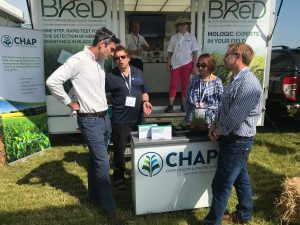
When I was standing out in a field in Cambridgeshire, at Cereals 2018 with colleagues, promoting our new product and getting somewhat sunburnt in the process, I was also reflecting on how close this brought us to the original philosophy and aims of Armstrong College, and later King’s College, even before we became the University of Newcastle. The focus of these institutions was on Engineering, Medicine and Agriculture and their objective was to work with the community and with industry to achieve practical benefits for everyone.  By following the same principles and using our academic expertise in partnership with industry we can play a key part in addressing serious problems that challenge the world, and we can make a real difference.

Getting it right for our students

At this time of year the temperature rises (possibly), the pollen count is up and we can all remember the smell of the exam hall. As we see our first cohort of students from Natural and Environmental Sciences graduate, this will also mark the first anniversary of our new School.  For me June is also the beginning of the round of agricultural shows, which are important events for my own personal agricultural research interests.  So it’s a key moment for most of us in the cycle of the year.  The agricultural shows get me out and about to meet producers and people involved in the industry.  They also enable me to promote work we do here at Newcastle and I particularly welcome this opportunity.

For our graduating students, of course, this is a particularly significant and tumultuous period. They are having to cope with final exams while also thinking about jobs and prospects for the future. We all tend to look back at the past with rose-tinted spectacles but in some respects the uncertainty they are experiencing is not so different from when I graduated from Bath University in 1981.  The economy was depressed then and there weren’t a lot of job vacancies.  I suppose the certainties about jobs for life and an assured career path had disappeared by the early 1970s.  But since then the world has evolved more and more rapidly and our graduates now face a future of constant change.  It’s a reality they have already had to get used to, so perhaps they cope with it more successfully than we do.  For our part, we try very hard to equip them with the skills that employers are seeking for the future.  We work with the relevant industries to make this happen and our new Teaching and Learning Strategy underpins the process.  Keeping in touch with students is also very important.  We aren’t simply being intrusive when we ask them to update us on their contact details, but trying to gain a better understanding of where our students are being employed, how they are doing, how their careers are developing.  This all helps us to design courses that will match with industry needs and prepare future students for the real world.  We now live in a time when everyone has to be prepared to continue their education throughout their lives if they are to keep up with the pace of change.

But to focus on the next few weeks for a moment, graduation is such an important event in a young person’s life, when friends and family come together to see the results of so much hard work and commitment. It’s a moment of pleasure for staff too, I know, to see how their efforts have come to fruition.  Although this year has brought particular challenges because of industrial action, I know that you have all done your best to minimise the effects for our students and I appreciate that.  For me, I have to admit, the graduation ceremony brings delight but also some deep terrors.  Every year, as I read out the names of students from all over the world, I fear not only stumbling over unfamiliar pronunciations but even transforming a name into something quite rude, simply by my clumsy attempts at reading them out.  When people tell me that the slightest change in tone or emphasis in languages such as Chinese can alter the meaning completely, I begin to sweat.  I can all too easily imagine how an embarrassing slip might not only ruin the day for the graduate’s parents but be forever preserved on that inevitable video recording.

We will be giving some thought to all the complex strands that come together at this time of year, when we gather for our School meeting next week. I’ll be reflecting on the developments we have seen (both good and bad) during our first year as the School of Natural and Environmental Sciences and how we have coped.  We will be thinking about our current focus – exams and plans for graduation – and looking ahead to our outreach work over the summer.  And if you’ve got any useful hints about pronouncing graduating students’ names, they will be gratefully received.


Bright young things

Over the past couple of weeks since my last blog, I’ve been working with my research group to commercialise some research that could be of considerable help to farmers and agronomists; turning an idea into a reliable, functioning diagnostic tool. Working with my research associates (RAs) on that kind of problem, I can’t help feeling a bit envious of their ability to focus on research and development.  They’ve got so much potential and a whole career in front of them, but when you start on the journey it’s not always so obvious what the future holds.

Despite their importance to the research life of universities, RAs sometimes seem to have a lower profile than one would expect from their importance in delivering the outputs and impacts from the projects we carry out. Importantly, this is a very creative and productive part of a researcher’s career.   Perhaps I am harking back to that period in my own career as rather a golden age.  When I finished my PhD I went on to take up a post doc RA position at Royal Holloway, based out at Egham. They were just moving the labs so everything was a bit chaotic.  We were setting up new facilities from scratch, which was hard work, but intensely exciting, with plenty of ideas exchanged and joint projects to develop.  At the same time there were frustrations.  I was conscious of some gaps in the organisation of the work.  For example we were using radio isotopes in the lab but there were no proper procedures set down.  I could see that nobody else was going to take on the paperwork so I did it myself.  That’s when I realised how important it was, even when I was in a junior position, to step up and get on with things, rather than assuming someone else would do it.  That was a good lesson for life.

Of course it wasn’t all work. There were a lot of laughs and a good social life.  I look back to an era when I was able to enjoy doing research, probably more than at any other time before or since.  It was also where I met my wife, so I have a lot of positive memories of that time.  But as far as the job was concerned, I always knew it wouldn’t be permanent.  I was on a three year research council-funded contract and after two years I knew it was time to move on and spend some time in industry.  That move was a bit of a culture shock, if I’m honest.  I went from a place where we had an attitude that was, at times, somewhat mischievous, to a workplace that seemed much more serious, though I did manage to find one or two like-minded colleagues.  Of course we wouldn’t have dreamt of indulging in any childish japes involving helium or dry ice – that would have been very much against the rules!

Our RAs are, I’m sure, much better behaved than I ever was and well aware of health and safety regulations. Their dedication and expertise deserves more recognition.  As senior staff we do need to be aware of RAs’ enormous value to our research and also bear in mind their training and career needs.    Working with us is only one step along their career path, so let’s do everything we can to make it a positive one for us and for them.

A cautionary tale from a lone researcher

It’s been a pretty frenzied week, finishing off writing a major grant application, a busy schedule here at Newcastle then a series of talks on Thursday and Friday. One of Thursday’s events was particularly interesting – the Annual Linnean Debate at Burlington House. This year it was on synthetic biology and it was a striking experience being in a place that was such a cradle of biological research.   I was impressed, not only by the setting (if you’ve been to Burlington House you’ll know it’s pretty grand with busts of Darwin, Wallace et al looking down) but by the organisation of the event.  It was held jointly with the London Evolutionary Research Network which is run by London postgraduate students and this event was organised and moderated by post grads from UCL. They were impressive in their efficiency and enthusiasm throughout the harrowing experience of chariring the debate. I was reminded of my own post grad days at St Mary’s Medical School, round the corner in Paddington, and the terrors of my own first rpublic speaking and research presentation.  It can be a defining moment of any career and we tend to forget quite how intimidating the moment can be in those early years.

Looking back, I’m reminded what a productive time that was for me and I certainly published quite a few papers. The work was intense but it was very satisfying being able to focus so closely on a particular piece of research.  Publication and communicating the results was an important part of the job and that ethos has stayed with me over the years.  Long hours were spent in the lab and there was a great camaraderie among the researchers who worked and socialised together.

But there was one evening when I was alone but could have done with someone else in the lab and I look back on it as a lesson in health and safety. I was working as a CASE student at a particular company in Kent – it had better remain nameless – and I had decided to spend a couple of extra hours one evening on some lab work.  I started labelling up an experiment but the marker pen seemed to be running out – or so I thought until I gave it a good shake.  Ink spurted out all over a brand new computer terminal.  Annoying but not disastrous, I thought.  Using my knowledge of chemistry I got out some solvent to clean off the ink.  What I hadn’t known was how acetone acts on plastic keyboards.  Worse was to follow. As I was examining the melting keys with growing alarm, I suddenly remembered the experiment I had running in the lab next door where water was being pumped from an aquarium through a glass column.  That wouldn’t have been a problem except for the gunk in the bottom of the aquarium that had, by this time, blocked the filter. I rushed back into the room just in time to see the growing embolism in the pipe as the pressure built up, and the ensuing explosion of water.  Which was actually radioactive.  It went everywhere.

Consequently I spent the rest of the evening mopping and decontaminating the lab. The computer keyboard was more of a lost cause.  My couple of extra hours of work turned into eight hours of clearing up and trying to put things right

Is there a moral to this story? Not really, I thought it would just amuse you all. If I had had my time again I would still have run that experiment, but the outcome does make a case for the rules we now have in place that outlaw lone working in the lab.  I guess my point is, we all learn and grow from our experiences and mistakes and that for many acacemics begins in those heady postgraduate years.

Visions of 1964

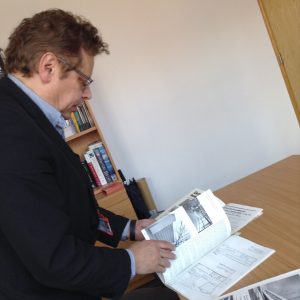
I hope you all had a relaxing Easter break, in spite of the rather grim weather. As you may have realised, I’m not very good at relaxing and like to keep on the move, so I did manage to get out to chop down a tree in the garden and helped a friend to sail their boat from Newcastle up to Amble.  But eventually even I was driven inside by the rain and I was collecting together some documents from an old file in preparation for writing a grant, when I came across a copy of the ‘Northern Architect’ from 1964.  I was intrigued to see that it included an article on the newly opened Agriculture Building at Newcastle University.  Looking at the photos of those earnest young men (and I’m afraid they were all men) with their brylcreemed hair and tweed jackets made me think about what has changed and what has come back to haunt us.  As a school boy in 1964 I can recall the cold war and tensions with Russia – so some parallels with the present day seem all too clear.

But it was also a time of great ambition, only a year after Prime Minister Harold Wilson gave his famous “white heat of technology” speech, and there were the first stirrings of the IT revolution to come. This was a brave new world in both science and business.  We had the first great Green Revolution in direct response to global food shortages, with producers achieving up to 10 per cent increases in yield, year on year, as a direct result of research being carried out at places like Newcastle.

It was particularly interesting that, in some respects, the vision being enacted in 1964 in Newcastle University’s Agriculture Building was very similar to our own thinking now. It was clear from the article that they were looking for ways in which bringing different disciplines together – engineering, chemistry, genetics and the latest business thinking – could increase productivity to feed the world.  Already they understood the need for multidisciplinary approaches to problem-solving.

Of course we have moved on, but looking around our new School of Natural and Environmental Sciences in 2018, I see the same kind of vision being applied much more widely, bringing disciplines together to address challenges not only in agriculture but across the wider global environment on land and at sea, and solving human problems as varied as energy storage and developing new pharmaceutical products.

We may not have the resources to invest in new buildings at the present time but we do have the building blocks to create a truly successful and creative interdisciplinary School that will be in the vanguard of a modern scientific era.

I wonder what those earnest young men from 1964 would think if they could time travel into this new era? I think they would be struck by how much more diverse we are – they would soon notice the numbers of very able women and colleagues of both sexes from all over the world among our staff.  This diversity is probably the greatest advantage we have over those 1964 predecessors.  It is an important strength that helps us to succeed in the modern world and continue to play a significant role in addressing global challenges.


Planes, Trains and Automobiles

When my mother asked me recently how I was getting on at work – as mothers do – I began to tell her about all the travelling I’d been doing. She couldn’t believe how many miles I was putting in but, of course, for anyone doing this kind of job, it’s just a routine part of one’s life.  Unfortunately that life does occasionally begin to resemble one of my favourite films – “Planes, Trains and Automobiles” with Steve Martin and John Candy. There was one very memorable occasion when I was on my way to Washington for a meeting with the US Food and Drug Administration.  I arrived at the airport and went to pick up the hire car I had arranged.  Opening my suitcase to retrieve the sat nav revealed an array of women’s clothing.  Obviously it wasn’t my luggage!  But trying to get back into the baggage hall to track down the true owner of the garments or find my own suitcase was virtually impossible.  That’s when I felt I really was in a Steve Martin comedy.

So, the true cost of travel can go well beyond the financial aspects. It doesn’t only include lost luggage and the effect on the nerves.  Jet lag is a real problem, and that is one reason why I have cut down drastically on my international trips.  Unless I can go for a reasonable block of time, my week can be effectively wiped out.  But I still do a fair bit of UK travel.  Since my last blog I’ve been down to London twice – to a very successful alumni event and to a meeting with Defra.  This afternoon I’m off again, to a Royal Society debate on food security.  I know that my mother would be asking why I bother!

The answer, of course, is that some meetings really are important. I stress the “some” here, and I thought I would take the opportunity to share some of my own criteria for choosing which meetings I will trek down to London to attend, and which I would decline.  For me there are three important reasons for attending a meeting: to influence; to network; to learn.  If you’re lucky you can do all three at the same time, but it’s helpful to have one in mind as your primary objective.

Taking the first of these, you need to ask yourself whether this meeting really is inviting you for open consultation. Are the organisers genuinely keen to hear your views or have decisions already been made?  There are some indicators that will help to give you a clue.  For example, are the organisers offering to pay your travel expenses?  Or do you get the sense that you being invited simply to make up the numbers?

If you are interested in going to a meeting in order to network, obviously you will want to see the list of people attending. Maybe there are individuals you know of and who you know are influential, but you haven’t yet had a chance to meet.  You will want to make a point of speaking to them and following up any such contacts after the meeting.  It sounds obvious, but I really learnt about the importance of making time to do this during my years at Fera.  Building a network helped both the organisation’s profile and, of course, my own career.  You need to be thinking about both of those aspects because they will work together.  What’s good for the organisation will also benefit all of our careers.

Then there are meetings where you will learn important information. Even in the era of information technology, this can often be achieved most effectively face to face.  Leaflets and webinars are useful tools but cannot replace being in the room and hearing the discussion and questions first hand, while also being able to contribute.  That is vital in order to understand all the issues, and events such as Town Meetings are really important for all of us.  Funding from the research councils and from the challenge funds, are often launched at such events and it is essential that you engage with the process at this early stage, from that very first briefing.  Very often the communications loop will only include those who have been there from the beginning, and who stick with it.

Taking all of this into account, my top tips for decision making about which meetings you decide to attend are:

  • Make sure you are inside the tent, not outside – where this is the launch of an initiative that could be valuable in the future be there from the outset.
  • Stay with it as the initiative develops because those who don’t may be dropped from the communications loop and will miss out on being involved in its development. If you really can’t attend make sure you send a trusted deputy.
  • Never leave a decision-making meeting early, even if that means catching a later train. The really important decisions will be made right at the end.

I’m not the only person who does a lot of travel, of course, and at this time of year in particular we are all feeling tired. I’m looking forward to some days of rest over the Easter break, as I hope you are too.  Let’s hope the snow and ice are over and that we can all make any journeys to see family and friends safely and without that “Planes, Trains and Automobiles” experience.


The Joy of Science

The Beast from the East has kept most of us indoors more than usual over the past week. Over the weekend this meant I spent more time at my desk.  Although I do normally spend some time carrying out routine admin tasks, I generally manage to get some time to myself as well.  But this week I spent the whole of Saturday and Sunday writing research papers and catching up on items I’d been promising colleagues for a while.  My daughter was with us for the weekend and she obviously thought this was a pretty dull way to spend one’s “free” time.  But I’m not sure I agree.  Doing research and writing papers is the creative part of being a scientist and I think for most of us it’s what drew us into academia in the first place.

I often think of an old friend who died recently, who was also a scientist. He used to say “I can’t paint or do any of those other creative things, but I can design experiments.”  I know exactly what he meant and that is why I was quite happy to spend my weekend writing up my research.  When you can start to look at problems in ways that haven’t been tried before, think about them from a completely different perspective, and begin to work towards new solutions, that’s what gives me a real buzz.  Nowadays research also provides the opportunity to work with colleagues across the world.  Nobody has to be the lone scientist working away without human contact any more.  We are constantly linking up, using technology such as Skype, discussing papers with co-investigators in other countries sparking ideas off one another and co-authoring papers.

I have my own theory about what draws people into science. Children are universally interested and curious about the world around them but many, perhaps even most, seem to lose that as they grow into their teens.  Scientists, I think, manage to retain that inquisitive spark.  We are certainly at the extreme end of the spectrum of childlike curiosity, so maybe our development is arrested in some way!  At a time when, as I discussed in my last blog, it often feels as though we spend all our time measuring science, perhaps we should be spending a bit more time celebrating that childlike joy in scientific creativity.  If we lose any sense of wonder about advancing human knowledge, we might as well give up on science completely.

Of course there is always a downside to success in science as in any other undertaking in life. The more research you do, the more papers you publish, the more returns you have to make about those publications.  (Yes I’m thinking of you Researchfish, among other obligations.)  Thus, it seems as though the more creative you are, the more time you then have to spend on non-creative tasks.  You might be tempted to assume that failure to comply never catches up with you or even that nobody is going to read the returns anyway.  However, I now know that isn’t true as I also received an email at the weekend, complaining that I hadn’t included the requisite number of characters in a particular box!  And so, back to the admin.

Weighing by the Feather

I spent some of the weekend clearing out some of my grown-up kids’ books and came across some of my son’s “Ancient Egypt” collection. One front cover grabbed my attention.  It showed the god Anubis weighing the heart of a dead Pharaoh against that of a feather, with Thoth recording the result.  The heart (of the good) weighing less than a feather allowed the dead to proceed to the afterlife. Now that’s what I call metricating an individual’s lifetime achievement!  And so back to the blog and the point of the anecdote.   As you will gather, my mind is currently occupied with accounting and assessment.  I’ve spent the couple of weeks since my last blog reviewing and assessing a whole heap of  academia, both for our own School’s two units of REF assessment and as an external reviewer on a two-day assessment visit with BBSRC.

It has prompted me to think; Is all of this assessment and the attempts at measurement by our funders a good or a bad thing? I think it’s fair to say that as with most aspects of modern life, there are positives and negatives. When I embarked on my own scientific career in the 1980s assessment of research was much more rudimentary.  Looking back, I can see that there was limited understanding of what “good outcomes” and impact even looked like.  In the main we were expected to list and describe what we had done in weighty reports that often gave little indication of the value of all of the work carried out.  Expectations have certainly changed.  We are required to tick more boxes and to demonstrate clearly that objectives have been met, along with excellence and impact achieved and I know that for many academics that this weighing of your achievements is enormously frustrating.  Some  feel that there is no longer any creative “wriggle room” from proposal to assessment of results. At the other end of the spectrum some colleagues delight in the game of metrics and the associated game playing involved.

Where ever you sit on the spectrum, from bean counting to game player, we live at a time when everyone really does need to read the instruction manual. That applies whether you’re trying to put together your Billy Bookcase from Ikea or write a grant proposal.  If you miss the key point at the beginning then your outcomes are not going to be successful and your bookcase is in danger of collapsing.  I’m sure you have all told students over the years to “read the question!” Without that key step, without knowing what the examiner is looking for and which box needs to be ticked, there is little chance of getting the right answer.  Indeed, you may find you are trying to answer the wrong question.

The reality is that everything we do is being assessed all the time, both internally and externally, whether we are conscious of this or not. Just one example – your My Impact information can be seen and information collected from it at any time by the university.  That is why you need to ensure it is up to date.  Expectations and requirements change constantly, and just keeping up with this can feel like hard work, but it is essential.  Fifteen years ago we were being measured on the numbers of papers published but now what matters is the impact of a paper – how many times has it been cited?  A paper that has no citations may actually be a negative asset.  We have to understand the ways in which expectations change, and respond.  Otherwise you may simply continue to answer the wrong question.

It’s a challenge, not only for this university but for all – I know that from my work as an external assessor. But it will be the organisations that “read the instructions” which survive and thrive.  This applies throughout the research process.  When you are putting together a grant proposal it must address relevant problems, and when carrying out research and assembling information, we have to be addressing the real objectives in the grant proposal and demonstrating this unequivocally.  Afterwards it’s too late to go back and find that lost screw that should have been inserted at the beginning.  Increasingly we are being managed and assessed by people who are not academics but who operate in a business-oriented environment.  Their measurements will be more ruthless and exacting than the processes we have experienced to date.

We don’t need to be too intimidated by this, but we do need to understand the world in which we are operating, the criteria against which we are being measured, and ensure we respond appropriately. Small and obvious actions such as keeping your own records up to date do help.  Just as important is to understand that all the metrics being collected aren’t just measuring the School or Newcastle University, they are measuring you and me and everyone who works in this organisation, and we will all be judged against the results.  It is a collective process so we need to make a collective response.

Flight 93


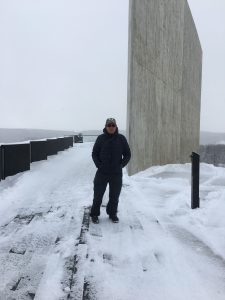
As you may remember, when I signed off on my last blog I was off to the US to give an invited talk at the Weed Science Society of America annual symposium,about our work in the UK on herbicide resistance. It was great to catch up with old friends in Arlington, then I had three days to myself, so I took the opportunity to drive through the snow and ice to up-state Pennsylvania.  There was a site I particularly wanted to see, and it was well worth the drive because it had quite a profound effect on me. This was the memorial to Flight 93 and to a group of people who didn’t even know one another, but who did something remarkable. You will probably remember that Flight 93 was one of the aircraft hijacked by terrorists on 9/11 2001.  It was heading towards Washington when the passengers brought the plane down by storming the cockpit and attacking the hijackers.  The monument is a very evocative place, miles from any town or main road, and it is a reminder of the collective decision taken by a random group of individuals in the space of few minutes to take decisive action.  They knew at this stage how the terrorists’ plan was unfolding and they actually voted as a group to take back control of the situation in any way they could, realizing that they had little chance of surviving the incident.  In doing so they saved hundreds of lives in Washington.  This is all on record in their final phone calls to loved ones.

Then it was back to work here at Newcastle on Monday, for discussions about the development of our research groups and how we can work together. Obviously nobody is being asked to make the kind of sacrifice I’ve been talking about, but seeing how by acting as one, a group of  stangers to one another can make such a difference did make me think more deeply about the way we work together here in the School.

Both at School and Faculty level we are engaged in pulling together a new structure for how our gropus work that is intended to better support everyone and improve our performance. I’ve seen how that “role of groups” can polarise opinion amongst those involved.  At one extreme we have a “corporate management” view that wants to concentrate on uniform procedures for PDRs, Work Allocation Models, Cost Centres etc etc, while at the other end of the spectrum there is the “maverick academic” tendency who want groupings to work simply as their own intellectual playground, without any need to take real responsibility for the nuts and bolts.  Of course, neither of these is going to work to our advantage.

My personal opinion is that no single formula is going to work for every institution or situation. We encompass many varied disciplines with different cultures and it’s important for us to nurture those disciplines and their academic excellence.  At the same time they have to act as launch pads for new and dynamic groupings that can address the global and multifaceted challenges we face.

Like those people on the aircraft, we are individuals with our varied concerns and aims but, at the same time, collectively we can be enormously powerful. In order to achieve that we are going to need to move from the extreme positions I mentioned above, to form research groupings that will function both effectively and creatively.  That doesn’t mean giving up your disciplinary “home” or always agreeing with everyone in your group.  Groups can be effective “critical friends” and they can also support new researchers and colleagues who are finding challenges of all kinds difficult.  Criticism, debate and challenging what has gone before are all vital to academic life.

We need to be what I think of as “T” shaped people. By that I mean that we have a central pillar that is our own discipline, while at the same time we can reach across to other disciplines via horizontal “arms”.  That ability is a specialism in itself, and it’s a skill everyone has to acquire.  We aren’t seeking to develop hybrid researchers but people who understand and respect the skills and knowledge of colleagues from other disciplines, and are willing to speak their language too.  I’m encouraged to see how many younger researchers in particular do seem eager to shift into this new gear and already understand the potential it offers.

The most effective ways of working in research groupings is a question being debated far beyond our School or Newcastle University. Discussions are going on all over the world about how scientists can work together more effectively – because it’s a world that is changing more quickly than ever before and the challenges are ever more complex.  That’s why I urge you all to get involved in our meetings about the future of our research groups.  If we get this right, we can be so much more than the sum of our parts.  This will be good for our research and for our teaching and it could even help to change the world.