Category Archives: Uncategorised

Tempus fugit, or where did that weekend go…?

I came into work on Monday wondering what happened to my weekend – or rather knowing that I spent it catching up on everything that really needed to be done by the end of last week. I even caught myself thinking that if only I had the time to do it I would go on a time management course.  I’m sure most of you know that feeling all too well.

It’s true that last week was particularly difficult in terms of workload. Just to give you a flavour of the urgent tasks coming over my desk in the latter part of last week, these included all the promotion cases for academics, work on the School Plan, rankings for staff appointments, completion of a patent refiling, responding to grant referees’ reports and revisions on a paper for resubmission to a journal.  At the same time I was giving a talk in Glasgow so needed to travel there and back – a normal part of our external research activity.  All of these tasks had to be completed within very short deadlines; there was no choice about it.

That is the price for being Head of School of course, but I know that most of you will be having the same experience, at least some of the time. In our larger and more diverse School there seem to be more deadlines to be met than ever before.  We all have to develop our own strategies for dealing with the pressure.   When time is tight I do try to prioritise according to what is really important for me to complete, and take into account what might/might not happen if I fail to meet particular deadlines.

Returning a grant proposal to an external funder by the deadline is obviously essential, otherwise it will simply fail. An internal deadline may be more negotiable, and if there is something I have to get done for Faculty, for example, I might contact the appropriate person and ask for a few days’ grace.  Breaking tasks down into more manageable chunks that I can either complete myself or delegate to someone else is another useful strategy – although I’m conscious that effective delegation isn’t something that always comes naturally to me and I have to work on it.

The reality is that we all have to address these challenges in our new School. Work life balance is an issue that we take seriously as an institution, but it can get lost day to day as we run to catch up with ourselves.  The danger then is that work begins to bleed into our home lives to an unhealthy extent.  The past week (and my “weekend”) reminded me of how difficult things can become – I think it exceeded anything I have experienced over the past decade.  That led me to think particularly about our younger staff and to wonder how they are coping.  Over the years most people do develop their own strategies but it can take time to do that, and to find ways of keeping problems in proportion.

First, I think it’s important for everyone, at all levels and in every type of job in the School to know that if they are feeling under pressure they aren’t the only ones and it isn’t a sign of weakness. Second, it is helpful to talk things through to begin to put everything into perspective – that could mean a discussion with your manager or another colleague, your partner or a friend.  Even quite minor problems at work can seem overwhelming, but it’s surprising how telling someone else can help you to see them differently.  And it goes without saying that your own health and that of your family should always take priority.

I’m now preparing to set off for Newcastle airport to catch a flight to Washington DC where I’ll be giving a talk, so you could say this is a case of do as I say, not as I do, but maybe I really will get around to doing that time management course one day.
2018 is breaking out all over

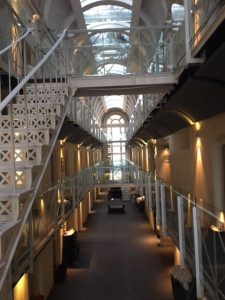
Happy New Year to you all. For me 2018 began with the Oxford Farming Conference where we were talking about one of my personal research interests, diagnostic technology for herbicide resistance.  You can see from the photo what happens when you annoy your secretary – she books you into a prison for your stay.  Fortunately a few mod cons have been added since Malmaison took it over, so I wouldn’t dare complain.

Looking further ahead, 2018 brings a new period for me personally. Over the past year my wife and I have had to sort out my parents in law’s estate following both their deaths in 2016.  It was quite a tumultuous time – both emotionally demanding and time-consuming – and it’s only now that we are able to look ahead more positively as a family.  For everyone in the School too, of course, it has been a time of change and challenges.  But now we are in a position to look to the future here too, and put together a new School plan that will capitalise on our strengths.  It’s a process that the School Executive Board will be leading, but I want many more of you to be involved in this than might have happened in the past.

We have been asked to produce a plan that aligns with the Faculty and University Plans, which feels like a good start. You may already be aware of the five themes:

  1. Education for life
  2. Research for discovery and impact
  3. Engagement for economic and societal benefit
  4. Creating inspiring places
  5. Influencing globally

I don’t want to pre-empt the process but I do think it’s worth sharing a few initial thoughts of my own about these themes, and how the School’s approach can key into, and benefit, from them.

Education for life prompts us to look afresh at what our students want and receive from their university experience, and how this aligns with the needs of a changing world when they move on to enter their careers. We have to be talking more regularly with government and industry so we are clear about what they are looking for in our graduates.

Research for discovery and impact highlights the growing need for us to consider the range of science at all levels, from basic science to its application. There is an increased emphasis on such an approach and it calls for strategic partnerships so we can make a real difference.  It is imperative that we ensure our research reaches the places and people who need it.

Engagement for economic and societal benefit, for me, means that it is time to move beyond a regional focus to raise our national and international profile. Our links with local government and other regional organisations and stakeholders have been a major strength and will continue to be important to us, but at the same time we should be making connections further afield.  This came over very strongly at the Oxford Farming conference – a forum where government policy is communicated and where the UK government takes soundings from industry and academia.  Newcastle has to be playing a significant role at this level.

Creating inspiring places prompts me to mention one of our most pressing objectives for 2018. As I mentioned in my blog before Christmas, all the opportunities offered to us come from outside, but lack of internal resources may prove to be a weakness.  I am aware that currently staff are not particularly well served by our estate, for example in respect of proper social space for interaction and creativity. This kind of space does tend to be forgotten as the needs of students understandably take precedence, but it is a vital resource if we are to exchange ideas and engage with colleagues across disciplines.

Influencing globally I have already touched upon in relation to engagement and societal benefit, but I think it’s worth noting that in a world where resources are always going to be finite, we have to be selective in our choice of partnerships and decide which links are going to be of greatest value to us. We should be targeting top class academic institutions, the movers and shakers of government, and globally important organisations when we are looking for alliances.  It is these partners that will bring best value in joint research initiatives, exchanges and fellowships.

These are my initial thoughts about how we can begin to position ourselves for the next couple of years. What can you do as members of staff at whatever level?  First, you can engage in the development of our strategic plan and I urge you to do that.  A plan that has engagement and contributions from all staff is much more likely to succeed in its objectives.  Second, when opportunities arise for representing Newcastle and the School, whether by teaching, research or engagement activities, please grasp those.  Publicity, talking about the work we do, and about the kind of organisation we aim to be, is always good.  As I mentioned in one of my first blogs as Head of School, our modern world needs more academics working across disciplines to solve problems.  In my conversations with people in government and in industry this is a recurring theme, and it’s exactly the approach we are well positioned to adopt.

As always in academia, our year is half way through as the new calendar year begins, but for us 2018 can prove to be a real turning point. We have the opportunity to shape our future so prepare to take part in that process.  Personally, I’m just relieved that they let me out of Oxford Gaol!

Looking back, looking forward

Christmas and New Year is traditionally a time for reflecting on the old year and looking ahead to the new.  As 2017 draws to a close we have just held our first Christmas symposium as a new school and I was pleased to see so many staff attending.  It was a great opportunity for academic, technical and professional support staff to come together and also for all the new academic staff who have joined us over the past 12 months to introduce themselves and their work.

For me it was an opportunity to provide some reflection on what has, undoubtedly, been a rather turbulent year for everyone. Restructuring and the introduction of many new systems have been stressful, that’s something we need to acknowledge.  But as I commented, in somewhat Churchillian style at the symposium, although this may not be the beginning of the end, it may be the end of the beginning.  We are able to celebrate some very real achievements, and to have come through such a major reorganisation with minimal disruption to our core operations, is a major achievement in itself.  The benefit in looking back is being able to see what we have done well, what not so well.  This helps us to identify the ways in which we could improve our performance, what past good practice we can draw upon for the whole school, and where we can seek new opportunities.

One of our great strengths is our diversity of disciplines and the unique blend this brings to our research. This sits alongside our well established links with industry and with government.  As I have said before this aligns with what the country needs at the moment and is a good fit with the kind of approach the government is actively seeking.  The world of commerce have recently taken up what they call Open Innovation, which brings together academia and businesses that seek new interventions – for example that could be a chemical company needing to draw on engineering expertise or modelling skills.  The kind of diversity we can offer will help to solve real world challenges that don’t necessarily fit neatly into disciplinary boxes, and I don’t only mean in applied contexts.  It’s clear that the government is also looking for innovative thinking and big ideas and sees the universities as the potential source.  This is very much being driven by Brexit but our international research is also in a very good place at the moment.  It’s gratifying to see Newcastle improving its world ranking and that sets an encouraging direction of travel for the future.

Although change is often daunting, we need to remember that the challenges we face here are small compared with those that the whole UK is facing, and also those the country has come through in the past. Major social changes set in motion by, for example, the loss of the coal industry, seemed to shake the foundations of North East England, but the region has survived and Newcastle continues to flourish.  The issues we have to deal with in the school are internal ones and within our power to fix.  The opportunities are external and have to be seized.  Hearing our new academics presenting at the symposium reminded me of this – they represent over a quarter of our academic staff and they bring a new perspective and fresh ideas.  Perhaps our greatest weakness in 2017 has been not blowing our own trumpet sufficiently loudly.  Let’s make that one of the things we change in 2018 and let’s all ensure we promote our successes more widely.

I want to thank everyone for their hard work over the past year and I would particularly like to mention the professionalism of the support and technical staff. We couldn’t function without them on the team and their dedication in getting on with the job over the past year has been very much appreciated.  Academic staff have also been seizing the positive linkages offered in the new structure, reshaping research groupings and teaching programmes to take advantage of these new opportunities.  Thank you all.  This all promises an exciting start to 2018 and early in the new year we will be organising workshops for all staff to get involved in planning our next steps.

In the meantime I would like to wish you and your families a relaxing holiday break, a very Merry Christmas, and a Happy New Year.


Careers and Celebrations

I was asked by a member of staff the other day, what the purpose is of our new school. Why bring these different sciences together and will they help our careers or hinder them ? As someone who has spent their whole working life working between the worlds of chemistry, biology and agriculture this multidisciplinary world is all I have ever known but I can understand the basis of the question. This conversation got me thinking….about careers, rites of passage, how we support new members of staff and how we celebrate and reward success. Those questions have been coming together in my mind and I thought I’d explain why.

We have some very bright and promising people coming along and it’s important we give them the opportunities they deserve. Times change and they won’t always take the plodding paths we did in our day, where promotion was about a minimum number of years of service and mysterious metrics relating to teaching and research. Having worked in other sectors, I’m keen we fast track people to take up posts at a higher level as quickly as is appropriate for their professional development.

These reflections were inspired in part by me having the opportunity to host Professor Sally Shortall’s inaugural lecture last week, and it reminded me of the thrill of presenting my own inaugural lecture at Durham in 2003. It felt like an important step on both a personal and a professional level, something that I was able to share with my family as well as with colleagues. Sally has achieved a great deal and for her too this was a significant moment, celebrating her appointment to the very prestigious Duke of Northumberland Chair of Rural Economy in CRE, and it was a pleasure to see how her family and friends, as well as her colleagues, were there to share her celebration, both at the lecture and afterwards at a dinner in the university. It was an extremely enjoyable evening and an opportunity for me to meet up with people I hadn’t seen for a while, including Professor Philip Lowe. We all had a great time.

Of course, as well as a pleasant social event, an occasion such as an inaugural lecture provides an important opportunity for sharing your vision of the world – which is such an important aspect of one’s research. It’s an insight for others into what you do and why you do it. For me, as a biochemist, this lecture shone a light onto social science. I really hadn’t thought about some of the points Sally was making, in particular about farm accidents, and how agriculture being a macho industry may influence behaviour. Hearing about research that is so very different from the kind of lab work that I’m personally involved in, does make one see things with fresh eyes.

To go back to that original question about the purpose of our new School of Natural and Environmental Sciences, I’m not entirely sure I can yet give a complete answer – other purposes will emerge over the coming months and years, I am sure. But one answer is, just like me attending Sally’s lecture, that it does bring our different disciplines together in a way that can stimulate new perspectives on problems. It means some of us who are biochemists and plant scientists learning more about social science, having the opportunity of a fresh look at problems that affect the world. It means chemists working more closely with marine biologists, or soil scientists. It could mean any combination of expertise coming together to address challenges – and that is very much the way that both government and industry want us to work.

So I hope that is an important underlying purpose for the School. As I mentioned at the beginning of this blog, it’s also about our youngest members of staff, and what opportunities we offer them to work with all these colleagues across a range of different disciplines. That will be their route to success and those of us in more established roles have to be alert to their potential and ensure they have the networking opportunities and the support they need. We should be celebrating their achievements as they build their careers – I would certainly like to mark these much more publicly in the future. Rites of passage are extremely important, whether that’s a graduation ceremony, an inaugural lecture by a new professor or any of the many steps and achievements in between. They need to be acknowledged.

Being a good citizen as well as a good academic

Moving to a new organisation can mean engaging with a very different culture, particularly when it’s a move between the public and private sectors. I was reflecting recently on my first annual appraisal as a government agency chief scientist. At that appraisal I was ask to present my major achievements in my job role during that first year. Like a good academic I diligently wrote out a list of all the presentations, papers and grants I had spent my time on, in much the same way as I would have done when I was in university. I then went to meet my line manager, the then CEO of the agency, who had come the private sector. He examined the long list of worthy activities and asked “What’s this?” I explained it was an account of everything I had been doing during the year. “But what have you actually achieved that will take the agency forward?” he replied. In fact I had achieved a great deal, but I assumed that was just the job and all the academic outputs in some way demonstrated it. How wrong I was! I just hadn’t thought about accounting for my time as delivering outcomes of use to the organization rather than myself. It was a useful lesson and I have never made the same mistake subsequently.

As most of you will know, I have moved several times between academia, government service and the private sector during the course of my career, and I have seen something of all these worlds. I have great respect for academic achievement and I have always regarded academics as intelligent and creative people who can find solutions to global problems, so I was shocked to see how little respected we are in other sectors, particularly by some government ministers and civil servants. They often regard academics as self-indulgent individuals who are paid from the public purse, but who fail to listen to the needs of the country and the world, who indulge our own personal interests to further our own careers and are unwilling to take on responsibilities and functions beyond that. Sometimes it is difficult to deny that reality.

The truth is that the university system does tend to encourage such a culture. In industry, things are different. Although there are plenty of ambitious individuals, everyone will be working together for the good of the company. In universities there is great emphasis on an individual’s publication record, with much less concern about team working, responding to the needs of society or using this to shape our work. But lacking a sense of community and common purpose is weakening us. If we are each responding to our own needs rather than working for the benefit of the school, the university, the region and the country, we are going nowhere and we will fail.

It was while I was thinking about the academic workload allocation model that I was reminded of my own experience, back at that annual appraisal. Here at Newcastle I do find that there is an obsession with accounting for every small action we perform, rather than thinking about the benefits we have delivered. It’s important of course to ensure individuals are not overloaded, and that is often cited as the objective of the workload allocation model, while often we miss out the vital part about how the model should lead us to creating wider benefits.

So what I’m really urging here, is that we recognise that tools such as the workload allocation model are there, not simply to ensure nobody is unfairly overburdened, but to guide the outcomes of the work we do, and help everyone to contribute to the positive contribution made by the School of Natural and Environmental Sciences and Newcastle University. That really does mean working in a more collegiate fashion, pulling together rather than apart, and thinking about being good citizens as well as good academics. Those objectives should work together if we are to fulfil our obligations to society and it could involve taking on roles that reach beyond our teaching and research, and our own immediate interests. That’s what being a good citizen is about. Of course it’s not only a question for us as academics, but for the institutions that employ us and for the government. The current system does tend to drive an individualistic response, and perhaps it is time to question whether that approach can ensure academia provides what we now need as an institution. Certainly in the School of Natural and Environmental Sciences, it is my intention to actively reward “good citizenship” with my support. So I would urge you all to think beyond your personal interests and make a difference in the world, and how we can work together to achieve that.

What doesn’t kill you makes you stronger – or so they say

October always brings us all back to Earth with a bump, new students arriving and, this year, all kinds of changes within the organisation involving new colleagues and new procedures. We have some new early career academics joining us and I’ve been meeting with them for induction over the past couple of weeks.  It takes me back to my own days as a young academic, when everything was new and unfamiliar.  In January 1991, I arrived at Durham University, full of enthusiasm to take up an academic post and duly reported to the Head of School’s office, expecting an enthusiastic welcome.  His secretary went in to announce the arrival of this new lecturer and I heard his response booming out: “What the b***** hell does he want?”

My enthusiasm a little dented, I went to find my office. It was fully equipped – with a desk, a broken chair and a rusty wastepaper bin.  The good news was that I had been allocated some bench space in the lab.  The bad news was that it was in such a state of disrepair it needed varnishing and in the absence of any response to getting the job done  I  bought a can of Ronseal and in one weekend took the bench to a mirror finish.  Overall, it wasn’t a particularly promising start to my academic career and at that time (as I learned from fellow new appointees in various instituions) not uncommon.  It was a product of the time. There was very much a culture of leaving young lecturers to sink or swim, so little support was offered in favour of natural selection.

Things were really tough in that first year.  I was shocked when my first grant application was turned down.  But even then, I was building up my resilience and beginning to understand what I needed to do. Part of that was becoming inured to failure and just getting on with things.  By taking on board the reviewers comments, I was able at to resubmit  and get funding on the second attempt.  Learning from the first experience, another grant success followed.

I’ve built on that knowledge and resilience over the years and you’ll still hear me banging on about the need for a diversity of funding and using your contacts. I already had plenty of contacts in industry at that time and they were extremely helpful.  It was a difficult 12 months but by the end of the year I had built up a research group of five staff and I thought I was doing pretty well.

Two years later and with our first baby on the way at home, reality began to bite as I realised that there was a lot more to academic life than writing and winning grant proposals. Horror!  There was also the expectation that I would deliver results and publish research papers,  deal with an increasing lecturing load and cope with requests to manage degree admin.

Why am I telling you this? Well, firstly I wouldn’t want our new members of staff to experience the kind of welcome I’ve just described, and I do think that the culture of academic life has changed for the better.  I’m glad to say that there is a lot more support available now, but it’s still tough for young researchers.  What I do want them to realise is that we have all been there and we are genuinely sympathetic.  The School and your colleagues are here to help.  I’d also like tell them that it is all worthwhile.  This is just the first step in what can be a great research career, but you will experience failure along the way and that’s ok.  It happens to everyone and it is part of being successful.  Building resilience is vital and the basis of success is learning to survive failure.

To my older colleagues: I want to ask you to remember that our younger researchers do need your encouragement and support and, above all your interest in what they are trying to achieve. Academia can be a lonely place – so remember what it was like for you and offer a helping hand when it is needed.

Getting out of the office and making your own luck

I was at a Newcastle University strategy event a few days ago and the discussion was all about how we need to develop unique selling points for Newcastle. There are certainly things we do well, but this poses a challenge because many universities would say they are just as good at those same things.  In addition, we are a long way from London, so we can easily be overlooked if we don’t get out there, network effectively with the people and organisations who make key decisions, and make Newcastle University and our own School count in that process.  That’s always been how I have operated myself in my professional life.  I learnt very early on that nobody is going to come looking for you to do you any favours; rather you have to make your own opportunities – your own luck if you like.  Personally I have been blessed – or possibly cursed – with a rather restless energy so perhaps the travelling and networking involved come reasonably easily to me.  That doesn’t mean I’m not exhausted at the end of a frantically busy week, but I can see the benefits and I know it is part of the job.

The past two or three weeks have been particularly frenetic. As I mentioned in my last blog, I have been in London meeting with a Canadian Government agri-technology and science mission, which provided a lot of interest, I’ve hosted a BBSRC visit here in Newcastle and attended a Bioscience Knowledge Transfer Network meeting, again in London.  Last week I was in Lincoln meeting with Frontier Agriculture – a large crop production and marketing business, then back to Newcastle, and on Wednesday I headed down to London yet again for a dinner at the House of Lords.

That makes for a packed programme and it means a lot of early mornings and late nights. It also means there is no way I can be in the office all day and every day, so if you wanted to talk to me and I wasn’t here, let me know and we can arrange to catch up.  But I am afraid it is inevitable that I’m not here 24/7, and if we are going to influence the future and move developments in the direction we want, we all need to get out and be seen beyond Newcastle and North East England.

Increasingly, as I do these kinds of trips and events, I am aware of wearing three different hats. On a personal level, as leader of a research group myself, I’m always looking for those opportunities for collaboration, funding and impact that come up all the time, sometimes unexpectedly, when we network.  Most importantly now, I’m also representing the new School of Natural and Environmental Sciences – promoting our expertise and seeking to influence our future.  Plus, I now need to promote the disciplines within the School, and move beyond my own research interests – which up until now have been largely within agriculture – to encompass the wider panorama of biosciences and the interests of our whole sector.  It’s particularly vital at this time for us, and the sectors we work in, to be visible, as there is intense competition going on for Research Council awards and BEIS funding and decisions are being taken about which industrial sectors will be prioritised by the UK Government.  It has never been more important to keep these issues in mind, and to work together to ensure Newcastle and the School of Natural and Environmental Sciences gets the opportunities it deserves.

So, if you don’t see me in the office every day, I’m probably at a meeting or an event or panel representing your interests, or on board a train or aircraft on my way to do just that. But I can’t do it all myself.  If we sit in our offices and let events overtake us we could all find ourselves out of business.  It’s up to all senior staff to take on the job of promoting and influencing as part of the role they play.  More junior staff too, if you have ambitions to build up your own portfolio of research and be recognised in your chosen field, you should be thinking of how you can incorporate responsibilities beyond the School and the University into your personal career plan.  If you don’t push yourself, nobody is going to offer you rewards on a plate.  But, if you are passionate about your work, the School of Natural and Environmental Sciences will support you in your ambition, I can assure you of that.

Looking ahead after our School Conference

With the summer holidays over, it is time to look forward to a new academic year, which was marked by the first School Conference last Friday (8th September). For those of you who were able to come along, thank you for making it such a great day. For those who weren’t able to attend, you did miss a good occasion but I hope there will be more to come over the next few months and we will be putting the slides from the presentations on the new staff intranet when that is available.

It’s always good to be part of something where academics involved in different kinds of research are hearing about each other’s work and there was a real buzz in the room. For me personally, there were several really notable aspects to the research being shared and the discussion generated. First, I was struck by the diversity in the scales of investigation – from examining individual molecules in chemistry to mapping the ecology of oceans in marine science, involving experiments that may take a few seconds or many years. These differences in scale and perspective are always good places to build new ideas.

It was inspiring to see such a rich combination of what the Americans now call “foundational science” and the application of this type of basic, curiosity-driven research to real world problems. In the new school we have both fantastic basic science assets in our campus labs, and unique resources for translation, including the Princess Royal research vessel, our farms and the research outstations that can help us to take just that kind of approach. Curiously, earlier in the week I had been at a UK-Canadian research workshop in agri-technology at Canada house in London, where exactly this combination of basic scientific research and its application at a practical level to benefit industry and society were the focus for forward plans.

Another asset that we enjoy within our new School is being able to work across both natural and social sciences. We all know of examples of technological advances that are never taken up but we don’t know why. An integrated approach that brings natural and social sciences together, designs and addresses research questions in a way that helps to ensure that scientific advances actually do benefit people. Many of you are also working with industry and the scientific problems they bring to us are seldom solved by one discipline alone. We are unusual in being able to respond by harnessing not only a wide range of natural sciences but social sciences as well. This is another bonus point that put us ahead of our competitors and builds in added value to our School.

There are going to be a lot of opportunities coming up to provide advice for the UK Government following our departure from the European Union. With that European source of expertise removed, policymakers will turn to the domestic academic sector and we need to ensure we are well placed to respond – we have the expertise, we need to ensure we are well linked in to the policymaking process.

As you will gather, I came away from the event feeling positive and excited about the future, and I hope you did too. But it’s worth saying that we are still in a phase of transition and we want to hear more about your ideas. The ways we do things at the moment aren’t set in stone. You may feel that you want to develop new research groupings, or tweak the current ones and draw in expertise from different parts of the School, based on what you heard at the conference. Or maybe the name of the research grouping needs to change to reflect better what you are doing? The Directors of Expertise will be meeting with the Research Groups over the next few weeks and that will provide an opportunity for those kinds of discussions. It’s important that the groupings provide the support everyone needs to do effective research, so if you have ideas about that please let us know.

Finally, I want to emphasise that your disciplines and the expertise you have built up within your discipline will underpin all these developments. That will not be devalued. On the contrary, by working in a more complementary way, by building our links with industry and by engagement with policy and increasing our international links, we will add value to what everyone is doing. Science is going to be critical to the future of the UK, after Brexit and beyond.

About the header image

In choosing a header image for my new blog, I’ve tried to use images that reflect the breadth of activity from across our School. I hope to change these images on occasion so that, over time, all aspects of our School are highlighted and celebrated.

I’ll write an inaugural post about the School soon but for now, I’ll say a little about each of the images (left to right):

Not only are we one of the few universities that operate a farm, but we operate two: Nafferton and Cockle Park. Working together as NU Farms, they give us a unique platform for research and teaching. Whilst Agriculture-focused, the farms can and do support a wide range of University activities across science and engineering. The farms not only have a very long and proud history but a very exciting future and we recently held a very successful event celebrating the farms and our role in two of the Government’s Centres for Agriculture Innovation.

A key feature of Biology is the first class facilities and excellent resources we have to support students’ study. As in many of the degrees our School offers, laboratory work is also supported by significant levels of fieldwork. Field and practical work is an essential component of our offering to students across our School and something I hope we can grow and celebrate as our new organisation matures.

The beautiful image in the centre comes from the work of Dr Mike Probert (Chemistry) on Crystallography.  It was taken by photographer, Max Alexander, who showed it at the Royal Albert Hall as part of his ‘Illuminating Atoms’ exhibition. The image shows a single grain of salt held between two diamonds. This arrangement of using opposing diamond anvils allows the controlled generation of extremely high pressures in a laboratory environment. Our work and expertise in this field made the front cover of Science in 2014.

The fourth image shows Earth Science students undertaking fieldwork in the Lake District. Colleagues from Earth and Environmental Sciences are already exploring ways to work more collaboratively to improve both the student and staff experience.

The fifth image was taken on our research vessel, Princess Royal. Like the farms, we are one of the few universities to operate our own vessel for teaching and research. Along with the, Dove Marine Laboratory we have fantastic facilities to support research, teaching and outreach work across the School.

If anybody would like to suggest and forward any images, please do.