
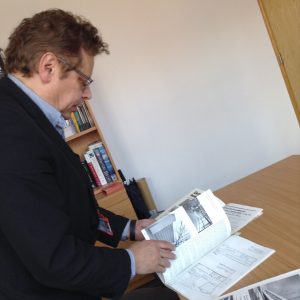
I hope you all had a relaxing Easter break, in spite of the rather grim weather. As you may have realised, I’m not very good at relaxing and like to keep on the move, so I did manage to get out to chop down a tree in the garden and helped a friend to sail their boat from Newcastle up to Amble. But eventually even I was driven inside by the rain and I was collecting together some documents from an old file in preparation for writing a grant, when I came across a copy of the ‘Northern Architect’ from 1964. I was intrigued to see that it included an article on the newly opened Agriculture Building at Newcastle University. Looking at the photos of those earnest young men (and I’m afraid they were all men) with their brylcreemed hair and tweed jackets made me think about what has changed and what has come back to haunt us. As a school boy in 1964 I can recall the cold war and tensions with Russia – so some parallels with the present day seem all too clear.
But it was also a time of great ambition, only a year after Prime Minister Harold Wilson gave his famous “white heat of technology” speech, and there were the first stirrings of the IT revolution to come. This was a brave new world in both science and business. We had the first great Green Revolution in direct response to global food shortages, with producers achieving up to 10 per cent increases in yield, year on year, as a direct result of research being carried out at places like Newcastle.
It was particularly interesting that, in some respects, the vision being enacted in 1964 in Newcastle University’s Agriculture Building was very similar to our own thinking now. It was clear from the article that they were looking for ways in which bringing different disciplines together – engineering, chemistry, genetics and the latest business thinking – could increase productivity to feed the world. Already they understood the need for multidisciplinary approaches to problem-solving.
Of course we have moved on, but looking around our new School of Natural and Environmental Sciences in 2018, I see the same kind of vision being applied much more widely, bringing disciplines together to address challenges not only in agriculture but across the wider global environment on land and at sea, and solving human problems as varied as energy storage and developing new pharmaceutical products.
We may not have the resources to invest in new buildings at the present time but we do have the building blocks to create a truly successful and creative interdisciplinary School that will be in the vanguard of a modern scientific era.
I wonder what those earnest young men from 1964 would think if they could time travel into this new era? I think they would be struck by how much more diverse we are – they would soon notice the numbers of very able women and colleagues of both sexes from all over the world among our staff. This diversity is probably the greatest advantage we have over those 1964 predecessors. It is an important strength that helps us to succeed in the modern world and continue to play a significant role in addressing global challenges.