
By Jack Wallace-Hunter
Drury Lane – The 1674 Reconstruction
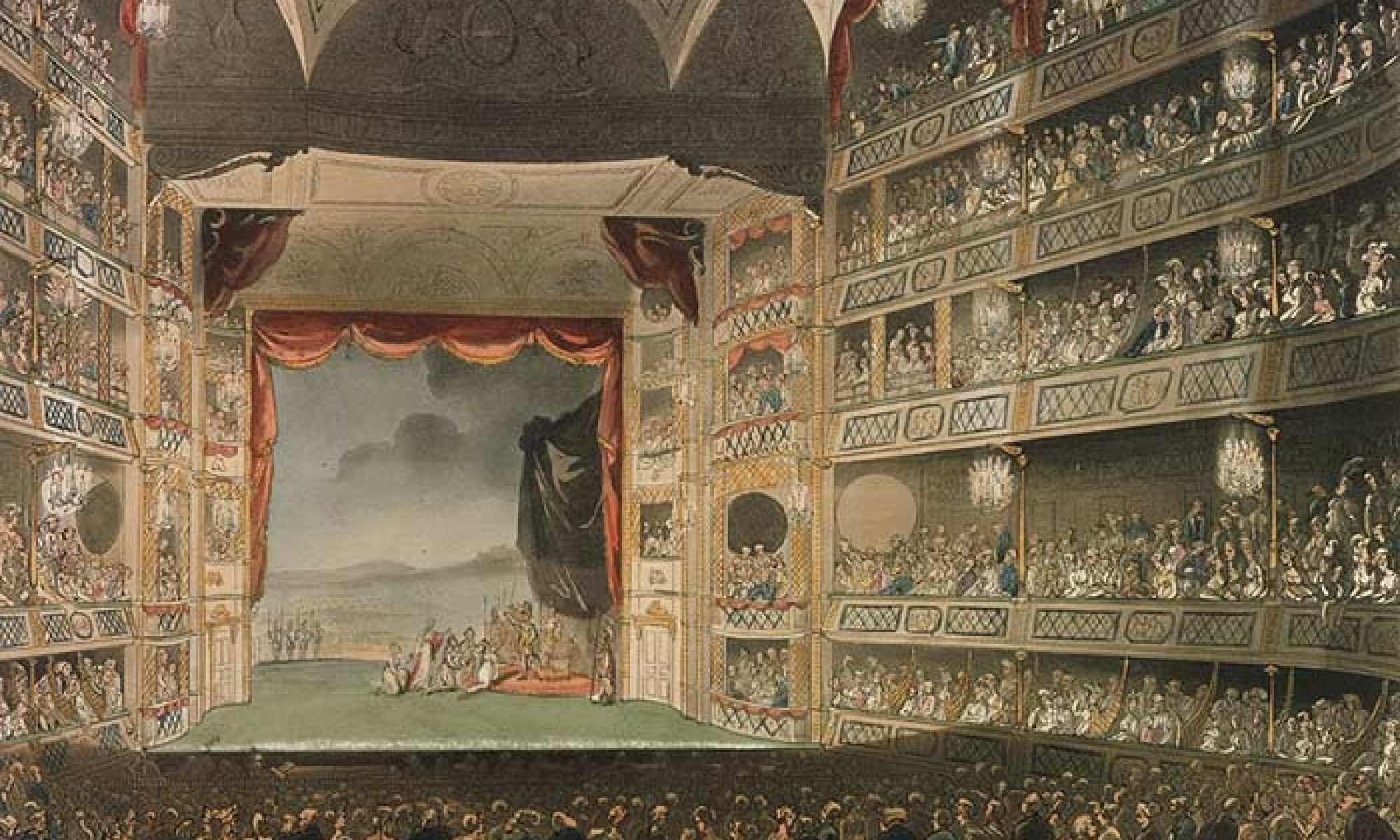
The theatre that A Wife to be Lett was first performed in was the Drury Lane Theatre Royal. At the time of the performance in 1723, the theatre itself had undergone a reconstruction in 1674; only eleven years after the theatre’s initial construction.
Drury Lane, which played host to the esteemed King’s company, housed many new technologies and audience layouts. Avery and Scouten explain that with new reconstructions, the theatres ‘permitt[ed] an intimate atmosphere. The stage extended in front of the proscenium arch into the pit, which was fitted with benches (backless)’.
Theatrical culture was therefore transformed by the very building that housed such a culture. The intimacy that was afforded by this convention of audience layouts amplifies the social aspect of theatre culture at the time. People from various levels of social ranking could have the possibility of being mixed, especially when a performance would have a large audience. This lent itself to a social environment.
But it was not only the audience that underwent change, as stage technologies also evolved. Avery and Scouten also claim that there ‘was a vastly increased emphasis upon changeable scenery and devices (“machines”) for creating such special effects as the flyings of persons and objects.’ Theatrical productions became a spectacle, as both the resident King’s Company and its rival, the Duke’s Company, cultivated an environment of innovation to attract greater audiences by out doing the other company. This idea of innovation was continued to be fuelled by future rivalries that came after both the King’s and Duke’s Company, for example the United Company and Betterton’s Company.
With an intimate environment that often mixed those in various levels of social class and encouraged greater interaction between audience and actors, this was the backdrop that A Wife to be Lett was originally performed in. A backdrop that I argue is very different to what we understand today as theatrical culture and etiquette now.
Drury Lane – The theatre of 1794 and onwards
In 1794 and 1822, Drury Lane Theatre Royal underwent a series of reconstructions. In 1794, the theatre became one of the largest theatres in the world, with reports claiming that it had a capacity of 3,611 seats.
This grand design, equipped with the latest technologies and with ‘its frontages… [an] integral parts of their streets, with shops, coffee-houses, etc’ (Tidmouth) therefore emphasised the social environment that had been fostered at the time of A Wife to Lett.
Yet, at the time of the reconstruction in 1822 and throughout the 19th century, theatrical audience culture began to shift. Theatres became redefined through a process of separation: bourgeoisie thinking prescribed the notion that high society must separate itself from lower social classes when going to the theatre.
Levine describes how this happened in three ways. Firstly, physical theatres were categorised into highbrow and lowbrow venues. Secondly, events that were considered highbrow or lowbrow were kept separate. Thirdly, audiences that participated in highbrow theatre were retrained to adopt the sense that the audience’s role was to be passive, and only active in its attention to the performance.
This attitude, characterised by a segregated highbrow elitism fashioned only for those higher on the social hierarchy shown by passive behaviour of audiences, physically manifested itself into the audience layout of Drury Lane, as the architect ‘took pains to segregate the various parts of the audience’. (Tidworth) Here we see a stark difference in audience participation from restoration and early 18th century theatre to a redefined theatre created in the 19th century that pacified audiences and deconstructed the social environment of the theatre. Furthermore, with the separation built into the theatre itself and passivity of the audience, A Wife to be Lett as a performance would be fundamentally different in its audience/performance connection. This changed relationship I would argue remains a part of theatre culture today, which proposes a fundamental problem if the production was to be restaged for a contemporary audience.
A restoration audience in a modern theatre
If a production for A Wife to be Lett was to be performed for an audience now, the main problem that it would face is the entrenched theatre etiquette created in the 19th century. It was built into the very building it was once preformed in, so it would never be able to replicate the social and intimate nature of an 18th century audience. The physical spaces of the audience and the separation that has been built between the stage, people and the building have been segregated from one another – completely at odds with the original production.
Therefore, I offer a strategy when restaging such a production to replicate the original environment as closely as possible. This comes in two courses of action: firstly, the physical stage and audience layout; secondly, audience behaviour and its sociability.
Separation has been built into the very foundation of Drury Lane Theatre Royal. Thus, to stage a modern production of A Wife to be Lett would simply fall victim to theatrical behaviours born from bourgeoisie practices in the 19th century. Instead, productions could be performed in a more intimate setting, such as the in-the-round stage of the Everyman Theatre in Liverpool. Here the physical separation of the audience between themselves and the stage will break down – allowing for the actors and audience to interact with one another more authentically. However, this does require the trade-off of the technologies that where a characteristic of such plays.
The other strategy is to combat audience behaviour – the notion of passivity in action but activity in reception. To replicate the environment that A Wife to be Lett was originally performed, audiences should be encouraged to flaunt etiquette: allow the use of phones, venders that sell during performance, encourage a social environment perhaps by explicitly directing members of the audience to walk around and have conversations.
A modern production of A Wife to be Lett, though historically connected, is incompatible with the staging and physical theatre that it once inhabited. Modern perceptions of audience behaviour and participation as well as the physical buildings prevent the intimate and social environments of original productions. To make such an environment feasible, drastic measures must be taken.