
By Emma Louise Hogg
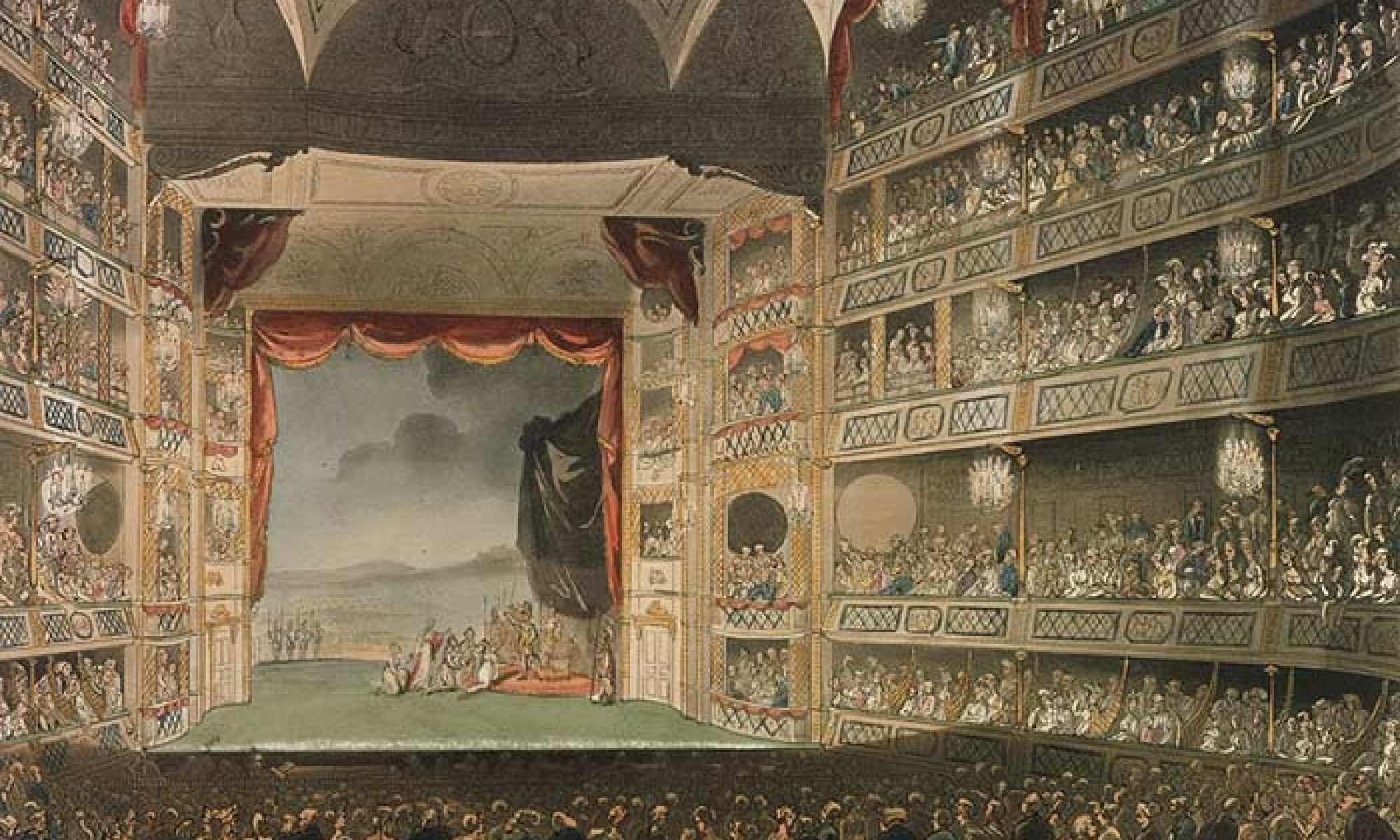
A night at the theatre in the Restoration period was very different to how we perceive the contemporary theatre experience. Audiences would not go just to see one play, instead the night was set up to have at least two plays – a mainpiece and an afterpiece – which were often intertwined with songs and ‘entertainment’ pieces, which could consist of musical performances in varying degrees, impersonations, animal acts, or acrobatics. It is stated that “People used theatres as social centres.” (Hume, 56) meaning that the atmosphere of the theatre would have been very different to our modern perception of theatre. Crowds were expected to be rowdy – they would be in fact more akin to a modern sports crowd – they would eat, drink, and talk with each other within the auditorium. If audience members were in the pit, they would often move around freely, with this being the ideal place for both pickpockets and prostitutes to find business. People sat in the boxes would not have such freedom of movement, but they were still quite the rowdy bunch.
As aforementioned, there would typically be two plays on the billing, a mainpiece and an afterpiece. A ‘mainpiece’ was usually five acts long and would be the bulk of the night’s entertainment. An ‘afterpiece’ was generally one or two acts long and would be the last item on the running order.
Using this information, the production history of A Wife to be Lett in the period 1723-1792 will be investigated on this page. This date period has been used as it marks the first and last performance of the play in the records held in the London Stage Database. Combining this data with evidence from (very sparse) remuneration records, we will be able to map the success, and relevance, of our play.
It is worth noting here, that the play’s stylisation differs slightly between A Wife to be Let and A Wife to be Lett, so any data or archival searches have included both of these versions. Further note shall be made that theatrical records “are patchy, and they mostly reflect the tastes of about half a dozen playgoers.” (Hume, 491) so although we can map a fairly accurate production history of A Wife to be Lett, we may not know of some performances purely because of the limited resources available to us.
A Wife to be Lett was first performed in Drury Lane Theatre on the nights of the 12th, 13th, and 14th August 1723 as the billing’s mainpiece. Unfortunately, this was also the play’s only performance run, apart from a few one-off performances 50 years later. The three-performance run is important, however, as the third night of a show was ‘benefit night’, which was when the author of the play would make a profit from ticket sales. So, we know that Wife made Haywood some form of profit, what exactly this was we cannot be sure. We can, however, use records of another of her plays, Frederick Duke of Brunswick, to deduce an approximate profit.
We have record that, “Haywood’s plays had been “indifferently” received previously. In 1723, her only other original play, A Wife to Be Lett, ran only three nights, but she uttered no complaint.” (Wilputte, 499) documenting the success, or lack thereof, of our play. When analysing this alongside remuneration records, we find that Frederick “netted her a dismal £29.” (Hume and Milhous, 14) If Frederick was more popular than Wife and did not bring a successful profit, we can assume that it did not manage even that, perhaps this is why it was not performed any further in its debut season.
It was, however, performed twice more in one-off performances as both a mainpiece, and interestingly, an afterpiece.
The first of these performances was on 22nd January 1781 at the Haymarket Theatre. On the records, it claims this piece was ‘acted’ rather than ‘performed’, although it states that “as no Expense has been spared in procuring respectable Performers from capital Theatres, there is no doubt (as the Comedies have sterling Merit) of their giving Satisfaction to the Audience.” (London Stage Database). It appears then, that this may have been a workshop, or preview, performance of sorts. Despite this, the records for this night’s billing are the most complete for Wife on the London Stage Database, and the night ran as follows:
Mainpiece: A Wife to be Lett
Song: End I: Stand to your Guns – Digby
Entertainment: End mainpiece: Monologue. Bucks have at ye All – Benson
Afterpiece: The Sharper’s Last Shift
Although this is a standalone performance and there are no other related recordings to this, it is interesting to see a full billing, exploring specifically how a night at the theatre would run.
The second one-off performance was also at the Haymarket Theatre, on 26th December 1792, what is particularly interesting is that it was performed as an afterpiece. On the billing it is written as, “Afterpiece: Not performed these 40 years [acted 22 Jan. 1781]. Written by the celebrated Mrs Eliza Haywood.” (London Stage Database) – here acknowledging the previous one-off performance but highlighting the fact that it was not ‘performed’.
“Performed these 40 years” suggests that we should expect to find a performance record around the 1750’s – this however does not exist due to the gaps in the records.
As it was introduced at the beginning of this page, an afterpiece was one or two acts long – so we assume that some editing has taken place ahead of this performance. It is recorded that some afterpieces were “translations or cut-down mainpieces.” (Hume and Milhous, 27) so this would make sense for the positioning of our play at this performance.
The exact editing to the script is a mystery to us now, but we do know that the reasoning for this performance was more than likely for monetary gain due to the record of, “Afterpieces were evidently an important way of augmenting income for a theatrical writer” (Hume and Milhous, 7).
Unfortunately, our play very much reflects the model of an initial three-night performance, described here,
“whenever exact figures survive, we will find a respectable turnout the first night […]; an empty house the second night; and a big crowd on the benefit night […] And then-no more performances, or one performance at a dismal loss, followed by oblivion.” (Milhous and Hume, 6)
However, we hope that by exploring this blog we will in some way revive Haywood’s A Wife to be Lett from oblivion, emphasising the importance of the female Restoration playwright and educating people on a fascinating play.