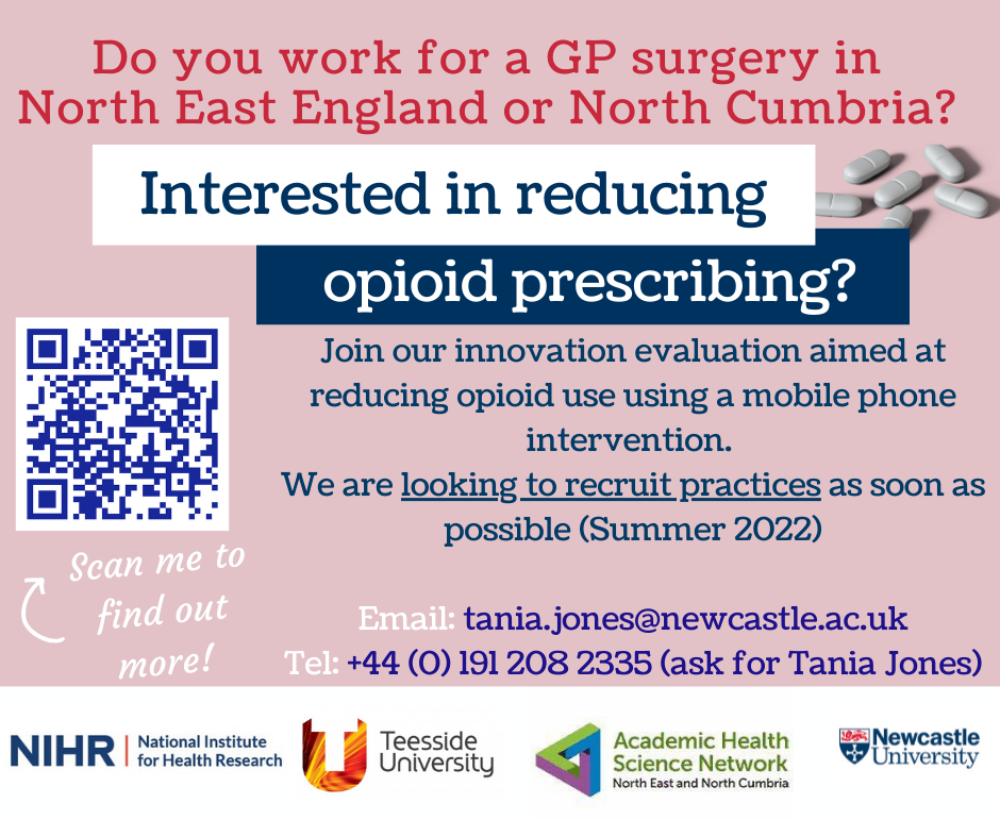
What is the intervention and can I see it?
The intervention is a short video designed and produced by a local GP which outlines the risks of using opioid medicines and benefits of reduction. It provides signposting for patients to supportive resources but also allows an option for the patient to respond to the invitation to reduce/stop opioids via SMS. If the patient wants to proceed, then they will be supported by a pharmacist opioid review and provided with additional resources approved by us. Unfortunately, at this time (Aug 2022), the video is still being refined and edited, so we cannot share it yet but we will be happy to share it once it is ready.
When will the project start and how do I sign up my practice/PCN?
We will be looking to gradually scale up the project, starting with a few early adopter practices initially, then this will be gradually expanded through into early 2023 and beyond. We are maintaining a database of all practices interested in joining and will be contacting you again, but please be aware that the project will be starting off slowly, so it may not be possible to recruit all interested practices in the initial phase. Please do bear with us!
Recognising the summer is now well underway and the holidays have started, we hope to have the first pilot practices engaging with the project by October 2022.
To express an interest in joining the project, please contact the study co-ordinator, Tania Jones via email: tania.jones@ncl.ac.uk. If you would like Tania to call you to discuss further, please email your contact telephone or leave a message with the Newcastle University Pharmacy School Office on 0191 2082335.
What sort of data do you need from us?
The project has both qualitative and quantitative research elements. For qualitative, interviews will be held remotely via Zoom/Teams with patients and staff members using the video intervention to ascertain barriers and enablers of adoption for the video intervention. I will personally be conducting all interviews for each practice. The plan is to have initial interviews conducted by the end of 2022.
Quantitative analysis of ePACT2 data will be conducted using searches designed for use with SystmOne and EMIS and will be analysed on a monthly basis by our research team.
What will the workload be like for practice staff?
We envisage that initially, the pilot practices will need additional support from us, in order to run searches (admin support) and to provide patients with clinical support to help with opioid reduction (pharmacist). Therefore, there will be some funding from us to provide initial support by means of a clinical pharmacist and admin team member on a part-time basis. We will also be providing some training resources for healthcare professionals around managing opioid reduction and a training webinar to deliver to enrolled practices. If more training is needed following early adoption, we will provide that too. After initial rollout, the reviews may be done as part of a structured medication review service, following the training. Further funding information will be shared with you in the next month once we have a better feel for the numbers of practices we want to start with.
What will patients receive in terms of support?
Patients will be provided with links to web resources approved by our team and an opportunity for a medicine review with the practice pharmacist/nurse who will have received training from us about opioid reduction. They will also receive a leaflet about opioid safety which has been designed by a patient with lived experience of opioid use.
Is this a portfolio-adopted study by the local AHSN? What ethical approvals are in place?
Unfortunately not. This study is sponsored by the NIHR funding stream NIPP as outlined above. The study has been approved by the HRA & HCRW. IRAS details are available on request.
What happens after I have signed up?
Please keep an eye out for further emails from myself regarding the first phase of adoption.
Kind regards,
Tania