How my PhD journey shed light to my inner desires

In this blog, I will use my own experience as a PhD student to explain how it helped me decide and prepared me for my next career step.Most graduates out there don’t really know where to start when it comes to choosing a career. Online material and career advice can help, however the true experience of another person and the way they used this student time effectively is very, very powerful as a way to go ahead. Activia scholarship will help me achieve one of my short-term goals; to get training on how to edit videos and how to manage my own Youtube channel. The aim is to reach as many postgraduate students and/or graduates as possible and explore opportunities they have to develop skills and experience.

Different reasons may lead to the decision to work towards a PhD degree. Mine was purely to implement my knowledge to a research environment, particularly in order to get involved with clinical research (although a non-clinician). Doctoral studies can certainly be a challenging time, full of responsibility, heavy workload and limited time to keep a work-life balance. In return, such a qualification, with all the transferrable skills it entails, is well-respected in the job market, even if at times it may not a prerequisite.

Among different countries, universities and even supervisory teams, the PhD experience can be quite diverse. Nonetheless, the expectations are high and resemble those of a proper workplace environment. What I recently realised though is that when you’ve naturally treated your PhD as your job, you may be a step closer to pursuing post-doctoral fellowship.

Every University should provide multi-dimensional career advice to their students. Yet, there are still Universities in the western world who are too sceptical to mess with industry or don’t have the resources to do so and only provide general guidance about careers in academia. Moving on to different university environments can really broaden the horizons and put industry more in focus. Coming from an old-fashioned university, this is how, during my first year of PhD, I ended up considering how many opportunities industry can offer.

Interestingly, having a first-hand experience of a high impact research environment during my second year, with industry staying close as a collaborator and numerous teaching opportunities while technically still a ‘student’ blew up my plans to follow a career in industry. Others have also struggled to spot job descriptions that match their much specialised knowledge area (although they may still carry the full skills palette), even for a research-based job. Soon, I went back to academia, but this time, fully aware of the potential disadvantages over industry and the fact that only less than one in six ‘survives’ and ends up getting a permanent position.

My third year starting, I didn’t quite have the time to take up many opportunities to grow as a teacher as the priority was to complete my research work and disseminate it to the scientific community (and my examiners). However, I kept my eyes open and responded to every stimulation about alternative careers outside both academia and industry. Some examples I came up with were research institutes outside Universities, government organisations such as the NHS, national and international regulatory authorities and charity-based jobs for research dissemination. My numerous opportunities to grow as a researcher during my PhD would be relevant in any such position requiring critical and analytical thinking.

Then it happened to me. One day, during an informal chat with my supervisor in the corridor, I realised how great a role model he has been. Going back to my memories of my UG supervisor, tutors and professors I have met across my years in education, I realised how lucky I have been so far to meet and work with people who have truly inspired me. People full of passion and love to teach, people with ethos, respect and care for the youth. I was naturally jealous of their impact on my life. This really couldn’t take me anywhere else other than academia, where I could use every opportunity to inspire others, especially so young students, to join the club and help science advance more to serve its purpose of improving quality of life.

My time in academia has been vital to grow self-esteem. I had never considered myself having enough people skills to teach at school; a desire of my mother. Now, I have such a passion to get involved with clinical research and pass on my knowledge to the next generations that people skills just occur to me with hardly any effort.

Industry on the other hard is very appealing to most people, due to the money it offers and the multiple benefits companies promise. Permanent contracts are more often in industry and the work environment is normally closer to what most people think an idea environment should be. Normal working hours are easily maintained and employees don’t normally have to worry a lot about work outside the office. All these advantages are great, but when I realised I may not that kind of person looking for all these from my work, I had to sadly admit that my values are closer to academia.

In the middle of my third year, a proposal to continue for a post-doc came to complete my thoughts that this is where I should be now. Fully aware of the challenges and with my enthusiasm about clinical research and patient safety at its peak, I knew this was the ‘destiny’ I created for myself. My hard work and commitment had paid off, with experts in the field showing their trust and continuous support with this opportunity to get better, enhance my knowledge and mainly make a greater impact with my research dissemination.

We can always easily make up for the losses, if they don’t mean much to us. There is nothing wrong with thinking and even trying out different places to discover your favourite destination. And if you are one of those who are still looking for their dream, think about the emergency exit of the plane; it may be behind you!


This blog is submitted as part of the Activia training UK Scholarship scheme:
https://www.activia.co.uk/scholarship-uk

Good people skills; ticket to a successful career

Professor Sir John Burn has been appointed the new chairman of the Newcastle upon Tyne NHS Trust a week ago. Immediately after reading the news, I felt that great satisfaction flowing inside me, like I’ve always wanted to see this happening. Then, I remembered. The first day I met him after an honorary lecture he gave in a meeting. I was impressed!

I have met loads of successful people so far in my life. And I consider myself lucky for that. I always take some time to observe them before I talk to them. While introducing myself, I look them deeply in the eyes and try to understand what they might be thinking. However, I’ve never managed to read their minds as they end up saying exactly the opposite to what I was thinking.

I’ve spend a few hours trying to understand what makes them so successful and influential at the same time. I know their secret now; among being clever and hardworking and lots of others, they also have good “people” skills!

Communication

This may be the biggest asset in someone’s life, both personal and professional. Studies show that when a person is speaking, over half of what people understand is coming from body language and particularly the expressions of the face. Another 40% or so comes from voice and tone, with the actual words falling under the remaining one tenth. Without wanting to underestimate words, the picture always counted more anyway. And the picture we are making, while smiling, speaking passionately or transmitting our best energy to the audience is what impresses and convinces people about the real truth. Successful people have a unique way of communication; full of experience, knowledge and expertise without pretending to be robots and forgetting to be humans.

Trust

In order to convince your audience, you definitely need to present your logic and data upon which you based your conclusions. Or, you can simply allow your audience to trust you. Those two are linked, of course, but the latter required a lot more effort. Trust is something we achieve, it’s never given for free. It’s always connected to sincere people that present facts as objectively as possible and never fall under promises they can’t keep. If you say, it’s worth the money I’ll spend on it, you have to prove me wrong when I say I am not paying. Or vice versa.

Patience

People make mistakes. Those who know that, also know that mistakes, excluding only but a few, can be reversible one way or another. As always, you need time to assess what is right or wrong though. And this is where patience fits. All you have to do is concentrate, think clearly, act slowly and give it some time to “cook”. Like you do with your delicious cake. Or employees. Or PhD students.

Empathy

This is the last, but maybe the most important. It defines the connection you cultivate with the people that surround you. Empathy can be demonstrated when you show pure interest in others’ lives. For that, you can be as open-minded as it takes. A detail from a conversation you had last week, that concert ticket they wanted and you found it, the name of their pet or even the last time they said they needed your help. (Try not to freak them out with the last time they popped into the loo.) These little moments are all important to them, as it is your children for you. They show you care.


Hopefully, the title is clearer now. People skills make us inspiring. Success is mainly demonstrated by loving your whole life as it is today. Don’t forget to be human, kind and have a bit of humour as well. It might not be necessary, but it helps making each and every day special.


Submitted as part of the Activia training UK Scholarship scheme:

https://www.activia.co.uk/scholarship-uk

4 steps towards powerful research outputs

Research has been constantly criticised in recent years. It seems rather odd that while increasing efforts have been made to upgrade the regulatory framework as well as the level of research, we are facing more than ever research outputs and publications of low quality or even results of trials that still remain unpublished. However, there are some simple steps that could improve the published research outputs.

1. Reducing publication bias

First and foremost, research results, positive or negative, should be published without reservation. I often hear early-career scientists complaining about being constantly rejected by journals for their negative results that lack significance. Rarely will I find a well-known researcher publishing studies that failed to prove the hypothesis. Whole books have indeed been written about the publication bias.

Equally, protocols that failed because of not easily predictable parameters should also be reported so that similar attempts are avoided. One reason for this is failure to critically assess the prior literature and another is the unspecified statistical assumptions in the analysis of studies. A statistician should be consulted to calculate sample sizes that are required for the target power of study and to set the relevant assumptions from the beginning.

Negative results and unsuccessful protocols should be seen as equally important and we should always allow them to influence our decisions to conduct further research based on previous failed attempts, the same way as positive results urge further study.

2. Maintaining transparency in research publishing

Peer-review is powerful precisely because it is made by peers; scientists that know how to recognise high-quality research and well documented research results. Most journals today publish work that has been peer-reviewed by at least two reviewers. Selecting a journal in which low quality studies with obvious pitfalls have been published is all but good practice.

Moreover, transparency is well maintained when study protocols and data analysis plans are published well in advance. These should be in accordance with the published results when the study is completed and any reasons for deviation from the initial plan should be well justified. Most researchers should be happy to make the complete set of data publicly available, for the purposes of not only transparency but also meta-analyses. Study funders should grant access to detailed clinical data in response to legitimate requests from both researchers and regulators. These data-sharing initiatives are increasing more and more lately and should be supported.

3. Clinical trial results

Randomised clinical trials are a special category, as they are considered the gold standard in biomedical research. In reality, not all questions are answered with a clinical trial that includes an intervention. Observational studies are very powerful especially when they are well designed and bias is reduced. It is required by law that all trial protocols are pre-published at clinicaltrials.gov. Other details such as recruitment goals, data analysis plan and sources of funding are recorded as well. Funders and researchers should stick to their commitment to publish the (positive or negative) results within a timeframe after completion to inform next steps that might already be in progress (e.g. research funding applications for similar study).

4. Systematic reviews

Last but not least, systematic reviews are an incredibly powerful tool to assess the quality of existing evidence and identify gaps in current knowledge. Every large trial should be supported by a systematic review that justify its planning and of course its cost. Otherwise, there is a great risk that the particular study may not add much to the problem and therefore it won’t be cost-effective. Systematic reviews should be reproducible, peer-reviewed and according to the Cochrane standards.

Each and every new generation of researchers should feel the responsibility to maintain the quality of research that the scientific community demands. It is now more essential than ever that we provide powerful and undoubtable evidence simply because we rely a lot on it to make informed decisions in clinical practice and patient management. We are all involved so we should care!

Initially written for react magazine blog (http://reactmagteam.wixsite.com).

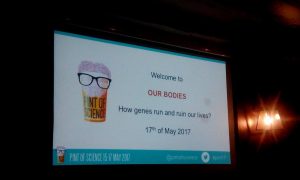
How genes run and ruin our lives: Pint of Science

Obesity, dwarfism and intellectual disability. Can you guess what they have in common? I couldn’t either before the 17th May when “pint of science” brought all three topics in one evening and explained “how genes run and ruin our lives”. Three local scientists, mainly PhD students, gave three wonderful presentations explaining the interaction between genetics and environment in the context of various diseases. Diseases we still struggle to fight in the 21st century.

 a 18838646_10207203752611524_381821069_o

Obesity, a modern pandemic, is the result of multiple factors such as exercise, quality of mitochondria, DNA mutations in mitochondria, nuclear DNA mutations and diet. Various myths around obesity and weight loss were refuted, starting from calorie-restricted diets that stress the cells and end up in the accumulation of fat instead of weight loss. Mitochondria are the energy-producing organelles of our cells. We inherit our mother’s mitochondria and therefore any mutations she carries are very likely to be passed on to the offspring. This is the idea behind three-parent babies, so that mitochondrial dysfunctions, such as the ones causing obesity, are not passed on to the next generations. Another factor is the problematic communication between nuclear and mitochondrial DNA that collaborate for the production of energy. Finally, exercise is important to maintain energy balance but is not enough to compensate for the genetic predisposition that obese people might have.

The second talk was related to people with deformities, such as hip dysplasia and osteoarthritis caused by dwarfism. The latter is a very rare disease and it‘s hard to study in humans therefore scientists use mice. Two mutations are responsible for funny-shaped proteins, stressed cells and skeletal abnormalities, however the main observation is their difference in autophagy activity. Autophagy is the mechanism for controlled cell death when the cells cannot get rid of defective proteins. This study is ongoing at the moment, but it helped us gain some insight in mechanisms that are involved in many physiological functions and when disrupted they have detrimental effects on development.

At the end, the almost exclusively female audience really enjoyed the talk titled “Should we mate with old men?”. In this talk, we explored the importance of age of both men and women in reproduction. The prevalence of Down syndrome increases exponentially when the mother is older than 45-50 years old. However, paternal age is also a risk factor for intellectual disability, with men passing one more mutation for every year older (i.e. 40 mutations at the age of 40). Freezing sperm is popular in the media nowadays, but we are not there yet. It is unknown why the consequence of mating with old men is intellectual disability, but it is possibly because brain function depends on numerous genes therefore there is a higher chance that it will be affected.

As you may have realised already, “pint of science” is an annual celebration of scientific development, with scientists organising informative sessions that aim to give the public a better understanding of the human body and resolve its mysteries with evidence. Join us next year to find more about the wonderful world of science!

8 tips for effective time management during exams

Exam periods are the worst, we all admit that. Especially after a Christmas break that lasted only few seconds in our minds. So many interesting and pleasant things to do, so little time. What shall we do with the unpleasant ones, though? Follow me to explore 8 ways to make the most out of your time of study.


  1. Prepare your notes early

I’ve always found myself panicked when starting studying for an exam. I was that student who would keep a notebook for one module and it would end up having notes for multiple modules (or even recipes). So, it used to take me 2 days to sort out what’s relevant and what’s not.

This is not a good example, so don’t follow my rule! If you are like me, tackle the issue early, always carry some blank notebooks or sheets with you, or start early! Before the end of the term, start working on your notes, numbering them according to the lectures, slides and further reading material available. It will save loads of time and won’t add fatigue to your shoulders during revision.

boro-gr

Source: http://www.boro.gr/


  1. Make a schedule

Start by setting the basic parameters of your revision, described by the following questions; “what module I am studying for each day?” and possibly (if you can) “what amount of the curriculum will I have finished each couple of days? ”. If you organise it by day, something will go wrong and you’ll be depressed from the first day of revision.

schedule-from-pexels

Source: https://www.pexels.com


  1. Follow the schedule and reward yourself

At the end of each day, whether it’s early or late, go back to your precious schedule and compare where you should be and where you are. If you’re close enough, you might consider continuing for another half an hour to reach your target. Otherwise, you might give up.

In any case, remember to buy some treats for yourself for each target you reach. Hopefully, it will increase your motivation! Oh and… ask your flatmate or friend to keep them, it’s always a better idea!

reward-4

Source: http://combiboilersleeds.com/


  1. Change the environment

Sitting on the same chair, looking at the same view and studying at the same place for a month won’t offer you something important you need during this period of time; visual memory.

visual-memory

I have always combined spaces with information. Something I did, the way I was sitting, the person or the wall in front of me were different while I was studying about this rare genetic syndrome. That’s how I now remember it’s symptoms. Don’t you believe me? Well, try it! Replace your desk at home, with the library, then a quiet cluster and then a different library. You’ll see it happening automatically, especially for information you don’t really care about.

study-space

Sources: https://quotesgram.com and https://play.google.com


  1. Keep the 10-minute break precise

One of the biggest rules of exams is a ten-minute break for every hour of study. This has been predicted from the average time our concentration lasts. Therefore, even if you don’t organise this break, you’ll have it in the form of not paying attention to what you study.

Keep your break short enough so that you don’t get totally out of the flow. Also, make sure it’s a proper relaxing break, so avoid stimulating activities such as playing video games.

Stay away from social media, as well. It can take hours to find the courage to close the “window”/app.

facebook

Source: https://quotesgram.com


  1. Prepare your biological clock

Different students choose different times of the day to study. I was one of those students who would start in the morning and would finish in the evening. Night was not my best as I always felt sleepy. It was important that I organise my lunch and dinner at reasonable hours to keep my brain up and running. I would wake up early and go to bed quite early.

If your daily routine differs, you would have to consider keeping it stable for the whole revision and exam period, as any changes would disturb your brain function and would take days for your body to adapt. For this reason, make sure you keep in mind your biological clock, without leaving behind your examination hours. Imagine staying up the whole night and struggling to wake up at 9am for your exam at 10am. NOT pleasant at all and probably impossible!

'I need to reset his internal clock...does anyone have the correct time?'

‘I need to reset his internal clock…does anyone have the correct time?’

Source: https://www.cartoonstock.com


  1. Fruits and chocolate vs salty snacks

Leave your favourite crisps in the cupboard and avoid hamburgers from McDonalds. Choose healthier options for your breaks. Fruits will help your body stay hydrated, without overloading your stomach and making you feel hungry all the time. A significant quantity, combined with yogurt, cereals and/ or chocolate will feel in the gap much better. Vitamins and minerals will help you stay focused, taking good care of yourself will increase your confidence and chocolate will definitely provide enough glucose for our brain.

  fruit

Source: https://www.cartoonstock.com


  1. Repeat before sleep

A final tip I always follow is exactly this: keep a note of the most difficult things, the ones you’ve failed to remember the whole day, then give it a read just before you turn off your lights (and brain) in bed. While asleep, you will subconsciously repeat it, you might even dream of it and in the morning it will be somewhere in your mind when you need it.


I know these might sound too much or impossible to implement. They are not! Certainly, there are few of them you definitely follow already. Your experience will show you the best way to study and that will be according to your results. So, think about these small details that make great changes and adapt them to your own study needs. Good luck with this and your exams and try the best for yourself.


good-luck

Source: http://giphy.com/


*Originally written upon request for the Newcastle University Students Union website.

What comes after Brexit?

Reading the news about the EU referendum “Leave” result was shocking, indeed. The next day was more uncertain than we thought, either “leave” supporters or not. Highlighted by Farage’s confession that the promise of £350million a week on the NHS was a “mistake”, Brexit caused even more doubt about what’s coming next.

Most of my colleagues at the University (MRes, PhD students and post-Docs) were against a Brexit and therefore disappointed. It would definitely cost a lot for Britain for current scientific collaborations and European grants. For research, it has always been proved better to work in large, multicultural and multidisciplinary groups. Personally, I believe that united we achieve more, we have the power of diversity and common goals connecting us.

pazzle

Source: http://kluwermediationblog.com/

Brexit caused much of anxiety to me and posed important questions. One of them was the future of EU students in the UK. Nothing has changed in my life and as far as I am aware, nothing is going to change dramatically in the next two years. We will go through a transitional period first. However, in my perception and after discussing with lots of friends in my country (Greece), I have realised that a great number of prospective students and graduates, especially doctors and engineers, have already started searching for other options. Although prepared to come to the UK for work or to start a degree and then stay to work, plans did change for many of them. Germany, Scandinavian countries and even the USA seem a more rational decision now.

When I first decided to come to the UK, there was no such thought as going to the USA when a leading country in research and science (UK) was so much closer to my home country. Today, this is about to change (and no one knows in what ways). Most prospective students consider the future visa issues and compare the opportunities, which can undoubtedly be more in the USA. This is a massive loss for the UK economy, apart from all the other problems including the drop of pound sterling and the general instability after the Brexit.

brexit

Source: http://voxeu.org/

Research students that had already started a degree and young professionals who worked here prior to Brexit are the least affected. They do consider other options for the future though. The possible introduction of stricter rules in crossing the borders, changes in the taxes for EU citizens and inequality in the workplace, which some people have already noticed, have all contributed in altering people’s minds about living in the UK for a long time.

Prospective students coming to Newcastle University have been reassured by the authorities that no change in fees will occur before 2018. I don’t see why students considering a one-year Master’s degree at Newcastle should cancel their plans. In fact, this is the right time to consider a one-year academic step forward, before any changes make it impossible to pay three times higher fees for a Master’s degree.

*Originally written upon request for the Newcastle University Students Union website.

Learning changes lives; my personal paradigm

Learning involves the acquisition of new or reinforcement of existing knowledge. The privilege of learning is possessed by humans, the fauna and the flora. Even by certain machines. Learning is present at every stage of human life and is essential for our survival. Nevertheless, its impact is evident in all aspects of our lives.

Mind-blowing experiences of learning; we all had some of these.

Learning has been the most important part of my life. Firstly, my personality has been largely shaped by different stages of learning. From a very young age, family taught me how to live with other people, take care of myself and how learning improves my life by making choices. In school years, I acquired an argument-based and logical thinking. This led to further appreciation of the means of learning, other than simple mimicry. Setting my personal goals was another step forward as a result of the opening of horizons by new knowledge.