OHD_DSN_0299 NT OH guide
Leave a Reply
Seaton Delaval Hall Oral History Strategy
V1
Hannah James Louwerse
1. Aim
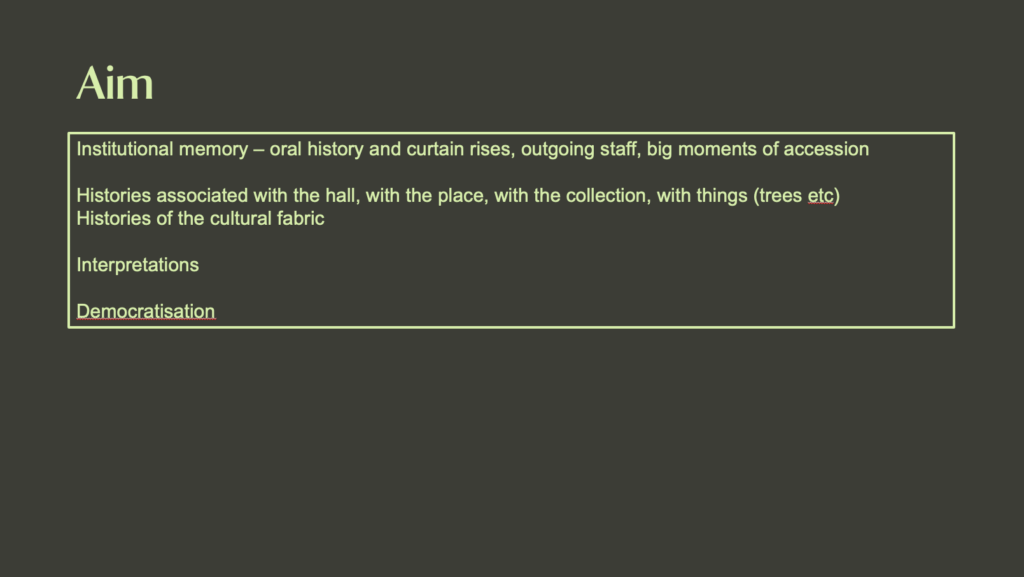
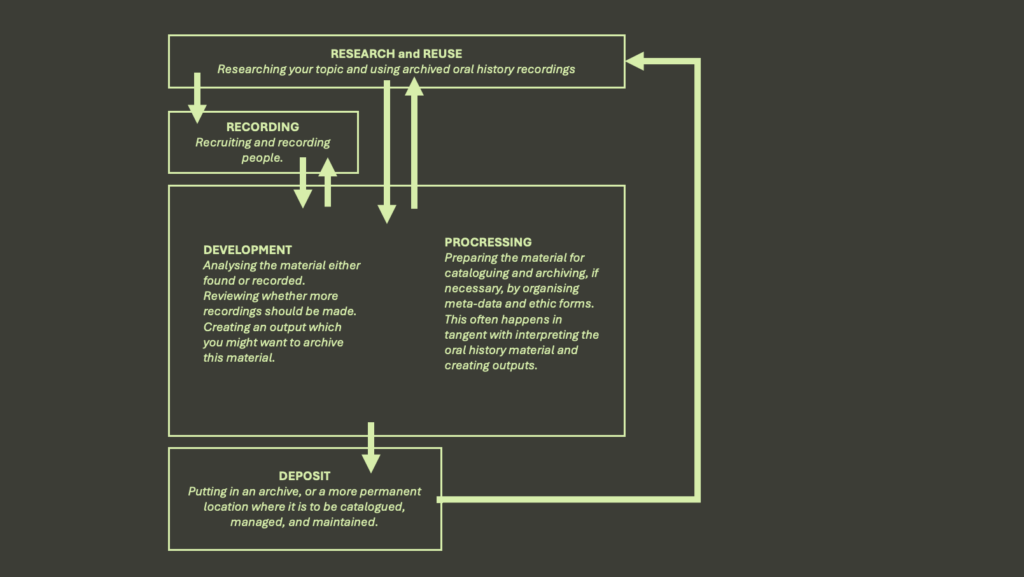
The overall aim of the strategy is to embed oral history practices into the Hall’s existing research activities to create an ongoing process of collecting, interpreting, and sharing oral histories.
2. Roles
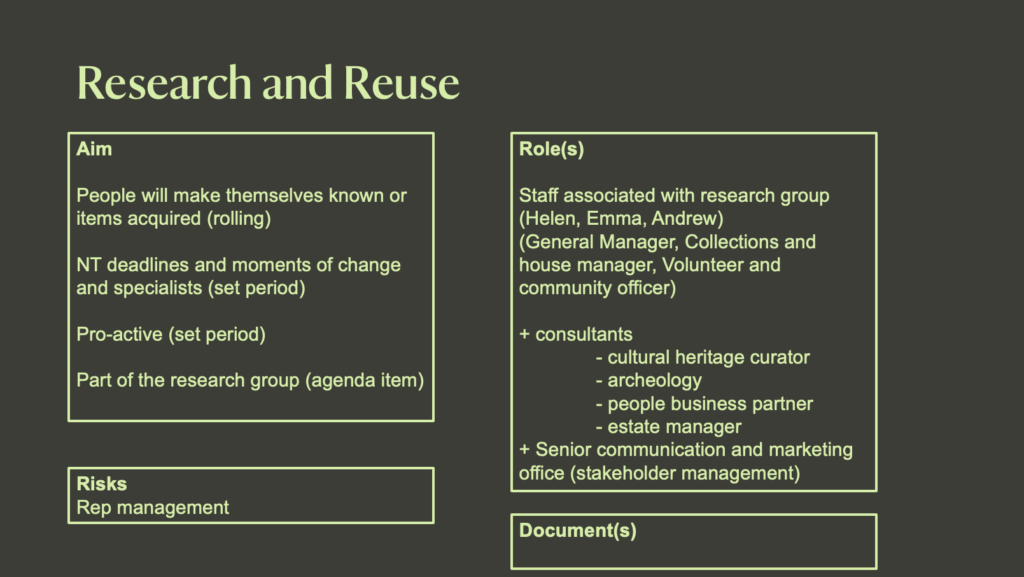
2.1 Core Oral History Team
The core oral history team consists of the General Manager, the Collections and House Manager, and the Volunteer and Community Officer. These members of staff already lead and support the volunteer Research Group. Their added responsibilities will encompass:
In addition, this group will make up the reviewing team in charge of checking sensitive content in both the archived and newly recorded oral histories. They will also lead the oral history review which will take place annually during a Research Group meeting.
2.2 Supporting Site Staff
Although the Senior Communication and Marketing Officer is not part of the core oral history team, their contribution is essential for the successful implementation of the strategy. They will advise the core oral history team in matters related to the Hall’s reputation and data protection issues.
2.3 Supporting regional NT staff
Identifying and recruiting candidates for oral history interviews will require drawing on the expertise of regional National Trust staff, such as people business partners, estate managers and cultural heritage curators in, for example, archaeology.
2.4 Volunteers
Conducting interviews, managing data, and transcribing or summarising new oral histories will to a large extent be executed by NT volunteers. Equally, they will play a vital role in the researching of the archived oral history recordings.
3. Collecting oral histories
3.1 Scope and Focus
There are two forms of oral history which the Hall is aiming to collect:
The recording accounts on the maintenance, restoration, and management of the site will help the Hall build an institutional memory. Collecting this information will create a collection of recordings which demonstrate the wide and diverse range of work done to preserve the site, its collection, and its history. It also avoids the loss of knowledge that occurs when an individual leaves the Hall. Histories of Seaton Delaval Hall’s cultural fabric will include recording information and stories about the collection, the hall, the gardens, and the surrounding area etc.
3.2 Pro-active Collection
The oral history is to be collected in a pro-active fashion, fully into the Hall’s knowledge gathering practices. Moments for potential collection are, for example, when a new item is acquired; as part of a research project; after restoration work; or when a significant person visits the Hall. More moments of collection will emerge as oral history gathering becomes a common practice on site.
4. Recording and processing oral histories
4.1 Training
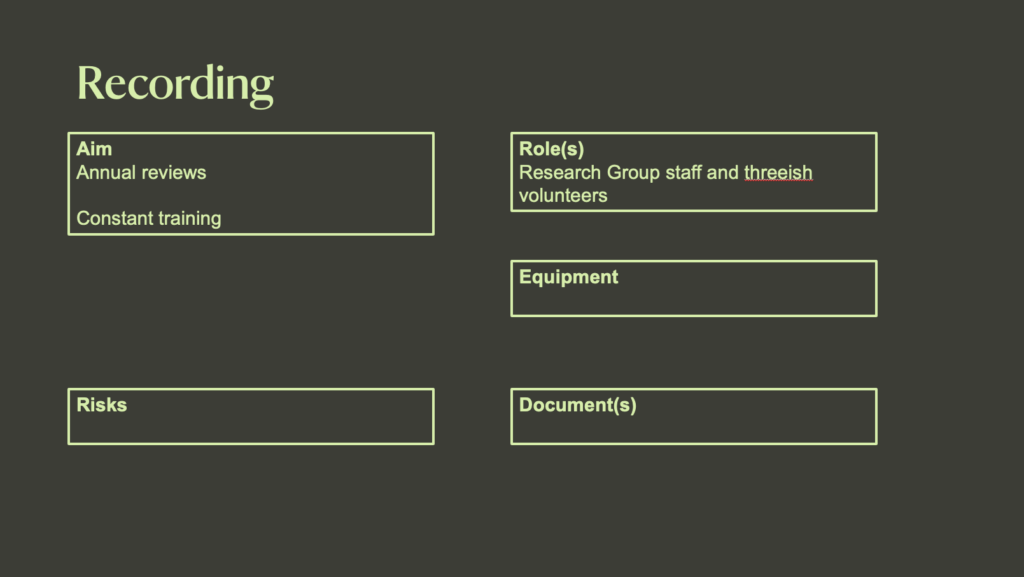
A handful of staff and volunteers can be trained in oral history interview techniques, processing the recordings, and analysing the oral history material. Training sessions should be arranged at regular intervals, e.g., every three years. An analysis of training needs and requirements will be reviewed annually during a Research Group meeting. The training can be done through the oral history society or through Northumberland Archives.
4.2 Interim Storage
An interim storage solution needs to be arranged with the IT Department and Data Protection Office. Both have specific requirements for digital devices and Microsoft SharePoint.[1] In addition, there are restrictions on what external devices can and cannot be connected to Trust computers. Until a solution has been arranged, it is best to follow two main principles of digital storage: keep the recordings in three different locations and ensure those locations follow data protection law.
4.2.1 List of stored material
All material listed here contains personal information.
4.3 Ethics
4.3.1 Paperwork
There are two ethics forms necessary to collect and archive an oral history recording:
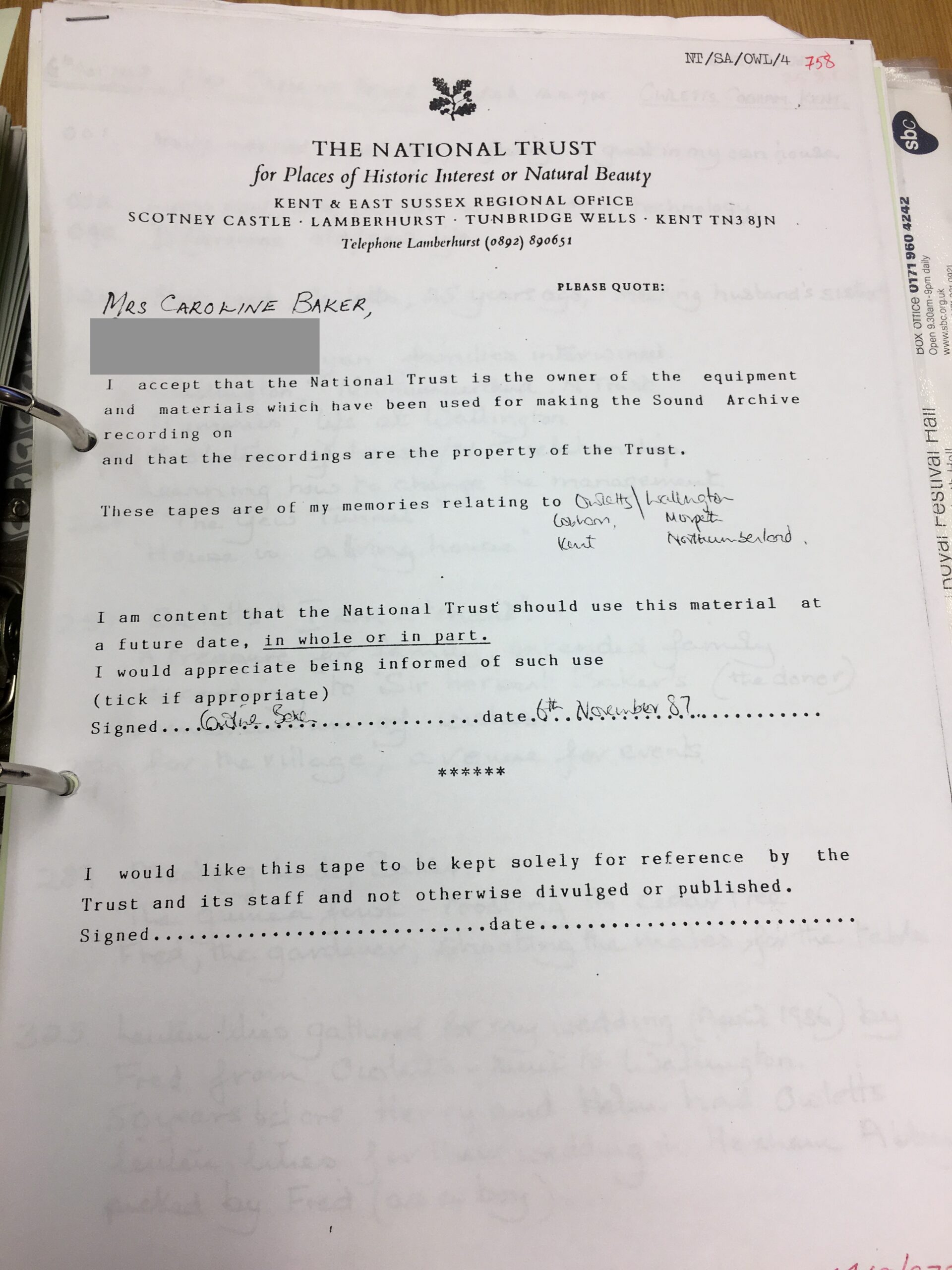
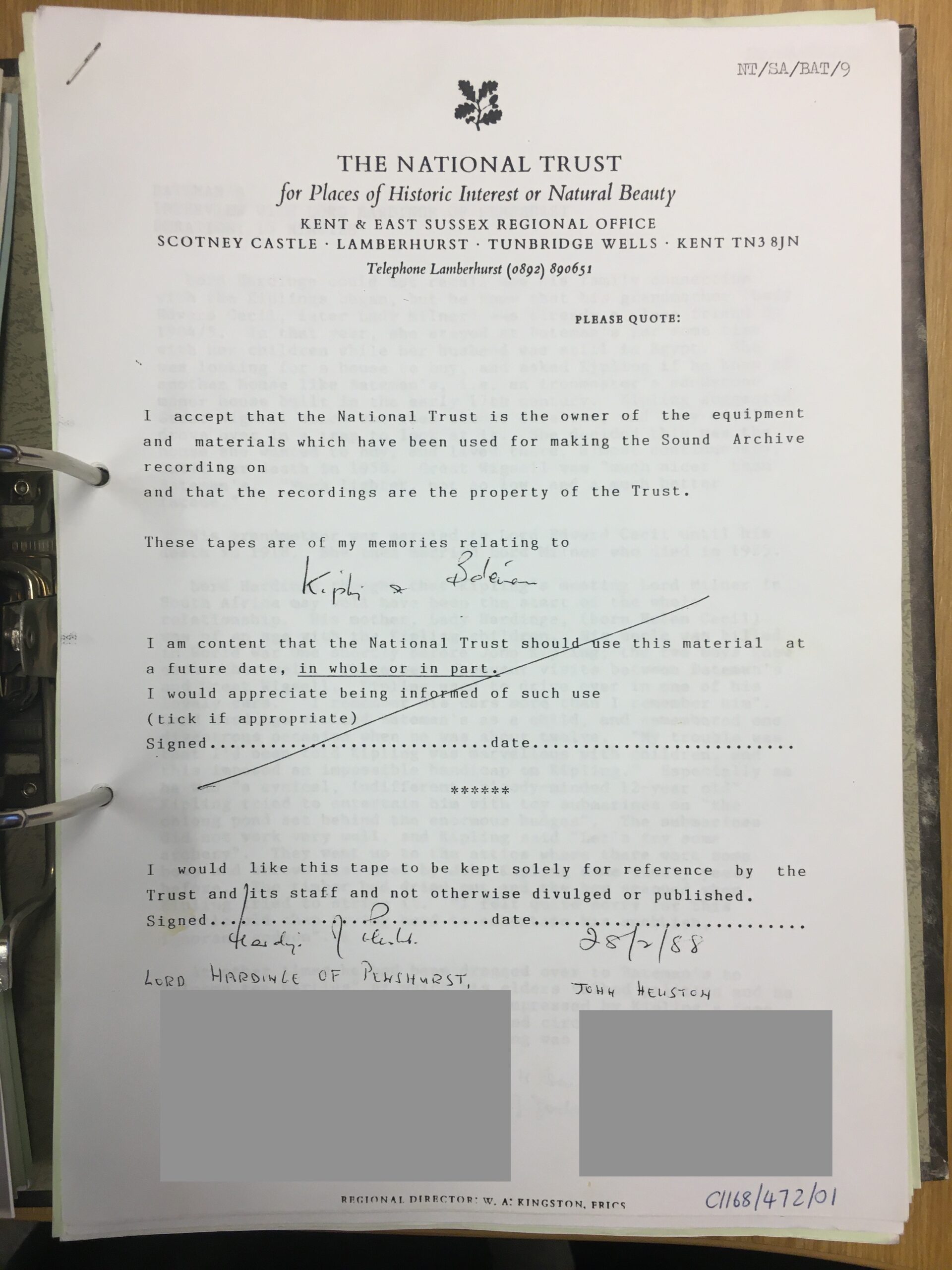
The Permission Form must be signed before the recording device is switched on. The Copyright and Reuse Form is signed after the interviewee has read the transcript/summary of their recording or has listening back to the audio. The Copyright and Reuse Form allows the interviewee to close all or part of the recording for a set amount of time. Note that both forms contain personal information and therefore need to be stored in adherence with data protection law.
4.3.2 Sensitivity checks
Sensitivity checks are the responsibility of the core oral history team. They will read or listen to the oral histories and assess whether there is any sensitive content. Sensitive content comes in two forms:
If the former is flagged by the core oral history team because they believe the interviewee might not want to share particularly information publicly, they should mention this to the interviewee before they sign the Copyright and Reuse Form. This may result in the interviewee wanting to close a particular section of the recording. If the team finds material which fits the latter, any sensitivity warnings should be added to the index.
4.4 Indexing
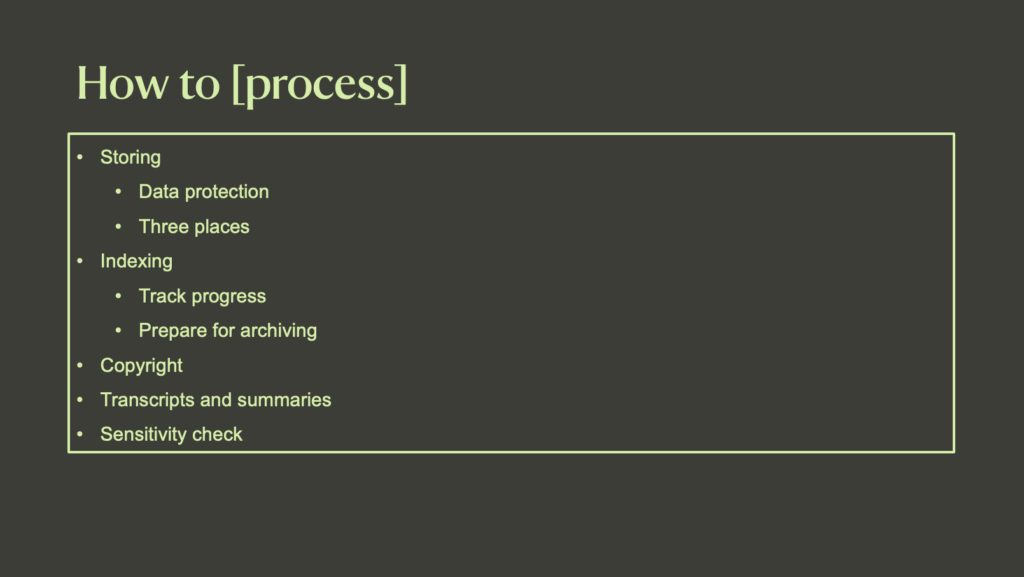
The spreadsheet created for indexing the Hall’s oral history recordings allows for easy tracking of progress and searching. It is also compatible with the British Library’s method of cataloguing in case the recordings are at some point donated to the British Library. The index contains personal information and therefore needs to be stored according to data protection law.
4.5 Transcripts and Summaries
The strategic aim is to create both a transcript and a summary for each oral history recording. Transcripts are essential if the audio file is lost or is corrupted. Interview summaries allow for content to be described in more searchable terms.
5. Archiving
Oral history recordings can be archived at Northumberland Archives. However, backup copies should be kept at the Hall in case the recording is also archived at the British Library. This is especially crucial since Northumberland Archives only excepts MP3 files and the British Library requires WAV files.
6. Reusing oral histories
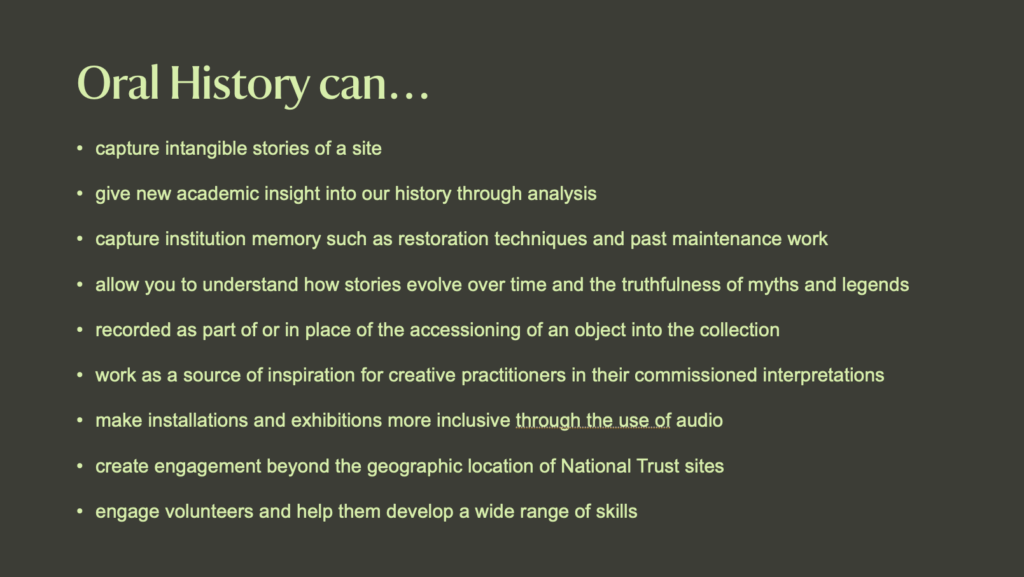
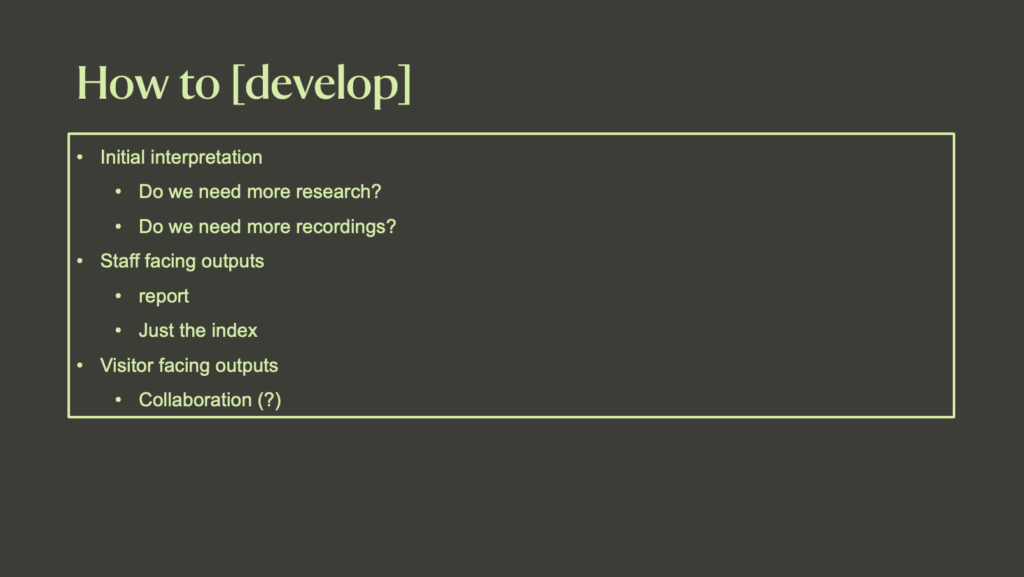
In connection with the Hall and the collection, oral history can be used in interpretations and exhibitions. In addition, new staff or contractors can access the hall’s institutional memory and learn about their predecessors and their work by listening to the stories shared. The overall objective is for oral history to be a fully integrated and accessible resource, equally available for consultation as any item in the collection.
[1] For example, the IT department does not want WAV files to be put on SharePoint because they are very large, while the Data Protection Office requires all personal data to be stored on SharePoint.
There were two main aims for the placement at Archives at NCBS. The first was to investigate and formulate how archives handle access to material while taking into account a multitude of factors from copyright to data protection to sensitive content. The second aim was to experience and understand the culture of a young archive. Archives at NCBS has only existed for four years which is considerably less than my partner institution the National Trust.
The first aim, surrounding access in the Archives, manifested into two mini projects. The first was creating a takedown policy and the other was developing a sensitivity check. The former had three iterations with the first version containing a basic spiel on how a visitor of the archive can contact the Archives to request material is to be taken down. The following versions expanded into a fully formed how-to guide on a takedown process and included a variety of reasons for and against takedown, ranging from copyright, defamation, and changes in the law. In addition, the final version was expanded again to become a takedown and alterations policy, meaning this process could be used by visitors and archive staff to make and document any changes to the archival material. The other mini project, the sensitivity check, only required two versions as a lot of the research done for the development of the takedown policy could also be applied to the sensitivity check. The sensitivity check ended up being a two page document which is to be used during the cataloguing process in order to clear non-sensitive material to be put online as soon as digitised. This is to ensure the Archives is able to make material accessible to the public as soon as possible after accession. What I learnt from this work is how the various ethical questions which surround archival material are woven into the entire process of acquisition and cataloguing. This principle was then used during one further activity developing a framework for an acquisition and cataloguing workflow.
The second aim of the placement was to experience and understand the work culture at Archives at NCBS. Initially there were no distinct activities attached to this aim, although during the Archives annual away day I did end up creating some activities. These activities were designed to get the archiving team to bring together their individual thoughts on the Archives and get everyone on the same page. One of the activities also helped the team to discuss their gripes and praise with and for the work environment of the Archives. Overall my experience at Archives at NCBS led me to conclude the Archives has two distinct identities the first is a public archive and the other is a knowledge hub for the development and innovation of archiving methods. However these two identities require very different work environments, which can cause stressed and disfunction under the staff if they are not managed correctly. The Archives therefore needs to review and reflect on how they manage these two different types of workloads across the team.
The aims of the placement at British Library were:
For the first aim I did an audit and presented my findings in a spreadsheet. The creation of this audit included searching through both analogue and digital files. The audit has given the staff at The British Library a better idea of what material still needs to be catalogue, digitised, and ingested, and which recordings need be to prioritise within each of these. For example, I found a handful of mini-discs which are harder to digitise then cassette tapes. The second aim of the placement lead me to create another audit, this one specifically about the copyright status of all the recordings in the catalogue. This was a long and tedious process which took up most of my time during this placement. It required me to be very thorough and rigorous as I had to repeatedly go through the recordings accompanying documents in order to check and double check whether the recording had copyright or not. In the end the auditing process produced one very large spreadsheet, containing information on all the recordings, and a spreadsheet for each individual National Trust property which had a recording without copyright. In addition to noting whether a recording had copyright or not I also had to work out whether an item could be an orphan work. Doing these two audits help me better understand the workflow within an archive and what is needed to make archival material accessible. In addition, to these two audits I also created a guide to what I had done so the person who next works on the National Trust’s sound collection can easily understand what I did and why. This was a very helpful exercise as it made me think about how you might communicate across project periods or other long periods of time and ensure work and information is not lost or repeated.
Overall this placement gave me a better idea of The British Library and the National Trust’s relationship surrounding oral history story. The National Trust sound collection is the second biggest in the archive and the recordings span nearly 40 years, so there is a great variety in needs when it comes to preservation and steps to make material accessible. The work I did while on this placement has become a foundation for further projects based around the National Trust sound archive, including the further cataloguing of analogue and digital material, and the development of a three-month PhD placement which will involve developing a workflow for National Trust sites to obtain the correct copyright forms and help The British Library in getting closer making the recordings publicly available.
Finally, I also wrote a report on the status report on the collection to share with both National Trust and British Library staff and have also written a blog post on the contents of the collection after I spent the last week listening to a handful of recordings.
The Methodology Bit – Version One (very bad draft)
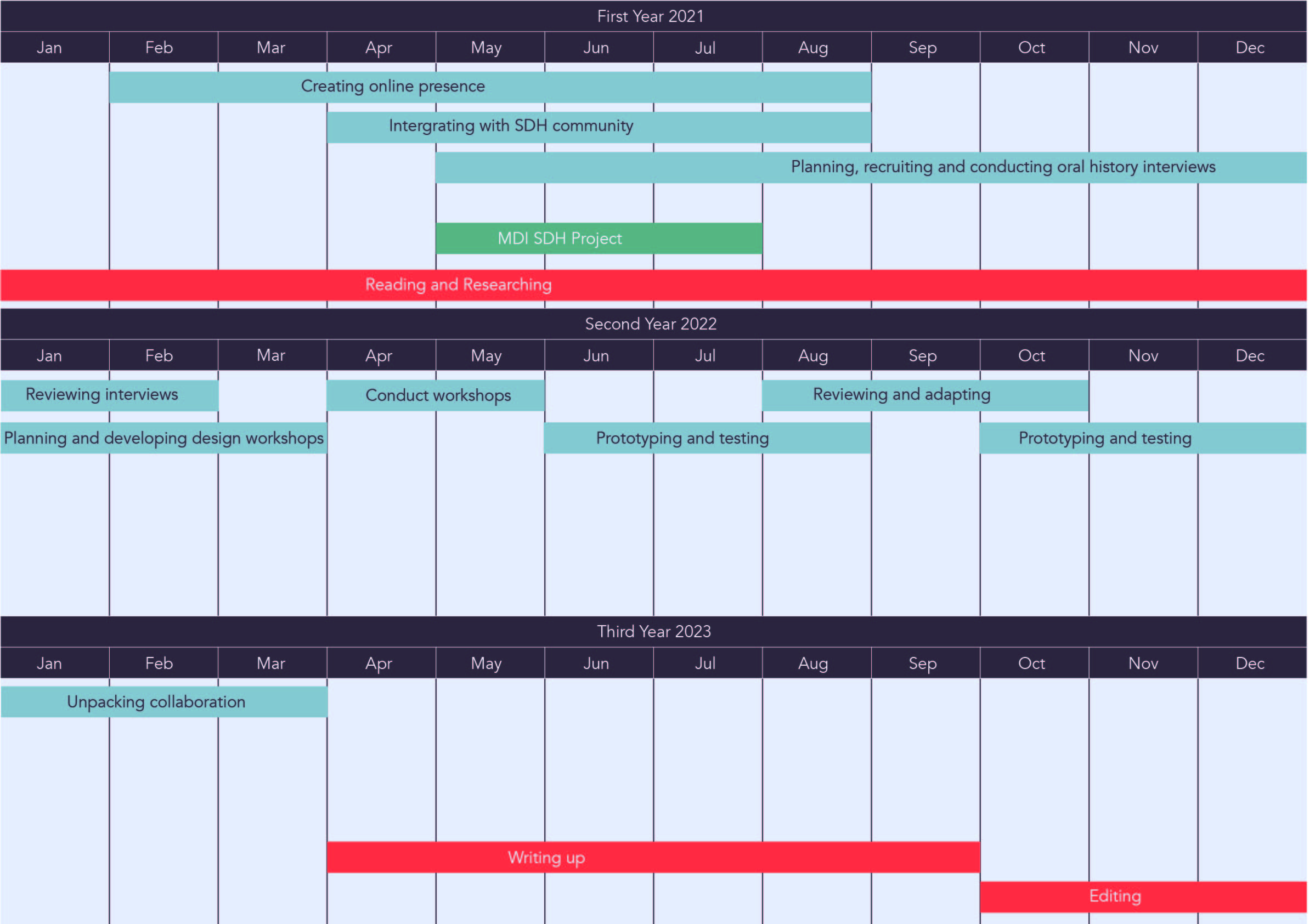
The above graphic was my initial project timeline. To say this is not how the project eventually played out would be an understatement. Both the initial chosen design methods and what I was intending on designing turned out to be highly inappropriate for the situation I was designing for. The central aim of my project was to develop a solution to encourage the reuse of oral history recordings, a problem infamously dubbed “the deep dark secret” of oral history (Frisch, 2008, p. 00). I was specifically looking at how to solve this deep dark secret with public history institutions, museums, heritage sites etc. My case study was the National Trust property Seaton Delaval Hall just north of Newcastle. I assumed I would make some kind of software or product to help ‘solve’ this issue, which would involve creating a prototype and then testing it out. However, within the first year it became apparent my plan was not going to work for two reasons. Firstly, my testing ground, Seaton Delaval Hall and National Trust were very risk adverse. The structure of the property and the National Trust in general is not a space where radical change or experimentation can happen easily, stability is key. Secondly, after researching the previous attempts of trying to solve the problem of oral history reuse, I realised me creating a new product was not going to work. There was something more fundamental that was being overlooked – maintenance.
Although there is little written on how certain attempts failed, what was written nearly always referenced how after the project money ran out the software or website fell apart (Gluck, 2014; Boyd, 2014, p. 9). This issue of oral history reuse is not about snazzy interfaces but about maintenance, politics, and wider complexities of institutions. Therefore, maintenance became the lens through which I did my project, specifically the way the performance artist Mierle Laderman Ukeles describes maintenance in her Manifesto for Maintenance Art 1969!. For Ukeles maintenance is: deeply undervalued in society; consist of many interconnecting boring tasks; and cannot afford to radically change (Ukeles, 1969). All three of these properties, but especially the latter two, led me to seek a methodology which could handle complex issues and be sensitive to the environment it is designing in, as I mentioned before the National Trust and the hall were risk adverse. I landed on Research through Design, a relativity young design methodology where the focus is not the creation of a product but creating new knowledge by using design methods (Stappers and Giaccardi, 2017). In my particular case this new knowledge would create a better understanding of how oral history recordings are/can/should be maintained. This in turn might lead to the development of more appropriate solutions to the deep dark secret of oral history.
I will unpack the concept of Research through Design or RtD and how it functions within the context of my project. Since the field of design is broad and there are the various interpretations of RtD, I will focus on the use and understanding of RtD within the field of Human Computer Interaction or HCI and Interaction design or IxD. HCI and IxD handle information technology and my work addresses the management of archive material, which is a form of information. Therefore, borrowing from HCI and IxD feels appropriate because their main purpose is to understand and design for the relationship between humans and their technology, which within my project can vary from analogue archive index cards to online catalogues systems. I will explain how RtD is explicitly suitable for researching and understanding maintenance systems, through its use of simultaneous problem and solution development, which originates from Rittel and Webber’s concept of ‘the wicked problem’. Following this I will focus in on what design methods I used as part of my research to generate knowledge. I will also explain how this knowledge and research is then presented in a way to demonstrate rigour.
Understanding RtD
RtD is a relatively young concept and it currently does not have a fixed methodology, which seen by some as a positive and some as a negative (Gaver, 2012). Although there is no strict definition of RtD there is consensus that, firstly, RtD as a method is excellent at handling complex problems, and secondly, the goal of RtD is to produce knowledge (Zimmerman et al., 2010, p. 311; Stappers and Giaccardi, 2017). The former is helpful to me because I am looking at the maintenance of oral history recordings in public history institutions. The latter is helpful because I was unable to do any thorough testing of prototypes as was originally planned, instead I will create knowledge which can help individual public history institutions understand and handle their own versions of the oral history reuse issue. To start with let us investigate the how RtD helps us understand maintenance infrastructures, and then move to looking at how creating knowledge is more appropriate for tackling this issue.
Wicked problems
RtD, like many other methodologies in design is focused around solving complex or ‘wicked’ problems. The term ‘wicked problem’ comes from the paper, Dilemmas in a General Theory of Planning, by Horst Rittel and Melvin Webber. The origins of the wicked problem come from the 1960s where designer shifted from exclusively thinking about the product they were designing to thinking about the systems around the products and the wider systems of our society. These systems of our society were becoming increasingly complicated due to the rise of more complex technologies, and increased awareness of societal inequalities and the emergence of Post-structuralism, which challenged the idea problems could be defined in an objective manner (Bayazit, 2004, p. 17; Rittel and Webber, 1973, p. 156). What became apparent was how the Newtonian and more scientific problem-solving methods and theories used in the early half of the Twentieth Century could no longer handle the complexity of the post World War Two problems (Rittel and Webber, 1973). The types of problem which could be solved using this method, where a problem is easily defined, and solutions either fail or succeed, Rittel and Webber refer to as “tame” or “benign” problems. And the complex problems appearing in the latter half of the Twentieth century are referred to as “wicked problems”. Wicked Problems are societal problems involving multiple stakeholders and are of a complete opposite nature to benign problem. They are extremely difficult, if not impossible, to define and there is no correct solution, only ‘better’ or ‘not bad’ solutions (Rittel and Webber, 1973).
Through their explanation of the properties of wicked problems Rittel and Webber do give a simple structure to the ‘solving’ of wicked problems – simultaneous problem and solution(s) development. This has become the basis of much of design research in the last fifty years including RtD. The idea of passing between the editing of the problem definition and creating solutions is a way to continually challenge the underlying assumptions made during the initial formulation of the problem (Zimmerman, et al. 2007, p. 495). In order to understand why the wicked problem, simultaneous problem and solution development, and the continuous challenging of assumptions is helpful in the context of reusing oral history recordings within public history institutions, you need to understand the nature of maintenance.
The invisible web
In Ukeles’ manifesto there is the line: “Maintenance is a drag: it takes all the fucking time (lit.) The mind boggles and chafes at the boredom” (Ukeles, 1969). Maintenance and how it works is boring. The sociologist Susan Leigh Star makes a call for the study of boring things in her paper the Ethnography of Infrastructure, and although Star does not directly use the word ‘maintenance’ in her work, her idea of infrastructures has been used to better understand and unpack maintenance (Graham and Thrift, 2007). There are several of Star’s infrastructure properties which can help to understand maintenance infrastructures, such as:
However, it is specifically the “invisible quality” of an infrastructure, where the idea of wicked problems and simultaneous problem and solution development come in.
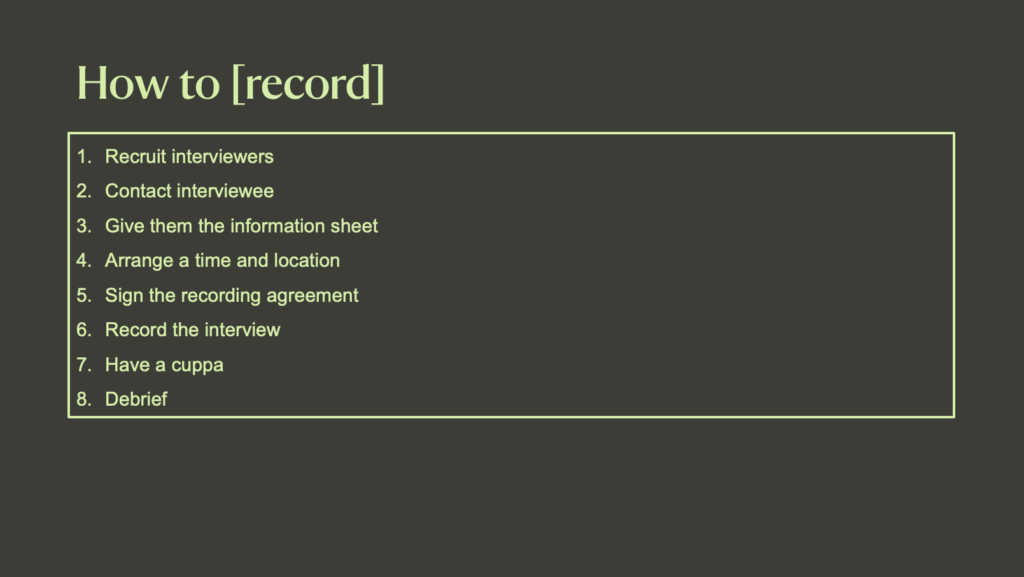
A maintenance infrastructure is a wicked problem. It is a complicated web of interconnected elements which is slowly, yet consistently, evolving in order to hold off any collapse. It is made up of technology, people, and their actions or labour which stops breakdowns from happening (Graham and Thrift, 2007, p. 3). These three aspects can be invisible in one way or another. Technology becomes invisible because it is buried underground like pipes or is suspended high above our heads like telephone poles. People can be invisible because maintenance workers are made invisible by either the location or the time the work takes place. For example, domestic workers stay in private homes and commercial cleaners work outside opening hours (Star and Strauss, 1999, p. 16). Within the context of my project the technology and the people are both invisible because the majority of work happens inside the closed doors of a storage space or office. The work associated with the maintenance and keeping of historical items, like oral history recordings, has always been invisible, however, like everything else, it has only gotten more complicated with the rise of technology. Technology has, in a way, opened up the storage space through the creation of digital archives, but this has also buried all those who maintain historical material deeper behind screens and servers. Actions or work can also be invisible. This is often emotional labour or other forms of care. A nurse is a great example of such a worker, because their work with patients is often “taken-for-granted” due to its completely intangible nature (Star and Strauss, 1999, p. 15). Oral history also has elements of invisible emotional labour because it relies on living humans to tell their stories. In order to ‘extract’ these stories the oral historians have to make the interviewee feel comfortable, which often involves many cups of tea.
In addition to the three main elements of a maintenance infrastructure being invisible in one way or another the outcome and function of a maintenance infrastructure also somewhat invisible. The main aim of a maintenance infrastructure is to keep things from decaying (Graham and Thrift, 2007, p. 1). However, because the product of the labour is a lack of decay it is difficult to quantify since there is no measurable outcome, only the absence of something, making it invisible. Everything about a maintenance infrastructure, the technology, the people, the work, the outcome, can or is invisible. These various elements are invisible in different ways making it additionally complicated. To solve the issue of oral history reuse in public history institutions we need to understand and map its maintenance infrastructure. This maintenance infrastructure and how it comes together is a wicked problem and the mapping of this maintenance infrastructure is equivalent to defining the problem in simultaneous problem and solution development. But in order to map the maintenance infrastructure we need to make it visible. Luckily how one makes an invisible infrastructure visible is relatively simple — you break it.
“The normally invisible quality of working infrastructure becomes visible when it breaks: the server is down, the bridge washes out, there is a power blackout.” (Star, 1999, p. 382).
You can see this with the previous attempts of solving the oral history reuse issue. Those who have written about it state how the eventual collapse of the website or software revealed how much the systems relied on the maintenance of digital systems (Gluck, 2014; Boyd, 2014, p. 9). The breakdown of the solution developed by these projects revealed part of the maintenance infrastructure for their particular situations. However, the information was only discovered after the project was finished, therefore the information could not be fed back into problem development.
Breaking the maintenance infrastructure to gain information for simultaneous problem and solution development is not an option; the system must keep maintaining. This is one of the reasons why the National Trust and Seaton Delaval Hall were worried about me widely testing prototypes, they were apprehensive to anyone who might disturb the delicate equilibrium they have in place. As I mentioned in the introduction the National Trust’s aversion to risk and testing, and the history of attempts to solve the oral history reuse issue led me to move away from designing a product. This is where RtD becomes different to other forms of design methodologies which also used simultaneous problem and solution development, because instead of creating a product or some other form of full realise system, it creates knowledge.
Knowledge, not a product
To understand why RtD focuses on creating knowledge rather than a product and why this is helpful within the context of mapping maintenance infrastructures through simultaneous problem and solution development, we need to look at how knowledge is defined within the terms, ‘research’ and ‘design’. Generally, research and design have often been pitted against each other, as Stappers and Giaccardi show in this table in their chapter Research through Design.
| Research | Design | |
| Purpose | General Knowledge | Specific Knowledge |
| Result | Abstracted | Situated |
| Orientation | Long-term | Short-term |
| Outcome | Theory | Realization |
Table 2.1 – In general, the terms ‘research’ and ‘design’ carry different connotations (Stappers and Giaccardi, 2017)
The definitions in the table above originate from the different types of ‘knowledge’ produced by academic and vocational forms of design education. Within the former, the ‘knowledge’ produced is in the form of research such as theories, frameworks, and matrixes, which can be used by others. The latter’s ‘knowledge’ comes in the shape of more tangible products for very specific situations (Glanville, 2018, p. 14; Stappers and Giaccardi, 2017). RtD sits somewhere in the middle where it produces knowledge which can be used by others but this is still grounded in the specifics of real-world application (Stappers and Giaccardi, 2017). According to Zimmerman et al. the outcomes of RtD can vary from new design theories, frameworks or philosophies to artefacts offering a possible new future, to tools to encourage wider discussion in the field (Zimmerman et al., 2010, p. 311). However, the goal overarching of RtD is to produce knowledge used to simulate conversations with interested parties about possible futures (Zimmerman et al., 2010, p. 311; Stappers and Giaccardi, 2017).
The knowledge created is purposefully ambiguous to make it more transferable to other situations and to allow it to be flexible when change does come. People are able to take the knowledge and interpret it for their own specific situation (Gaver et al., 2003). This recognises Rittel and Webber’s idea that a wicked problem is never truly solved, and each variation of the issue is completely unique (Rittel and Webber, 1973, p. 162, p. 164). Its ambiguity means it is removed from its specific situation and time; therefore it allows room for slow implementation, which is again essential to maintenance infrastructures because there is little room for radical change (Ukeles, 1969, p. 2). If a product was being created instead of knowledge this would not work. Creating a product is akin to the design description in the table above, specifically fixed in one location and time, this makes it difficult for others to replicate or use in anyway. Within the context of my work making something which does not need to be implemented immediately and can be used by other public history institutions is more suitable than making a product which cannot even be tested properly. By not having to do thorough testing of a product RtD can help avoid breaking the maintenance infrastructure. However, RtD still requires some form of simultaneous problem and solution development which by nature of the method would require some probing of the maintenance infrastructure. By using less invasive design methods in RtD you can navigate the delicate maintenance infrastructure and still do simultaneous problem and solution development.
Plan for January conference/crit day – Version One
The day has been split into two halves. The first half will be more orientated towards the National Trust and any other public history institutions, while the second half is more focused on how to innovate and design solutions for maintaining archives. Both sessions will be online and will be recorded. I will also use a virtual whiteboard to document ideas, questions, and thoughts from the participants.
Morning Session – Oral history at the National Trust
Aim:
The general aim of this session to inform participants on the current status of oral history at the National Trust and to get feedback on some of my work which illustrates the various elements of oral history maintenance and see how this may translate over to the collection processes and policy at the National Trust.
Starting activity:
Everyone is asked to write down what they think oral history is.
Part one: Oral history at the National Trust up to now
In the first part of the session we will look at the current situation of oral history at the National Trust, starting with asking the group if anyone has done or has knowledge of any oral history projects done by National Trust sites. This will be followed by me giving brief history of oral history at the National Trust and information on the National Trust sound collection at The British Library. With permission from The British Library I would like to share the spreadsheet I made during my placement and get small groups to explore the catalogue for a couple minutes. We will then end this part of the morning with a quick “brain dump” where any thoughts, questions, ideas are shared with the wider group.
Part two: The future of Oral History at the National Trust
The second part of the sessions starts with me sharing my general breakdown of what is required to maintain an oral history recording. After this the larger group is split into smaller groups again and they are asked to think how this might work within the context of the National Trust. To give the groups a bit of structure they are encouraged to think of the 5 Ws and 1 H questions (Who, What, When, Where, Why, and How), then think how they might answer these questions.
Ending activity:
Everyone is asked again to write down what they think oral history is.
Afternoon Session – Innovation and design in archives
Aim:
The aim of this session is for me to share my experience and ideas of designing in archives.
The group will think about what it means for designers to work in archives but also what we mean by a “successful” or “good” archive.
Starting activity:
Everyone is asked to write down what they think an archive is.
Part One: What we learn from designer in archives?
In the first part of the session the participants are split into smaller groups which are a mixture between archivists and designers. Each group is given a scenario about maintaining access to oral history. They are then asked to think about what they would do in this particular scenario and as a group have to come with a plan. The plans are then shared in the larger group. They then go back into their smaller groups and are asked to think about whether the designers or archivists learnt anything from each other. After the smaller groups feedback again, I briefly talk about my experience of being a designer working in archives, specifically my thoughts on design and maintenance.
Part Two: What is a good archive?
Leading on from my thoughts on maintenance and design, the group is task with critically thinking what success looks like within archives. The group is first asked what they write what they think the value of archives is and are then given another scenario to discuss in their smaller groups. The scenario they are given is a world where everything can be kept and is accessible, all issues around digital obsolescence, copyright and data protection have been solved, but the climate crisis is threatening the stability of the storage systems, decay, and destruction of original material is inevitable. To give the groups some structure they are given a concepts and ideas matrix to sort their thoughts. After coming together as a big group again and feed backing, the whole group is asked whether the ideas and concepts they came up with reflect what they believe the value of archival material is.
Ending activity:
Everyone again writes what they think an archive is.
Version 2
Introduction to my PhD (General) – 15 mins
Story of the current collection PLUS values – 10 mins
Q and A – 5 mins to 10 mins
What value can oral history recordings give to the collections on sites? – 20 mins
Feedback – 10 mins
—————————————————— BREAK 5 mins
Issues with archiving and storing of OH at NT – 10 mins
Q and A – 5 mins to 10 mins
What resources do we need to make the flow from recording to archived easier? – 20 mins
Feedback – 10 mins
________________________________________ BREAK 5 mins
Legacy and knowledge transfer – 5 mins
Q and A – 5 mins to 10 mins
How do we make it easier to reuse oral history recordings? – 20 mins
Feedback – 10 mins
__________________________
Wrap up and thanks – 10 mins
Close
Workshop Blurb
A look into Oral History at the National Trust
Wednesday 31st Jan 2024
14:00 – 17:00
Online
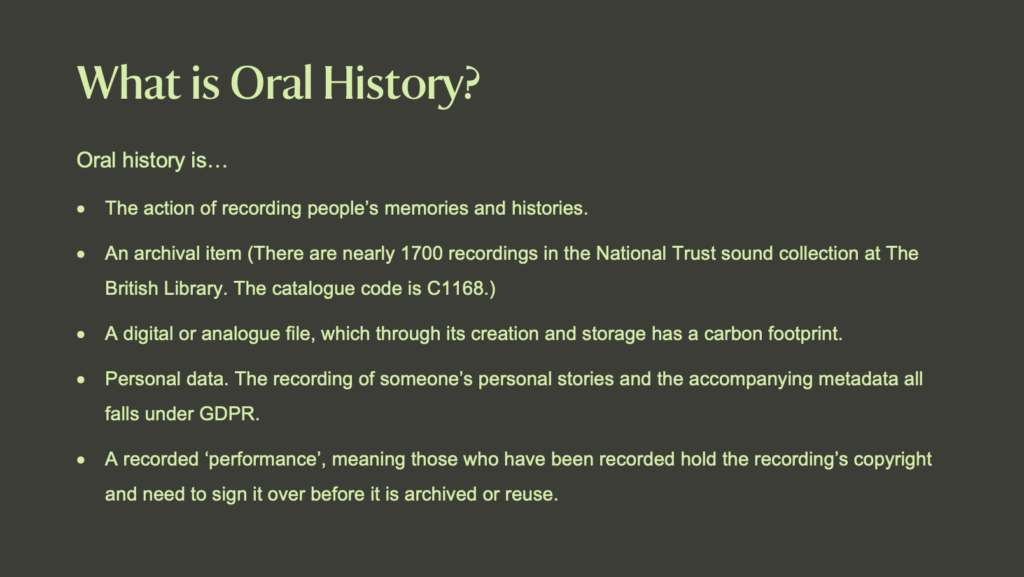
This workshop is a culmination of three years of research into the past, present, and future of Oral History at the National Trust. It will take you through the stories found in the sound collection of 1700 recordings archived at The British Library, and the experience of recording Oral History on a National Trust site today. It will also offer insight into the opportunities and obstacles of recording future Oral History at the National Trust. The workshop aims to create a discourse around the rich, yet awkward resource of Oral History, how it can enrich the stories told by the National Trust, and the practical side of recording, archiving, and using such a personal artefact.
Hannah James Louwerse is completing her Collaborative Doctoral Award at Newcastle University. Her project is partnered with Seaton Delaval Hall where she has recorded oral histories from the community. She also completed a placement at The British Library auditing the National Trust’s large sound collection.
| Collection name | Institution | Year | Info | link |
|---|---|---|---|---|
| The Radstock Museum oral history video archive project | The Radstock museum | 2003 | School children were trained in oral history. The made learning resources, an exhibiton, bookelt and DVD, because “ensuring the heritage is now better interpreted and explained for future generations.” (HFL website). On the website of the Radstock Museum I searched oral hsitroy in their online catalogue but got nothing back. | https://www.heritagefund.org.uk/projects/radstock-museum-oral-history-video-archive-project https://radstockmuseum.co.uk/ |
| Capturing the stories of London’s Chinatown | Chinese Mental Health Association | 2005 | “The project created 50 oral history recordings, the documentary How Far Do Leaves Fall?, and a children’s booklet, Dragons and Teacups. Over 30 volunteers developed oral history interviewing and recording skills. The project raised awareness of the heritage of the UK’s Chinese community nationwide. The project was so successful that CMHA went on to deliver another HLF-funded heritage project.” (HLF website) The website link on the HLF website is a dead link. I cannot find the website anywhere. NHS project A copy of the DVD is in the British Library. | https://www.heritagefund.org.uk/projects/capturing-stories-londons-chinatown |
| Capturing 1940s-1960s stories of Nigerian immigranst to Manchester | Afristar Foundation | 2015 | The made an exhibition and a documentary film. “Members of the Nigerian community are proud that these early memories are safely lodged in Archives+ at Manchester Central Library.” (HLF website) The website link on the HLF website is a dead link. I cannot find the website anywhere. I also struggled to find the original recordings in the Manchester Central Library | https://www.heritagefund.org.uk/projects/capturing-1940s-1960s-stories-nigerian-immigrants-manchester |
| Hadhari Oral History Project | Hadhari Project | 2011 | 36 young people were trained in oral history. They had formal launch event and an exhibition, a resource pack, and DVD. NHS project. | https://www.heritagefund.org.uk/projects/hadhari-oral-history-project |
| Rebellious Sounds Archive: women and activism | Dreadnought South West | 2017 | Funding from HLF was specifically for setting up an online archive. It is still online. On th ewebiste they have clips of the oral history recordings and most have transcripts. | https://www.heritagefund.org.uk/projects/rebellious-sounds-archive-women-and-activism http://dreadnoughtsouthwest.org.uk/rebellious-sounds-archive/ |
| 2016 Punk London project | Museum of London | 2016 | I found the punk porject because I search the Museum of London catalogoue for oral hsitroy recordings. And ther first recording said which exhibtion it belonged to. There were however other oral history recording which did not say what they were recorded for. | https://collections.museumoflondon.org.uk/online/object/952817.html |
| Cambodian Recollections | SEA Arts | 2014 | Project was run by Dayanny So and was supported by Hackney Museum and SOAS and the Khmer Arts & Heritage Gallery. They had an exhibiton, made a booklet and had workshops. The recordings are on youtube. 8 are free to view and 15 are hidden. There is very little meta data available. The recordings are not archived at Hackney Museum. SEA arts website is not registered anymore | https://www.heritagefund.org.uk/projects/cambodian-recollections-0 https://hyperallergic.com/221784/an-artist-collects-the-stories-of-cambodian-refugees/ |
| ARKive | Wildscreen | 2003-2019 | At the time of the launch ARKive was supported by some big dogs. It aimed to become the world’s biggest encyclopedia of on Earth. It closed in 2019 due to funding issues. “the complete collection of over 100,000 images and videos is now being stored securely offline for future generations” (yippy.life/brand/arkive) The porject had been mentioned in Review of HLFs Investment in Oral History Projects Final Revised Report | https://yippy.life/brand/arkive https://www.gov.uk/government/news/minister-announces-new-arkive-of-rare-wildlife-images https://www.stem.org.uk/elibrary/collection/2776 |
| Captive Memories | Liverppol School of Tropical Medicine | 2009 | An oral history project on Far East prisoners of war. They worked with a High School. They do have a page on the HLF webiste but no information is available except how much money they got. On the LSYM website I found a link to the Captive Memories website which is a dead link. The page also has a link to an episode of Radio 4’s woman’s hour. I have now found the Captive Memories website. It is .org.uk not .co.uk. The websiet has clips of oral history recordings. The project had been mentioned in Review of HLFs Investment in Oral History Projects Final Revised Report | https://www.lstmed.ac.uk/news-events/news/womans-hour-and-lstm https://www.lstmed.ac.uk/news-events/news/fepow-bamboo-garden-launched-at-ness https://www.lstmed.ac.uk/history/far-eastern-prisoners-of-war-fepow/captive-memories |
| African Heritage Initiatives: Contributions of African Migrants in Birmingham | Cameroon Advice and Support Service UK | 2009 | The project had been mentioned in Review of HLFs Investment in Oral History Projects Final Revised Report. They do have a page on the HLF webiste but no information is available except how much money they got. I can find very very lilttle on the project, but there is a book that was published. It was written by Frederick Ebot Ashu. I can’t be sure who he is. | https://www.communityarchives.org.uk/content/organisation/african-heritage-initiatives-contributions-of-africans-to-birmingham |
| Walking Proud in East London | River Cultures Festival | 2009 | The project had been mentioned in Review of HLFs Investment in Oral History Projects Final Revised Report. They do have a page on the HLF webiste but no information is available except how much money they got. Www.rivercultures.co.uk does not work, eventhough it is linked to LGBT archive. I found the recordings on youtiube with limited metadata. The last thing posted on the channel was 7 years ago. | https://www.heritagefund.org.uk/projects/walking-proud-east-london-revealing-lgbt-lives-and-memory-0 https://www.youtube.com/watch?v=j_JRA-4Q_wg |
| Celebrating Stornaway | Stornaway Historical Scoiety | The project had been mentioned in Review of HLFs Investment in Oral History Projects Final Revised Report. | ||
| The Past | African Heritage and Educational Centre | The project had been mentioned in Review of HLFs Investment in Oral History Projects Final Revised Report. | ||
| Embracing Africe Project | The Highlife Centre LtD | 2015 | A project where they collected objects and historical information. The made an exhibiton, a website amd a festival. The project had been mentioned in Review of HLFs Investment in Oral History Projects Final Revised Report. No sign of oral history recordinsg on the webiste. | https://www.heritagefund.org.uk/projects/embracing-africa-project |
| Hidden Minds: The untold heirtage of Shenley Asylim | Mind in Harrow | 2011 | The project had been mentioned in Review of HLFs Investment in Oral History Projects Final Revised Report. They do have a page on the HLF website but no information is available except how much money they got. They made a touring exhibiton. And I found on transcript extract. I tried to search the archives on the website but could not find anything. | https://www.heritagefund.org.uk/projects/hidden-minds-untold-heritage-shenley-asylum-0
Hidden Mindshttps://headstonemanor.org/the-collection/your-exhibitions/past-exhibitions/ |
| Steelos – Song of Steel | Rotherham Metropolitan Borough Council | 2008 | The project had been mentioned in Review of HLFs Investment in Oral History Projects Final Revised Report. They do have a page on the HLF website but no information is available except how much money they got. They made a documentary. There used to be a website. Project was not maintained. | https://www.heritagefund.org.uk/projects/steelos-song-steel https://www.kubrickslenscap.co.uk/documentaries/steelos-songs-of-steel/ https://www.webarchive.org.uk/wayback/archive/20121101114516/http://www.songsofsteel.com/ |
| Sharing Tongues: Black LGBT Oral Testimonies | Rukus! Federation | 2008 | The project had been mentioned in Review of HLFs Investment in Oral History Projects Final Revised Report. They do have a page on the HLF website but no information is available except how much money they got. A card leaflet advertising the porject is in the wellcome collection. The collection is in the London Metropolitan Archives. I looked through the collection list and there does not seem to be any oral history recordings in teh collection. | https://www.heritagefund.org.uk/projects/sharing-tongues-black-lgbt-oral-testimonies https://wellcomecollection.org/works/dgt2h2mf https://lgbtialms2012.blogspot.com/2012/06/sharing-tongues-black-lgbt-oral.html |
| High Fell – the Cumbria Landscape Story | Cumbria Wildlife Trust | 2010 | The project had been mentioned in Review of HLFs Investment in Oral History Projects Final Revised Report. They do have a page on the HLF website but no information is available except how much money they got. “The full length interviews will be available at Carlisle Archive Service in due course. A selection of interviews will be published on the British Library website. You can read the full descriptions online at the British Library’s Sound and Moving Image catalogue. The British Library collection reference is UAP026. The local reference is DSO-313.” (northwestsoundheritage.org) The website highfell.org.uk/listing does not work | https://www.heritagefund.org.uk/projects/high-fell-cumbria-landscape-story-0
High Fell – the Cumbria landscape story High Fell – The Cumbria Landscape Story |
| Therapeutic Living With Other People’s Children: An oral history of residential therapeutic child care, c. 1930-c.1980″” | Planned Environment Therapy Trust (also knowned at the Mulberry Bush) | 2009 | The project had been mentioned in Review of HLFs Investment in Oral History Projects Final Revised Report. They do have a page on the HLF website but no information is available except how much money they got. This is an archive. Planned Enirvonment Therapy Trust was dissolved in 2018 and was moved to the Mulberry Bush Organisation. There a catalogue entry indecating a full collection. | https://www.heritagefund.org.uk/projects/therapeutic-living-other-peoples-children-oral-history-residential-therapeutic-child-0
Planned Environment Therapy Archives and Special Collectionshttps://archives.mulberrybush.org.uk/ |
| Heritage Plus | Women’s Royal Voluntary Service | c. 2010 | The project had been mentioned in Review of HLFs Investment in Oral History Projects Final Revised Report. They seem to have something in the National Archive. But I also search the roayl voluntary service archive catalogue with “heritage plus” and I got nothing. They do have oral history recordings but they were recorded in 2014 which is a bit later than the report suggests. | https://discovery.nationalarchives.gov.uk/details/c/F227578 http://catalogue.royalvoluntaryservice.org.uk/calmview/Overview.aspx |
| Movies and Memories Project | Screen Archive South East | 2009 +2011 | They have two entires on the HLF website. The project had been mentioned in Review of HLFs Investment in Oral History Projects Final Revised Report. “Screen Archive South East was funded by the Heritage Lottery Fund to run the Movies and Memories project which took place in 2012/13. The project used SASE’s collection of archive film to stimulate memories and stories, and gathered over 60 audio and video recordings of local reminiscences and oral histories.” (screenarchive.brighton,ac.uk) They seem to only have a compilation of oral history recordings. | https://www.heritagefund.org.uk/projects/movies-and-memories-sase-medway-community-history-project-0 https://www.heritagefund.org.uk/projects/movies-and-memories-exploring-west-sussex-seaside-towns-film https://screenarchive.brighton.ac.uk/collection/1473/ |
| Foundling Lives | Foundling Museum | Strangerly does not have a page on HLF. The project had been mentioned in Review of HLFs Investment in Oral History Projects Final Revised Report. It even has a link to a page but it is dead. https://foundlingvoices.foundlingmuseum.org.uk/ | ||
| From Auschwitz to Ambleside | Another Space | Strangerly does not have a page on HLF. The project had been mentioned in Review of HLFs Investment in Oral History Projects Final Revised Report. It even has a link to a page but it is dead. https://www.anotherspace.org.uk/a2a/ Have found the correct page for Anotehr Space. From Auschwitz to Ambleside is a permanent exhibition at Another Space. It appears to be part of The Lake District Holocaust Project. On the LDHP websiet you can get extracts of the oral histories. But where the raw recordings are I do not know. | http://anotherspace.org.uk/?page_id=15
Oral Testimony |
|
| The Birmingham HIV Living Archive Project | Freshwinds | 2008 | The project had been mentioned in Review of HLFs Investment in Oral History Projects Final Revised Report. It even has a link to a page but it is dead. http://www.birminghamlivingarchive.org.uk/ They do have a page on the HLF website but no information is available except how much money they got. NHS project. I cannot find the birmingham living archive. Absolutely no idea where these recordings are. | https://www.heritagefund.org.uk/projects/birmingham-hiv-living-archive-project |
| Italians in Wales | ENAIP | Does not have a page on HLF. The project had been mentioned in Review of HLFs Investment in Oral History Projects Final Revised Report. It even has a link to a page but it is dead. http://www.enaip.org.uk/ CANNOT find anything | ||
| Kingston Aviation Centenary Project | Hawker Associtation | 2011 | The project had been mentioned in Review of HLFs Investment in Oral History Projects Final Revised Report. They do have a page on the HLF website but no information is available except how much money they got. They have transcripts on the website. The Kingston Aviation webiste claims the oral history recordings have been deposited at Kingston Museum and Brooklands Museum. Brookland Archives does not show any sign of having oral history recordings. | https://www.heritagefund.org.uk/projects/kingston-aviation-centenary-project-0
Homepage |
| Going to the Pictures | Plaza Community Cinema | 2011 | The project had been mentioned in Review of HLFs Investment in Oral History Projects Final Revised Report. They do have a page on the HLF website but no information is available except how much money they got. “These memories have helped create this website, a film, a documentary and a Cinema Heritage Trail.” (goingtothepictuers.org.uk) The project website claims the recordings are at the North West Sound Archive and Sefton Records Office. Cannot find any evidence of recordings on the North West Sound Archive. | https://www.heritagefund.org.uk/projects/going-pictures-0 http://goingtothepictures.org.uk/ |
| Birmingham Pigeon Archive | Project Pigeon | 2011 | The project had been mentioned in Review of HLFs Investment in Oral History Projects Final Revised Report. They do have a page on the HLF website but no information is available except how much money they got. Community Archives has a website for the project but the address just leads to a betting website. https://project-pigeon.co.uk/ Alexandra Lockett wrote about it in the Guardian. | https://www.heritagefund.org.uk/projects/birmingham-pigeon-archive-0
Birmingham Pigeon Archivehttps://www.business-live.co.uk/economic-development/birmingham-pigeon-archive-launched-honour-3918284 |
| LGBT Archive Project | Plymouth Pride Forum | Strangerly does not have a page on HLF. The project had been mentioned in Review of HLFs Investment in Oral History Projects Final Revised Report. The Plymouth LGBT Archive is part of Plymouth University. The community Archive website has a link on it for the archive but it is a dead link. http://plymlgbtarchive.org.uk/ | https://www.plymouth.ac.uk/research/cornerstone-heritage/the-plymouth-lgbt-archive
Plymouth LGBT Archive |
|
| Feading the Nation’: A celebration of the women’s land army | The yorkshire Museum of Farming (Also known as Murton Park) | 2012 | “Members of the Women’s Land Army reunion group were interviewed by a professional oral history officer and volunteers. Their memories and photographs were then preserved in the museum’s archives and exhibition.” (HLF website) Found the website but no sign of the archive | https://www.heritagefund.org.uk/projects/feeding-nation-celebration-womens-land-army
Museum Of Farming |
| Celebrating the Spirit of the Cracker Packers | Carlisle City Council | 2017 | There had oral history workshop. They work with the Factory, Tullie House Museum and Carlisle Archive Centre. Cannot seem to find the archives at either the archiev centre or the museum | https://cumbriacrack.com/2018/02/28/new-exhibition-celebrates-carlisles-cracker-packers/ https://www.heritagefund.org.uk/projects/celebrating-spirit-cracker-packers |
| 50 Years of Bangla Brummies | Purbanat CIC | 2021 | Oral history recording are on their website as youtube videos. There is no metadata but there are transcritps. | https://www.purbanat.com/interviews https://www.heritagefund.org.uk/projects/50-years-bangla-brummies |
| Hidden histories of owmen’s community and feminist activisim in nottingham since 1970 | Nottingham Women’s History Group | 2021 | The project had been mentioned in Review of HLFs Investment in Oral History Projects Final Revised Report. No idea where tehse oral histories migth be archived or even if there were any. | https://www.heritagefund.org.uk/projects/hidden-histories-womens-community-and-feminist-activism-nottingham-1970 |
| Battlefield bonds: sharing the heritage of Nepal and the UK’s military partnership | Gurkhan Museum | 2023 | Bit early to see where they might put their oral histories. | https://www.heritagefund.org.uk/stories/battlefield-bonds-sharing-heritage-nepal-and-uks-military-partnership |
| Wales is Proud: a look into a national LGBTQ+ collcetion | Museum Wales | 2023 | Maybe a bit too early for knowning what they are going to with the oral history. Catalogue also does not seem to be working | https://www.heritagefund.org.uk/stories/wales-proud-look-national-lgbtq-collection |
| Rediscovering 800 years of disability history | Screen South | 2014 | They collected 31 oral history recordings. The made interactive games and other digital resources. | https://www.heritagefund.org.uk/projects/rediscovering-800-years-disability-history https://www.accentuateuk.org/Accentuate-History-of-Place |
| Wear it out: The culture and heriatge of LGBTQ+ dress in Sussex, 1917-2017 | UAL and Royal Pavilion and Museums Brighton and Hove | 2016 | HLF has a link to a page which claims to give me access to the oral histories. Classic word press page. | https://www.heritagefund.org.uk/projects/wear-it-out-culture-and-heritage-lgbtq-dress-sussex-1917-2017 |
| Celebrating the 50th anniversary of being legal to be gay in Doncaster | Doncaster Pride | 2016 | Strangely says there was a amuseum involved but not which one it was on the HLF page. They made a film. | https://www.heritagefund.org.uk/projects/celebrating-50th-anniversary-being-legal-be-gay-doncaster https://www.doncasterpride.co.uk/doncaster-50 |
| Madhouse: My House? Exploring the history of learning disability | Access All Areas | 2015 | “Eight people with learning disabilities formed a core group and developed and practised heritage skills in research, oral history interviewing and working with archives.” (HLF website) They have written a paper. Access all Areas looks like a very swish company. | https://oro.open.ac.uk/78905/ https://www.heritagefund.org.uk/projects/madhouse-my-house-exploring-history-learning-disability |
| Britannia Museum Oral History Project | Britannia Museum Trust | 2015 | They do have a page on the HLF website but no information is available except how much money they got. Found the infromation sheet for interviewees online. | https://www.heritagefund.org.uk/projects/britannia-museum-oral-history-project-0 https://www.devonmuseums.net/includes/documents/BRNC%20OHP%20INFORMATION%20SHEET%20for%20interviewees.pdf http://www.britanniaassociation.org.uk/news/news.php?id=132&archived=true |
| Forgotten Faces of the First World War: The Chinese Labour Corps | The Meridian Society | 2016 | They made a documentary which is on Youtube. And they have recording of a talk at the british library archived at the birtish libaray. One website was more up to date than the other. | https://www.heritagefund.org.uk/projects/forgotten-faces-first-world-war-chinese-labour-corps http://themeridiansociety.org/CLC/CLC.HTML http://themeridiansociety.org/ |
| Manchester’s China Town Archive Project | Nmanchester Chinese Centre | 2009 | “Working with Manchester Archives and Local Studies (Archives+), Manchester Museum of Science and Industry (MOSI) and North West Sound Archive volunteers were trained in oral history skills.” (HLF website) | https://www.heritagefund.org.uk/projects/manchesters-china-town-archive-project |
| You, Me and Tea | ArtsEkta | 2019 | “The project website will preserve the collected oral histories and features a digital tea tour around Belfast. The oral histories have also been donated to the Public Records Office of Northern Ireland.” (HLF website) | https://www.heritagefund.org.uk/projects/you-me-and-tea https://www.youmeandtea.org/explore |
| 100 years of the Women’s Institutue in the Isle of Ely | Women’s Institute | 2012 | “As part of the project, 14 volunteers were trained in conducting oral history interviews of members which have been made available online.” (HLF website) | https://www.heritagefund.org.uk/projects/100-years-womens-institute-isle-ely |
| From Parks to Pavilions: The history of the first Asian cricket league in Yorkshire | AYA Foundation | 2016 | “Following training from the Oral History Society, the participants put their skills into practice and recorded 26 new oral histories. The interviews focused on cricket but also explored the challenges of being a new arrival in Britain in the 1960s and 70s” (HLF website) They amde a documentary. The oral history recordings are on their webiset as youtube videos. No meta data. Alos they take a long time to load. They are big boys. | https://www.heritagefund.org.uk/projects/parks-pavilions-history-first-asian-cricket-league-yorkshire
Full Oral History Interviews |
| Yemeni Roots, Salford Lives | Ahmed Iqbal Ullah Education Trust | 2011 | “The 18-month project captured the oral histories of 22 people, from elders who migrated during the 1950s throughto third generation descendants. Once completed, the recordings were deposited at AIUET’s Race Resource Centre in Manchester.” (HLF website) The Race archive does have a soudn cloud but it does not seem have the Yemeni Roots recordings. | https://www.heritagefund.org.uk/projects/yemeni-roots-salford-lives http://www.yemeni-community-manchester.org.uk/yemeni-roots-salford-lives https://soundcloud.com/aiucentre/albums |
| Sharing Stories – a people’s museum for Daventry | Daventry Town Council | 2012 | “Project outputs included: a wall of local faces, an oral history archive, interactive displays, and useful digital tools such as a new website. ” (HLF website) Hopefully daventry msuem knows where they are | https://www.heritagefund.org.uk/projects/sharing-stories-peoples-museum-daventry |
| Redeveloping the Green Howards Museum | The Green Howards Trust | 2012 | No sign of oral hstories on the website. | https://www.heritagefund.org.uk/projects/redeveloping-green-howards-museum |
| Blinders to Burgers: Gang Culture in Birmingham: Lessons from History | Recre8 | 2014 | They did archive research and oral history recordings. They made drama pieces, a booklet, a documentary and variosu events. Dead link to project website on HLF webiste. Hard to find Recre8 it a popular name. Very hard to find any more info. They were trained at Birmingham Library so maybe I should look there. | https://www.heritagefund.org.uk/projects/blinders-burgers-gang-culture-birmingham-lessons-history |
| Windrush Scotland: African-Caribbean Experiences in Scotland | Fair Justice System for Scotland Group | 2021 | The HLF page says they were going to make an oral history archive but where it is I do not know. | https://www.heritagefund.org.uk/projects/windrush-scotland-african-caribbean-experiences-scotland
Windrush Scotland – The Experiences of People of African Caribbean Heritage – A Consultative Project |
| Worthing’s First World War discovery trail | Creative Waves Community Arts | 2014 | They did oral histroy recoridings together with archival research. And they map a historical trail map. They worked with Worthing Museum and Art Gallery. Have found the porject page but no sign of raw oral history recordings | https://www.creativewaves.co.uk/heritage https://www.heritagefund.org.uk/projects/worthings-first-world-war-discovery-trail |
| Badges of Honour: How Women Changed the World | Glasgow Women’s Library | 2012 | Hopefully everything should be in the Glasgow Women’s Library archive. | https://www.heritagefund.org.uk/projects/badges-honour-how-women-changed-world https://womenslibrary.org.uk/discover-our-projects/badges-of-honour/ |
| Celebrating Cumbria’s LGBT history | OutREACH Cumbria | 2014 | “The activities are being delivered in partnership with the Tullie House Museum and Art Gallery and concluded with an exhibition showcasing the oral histories, artefacts and images collected as part of this project.” (HLF website) | https://www.heritagefund.org.uk/projects/celebrating-cumbrias-lgbt-history |
| Cutting Edge Heritage – Conserving the Past for the Future | National Coal Mining Museum | 2005 | “19 oral histories were also recorded, in both group and individual interviews” (HLF website) There is one oral history recording on the mining museum website | https://www.heritagefund.org.uk/projects/cutting-edge-heritage-conserving-past-future |


Tranche 10 [G: Drive]
Property: Batemans
Folder contains:
One spreadsheet – which indicates four recordings on CDs transferred from mini disc
Four PDFs – scans of permission forms, summary, transcript and additional material
Property: Mottisfont (and Stockbridge?)
Folder contains:
One spreadsheet – which has 7 entries but only three are fully described. The NT reference is NT10678. There is also an additional sheet in the document for “Stockbridge” which has one entry with the NT code NT10924-001
Three word documents – summaries for interview with Derek Hill (NT reference NT10678-002), Prof. Rosalind Hill (NT10924-001, the Stockbridge one) and an BBC interview with Derek Hill (NT10678-004)
Property: Mottistone
Folder contains:
One spreadsheet – single entry NT10679
Tranche 11 (Knole) [G: Drive]
Property: Knole
Folder contains:
A single spreadsheet with 73 entries
C1168 Tranche 11 [N: Drive]
Property: Knole
Folder contains:
73 folders – each folder corresponds to an entry in the spreadsheet on the G: Drive folder “Tranche 11 (Knole). Each folder generally contains consent form, interview data sheet, timed content summary and the audio recording
Tranche 12 (Southwell) [G: Drive]
Property: Southwell
Folder contains:
One folder with 95 copyright forms and a spreadsheet of oral history interview metadata with 77 entries. The difference in the total of copyright forms to spreadsheet entries is likely due to some recordings having two or more interviewees. However the reference numbers for the recordings also seem to skip between NT10985—058 and NT10985—072 which could suggest files are missing although this is complete speculation. There are two entries for Brian Kay but this seems to be a mistake and one should be Paula Clifford. For nine of the entries I had not been able to locate any files these are:
Adkin, Margaret
Bowler, David
Cotterill, L
Gaunt, William
Knobham, Lily
Pitchford Diana
Ryan, Wendy
Thomas, Doris
Wright, Frederick
C1168 Tranche 12 [N: Drive]
Property: Southwell
Folder contains:
“OneDrive_1_05-10-2020” – the interviews on ten interviewees, one has an interview summary and the other seems to have additional written material. Two only have mp3s files. None of these names are found in the spreadsheet in the folder “Tranche 12 (Southwell)” in the G: Drive but their copyright forms are in the folder “copyright assignment” in in the folder “Tranche 12 (Southwell)” in the G: Drive.
Adamson, Louise
Ball, Samantha
Grice, Irene
Hancock, Peter
Kemp, Trevor
Kent, Pauline
Manning, Michael
Nicholls, Angela
Powell, Rosemary
Williamson, Neil
“OneDrive_1_25-09-2020” – 10 tapes with summary sheets in word doc format. Lynne Bush and Dorothy Bush are the same person. These are found in the spreadsheet in folder “Tranche 12 (Southwell)” in the G: Drive and their copyright forms are in the folder “copyright assignment” in in the folder “Tranche 12 (Southwell)” in the G: Drive.
“OneDrive_2_25-09-2020” – 19 interviews with summaries and one extra summary sheet for Hughes, Daphne and Stanley. These are found in the spreadsheet in folder “Tranche 12 (Southwell)” in the G: Drive and their copyright forms are in the folder “copyright assignment” in in the folder “Tranche 12 (Southwell)” in the G: Drive.
“OneDrive_3_25-09-2020” – the audio for ten interviewees some do not have summary sheets and the is one lone summary sheet for Kay, Brian. These are found in the spreadsheet in folder “Tranche 12 (Southwell)” in the G: Drive and their copyright forms are in the folder “copyright assignment” in in the folder “Tranche 12 (Southwell)” in the G: Drive.
“OneDrive_4b_25-09-2020” – One interview in Mp3 format, 15 in WAV. Only six have summaries. These are found in the spreadsheet in folder “Tranche 12 (Southwell)” in the G: Drive and their copyright forms are in the folder “copyright assignment” in in the folder “Tranche 12 (Southwell)” in the G: Drive.
“OneDrive_5_27-09-2020” – 14 interviews no summary sheets. One additional document in PDF format. These are found in the spreadsheet in folder “Tranche 12 (Southwell)” in the G: Drive and their copyright forms are in the folder “copyright assignment” in in the folder “Tranche 12 (Southwell)” in the G: Drive.
C1168 Tranche 13 [N: Drive]
Property: Clumber Park
Folder contains:
Material from one interview with Peter Stevenson, including permission forms, transcript and WAV file
Cupbooard
Tranche 5
Properties: A lot
Box 1 – Contains loads of CDs which are also found in the folder “C1168 Tranche 5” on N: Drive. HAS BEEN CATALOGUED but the CDs have not been given BL catalogue codes.
Box 2 – Contains CDs of recordings which are also found in the folder “C1168 Tranche 5” on N: Drive. A USB with summary sheets which are also found in the folder “Tranche 5” on G: Drive. HAS BEEN CATALOGUED but the CDs have not been given BL catalogue codes. There is also a cheat sheet explaining some stranger donations.
6 Rogue CDs – Definitely from Tranche 5 but these have bee labelled with their BL catalogue code.
Tranche 12
FIVE INTERVIEWS IN TRANCHE 12 ARE ALSO IN TRANCHE 4 IN THE FOLDER “WORKHOUSE”
The names are: Curtis & Freeman, Pointon, Smith S, Bush, Green
Property: The Workhouse, Southwell
Harddrive – OneDrive dump same as in the folder “C1168 Tranche 12” [N: Drive]
Box 1 of mini discs – Five interview which have been digitised and can be found in “OneDrive_3_25-09-2020” in N: Drive. Interview with Brain Kay which does have a summary in N: Drive but no audio file. And an interview with Margaret Adkin which does not have any material on N: Drive. One disc has no label, one has “interview (2)” as label and the final one is a test disc.
Box 2 of mini discs – One mini disc possibly labeled Touley, Law (handwriting is hard to read). And two labeled “Wendy Ryan ?” Note: Wendy Ryan’s interview is not in N: Drive.
9 CDs – also found on N: Drive. One is labeled Barker but there are two Barker in the spreadsheet
25 cassettes – Cassette not ripped from mini discs. One is labeled Holmes but there are two people called Holmes in the spreadsheet.
20 cassettes ripped from 13 mini discs
Tranche 10
Property: Bateman’s, Mottisfont, Mottistone, Stockbridge
6 cassettes of 3 interviews
A memory stick which is labeled Tranche 4 but is not Tranche 4 or any other Tranche