OHD_BLG_0044 To archive or to exhibit: A SPECTURM

This is the thing: WE CANNOT ARCHIVE EVERYTHING. We do not have the room or the resources. Now, one can think that in the case of oral histories that maybe we should not go around recording everything, especially when recordings have already been done of that community. An example of this that was recently mentioned to me was Chinese people in Soho, London. In America the Oral History Association warns people not to record people or groups that already have been recorded. In the UK however there is no such thing. Funding bodies AKA the people who own all of our heritage, do not care if a project has already been done, they only really care about community engagement (good for PR). This means people do projects that the people want to see, which is find but the public has bad taste and often just wants to see the same things over and over again. From an archiving standpoint this is not super fun. However I think there are two things I think we can do.

Firstly, archives need to be more picky. I know that this is super dangerous but there is a difference between having a lot different types of shoes and just having the same shoe multiple times. Archives should not be the dustbin of history because we cannot afford that resources to keep everything afloat. The second thing I think we can do is encourage more exhibiting of project results. So instead of archiving, people just exhibit their work for a set amount of time and then after that it is no longer available. You can then do an oral history of the project later on if you wish to do so. Another option is to only archive the exhibit and not the raw oral history recordings, this will probably also save space and time. Either way I believe it is always good to think about these things before you record your oral histories, even if it is just about managing expectations.

OHD_BLG_0045 Leaching off Public History MA trips

Two thing I learnt while tagging along with the Public History MA trips to various heritages sites.

Chasing funding

We went to three different heritage sites of varying status and every single one of them mentioned funding many, many, many times. Like many things in the world money is the foundation of any project, endeavour, or system, without it nothing happens, even in the heritage sector where a considerable amount of the labour is free because of volunteers. The majority of funding is project based. That means you write a proposal for a project, which has target outcomes and needs to be completed in a set amount of time. Once the project is finished and you have used up all the funding you have to go look for another project and a new funding. This is often referred to as the funding cycle. The funding cycle is not necessarily good in supporting legacy long term projects. “What will happen when the funding runs out?” is constantly looming over any project and many people actually spend a lot of time writing funding bids instead of working on projects. I therefore not the greatest fan of the funding cycle but there was one person we talked to during the week that gave me a new perspective on the whole thing. They said that the funding cycle allowed them to constantly be reflecting on their practice and what they should be doing next. This is interesting to me because reflective practice has been taught to me as a new and innovative groovy thing. New systems keep on being developed in order to incorporate more reflection but in the funding cycle it has always existed, kind of… It is probably a lot easier to have this attitude when you know you are going to get the next funding anyway, which this person definitely did.

Democratisation of Space

The second thing I realised/changed my perspective on during these trips was how you can view a lot of the politics through the idea of “whose heritage is it anyway?” but somehow I realised that it might be helpful to view it within the context of space and ownership of space. This is quite common in art I guess as people often talk about who gets put in certain gallery spaces and who does not. Every group has their history which they can keep but where it is displayed is where the power truly lies. Sure you can have a history of black people in the black history archive but a far more powerful space to have the exhibition would be the British Library or National Gallery. My theory is: that when we talk about democratising heritage what we really are talking about is democratising space. How can we represent our multilayered history in our limited heritage space? I am thinking that the answer is probably something along the lines of nonpermanent exhibitions…

OHD_BLG_0046 the nerd filter

The nerd filter is an idea that I have been mulling over for a while now. The basic principle is that you gain more access to an archive the more time you spend in the archive and interacting with the archivists. In other words as you get more integrated into the community of the archive you are able to view more sensitive documents. I see it as a type of social trade. The user invest their time into the archive and exposes themselves to the eyes of the archivist and in return they gain trust and access to other documents. The reason it is called the nerd filter is because those who are not as passionate or “nerdy” will eventually give up and leave the archive community. The people who are then left behind are the proper nerds, who have a significant amount of social capital with the archive. My theory is that these leftover nerds will be more responsible with archive material because they risk losing the access they worked so hard for if they betray the archive community.

It is like a type of loyalty card scheme, but whether it will be taken on by archives is another question…

OHD_BLG_0047 Delete as appropriate: Bad/Good Slow/Fast

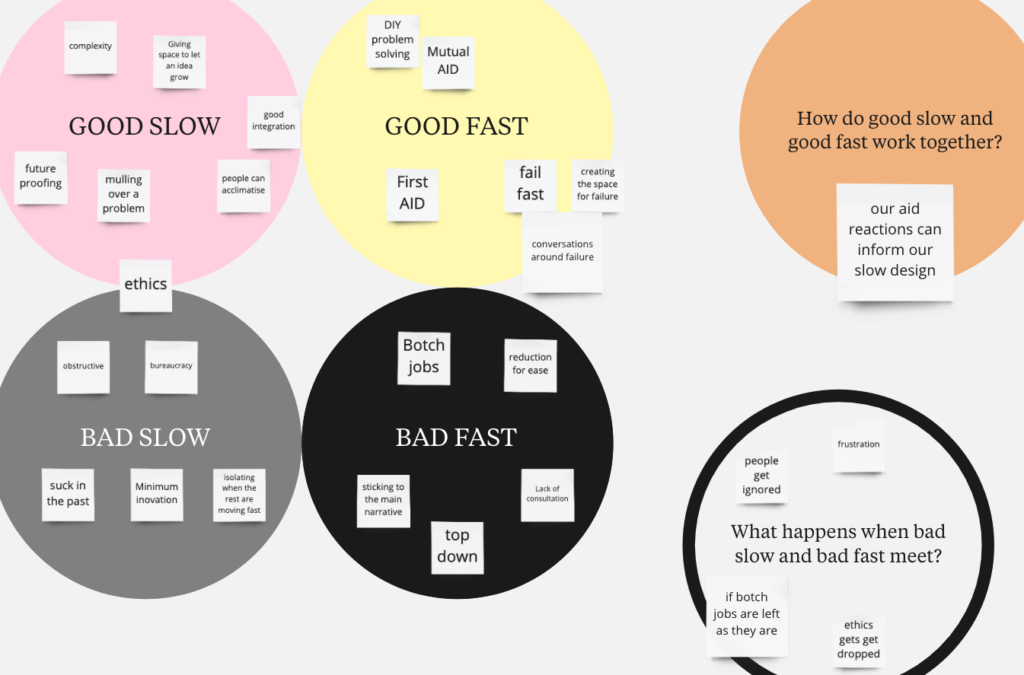
Two weeks ago I had a chat with Ollie Hemstock from Northumbria University about Slow Design. We discussed the benefits and downfalls of slow and fast design and eventually wondered what makes fast good and what makes slow good. So I took up the challenge of defining good fast and good slow, and while I was at it, I also defined bad fast and bad slow. Making myself a little online mind-map I speedily popped down virtual post-its and quickly discovered that what makes a speed good is also sometimes the reason why it is bad.

  • Good Fast – Creative thinking under pressure, Google Sprint, First Aid. No overthinking. Magical solutions. Fail fast.
  • Bad Fast – Drawing on stereotypes and single narratives. Reducing information, and a lack of consulting. Can do damage.
  • Good Slow – Allowing ideas to grow. Future proofing. More room for nuance and complexity. Ethics.
  • Bad Slow – Obstructive bureaucracy. Sticking to the past. Minimal change.

Fast does not give you enough time think, which makes things less complicated but also reduces information and abandons nuance. Slow makes loads of room for nuance but can block change in fear mistakes. One is therefore not better than the other. But what happens when we combine the two.

Good Fast + Bad Slow

Good Fast is blocked by Bad Slow killing innovation. Good Fast means testing and failing fast but Bad Slow would put a stop any testing.

Bad Fast + Good Slow

While Good Fast is blocked by Bad Slow, Bad Fast and Good Slow stand in complete opposition. They simply cannot happen at the same time. Bad Fast is bad because there is little thinking, while with Good Slow there is loads of thinking. These two cancel each other out.

Bad Fast + Bad Slow

In this combination someone quickly solves a problem but then does not go back to reflect on it. For example someone does some botch DIY which works at first but really needs a long term solution, however bureaucracy and rules are blocking that long term solution from happening.

Good Fast + Good Slow

Instead of being blocked by Bad Slow, Good Fast releases information that is then integrated into Good Slow’s thinking process. Here there is an agreement between the two speeds that failure is good for the future but that you need to be able to put the breaks on at any moment. It is the ultimate feedback loop. Like a well run household, because sometimes you need a quick book under a table leg and other times you need to slowly work out where you actually what to put a shelf.

OHD_BLG_0048 The right to repair 🛠

The right to repair is important and connected to my work because like many things in the world it has to do with maintenance. I had a chat with O Hemstock from Northumbria University about slow design and he brought up that maintenance is about agency. It is about the right to repair and the power you have over the objects that make up your life. Having agency means that you can fix it when it is broken, you don’t need to rely on others to fix it for you and you are not forced to buy another. But it is also about the ability to customised and edit and make the object fit to your needs instead of the other way round. It is important to think about maintenance not only because of the planet but because of the effect objects have on people’s lives. For example you want a pan to be good but what if the person burns something in the pan, which they are likely to do because they are human. What do you as the producer of the pan do then? Sure technically the ownership of the pan has moved from one to another but what can you do to help the new owner with maintenance of the pan. Handy youtube videos on how to clean your pan or a cleaning service for example. Now I am aware that the pan scenerio is a bit of an odd one but thinking about maintenance is always a good thought exercise in design.

OHD_PRT_0016 Failed Archive – again (formerly a blog post)

Let me start at the beginning…

I wanted to do an inventory of my work so far – see my journey. To do this I went through my blog posts, bits of longer writing, mind maps, and all the bits and bobs on my website. I noted them all down on a post it and sorted them into five categories: the big idea/overall concept, development of stuff, development of space, historical maintenance, and background maintenance. Super proud of myself, I thought that I finally had the basic idea for my PhD by practice; an archive in various different forms (digital and analogue) with some lovely categories that people can look through.

Two weeks later I go through my “archive” because I need to write a summary of my first year. I start going through my post its and concluded that everything is in the wrong place…

*sigh*

CATEGORIES NEVER WORK! People always change their mind or are looking for something different. Tagging is therefore the only option. They are flexible and very easy to word search.

( how to make it analogue is not easy but is an interesting thought experiment )

💡💡💡💡💡💡💡💡💡💡💡💡💡💡💡💡💡💡

Here is an idea…

Instead of having an archive where there is detailed cataloguing done by one archivist, all we do is give items a code, a date of entrance into archive, and a brief description of archive item. No need to catalogue in a specific spot.

Then all people need to do is word search the archive and whenever people bring up an item, they are invited to add their own description, increasing the word search capabilities.

Like URBAN DICTIONARY

OHD_BLG_0049 Testing archives

I have realised a rather large problem with my project and that is that it is very difficult for me to test out my ideas. I am essentially building an archive-like system and the true test of an archive is to see how well it stands up to time. Within the time frame of my CDA I will not be able to truly see how well my archive system works both from a user point of view and the maintenance workers.

I wonder if there is any literature on this that could help me workout how to test long term products in the short term…

OHD_BLG_0052 It’s all about the cleaners

I always get frustrated when I clean my fridge. There are so many little ridges that stuff gets into. I even have to have the door of my fridge open a certain way, which is not logical in the day-to-day of opening it but is the only way I can make sure that I am able to take out the shelves to clean them properly. This is an example of people designing a product without thinking about maintenance. The designers were not thinking about the cleaners they were thinking about the users. In a capitalistic and consumer driven world this is not surprising. We want to sell products to the users and cleaners are not important. Cleaning is after all a women’s job and who gives a shit about them. However cleaners are extremely powerful. If cleaners go on strike you have a big problem.

Waste disposal strike during the winter of discontent

However, cleaners do not generally go on strike. They are often women, who are most likely from a minority background and need the money. Striking is a privilege.

But cleaners are extremely powerful and this is proven by the new types of cleaners and maintenance workers. The computer guys. The IT department. The software developers. However unlike domestic cleaners our digital cleaners are mostly privilege educated men. This in combination with the fact the we view digital as our new god, means that we view these new, digital cleaners in a very different light. These types of digital cleaners are a luxury. Don’t get me wrong being able to employ a cleaner to clean your house is also extremely privileged, but this is a whole new level.

Now some might point out that the digital cleaners need way more training but then I would invite them to clean a university building. To be able to clean fast and well, while simultaneously being completely ignored by your fellow humans and having to deal with the disgusting things that come out of these humans, you need to be really good and have a lot of experience. The most elite cleaners, those who work in very fancy hotels, have to under go extreme training. They are different jobs but one is not harder than the other and the difference in pay a shameful.

But what does this have to do with archives, because that is what I am normally talking about. Well, in this article by archivist Charlie Morgan he talks about Mierle Laderman Ukeles’ Manifesto for Maintenance Art 1969!, which is one of my favourite art pieces. With her work Ukeles brings to light the people to who have to maintain the work after it has been created. Morgan writes that as a society we are focused on creation and under value maintenance (not surprising as this is either done by women, or the working class.) This focus has led everyone including archives to become obsessed with collection. GIMME ALL THE STUFF! This is like my fridge completely ignores the maintenance staff. How are we going to look after all this? WHO CARES I WANT IT!

Not helpful. Especially when people are handling sensitive informative which many archives do (so does most of Silicone Valley, but that’s another issue.)

My work is about getting people to reuse oral history, to give purpose to the storing of recordings, but I must NEVER forget about the cleaners. I cannot design any thing extremely complicated because most archives cannot afford the luxury digital cleaners. They have to do all the cleaning themselves. Heck, I was talking to an archivist who said the they currently were not doing any archiving they were doing building maintenance. Archiving is not the job you think it is. Archiving is cleaning. Cleaning up the world’s information.

OHD_BLG_0054 Stay Healthy!

We are cyborgs. We are so dependant on our digital devices that we have become cyborgs. I do not even use my phone that much but I am definitely a cyborg. Someone pointed this out during a seminar. They said, “if you don’t believe that you are a cyborg let me take your phone away and then you will realise that you are a cyborg.”

I just read The Unsustainable Fragility of the Digital, and What to Do About It by Luciano Floridi. In the paper Floridi talks about the fragility of the digital and how we need to make sure that it stays healthy because otherwise viruses can spread fast. Linking this with the cyborg idea I realised that we need to start talking about our own “digital health”. The digital is not going away any time soon, so in order to stop the spread of viruses, which can cause enormous amounts of damage, we need to start thinking about digital health. Now this obviously firstly works on the level of software and cybersecurity companies. They are the healthcare sector, but we as individuals also need to work on this, just like we do with our physical health.

We have our bodies (physical health), our brains (mental health), and our digital extensions (digital health). If we are cyborgs then it only makes sense that we look after the robot part of ourselves. Especially because that robot part is only going to grow over time (sadly).

OHD_BLG_0055 Let’s do it slowly sometimes

One of the biggest problems I have discovered while trudging through the world of oral history is that people do oral history projects, make a website, and then that website inevitably dies. This really sucks and is very annoying when it comes to researching. The reason for this is mostly because of funding issues. You get a chunk load of funding for one project and that is it. This (I believe) is due to us living in an extreme capitalist world, which pushes people to think in quick wins rather than long term projects. This is for example the reason that governments and business are hesitant to pursue environmentally friendly options, because it costs a lot of money and the returns will only be seen way down the line.

However, there was one super slow, relatively ridiculous, and extremely expensive project during the Cold War that has deliver a truly insane amount of returns and profit – the space race. The space race was really really expensive but the technology it produced we still use to this day. (This might be why idiot billionaires really want to go to space, but that is another discussion.) The point I want to make is that we need to start embracing slow scholarship because I believe that overtime the profits will be a lot better than a handful of dead links.

But I also know that slow scholarship costs money and people need money to eat so maybe this is not the perfect solution. What might work is intermittent scholarship. If we build systems of data storages, and networks that support intermittent scholarship we might be able to avoid “drive by collaborations” and “project websites”. The best option would be that we change the funding system, but that is very unlikely to happen so instead intermittent and slow scholarship systems might actually be our best bet. I imagine that these systems will support collaboration over longer periods of time and allow scholars to exchange “hunches” and thoughts more freely.

OHD_BLG_0060 Creative Tensions

From conflict to catalyst: using critical conflict as a creative device in design-led innovation practice

by Nathan Alexander STERLING, Mark BAILEY, Nick SPENCER, Kate LAMPITT ADEY, Emmanouil CHATZAKIS, Joshua HORNBY


I read this on Mark’s recommendation because I was talking about the workshops I wanted to run and how I wanted to set them up in a way that allow there to be tensions that can then be explore creatively. So reading this paper was probably a sensible thing to do.

Diversity?

The piece features a project that brought together a “diverse” group of people to think of ways to solve the wicked problem of cyber-crime under teenagers. The “diversity” of the group is not expanded on beyond that it was several people who either were doing or had done the MDI masters, police officers, and a couple of members of the public. This does not really explain the diversity to me. I want know where these people came from, how digitally literate are they, what ages are they? None of this information is enclosed which makes it hard for me to fully imagine the diversity. For all I know the diversity lies in the participants different heights.

We need to show this information because then I can truly see the diversity rather then relying on people word, which is really hard since the idea of diversity is subjective and it is a word that is very much thrown about.

Get out of my shoes

The paper talks a lot about “deep empathy” which when I first learnt about it during my masters I was on board with, now I very much reject this idea. Why the sudden change of heart? Well, for me it started to become clear that terms like “deep empathy” is a gimmicky way to show the performance of diversity. Instead of actually employing a diverse group of people we bring diversity in for a workshop, get them to do a couple of exercises and then send them on their merry way. The paper does note that some participants thought that you could not really get a in depth and nuanced idea of someone’s point of view because of the time limit and the group setting.

I personally think that telling ourselves that we can fully understand where people are coming from in a short space of time is delusional and reductive. If I am being completely honest I do not think I will ever be able to understand the experience of a black man. A white man? Maybe. But only because of the cultural domination of white men. But a black man? No way. A person in a wheelchair? Nope. A transgender person? No. It is not because I do not try, but because I believe that one cannot communicate a human life through words alone.

“Deep empathy”, “active listening” etc. these can all work in an attempt to understand people, but we should not deluded ourselves that we can embody another person’s life experience. I think it’s really necessary to put an intersectional feminist lens over this, because it is a dangerous path to go down.

The DaDa way

Now here is something fun. The participants thought that by blowing up the creative tensions and making them very obvious people could better understand them and use them. They also wanted the view points to be a bit more than a line of text (news flash you cannot judge someone by their tweet). People wanted images, videos, animations. These were things they felt they could relate to better. This got me thinking about a discussion I had with Joe about a podcast, the Bodega Boys. The podcast is super strange to listen to but because everything is very absurd they can tackle difficult issue. In this podcast they create this strange but safe space. The absurdity makes the issues more approachable and digestible. This then got me thinking about DaDa and how they came to be in a time of a nonsensical war. We are kind of in a nonsensical time now, maybe we need Dada to create empathy.

OHD_BLG_0062 Create a bit

Summary of the Createathon 19/04/21 – 23/04/21

The mind map I made

I took part in a Createathon because it has been a while since I had done a design workshop and I wondered if I could still do it.

During the first day of the workshop I started to remember some of the painful aspect of doing design workshops. For example the time limit, in my opinion, dulls the creative process a bit, so you start thinking of easy wins instead of bigger pictures. There is was also a lot of rambling talking which was a little frustrating.

However…

In the end my group, which was a girl from Azerbaijan and a PhD student who had also work with Seaton Delaval Hall, delivered a pretty good presentation and we didn’t mention social media once! We had not really come up with super great ideas, instead we had kept it pretty open ended and offered the person whose business we were working with only a vague direction for the future. I personally thought that it wasn’t going to go down well but it really did. After we had explained the plans of actions and presented our Pecha Kucha, the client was super enthusiastic, because she suddenly saw her business in a different light. We told her her story but how we understood it and this process of multiple translations help her get an inspirational boost.

What I took away from the Createathon is that what I really want to do as a designer is not give someone a stack of clear cut ideas but a new way of thinking. I want this because that is far more sustainable in the long run and it is also harder to dismiss. You can throw away a stack of ideas but if I have incepted a new way of seeing the world into your brain that is hard to ignore.

OHD_BLG_0063 A Spanner, a Chat and a Gang

Subheading: a meeting with Lucy Porten

Bad news first? Or good news first? Lets end on a positive…

The Spanner

So… The National Trust is not an archive. Every recording is stored at the British Library and you have to pay to get it out; a small fee but still. A fabulous perk of having it stored at the British Library is that the library is a power house and has the money and facilities to keep everything updated and playable. They also have great paperwork, which can be interpreted in multiple ways. The National Trust also does not use this archive. The National Trust podcasters have only recently discovered the existence of the archive, which is a bit awkward. Also it is unknown whether the British Library wants to store any edited recordings.

This does not mean that I am not allowed to keep copies of the recordings at the hall, but the British Library have pretty strict rules around keeping second copies. They are definitely a bigger stakeholder then I initial imagine, but I think we can still think of something.

Added note (27/04/21) Tried to find the National Trust archive on the British Library website and failed. Even asked the help chat and they could not help me.

The Chat

I mentioned that I was interested in doing an oral project around this oral history project, Lucy reacted by saying that she also was interested in doing an oral history project of oral history at the National Trust. The National Trust seems to be in a similar spot as the UN and the WTO where they have no idea how they got where they are now.

The Gang

Now this is the really fun bit because Lucy’s and my thinking do align, and my CDA is starting at a time of change within the National Trust and an increasing interest in oral history. Lucy therefore wants to set up an informal gang of like minded people and I have an invite. Hopefully this will result in a super helpful network of people who want to reform how oral history is conducted at the National Trust with an extra focus on reuse. Yay! I have also offered my services as someone who can deliver all sorts of fun innovation workshops.

OHD_MDM_0032 Beasties of the Archive

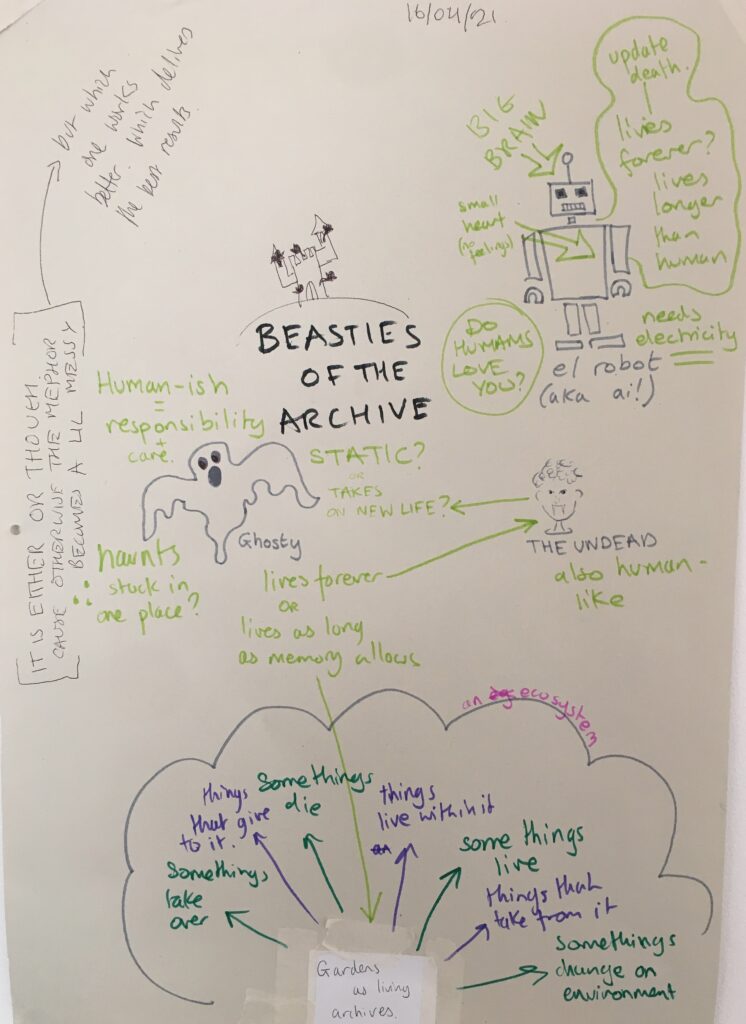
I did a mind map/a brain dump around all the supernatural bullshit that bounces around in my head and I finally used a post-it note that some how has survived since February.


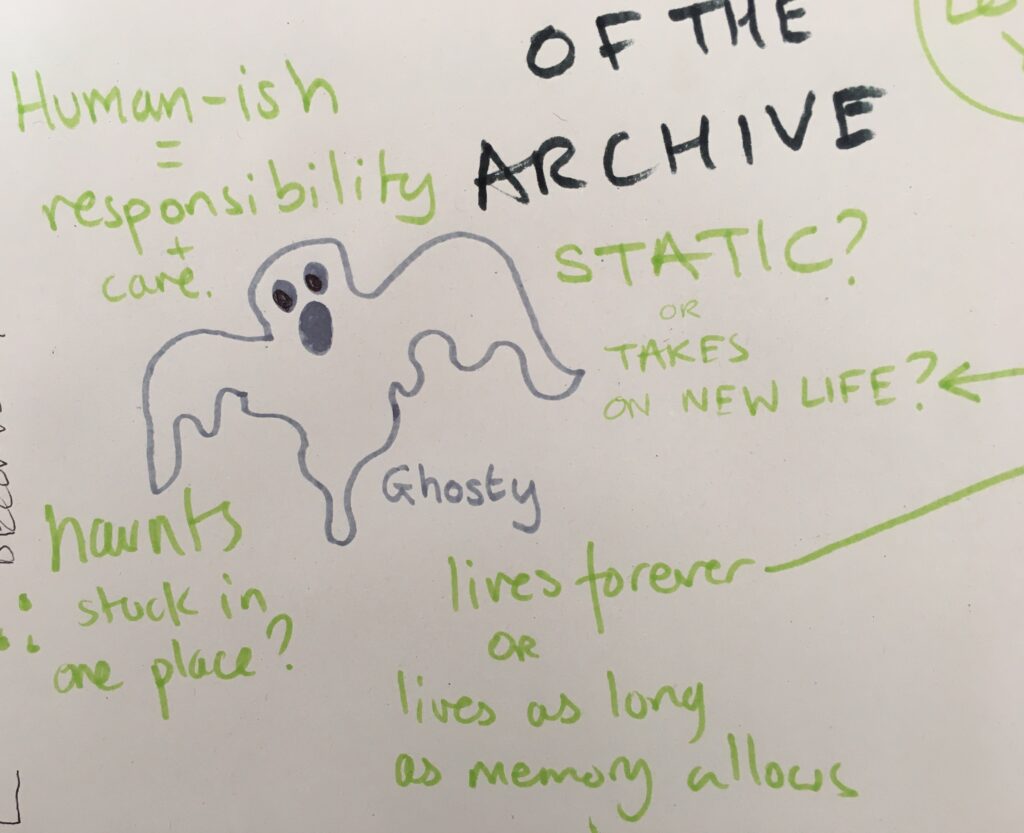
The Ghost

The idea of archives being haunted I have talked about a lot. I do find it a rather beautiful and romantic idea but some people do not believe in ghosts or went to art school so they have a lower tolerance for bullshit. Let’s leave the bullshit argue for now and just enjoy the idea of ghosts of Seaton Delaval Hall floating around the archive telling their stories. The root the stories within a human and therefore more relatable setting. The story has a face and a personality so there is more room for the reuser to create a bond with the person.

However, ghosts are by their mythology rather static beings. Ghosts exist because they have unfinished business in this world. They live a rather selfish existence which is not too ideal for the space that I want to create where ghost and human collaborate together.

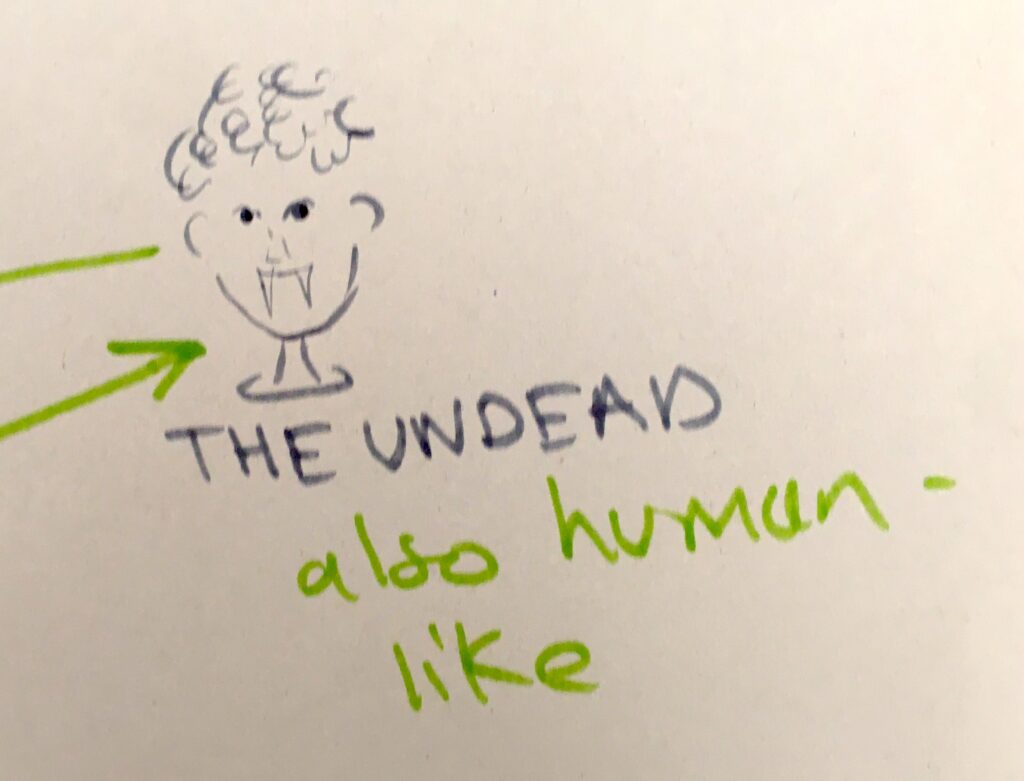
The Undead

Unlike the ghost the undead are able to stay in this world forever, adapting with society, taking on new trends etc. They are also human like but unlike ghost they have less of an agenda so are more likely to be open to ideas.

However humans do not generally like things that live forever, mostly because we are very jealous, so the undead are often painted as pretty gross. For example, rotting zombies or blood thirsty vampire, generally both are not very cool when it comes to fitting in with society.


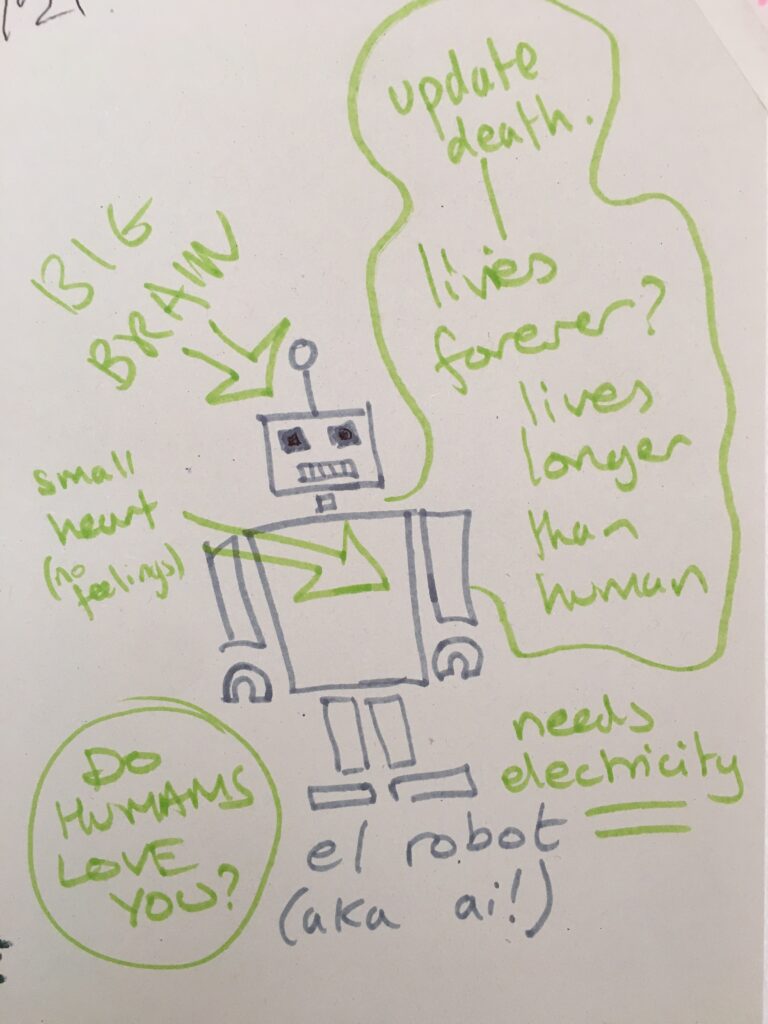
The Robot

Here is another potentially immortal being, the robot! However this one might potentially die faster than all of us due to rampant capitalism, built in obsolescence and many many updates. But if it does survive it has a bigger brain than all of the beasties. However, it does not have a heart and unlike the above beasties this one is less of a metaphor and more of a physical system many of which already exists. My only addition is that we give this robot a name, which is not a particular new idea just ask Alexa. By the way here is probably the biggest problem – I do not really like Alexa, I think she is creepy.


The Garden

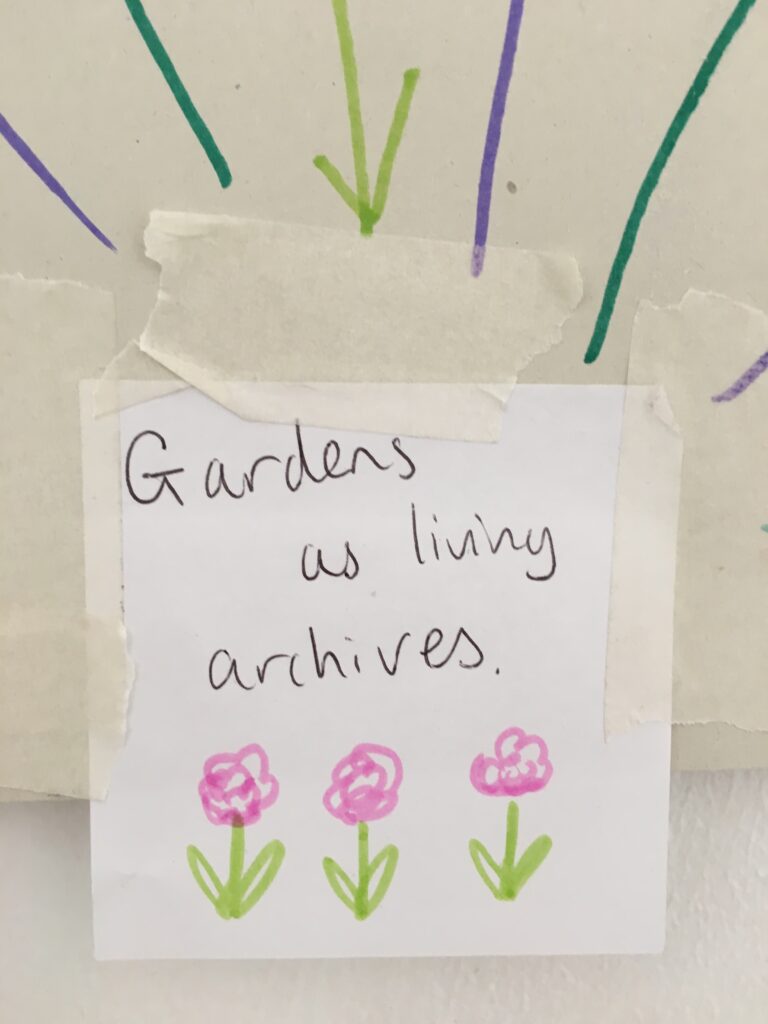
From fauna to flora here comes the archive as a garden. Originally this post-it was created because I was thinking about how I have memories attached to plants but it has now morphed into this… Archives can be viewed as an eco system just like a garden. The plants are the documents that live within the garden: some die, some live, some completely take over and some change with the seasons. The insects are the users of the archive: some users are bees they take and add to the archive, some are snails and just take take take, and some are flies who deal with the messy that is created. The whole thing becomes an eco system that needs everyone to help in order for it to keep existing. Take one thing out and it all falls apart.


Now I perfectly aware that I cannot use all these metaphors at once because then they do not work, but it is interesting to think about which metaphor can best encourage the mindset that I wish for the users of the archive to have. That mindset being one of care for those who donated parts of their lives to this public space. Are people more likely to care for ghosts, zombies, robots or plants? Or maybe I need to create my own supernatural archival being?

HERE LIES A POTENTIAL EXPERIMENT

OHD_BLG_0065 New words among other things

Readings:

Community archives and the health of the internet by Andrew Prescott

Steering Clear of the Rocks: A Look at the Current State of Oral History Ethics in the Digital Age by Mary Larson


Sometimes I feel like we are in the trenches with our machine guns and old military tactics…

This ain’t for you

People live their lives in very specific ways. They have certain rituals and values that they hold very close to their hearts. However it is very unlikely that everyone else in the world has the same approach to life as you do. Some people do not use the right tea towel in my opinion, some people think it is perfectly fine to wear socks in sandals, and some people a zero problems with eating meat everyday. In the case of Prescott’s paper on community archives/Facebook groups we have an academic freaking out because a community is not archiving properly something which he considers to be a great sin, and yes, in a certain way it is a great shame that a community archive is not sustainable because of the platform used or the limited funding. This is especially the case when you come from an oral history angle where one really wants to preserve the voices of those who current fall outside of history. However, maybe we need to remove the academic lens in these situations, maybe these archives just aren’t for you. They have a different, more temporary, function to bring people together over a shared history. They are about sharing history not preserving history like archives do.

This is where I think I (as an academic 🤢) feel that my role is not to impose my beliefs onto these make-do archives but instead build better tools to support them. A community archive on Facebook is a different beast to the university backed oral history project. Truly it is a shame that this knowledge might go missing, but then I suggest that we get more minorities to work in academia rather than dictate what we think they should do.

It’s a power thing.

Anonymity is anti-oral history ?

…, anonymity is antithetical to the goals of oral history if there are no exacerbating risk factors.

Mary Larson

Anonymity, accountability, freedom of speech, privacy, welcome to the 21st century. There is the opinion within the field of oral history that anonymity is against the principles of oral history. This is mostly because oral history demands a high level of context in its reuse, which makes complete sense. However does that mean that all information should be available? Is it impossible to have different levels of anonymity?

It seems odd that currently when it comes to privacy we have to work in such absolutes. You can get a certain level of privacy on the internet but that often requires lots of digging around and downloading plugins that send out white noise. You basically have to spend time fending off those who run the platforms you use, which when put in a AFK context would be the equivalent of the shop keeper pickpocketing you while you were shopping. Currently privacy and anonymity equals not using either the internet or archives, which defeats the point.

Why is this our only option?

Well, in my opinion it is not. We just need to get a bit more creative for example:

  • Use pseudonyms
  • Use other identifiers e.g. White, young adult, middle class, female (that’s me)
  • Use identifiers + 𝓲𝓶𝓪𝓰𝓲𝓷𝓪𝓽𝓲𝓸𝓷. There are loads of researchers who have to use their imagination because history has not been good at recording their subject
  • Only allow access to certain information if you either visit the BAM archive or ask for permission
  • Generally encourage more thorough and ethical reuse and research

New words

To elaborate on that last point we currently approach the ethics around archiving from the donating angle; if everything is correctly archived now there will definitely be no more problems in the future. This attitude I do not find very sustainable because attitudes towards ethics change all the time. So instead I purpose a different angle: ethical reuse of archival material lies predominantly with the reuser not the donator. This is where I would also like to insert the ‘new’ words. Instead of using the terms ethical and ethics we instead use responsibility and care, because the former is so slippery so ‘high-level’ thinking that it loses its meaning while the latter are more human words. Responsibility and care are concepts that you teach your children. They are more instinctive. So what I wish for is more care and responsibility from those who reuse oral histories. I want the reuser to remember the human-ness of the archive and the responsibility they have to care for their other humans.

NOTE: this is why I love the idea of archival ghosts so much because it gives the oral histories a face.
OHD_BLG_0066 An Archival Impulse

by Hal Foster

turn “excavation sites” into “construction sites”

No Ghost Just a Shell

This is why I want to work with some of the art students because you can get some of this lovely weirdness when you work in that space. I just think there is great benefit in looking at how artists approach archives. Do I think that this artwork is archival? Well the ‘shell’ AnnLee (the manga character) is indeed an archival source but the majority of the piece is artists building on this archival source. So the artwork uses the archive and builds the archive AKA makes the excavation site into a construction site. There is all sorts of interesting things happening around the copyright of this piece. First an artist buys the copyright then invites others to do what they want with it and then finally they block anyone using AnnLee.

The idea of AnnLee and No ghost just a shell got me thinking again about this idea of something living in the archive, a ghost, a shell, a figure; something that people can project onto, something that embodies their need for a story. Anansi-esque, forever changing with the times.

Which is why I say…

Kill originality its all about collaboration now.

The story of a single narrative, a lone genius, an isolated idea is silly, because that is not how the world works. There is not one story that can represent a large group of people. A lone genius is most likely someone with an extensive network where they are able to exchange ideas. An eureka moment is often the result of many smaller ideas coming together. There is no such thing as an original idea and all artists steal. So maybe it is a good idea to stop obsessing over this idea of originality because all it does it put people with great ideas against each other instead of getting them to collaborate. Collaboration is more sustainable. Time would have change AnnLee and she would have reflected the world as it progressed and different people manipulated her. She could have lived on forever. Allowing things to change through collaboration instead of preserving and protecting an idea will allow the piece to support society while at the same time keeping its archived versions as windows to he past. This seems a more favourable than it becoming an artwork that needs to have a plaque added to it that says something along the lines of “by the way this dude was a massive misogynist”.

Moving on…

Vandalism as AFFECT

Trying to capture affect is very difficult/probably impossible. But in the written piece Foster mentions the spontaneous creation of the Diana memorial in Paris.

This got me thinking about how this spontaneous shrine and other types of vandalism or sudden outbursts of marking is maybe the closest you could get to capturing affect. Think the tearing down of the Berlin wall or the Edward Colton statue in Bristol. Pure in the moment emotion.

OHD_BLG_0067 Sites of Conscience

by Liv Ševčenko

Heritage can never be outside politics – it is always embedded in changing power relations between people.

“integrating dialogue into every stage of heritage management, from planning to preservation to interpretation, and allowing for continual evolution.”

Museums are great at showing history, but they always do this through the lens of the present. And the present has this annoying habit of constantly changing, this means that the lens used to initially set up the exhibition is probably out of date by now.

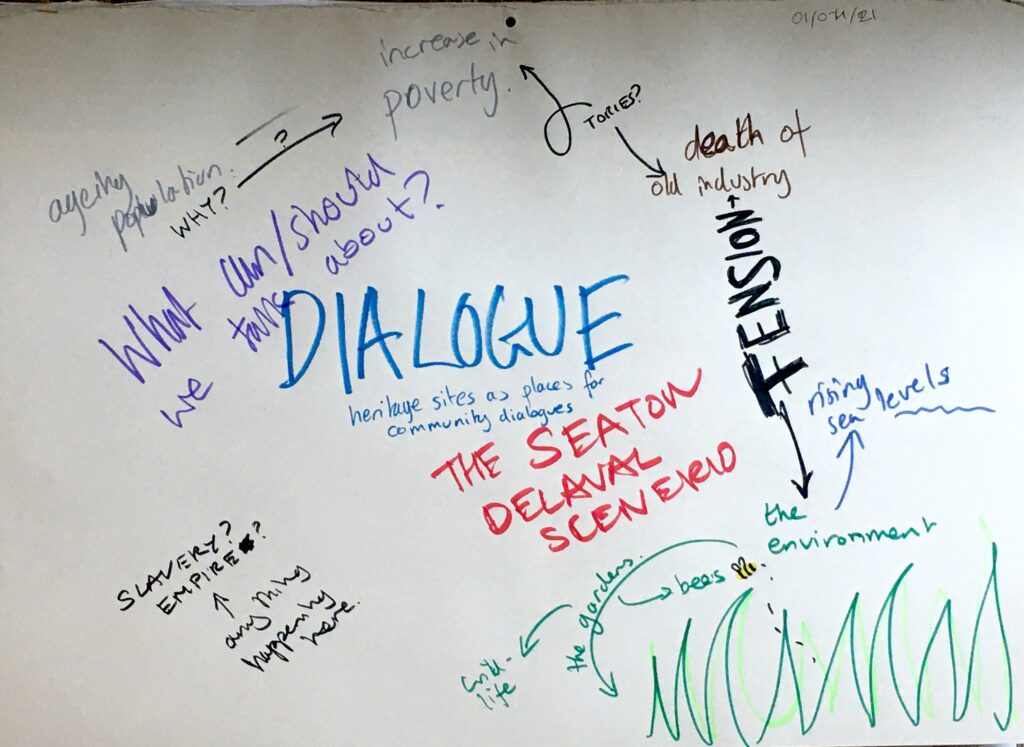
The International Coalition of Sites of Conscience fights this problem by setting up heritage sites as places for open dialogue about contemporary problems. They do this by obviously working with the community but also continuously mining their history for perspectives on problems. It’s continuous baby! And exactly what I want to do!

Also super fun idea of incorporating discussions on how to set up an exhibition into the exhibition.

Above you see my brainstorm around what dialogues we could possibly do a SDH, bu I think that other people are way more suited to think about this. However it will be a good exercise to do with people.

OHD_BLG_0068 it’s always language

A couple of weeks ago I learnt about structuralism and post-structuralism and post-modernism. All these concepts that I did not know about and now do know about and think they are fine but not as great as some people think they are. I am now going to talk about them in a very crude and simplified way by discussing the one thing that I really took from all of this and that is language.

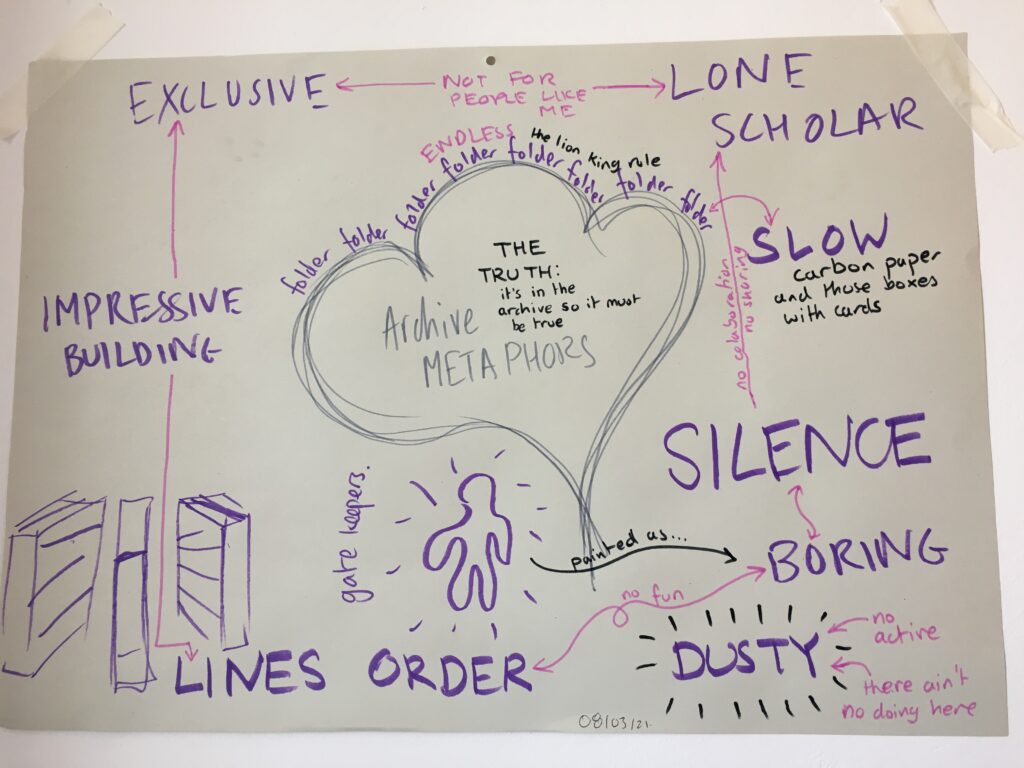
It is the way we talk about things that sets up power. For example the word archive evokes ideas of dust and a general boring space. This is mostly because the symbols and cultural metaphors we use to communicate the archive beyond the word are generally boring dusty spaces.

This is also why there was confusing during MDI group because different people had assigned different symbols and metaphors to words e.g. concept.

It is very frustrating that our fundamental way of communicating with each other is not very clear at all. But maybe that is because we put too much value on verbal communication. Some philosophers considering it the purest form of expression but it is not. Firstly we have different languages, then we have different dialects and slang and all of this influenced by how the individual experiences the world. However the majority of people know what this is ☁️.

Visual and kinetic communication and aural communication that is not speaking but sounds or music are also fundamental ways to communicate. In some cases it might be more fitting to communicate in a visual way or kinetic way. So limiting ourselves to writing or speaking seems a miss opportunity.

An idea has to be communicated and humans need to communicate but maybe we need to tailor the communication more both to the speaker and the audience.

I realise now that I am doing exactly what these philosophers did complain about the limitation of language through the limiting language. How very frustrating. But that is what language very frustrating.

OHD_BLG_0070 Reading Group – 16/03/21

Readings

Families remembering food: revising secondary data by Peter Jackson et al.

Secondary analysis reflection: some experiences of re-use from an oral history perspective by Joanna Bornat


Dynamic Attitudes

Everyone views the world through their own personal lens and academics are not exempt. If when an academic sets out on their researching journey they already have a vague idea about what they are going to write about. An oral historian will pick people to interview based on this idea and will ask questions that will fulfil this idea. However, many unexpected things can happen during research that causes you to change your attitude, readjust your lens etc. Your mindset evolves with the project and there is nothing you can do to stop it. This is why constant reflection is so important because our thought process is never static.

Reuse is not the issue, its about permissions

To reuse an oral history can be very valuable but because everyone views history through a different lens it is likely that the reuser will have different attitude to the creator. This results in different conclusion to be made from the same source. However, oral histories are set up in a way that makes the source only give permission for the creator’s interpretation and not necessarily the reuser’s. This is why it’s not about the reuse of oral histories, we know that creates value, but the permissions around the new interpretation, the one that was not necessarily agreed on by the source.

Even if the source agreed that their recording is open source the reuser might still feel the need to ask for permission especially if that person is still alive.

Recording for reuse

What this reading group made clear to me was that the particular oral histories I will be recording are solely for reuse. I am not planning on writing any analysis on the content of the recordings I just need to make sure that they can be reused properly. Reuse is my mission. I have no lens to work through. (Only the subconscious ones and the large one where I am super focused on getting ALL information.)

Always reflect

This reflection is not only for the interviewer but also for the interviewee. In the piece about food they end with the conclusion that it is important to get the interviewee to reflect on what they are saying. To encourage them to become active participants in their own historical analysis, instead of it solely being the interviewer being the one who is analysing it. This is better for the power dynamic.

The code

Now I have already started writing a code of practice for the design aspect of this CDA but I have not really thought about what this would be for the oral history side. On reflection the system I am building for this CDA probably should have some type of code that accommodates it. And I believe that a point that was brought up by Graham in the reading group is a good starting. You see he mentioned that on of the oral history collections that was being reused had field notes attached to the recordings that would now be considered very unethical. Now of course these notes are a fabulous source for showing previous scholars attitudes to the method of oral history collection but they probably should not be digitised and on the internet for everyone to find. Graham therefore had them removed from the internet. This made me think that in the process of reusing oral histories there maybe should be the task of also doing ethical checks on the storage. A kind of mutual agreement that all oral historians keep each other in check since ethics is such a nebulous minefield.

OHD_BLG_0072 Community archives and the health of the internet

By Andrew Prescott

This was great. A very helpful piece of writing that was in the recommend reading for my seminar Digital Culture: Collaborative projects.

The bulk of the text discussed community archives or counter archives, as I have previously called them. Prescott discusses how these archives have been forced to work on commercial platforms like Facebook and Instagram. But on the flip side these archives do create a sense of community around the archival material, which often cannot be found in brick and mortar archives (BAM archives). This community archives in a way that is contrary to all the systems and rituals that take place in BAM archives. It’s chaotic and there is no categorisation at all. But it is being used.

Now this is where an interesting paradox comes into play. The more i read about archives the more I see the importance of building a community and tradition around a history. Oral traditional survive because of strong communities. A strong community therefore equals pretty good sustainability of a history. However, this is where the paradox comes in because currently these communities are hosted on commercial platforms that have no proven longevity or sustainability. Counter or communities archives often do not have a sustainability plan which has caused many to disappear. So the question is how can we capture the sustainability housed in strong communities while avoiding the pitfalls of modern technology?

However there is another far more consequential down side to counter archives being housed on social media – radicalisation. Due to the algorithms that operate on social media platforms these groups can become breeding grounds for radicalisation. They are community bubbles and you never know how far away you are from a new recommended group.