Category Archives: Blog

OHD_BLG_0107 DIGITAL FORAYS: ARCHIVES & ACTIVATION // PLATFORMS AND PUBLICS

With Kristine Khouri (Arab Image Foundation), Yazan Kopty (Imagining the Holy), Sana Yazigi (Creative Memory of the Syrian Revolution) & Discussant Laila Shereen Sakr (UCSB). 08/10/20

This talk was recommend to me by Joe because he is on the mailing list for talks at NYU. He joined me for the zoom (obviously it had to be a zoom).

The talk was interesting and generally it was nice to attend a talk again even though it was in my living room. Many different topics were discussed but there was less discussion around digital archives and the consequences of digitising. This was a little disappointing although not surprising, because as you often get with talks the speakers will always bring the conversation to their research. And who can blame them, we all suffer from ‘the researcher’s lens’ where you view the world completely through what you are thinking about. However, during this talk it meant less talking about the digital and more talking about post colonialism and decolonising archives, which is still very interesting. And not surprising as the talk was organised by middle eastern studies at NYU.

Anyway what follows is some of the things I picked up on during the talk.

Archive as collateral

Something that was briefly brought up in the talk was the idea of a collateral archive. In other words, an archive that exist because at the end of a project you realised that you had enough stuff to make an archive. If you take this term in its broadest sense everyone has a collateral archive: diaries, planners, notes, shopping lists etc. All of these can make up an archive of your life. The same can be said for any project. If we take the Hand Of school summer project, NTSW then you could very easily create an archive from the kids sketchbooks to the notes of the planning meetings. Every thing can be archived. 

But there are some questions to be asked, one: should it archive in the first place, and two, if so how should it be archived? Now the first question is a big one and one I will probably revisit several times. The second question was triggered because in the talk one of the speakers had set up a completely new archive because they looked at all the stuff they had collected for their project and decided that they might as well make a archive, hence collateral archive. So should they have made a completely new archive? Or should they have added to an existing one? Or should have created it but then have it live in a network of other collateral archives?

Another big question is whether people should think about their collateral archive before they start a project or after? Should there be a software that allows for easy archiving as a project progresses? I guess it is often the case that you don’t know what you are going to collect until it has been collected. But then again the internet has led to an increase in document production, so maybe we need to start preparing more for an influx of stuff in order to avoid a desktop soup of documents.

The ‘home’ of History

As I previously said the talk was arranged by the school of middle eastern studies, hence the steering of the conversation towards decolonisation. Unsurprisingly the topic of where documents should be stored came up. This was mostly concerning Yazan Kopfy work on Palestine. He is working on gaining more information on photos of Palestine that are stored in the national geographic archive (one hell of a collateral archive by the way, as they were not initially stored there for archiving proposes but as leftover stuff from articles. Which they were thinking of throwing away somewhere in the 1980s as a clearing out exercise.) Many of these photos only state who took the photo and not who is in the picture or any wider cultural information. So he has started to flesh out this information. What was interesting was his comment that people outside of Palestine view it as the holy land when in Palestine it is first and foremost viewed as home. So where do you store photographs taken through the (literal) lens of a coloniser? And how does this work in the digital context? Because even if there is a digital copy there is also a physical copy somewhere.

EXTRA NOTE: this is also where Joe mentioned ‘Nice White Parents’ and how this might be another case where diversity and decolonising is in fact benefiting the white-western academic world more than the people of Palestine.

The Scale of the Digital

There were three main speakers Kristine Khouri, Yazan Kopfy and Sana Yazigi. All three had a very different approach to digital archiving.

On side of the scale I am going to put Khouri, whose project was ‘Past Disquiet’, which she described to be like a website in an exhibition space. She seemed to be slightly fearful of algorithms and digital space. On the other end of the scale Kopfy, who used instagram to collect information on his pictures. Interestingly he struggled to get information on images from the 1920s and 30s, but got lots on photos from the 1970s. I feel this really shows the age of instagram users. And in the middle of the scale I will place Yazigi, who created the Creative Memory of the Syrian Revolution, a rather epic website, which is kept update. The only thing I worry about is the actual user friendliness of it.

To me this wide range of approaches to the digital is typical of our time. There are those who embrace it and those who are fearful of it. Either way there are questions to be asked around big data, data rot and the environment. Because all these digital things are stored on servers which use a lot of energy. Sadly this was not fully disgusted which I do wish they had done.

Hauntings

Nearer to the end of the talk Kristine Khouri started talking about hauntings in the archive. An idea that Joe could get behind if it was art but not necessarily if it was academic. But the idea of ghost and hauntings I do not think is too much of a far fetch idea since going through an archive can be like going through someone’s knicker drawer. I think this is especially true with oral histories because you are listening to the person’s voice. There is a responsibility attached to going through people’s archives. Maybe an increased awareness of people’s presence when researching will deliver a more ethical research or an awareness of their intentions or maybe even warnings about the future.
OHD_BLG_0109 Reading Group 22/09/2020

The topic of this reading group was trauma and oral history. The two pieces read were: “Oral History and Trauma: Experiences of sexualised violence under National Socialist persecution” by Helga Amesberger (Austrain) and “Oral history – ‘More dangerous than therapy’ ?: Interviewers’ reflections on recording traumatic or taboo issues” by Wendy Rickhard (who did Creature Comforts).

Event .v. People

A big issue in interviewing people about traumatising events is that you have this tension between the interviewee’s whole life and that key event. Both parties involved come together because of this event but the life of the interviewee is bigger than the single event. Their opinion of the event might have changed over the years and might still change even after the interviews, making the interviews also a single event in that person’s life.

There is also the issue between the traumatising event and the trauma that the person lives with because of the event. On top of that the trauma that these people live with might change and be manipulated by other things in their life and wider society. In the examples in the texts the traumatic events are layered between the taboo of sexual harassment. Which brings me on to the second point.

TABOO!

Taboo topics can become a bit of an obstacle for oral historians, as was discussed during the reading group. When talking about uncomfortable topics you could walking into the situation where you could reenforce the taboo further. By interviewing a person about a taboo subject you are also highlighting it, which is often considered positive however it has the possibility of backfiring. In addition when the interviews are done and the contents is released into the world no longer have control over how people react to the taboo subject.

The Transcribing Problem

This was a fascinating thing that came up in the discussion. It seemed that nearly everyone had experience of having the heaviness of the conversations hit them when they were transcribing the interviews. In fact Graham even said that he gives his transcribers a heads up that they do not have to finish it if they are not comfortable with it. Clearly the re-listening of the interviews opens up this space of realisation of the heaviness of the topic. I just found this to be a very interesting problem everyone was experiencing.

Access

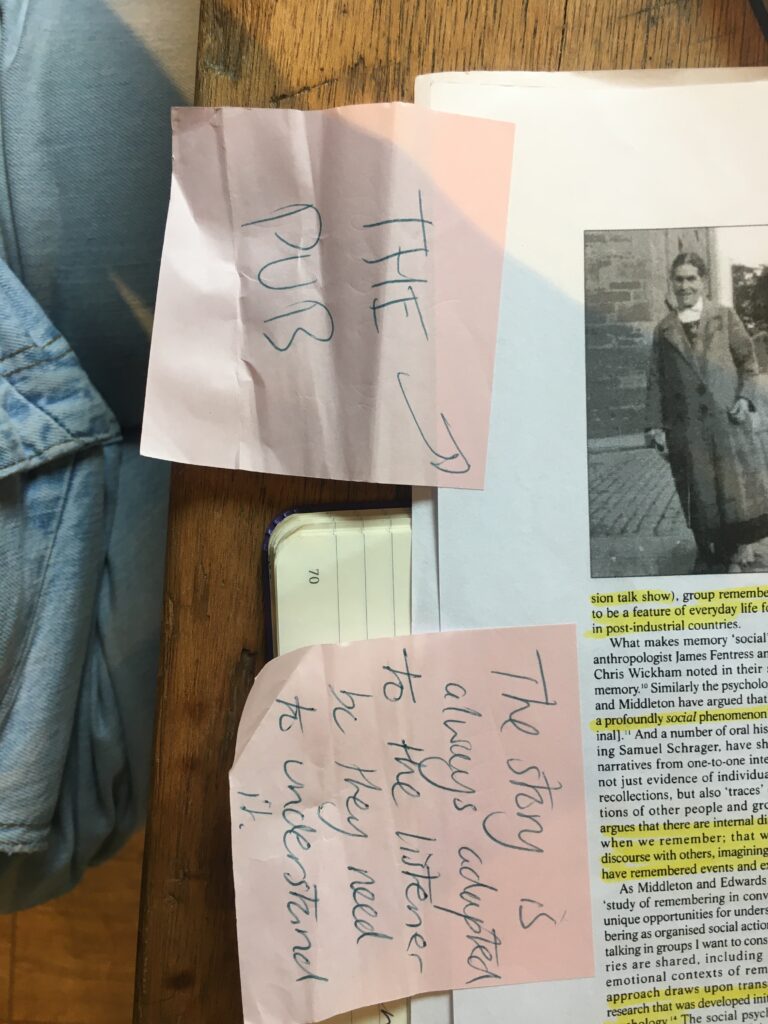
Now this is the part most relevant to my work: what do we do with the tapes? The tapes can offer a whole bunch of problems. Lets say the tapes are available in an archive which can be accessed by anyone and some random person listens to them, what could happen? Well the recording could be taken completely out of context (like an old tweet) and manipulated into something else. The people were experts in their topic and knew exactly what they were talking about but if anyone can access it the recording they might not actually understand what is being said. Having the recordings open to complete interpretation could have extremely damaging consequences.

This only becomes a bigger problem when you make access to these tapes easier like what I want to do. This mostly happens through the use of technology which currently does not have a good reputation in protecting the users.

To end this access issue the group pondered on whether the tapes should be archived at all, only leaving behind the research done by the expert. This protects those who took part in the interview but also leaves a slight emptiness. (but that might mean because then my whole PhD would be pointless.) Maybe the question is not how should we archive but what we should archive.

And finally…

My favourite quote had to be from Rickhard’s text:

“You need to have money to be ethical”

That truly sums up everything. Because if there is anything that I have worked out about oral history is that it is in a constant battle between capturing an ongoing saga and permanent nature of capturing itself.

OHD_BLG_0110 Reading group – 21/07/2020

Articles read:

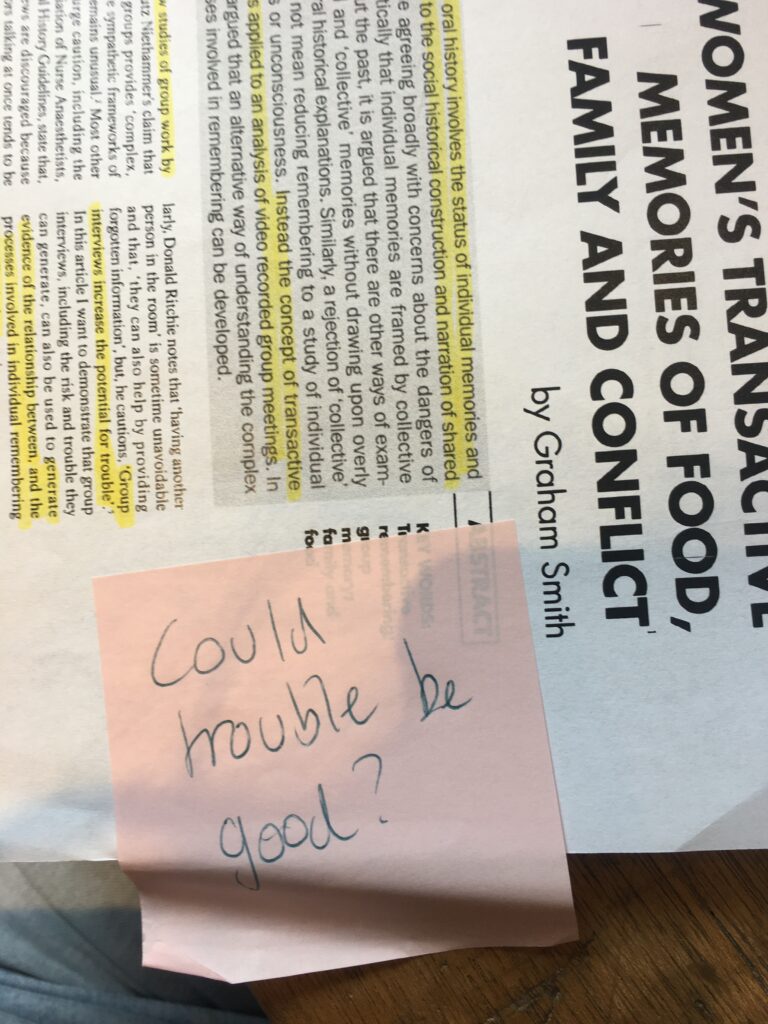
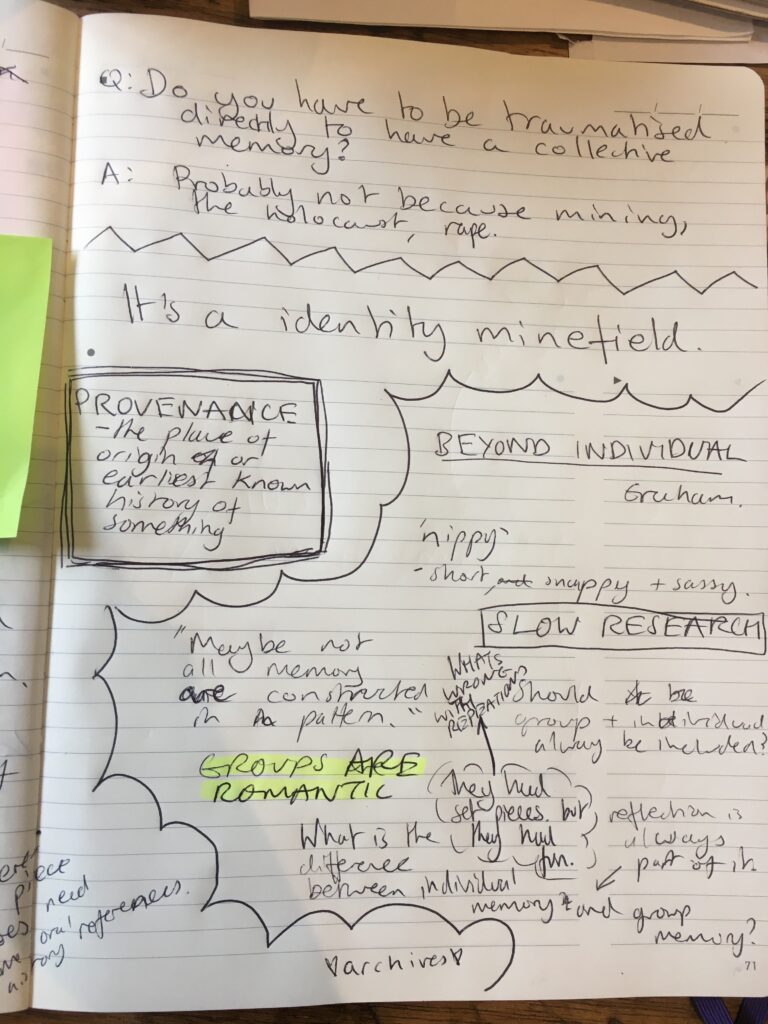
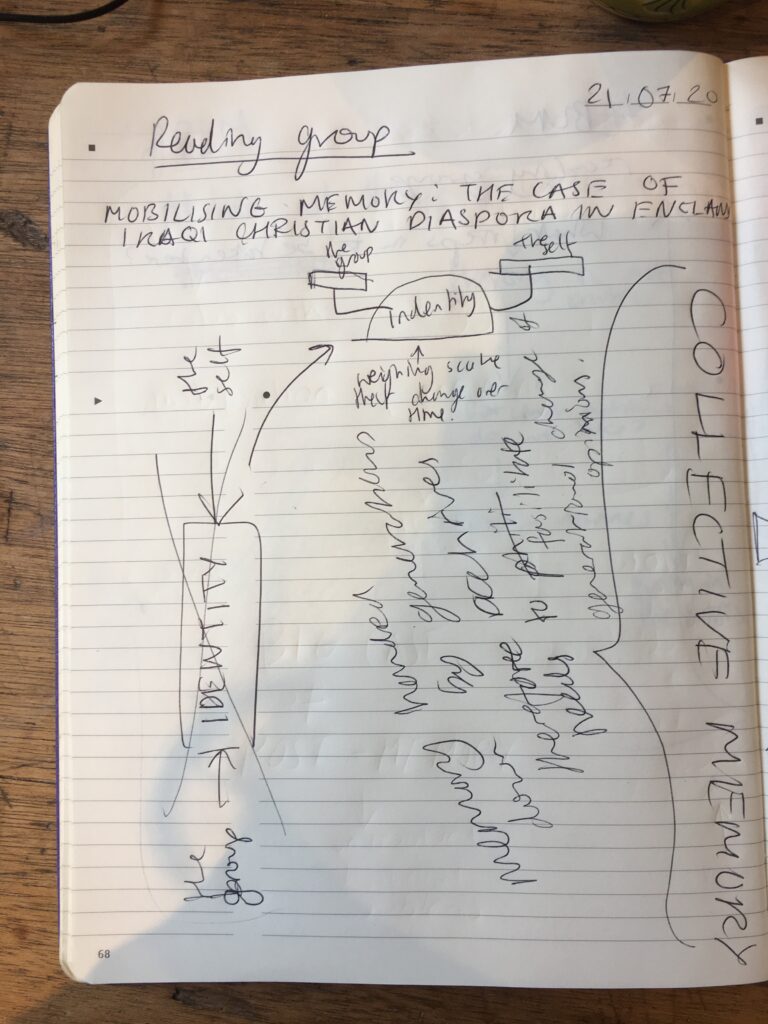
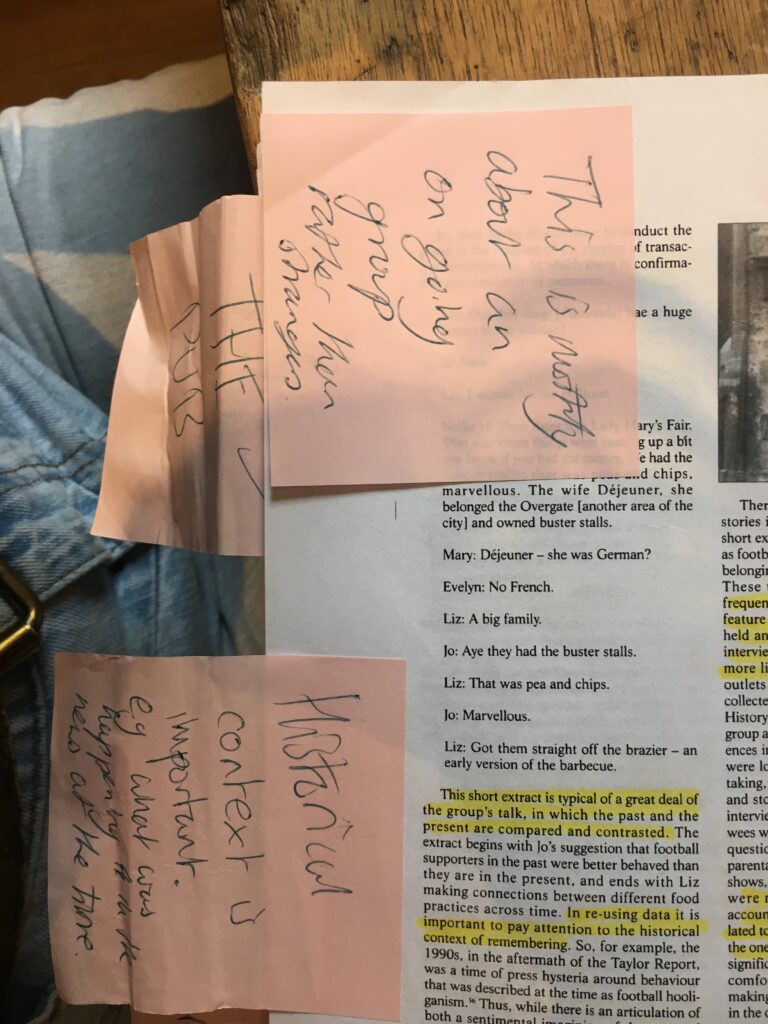
Mobilising memory: The case of Iraqi Christian diaspora in England by Niveen Kassen and Beyond Individual/ Collective Memory: Women’s Transactive Memories of Food, Family and Conflict by Graham Smith

Kassen’s work was read in order to give feedback to her and Smith’s work was an appropriate partner for the work.

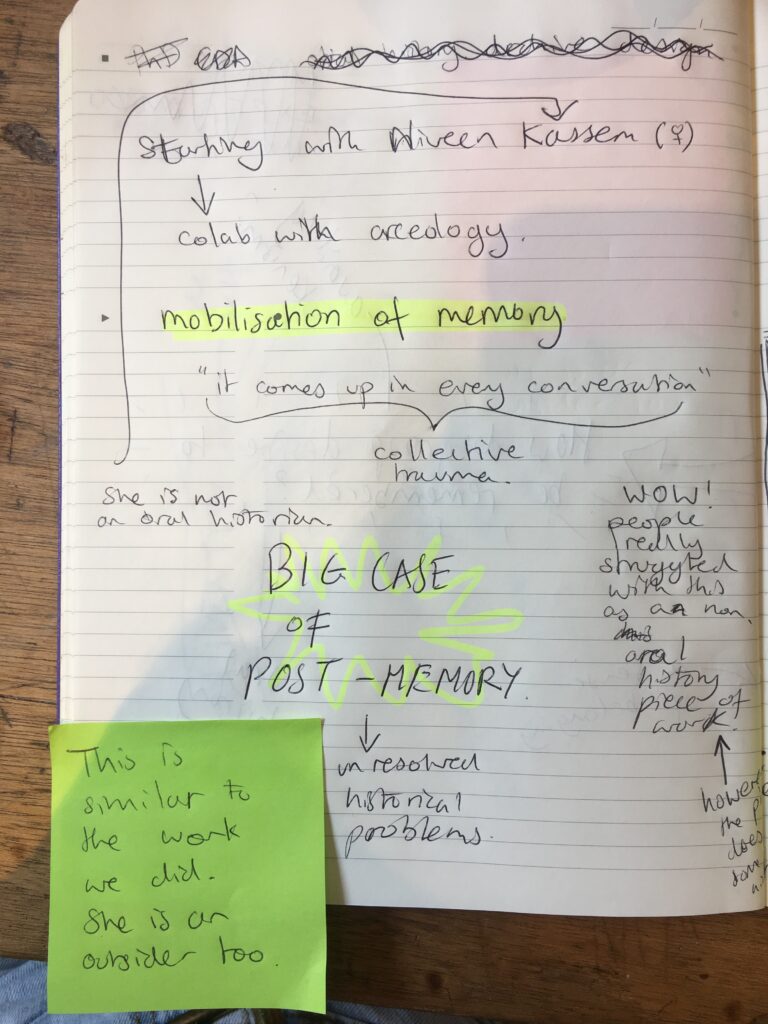
Kassen like me is not from an oral history background and it was clear that because of this some people struggled seeing the work as an oral history paper. It had very little oral history references and Kassen had only conducted group interviews, which is not the clubs favourite. To her, her study was a good opportunity for an oral history project. But it did not stick to the rules. However it started the conversation around one of my favourite oral history topics – Group .v. Individual interviewing.

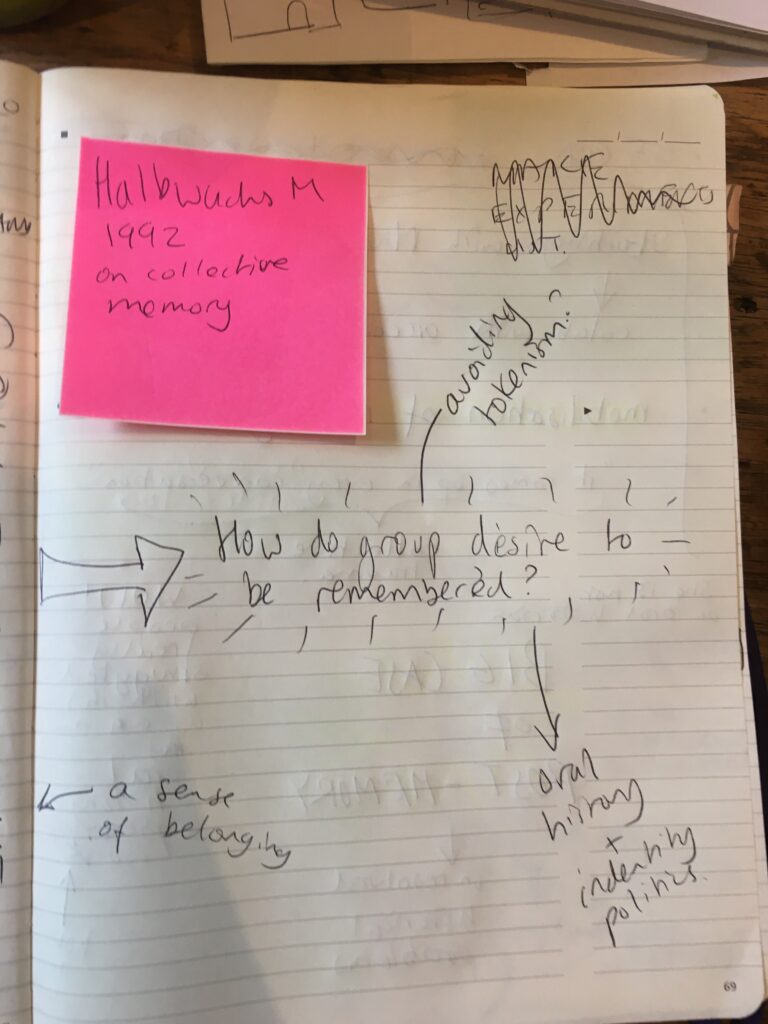
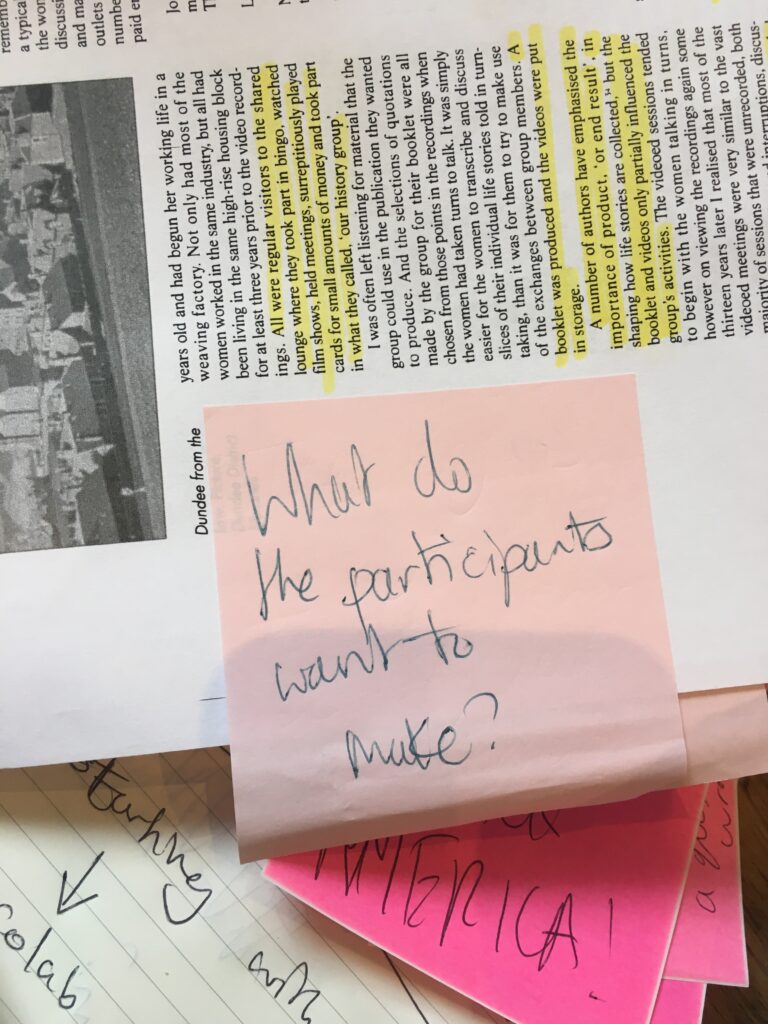
Kassem’s work, I found illustrated the power of group interviews. The project was based around the collective trauma that the Iraqi Chirstians had experienced and how they, through memory and storytelling were using this to create an identity. These stories and memories are used to write the narrative of remembrance. The group decides how these stories need to remember, which is why oral historians do not always agree with this group method. The group interviews are heavily influenced by performance and group pressure and therefore the stories told are not always true. But the stories are still important because it is what the group wants to tell. It’s their identity.

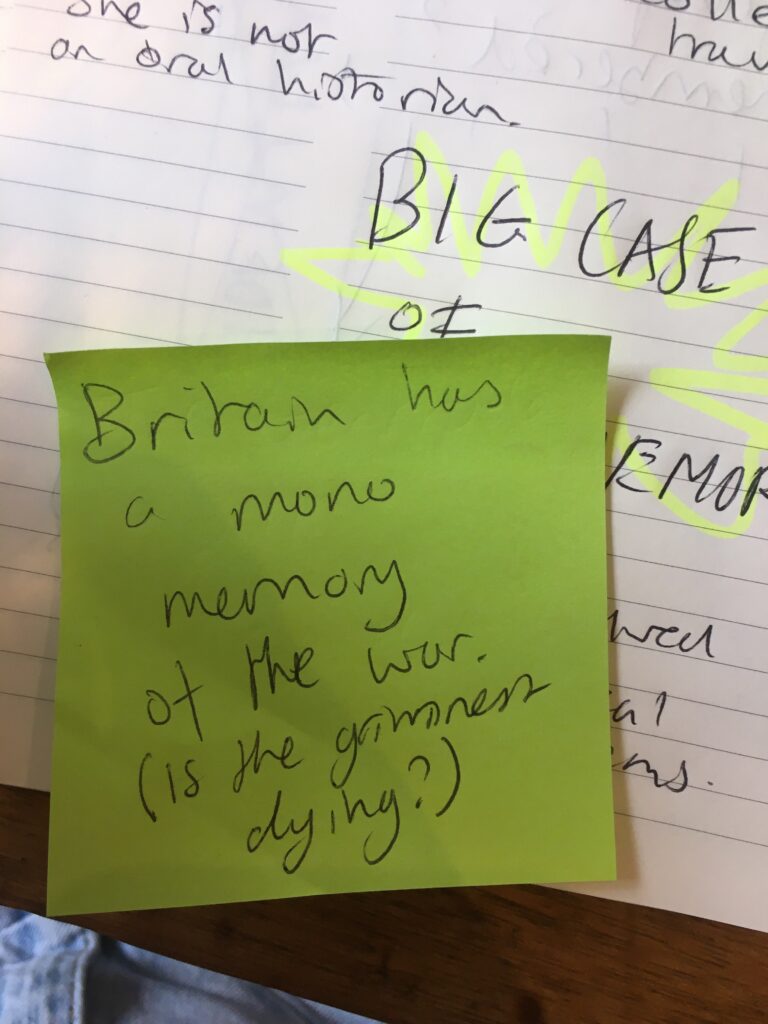
However, there are pitfalls here. As Graham pointed out a group can start to create a mono-memory. He used the example of the war in Britain being viewed as a moment of British excellence, due to the fact that those still alive were probably young at the time and therefore had more fun than the older generation (especially in the case of women.) We, therefore, need to keep this collective memory in check, keep it updated, and also be reminded of the stories told at the beginning of the memory by those who were closer to the reality.

This however has to happen in all cases of oral history interviews as both a single person or a group cannot represent a whole people.

P.S.

It is important to note that the experience of group interviews is probably more fun and community building than individual interviews. It might be slow but it is more fun.

OHD_BLG_0111 #BLM

There is a lot say about this topic but mostly there is a lot to ask. For some #BLM is a time to fight and for others, it is time to reflect and review.

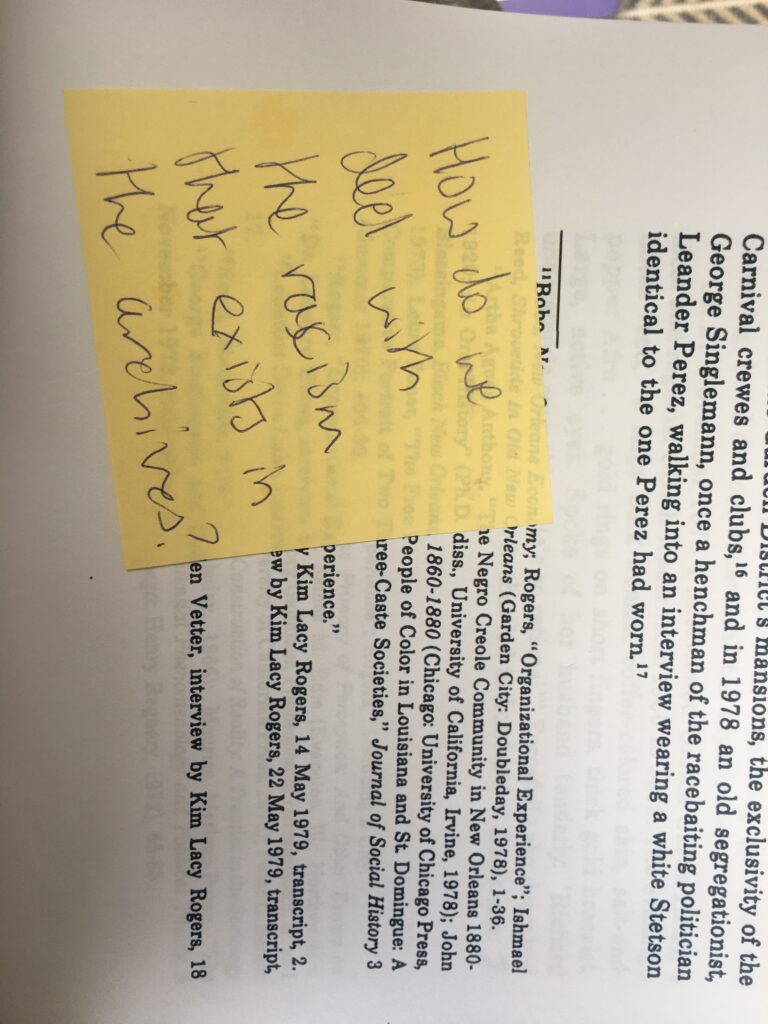
This reflection can been seen in the removing of statues and renaming of streets or in the case of my dad the renaming of inappropriate climbing routes. If I look at this from the point of view of someone who is interested in archives and the preservation of history, I feel this moment in history proves how history is not static. And it shows that how we tell history needs to be constantly updated. This includes archives. I remembering hearing somewhere that people struggle to find black history in archives after the mid 20th century because the words used to catatorgise the documents are not words we use today.

What I am hopefully am going to explore during this PhD is to how do we set up archives that allow this reviewing of history to happen easily and inclusively. Rather than making history a battle ground of identity it becomes the educational resource that it should be.


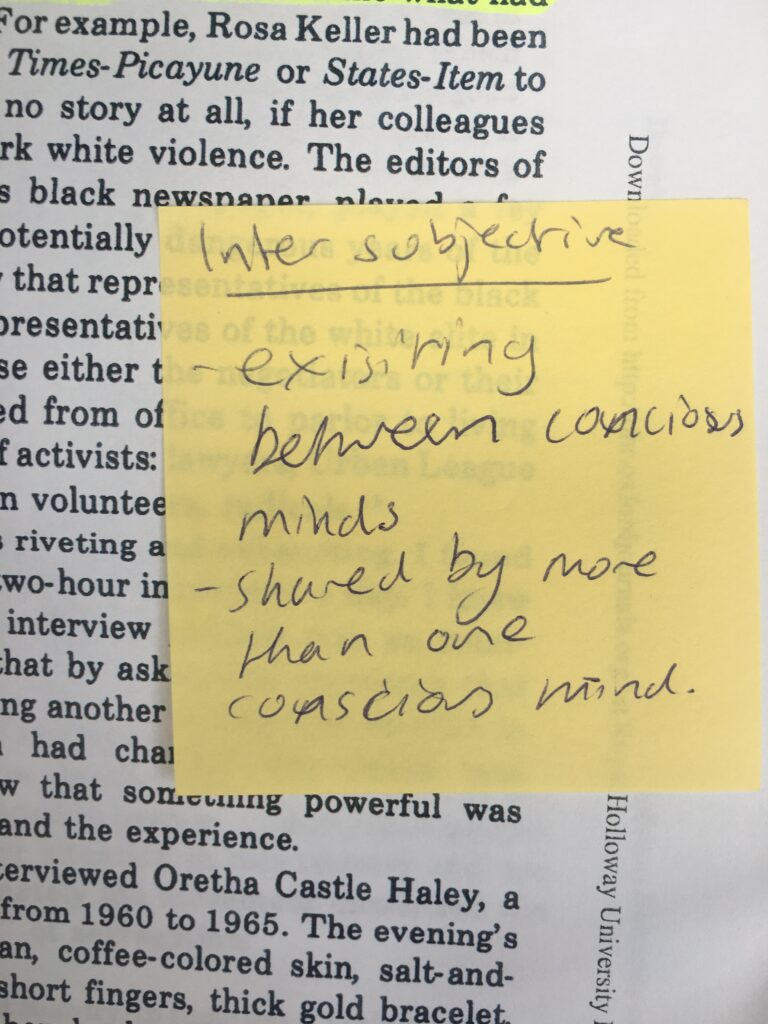
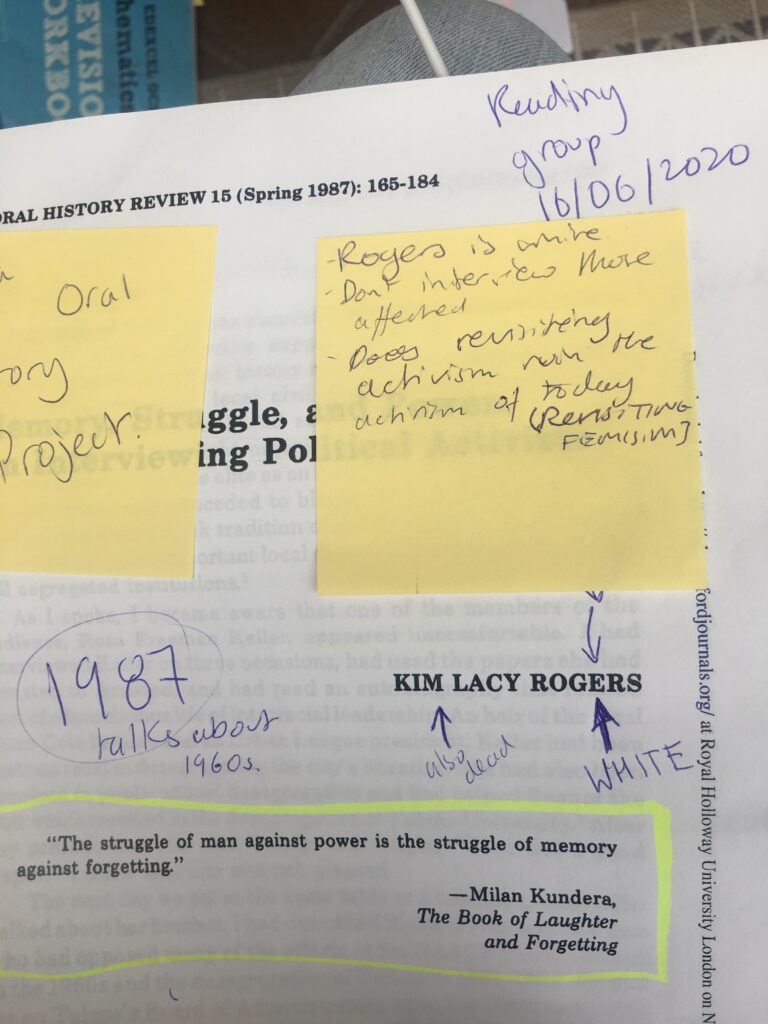
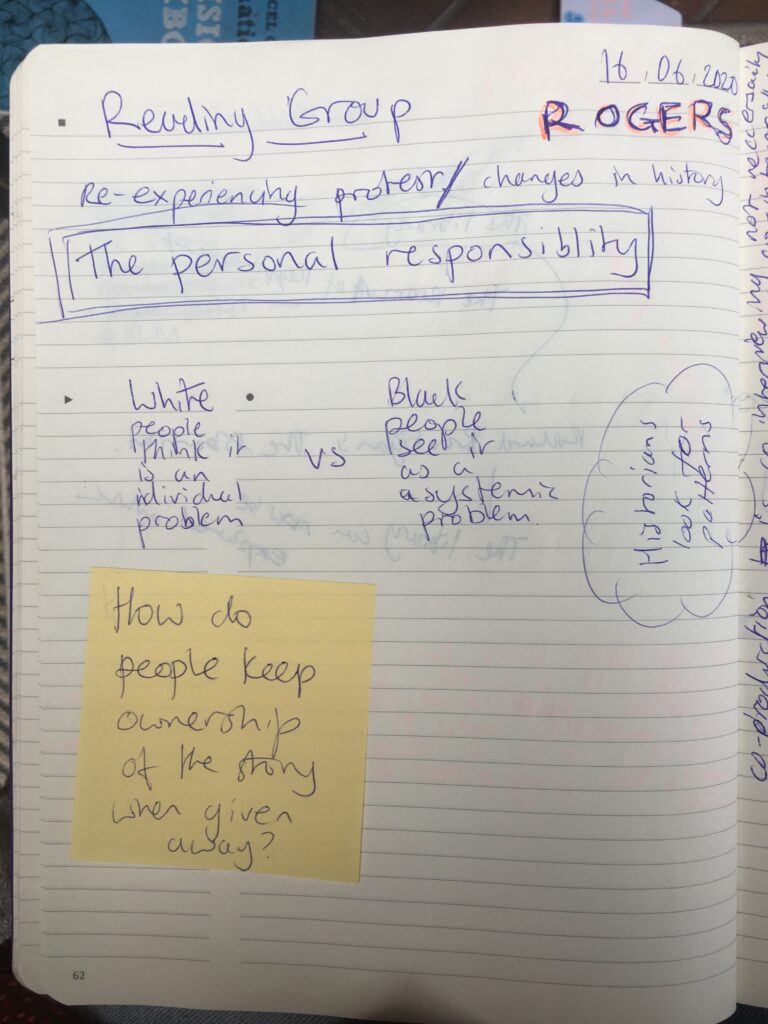
On the 16th June I joined the oral history reading group. We had been given two papers to read that were written in the 1980s and only one was written by a black person.

The first paper was by Kim Lacy Rogers called ‘Memory, Struggle, and Power: On Interviewing Political Activists” published 1987. In the paper Rogers reviews her work on interviewing activists, both black and white, who were involved in civil rights in New Orleans in the 1960s.

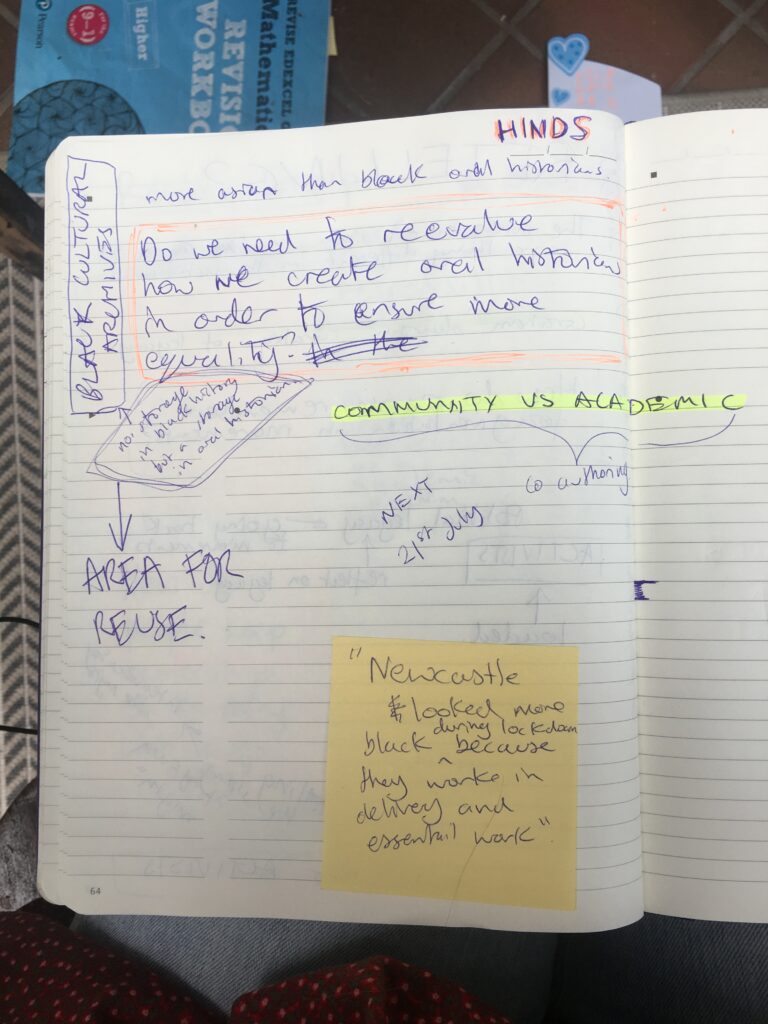
The second paper was by Donald Hinds called “The ‘Island’ of Brixton”. It was a portrait of Brixton in the 1960s.

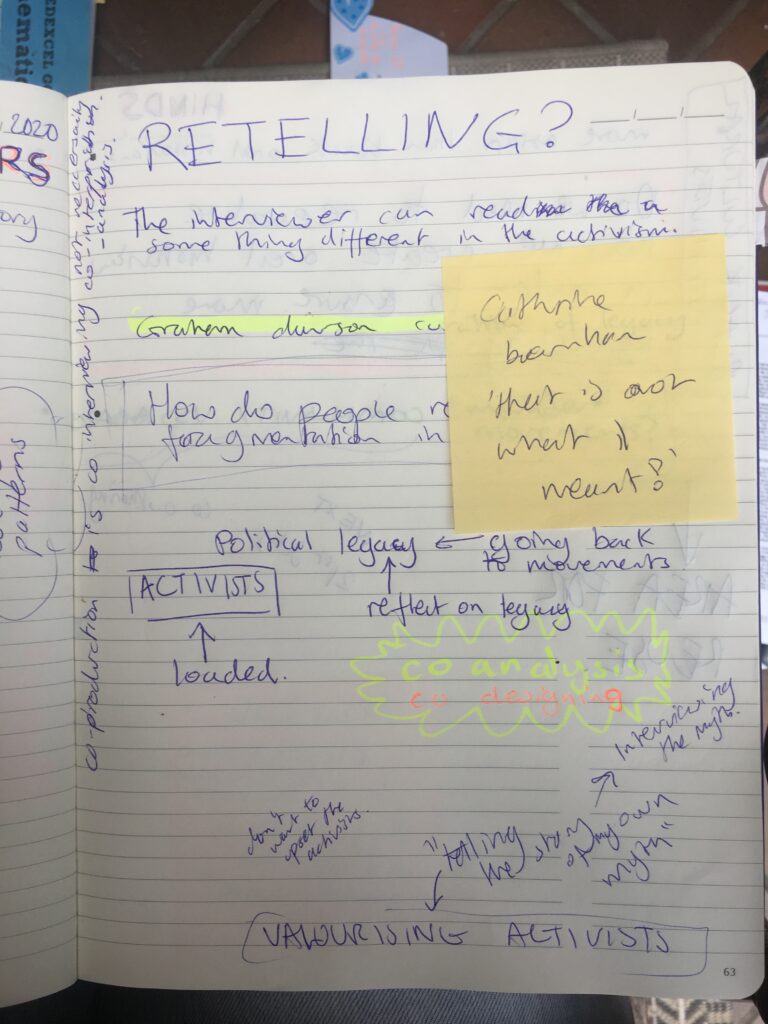
The discussion was mainly about how you interview activists when they are people who are aware of their position in history. What seemed odd to me was that people were not interviewing the people who were affected by the activism. If we are looking a text about activism in the 1960s written in the 1980s, yet the world it talks about could easily be the current one, then why aren’t we asking why things haven’t changed? What is their legacy? Do we need more revisiting of movements and more reviewing?

The other main topic was co-analysis, co-creation and other co-activities that should occur in order to create a more equal representation of the situation when it comes to race. The biggest issue being that there are not many people of colour in oral history yet there are plenty oral history recordings on the topics. Which as always are stuck in the archives.

I found it tragic that we were a group of white people who could only dig up two papers on the black oral history from the 1980s. This situation proves that a review of how we take oral histories and how we set up the archives is desperately needed.