Tag Archives: Digital

OHD_WRT_0172 Chpt. 01 History of oral history tech

Chpt. 01 – The History of Oral History Technology

“The history of progress is littered with experimental failures.”

– Victor Papanek, Design for the Real World

Let is take a moment to contemplate the MiniDisc. Developed by Sony in 1992, it was meant to replace the cassette, with its ability to edit and rewrite recordings, and 60 – 80 minutes audio storage, it was the hot new thing that was going to change how we record forever. Fast forward thirty years or so and the MiniDisc has become one of the textbook examples of a failed technology. For oral historians and sound archivists the promises made by the Minidisc were never fulfilled but for different reasons. For oral historians it was difficult to use when recording, and for sound archivists it was incompatible with certain editing and storage softwares, and sharing files was not universally possible (Perks, 2012). Today there still is a disconnect between what oral historians want from technology, what sound archivists want from technology, and what the technology actually offers. It is a three-way relationship where no one is completely satisfied. Oral historians wish technology to provide them with the tools to better contextualise their archived oral history recordings and utilise the orality of oral history recordings, even though oral historians have heavily relied on transcripts for years (Boyd, 2014; Frisch 2008). Archivists simply want a technology that will last and ensure access for many, many years to come (Perks, 2012). Technology however does not exclusively cater to oral historians and sound archivists, but supplies far more lucrative fields and is therefore more likely to bend to their needs and desires (Perks, 2012). This means there is a gap in the market for technology that satisfies oral historians and archivists. Over the years there have been several attempts to fill this gap. I say attempts because no one technology has completely fulfilled oral historians and sound archivists wishes, some are very close but complete adoption has not yet been achieved. To some extend this is due to people having their fingers burnt too many times, I refer back to the Minidisc. Alongside the differing needs of oral historians and archivists, there is the tension between the techno-enthusiasts and the techno-phobes. While some oral historians, like Michael Frisch greet the technological age with much enthusiasm others, like Al Thomson have taken a slightly more cautious approach (Frisch, 2008; Lambert and Frisch, 2013; Thomson, 2007). Although truth be told it is difficult to constantly be aware of people’s feelings towards technology as it is so rapidly evolving. When Al Thompson wrote about about the digital revolution in Four Paradigm Transformations in Oral History, Youtube was only two years old and social media sites were not as prominent as they are now. Rob Perks wrote Messiah with the Microphone before the huge revelations around the NSA and GCHQ surveillance in 2013 and the Cambridge Analytica scandal post-2016. Not to mention the colossal impact the COVID-19 pandemic had on both the fields of oral history and archiving and their relationship with technology.

Nevertheless, taking all of this in my stride, in this chapter I wish to explore the attempts made to find a technological solution to the problem of archived oral history recordings as my project makes up part of this bumpy ride. I wish to take a moment to reflect on the history of oral history technology, investigating what has happen so far and what I can learn from my predecessors. Above all what I am looking at is why they failed. At face valued this seems cruel but in reality any story about innovation is a story about failure (Syed, 2020, p.43; Papanek, 200, p. 184). The trick is to look failure in the face, something designers are repeated credited being good at (Syed, 2020; Kelly and Kelly, 2013). So that is what I am going to do. I, a designer, am going to visit my ancestors, the endeavours that sadly failed, and my elders, those who are still battling away. I shall pay my respect, listen to their stories and warnings, and build the foundation of this project. My journey starts with a visit to the graveyard of oral history technology. 

Welcome to the graveyard

The oldest plot in the graveyard of oral history technology belongs the TAPE system. A system devised by Dale Treleven in 1981 at the Wisconsin State Historical Society, that encouraged users to access oral history tapes in a way that puts ‘orality’ at its centre. Naturally it was deemed to much and not shiny enough (Boyd, 2014). The second oldest and rather grander plot belongs to Project Jukebox. Developed at the University of Alaska Fairbanks at the start of the nineties it was described as “a fantastic jump into space age technology” (Lake, 1991, p. 30). However according to Willam Schneider, one of the developers, it was more like a “stumble” into digital technology with the naive hope that it would save time and money (Schneider, 2014). There is mention of CDs, dial-up technology, and software support provided by a corporation they refer to as Apple Computers Inc. (Lake, 1991; Smith, 1991). Project Jukebox did not fully make it out of the twentieth century, but it definitely started trend. Next to Project Jukebox lies the grave of the Visual Oral/Aural History Archive or VOAHA. Sherna Berger Gluck at California State University, Long Beach was deeply inspired by Project Jukebox during the creation of VOAHA, specifically their approach to ethical concerns surrounding sharing oral history recordings and its ‘boutique’ nature (Gluck, 2014; Boyd, 2014). Although this time there was a focus on ensuring that it was better connected to the web, we were after all at the turn of the millennium and the internet was getting big. Eventually both Project Jukebox and VOAHA became victims of the seemingly inevitable technological advancements and university budget cuts, however both are also survived by their ‘children’. The former has a version available online and the latter was absorbed into the university library system, not without some hiccups (Gluck, 2014).

Beside these two juggernauts of projects the graveyard is filled with similar endeavours, mostly websites copying the ‘boutique’ style interface, which remained largely the same only slight altering to fit wider developments in digital aesthetics (Boyd, 2014). An example of such website was the Civil Rights Movement in Kentucky Oral History Project Digital Media Database developed by Doug Boyd, which in his words was a “gorgeous” website that had “logical” information architecture. However, the requirements to achieve this ‘boutique’ style every time a new recording was added were too high for these larger scale oral history projects, making ventures like Civil Rights Movement in Kentucky Oral History Project Digital Media Database, Project Jukebox and VOAHA, more akin to well curated exhibitions than oral history archives (Boyd, 2014, p. 89). Another project, Montreal Life Stories, established at Concordia University seemed to whole heartedly embrace this digital exhibition format. Steven High writes how digital storytelling, using digital software to blend together various mediums into a narrative experience for a viewer, became key in ensuring better community participation in the Life Stories project (High, 2010). Sadly, although no surprising, www.lifestoriesmontreal.ca no longer links to the original project. When reflecting on Civil Rights Movement in Kentucky Oral History Project Digital Media Database Boyd admits this focus on the userbility led to a lack of consideration for the maintenance required to keep his website running. In the end it was “digitally abandoned, opened up to online hackers and eventually taken down” (2014, p. 9). Just like Project Jukebox and VOAHA, the Civil Rights Movement in Kentucky Oral History Project Digital Media Database is survived by a comparable version on the web today. I am of course unable to compare the two, however the project’s kin does seem to crudely jump between host websites and insist on opening a new tab every time. Nevertheless the same cannot be said for many of the project’s comrades which leave nothing behind bar a trail of dead links.

In another part of the graveyard lies the significantly smaller section of oral history software. Here Interclipper and Stories Matter lie side by side. Interclipper was a software most prominently championed by Michael Frisch, who in 1998 saw the market research software as the answer oral history’s archiving problem. The appeal of the software was its ability to ‘clip’ larger audio files to into more bitesize chucks and adding appropriate metadata (Lambert and Frisch, 2013; High, 2010). Sherna Berger Gluck decided to use it in her pilot project pre-VOAHA, however Gluck opted to develop her own system instead as Interclipper did not supply a digital file of the entire oral history recording alongside the clips, and its database was not compatible with the internet (Gluck, 2014). In another situation, students at Concordia University tested out the software and found it frustrating to use, worried about certain information being lost, and thought it too expensive (Jessee, Zambrzycki, and High, 2011; High, 2010). This testing was part of a wider project for developing a new oral history software, which would become Stories Matters.

Stories Matter started as an in-house database software created at the Centre of Oral History and Digital Storytelling at Concordia University. It was meant to be a software for oral historians by oral historians (High, 2010). Like all its predecessors, including TAPE to some extend, Stories Matters wanted to move away from the transcript and focus more on the orality of oral history recordings, and better contextualise the recordings. Jacques Langlois from Kamicode software was hired as the software engineer. He mostly had experience developing video games and no experience with oral history (Jessee, Zembrycki, High, 2011, p. 5). From the article written about the project the development process seemed to be a bit of a bumpy ride filled with miscommunication and endless bug fixing, in other words a classic design process. And yet as far as I can tell Stories Matter no longer exists. The majority of the links in the article on the software are dead and, although Stories Matter does have a page on the Kamicode software website, I am unable to download it.

Neither Interclipper nor Stories Matters are available to use, hence the graves. They, like the digital archives/exhibits, broke down under technological advancements, university austerity, and a lack of maintenance, leaving nothing but suggestions of their existence in a handful of papers. In a relatively short period of time this graveyard has been fill with projects initial fuelled by the promise of technology advancements only for them to left in the dust. At first this all seems to be a deeply tragic story but then I must remind you of the quote at the start of this chapter: “The history of progress is littered with experimental failures” (Papanek, 2020). So let us see what we able to learn to from all these failures.

Learning from my ancestors

After visiting my ancestors, walking between all these graves, there is a lot to unpack, but one thing stuck in my head, Doug Boyd’s story of the Civil Rights Movement in Kentucky Oral History Project Digital Media Database. The database was, according to Boyd, a beautiful site to behold, yet fundamental requirements were not met and it stop working. This reminded me of the age old debate between whether a design should be functional or beautiful. In his book, Design for the Real World, Victor Papanek writes how the most asked question by design students is “should I design it to be functional or to be aesthetically pleasing?” But this is the wrong question to ask, in fact according to Papanek the question does not even make sense, because aesthetics actually is one of the elements of function. Papanek goes on to explain how in order to make a design function you need address six elements: method, need, association, use, telesis, and aesthetics (Papanek, 2020). As I said there is a lot to unpack from my visit to the graveyard of oral history technology so to give myself some structure I will use Papanek’s six elements of function to further dissect the triumphs and tribulations of my ancestors in an attempt to discover why they are no longer with us.

Use

 I think it can be said the general aim of my ancestors is to use technology to help bring orality into the centre of archived oral history recordings and frame the recordings in a wider context. The designs were meant to be used to create a better listening experience. This is where the designs were mostly the same, their differences lay with access and format. Project Jukebox was, due to it being the 1990s, was not connected up to the internet, but projects like VOAHA, Civil Rights Movement in Kentucky Oral History Project Digital Media Database and Montreal Life Stories, had a prime aim to make the oral history recordings as accessible as possible via the internet (Gluck, 2014; High, 2010). Similarly the creators of Stories Matters decided to make their software web-based instead of being a downloadable software like Interclipper (Jessee, Zambrzycki, and High, 2011; High, 2010). When we look at format things become a bit more vague, as it was only in retrospect Boyd labeled Project Jukebox, VOAHA, and Civil Rights Movement in Kentucky Oral History Project Digital Media Database as well-curated exhibitions rather than an archives (Boyd, 2014). However, Steven High championed the digital storytelling in Montreal Life Stories, and in a paper on Stories Matters, it is mentioned that other database projects like The Survivors of the Shoah Visual History Foundation and The Informedia Digital Video Library at Carnegie Mellon were seen as too archive-like (Jessee, Zambrzycki, and High, 2011). And of course some projects focused more on creating general software, while other focused on enhancing one particular set of oral history recordings. In conclusion, even though there was the overarching aim to focus of orality and wider contexts, the use of each design changed slightly depending on their attitudes towards access and format. These discrepancy suggest there is no universal idea under oral historians as to what they want these digital designs to be and do – what they want to use them for. I imagine there is a need for multiple designs: a good exhibiting tool for when oral historians want to present their findings, and a good storage and access tool, for after the end of an oral history project when everything is archived. But the latter is where something far more fundamental needs to be addressed by these designs.

If we return to Papanek, he starts his section on use with the question “does it work?”. Clearly, the designs in the graveyard of oral history technology no longer work, thus something within use of the designs was overlooked. If these projects aimed to be archives or tools to build archives they failed, because the main use of an archive is keeping things for a long time. This leads us back to Rob Perks and his writing on the relationship between technology, oral historians, and sound archivists. According to Perks oral historians are more likely to embrace new technology which makes recording easier, while sound archives are slightly more apprehensive since the longevity of the technology has not been proven. Permanent preservation of recordings is a priority for sounds archivists which sadly none of the designs I have discussed were able to achieve. In fact there is little to no mention of sound archivists in the articles on the projects in the graveyard and not including them might have contributed to their deterioration. Designs failing because certain people were not included in the design process is a common occurrence. One of the most famous examples is the Segway, which was heralded as the future of transport by Jeff Bezos and Bono. Sadly no one decided to asked town planners where the Segway could be ridden: the street or the pavement? Or wondered whether actual humans would use this, as you could not take your kids on it, do your weekly grocery shop on it, or commute long distance (Hall, 2013). Now, the projects I have been talking about are not close to being as horrendously tone-deaf as the Segway, but if they intended to create something which would last and be used as a type of archive then something was missing in the designs. That something brings us the original reason these technologies are needed—“The Deep Dark Secret of oral history” (Frisch, 2008).

Need

The general principle of “the Deep Dark Secret of oral history” is the painful reality that archived oral history recordings spend their time collecting dust rather then being listened to (Frisch, 2008). To solve the deep dark secret of oral history the design needs to last, like an archive, yet the projects I have discussed have not done that. They have address some of the issues Frisch discusses in his paper, Three Dimensions and More: Oral History Beyond the Paradoxes of Method, like orality and context, but not, as I said previously, the requirements set by sound archivists. However, as Perks highlights with his tales of Minidisc and such, technology is not known for its longevity. I would also add, while it is often believed that once something is on the internet it is there forever, the average life span of a webpage is in fact around a hundred days. Webpages and their accompanying links move about, are removed and go missing on the expansive network of the internet all the time causing all sorts of “link rot” (Lapore, 2015). Link rot is a phenomenon I experienced many times during my research into these projects, because while the projects no longer exist, the papers on them do and they contain all the original links which have now ‘rotten’ completely. What all of this highlights is “digital fragility”. Digital networks are complicated. If we look back to the MiniDisc it was only particular softwares and hardwares matching up—a particular network—that allowed use and access. In the twenty-first century digital networks are becoming increasing complicated and therefore increasing fragile, like a giant house of cards, one wrong move and everything comes crashing down (Floridi, 2017). What we have here is a radical disconnect between the need for a solution that last and the medium chosen by oral historians to solve the problem, which has proven to be rather unstable. I am not suggesting a complete abandonment of digital solutions but a better focus on how to use it in a way that will last and therefore addresses the fundamental need of archived oral history recordings to last beyond a hundred days.

Method

An underlying with problem with how we think about technology is the perception it will deliver us the future. A far more logical and realistic way to think about technology is not to look at the latest technological developments but the technology the average person actually uses (Edgerton, 2008). In the book, The Shock of the Old, the historian David Edgerton gives examples of historical uses of technology from horses being far more important to Nazi Germany’s expansion then the V2, to how more bikes are made every year than cars, to the truly insane amount of coal we consume now in comparison to the period of the Industrial Revolution. According to Edgerton there is no such thing as the modern era, just newer and older tools being used to muddle through life as we have always done. The area of oral history technologies is not exempt from this as Frisch and Douglas Lambert suggest a do-it-yourself approach by “rummaging around in our virtual toolbox” for more cost effective, quicker, and more efficient solutions the deep dark secret, as least for now while we wait for “the optimally imaginable tool” (Lambert and Frisch, 2013). Papanek also encourages DIY. More specifically, he discusses how the relationships between methods, materials, and tools all work together to create the foundation of a functional and responsible design. For example the log cabin was the result of a large amount of trees, the axe, and the process of the ‘kerf cut’ (Papanek, 2020, p. 7). There was no need to import skilled labours, tools or materials, it was all already there, it was to an extend DIY. This type of DIY not only delivers inventive solutions but also is likely to address the foundational needs of a group in areas like cost, and allow easier reparations, again good for cost.

If we now look at the designs found in the graveyard of oral history technologies and the processes, tools, and materials used to make them, we see little DIY and a heavily reliance on newer technologies. Project Jukebox had support from Apple Computers Inc.. During the development of Stories Matters a software developer from Kamicode. Others did utilise their university’s own IT department (Gluck, 2014). However, as I learnt from interviewing the archivist who helped set up the archive at BALTIC art gallery, each software developer often has a unique way of doing things. A consequence of this is that once a software developer moves on, trying to find another who can help maintain the software without overhauling it completely is a challenge. And in all cases updates within the new technologies or the complete abandonment of them led to the project collapsing. As I mentioned in the previous section on need, digital networks are incredibly fragile and the work needed to sustain them requires expertise not everyone has. Sticking to you “virtual toolbox” and older more established technologies might make creating a solution to the deep dark secret of oral history archiving easier to achieve within the structures it is built in.

Telesis

The structures we design in and how we make our designs synthesise with these structures Papanek refers to as ‘telesis’ element of design function. As he writes: “the telesic content of a design must reflect the times and conditions that have given rise to it and must fit in with the general human socio-economic order in which it is to operate.” (Papanek, 2020, p. 17). Others have referred to this a ‘product ecology’ (Tonkinwise, 2014). To explain how the design and its surrounding structure interact Papanek offers the example of Japanese floor mats, tatami, and a grand piano. The tatami fits within the Japanese culture of leaving your shoes at the door, but in Western society where we happily walk around inside in our high heels these rice straw mats would not last long. Then again a Western grand piano, which utilises the reverberations of stone walls, would not do well in a Japanese home of rice straw floors and paper walls (Papanek, 2020, p. 18). It is similar to the previous section on methods but boarder, including cultural habits and importantly the thing that makes or breaks most endeavours – money. Up to this point I have only briefly referred to it but funding or the lack there of was a recurring obstacle in many of the oral history technology projects and in many cases it delivered the final blow to the projects (Schneider, 2014; Gluck, 2014; Boyd, 2014; Lambert and Frisch, 2013). If we view this through Papanek’s idea of telesis then we can see how the developers were deeply focused on the design and less on the design’s ecology. There is the possibility that within a different structure which offered a steady supply of money the designs might have worked, as is the case of some of the living members of the oral history technology family. However, the majority of them were developed within the structure of a university where funding is scarce and not recognising this a start of the design process is probably one of the leading reasons as to why these projects ended up in the graveyard.

Association

There is another, more nebulous element of design function that also draws on the design’s wider context; the languages and associations we use to navigate the world. Within design association is a very powerful tool to assist users in using new products. The best examples of this are the document save button which looked like a floppy disk, and the early automobiles, whose design is clearly based off horse drawn carriages. Our familiarity with already existing products helps the designer integrate new products into society, but it is also the element of function where a huge amount of manipulation can take place (Papanek, 2020). For example in certain smartphone applications the refresh motion is purposefully designed to emulate a slot machine to replicate the addictive nature of slot machines to the applications keeping the user on there for longer (Orlowski, 2019). Whether the creators of the designs in the graveyard of oral history technologies intentionally tried to play on certain associations, like the above examples, or not, I do not know. Nevertheless, this does not mean associations were still not subconsciously made by the designers and users. As soon as people started putting oral histories online they moved into the sphere of association that surrounds the internet: the world of speed, efficiency, and entertainment. This move, as Anna Sheftel and Stacey Zembrzycki discuss in a paper on the affect digital technologies are having on oral history practice, might have made oral history recordings more consumable but a side effect is people are spending less time reflecting the wider context of the recording (Sheftel and Sembrzycki, 2017). Similarly, William Schneider also warns against the allure of technology: “technology, with its opportunities and constraints, can also take over our attention, and we can get carried away with the possibilities offered and lose track of the speakers and their narratives.” (Schneider, 2014) Associations are very powerful tool, not recognising them can cause all sorts of unforeseen consequences and therefore, like all the elements I have already discussed, need to be integrated into any design.

Aesthetics

The last element of function returns us to the question “should I design it to be functional or to be aesthetically pleasing?” or “do you want it to look good or to work?” (Papanek, 2020) Aesthetics are important because humans are very ruthless creatures, if we do not like the look of something or there is a second better looking version, we reject first version. The previously mentioned Segway was, among other things, also relentless mocked for the way it made people look (Hall, 2013). Many of the projects discussed did look nice and most of them were user friendly, but because this was the creators main focus the other five elements of function were forgotten and that had devastating effects. I hope that I have made it clear that the answer to the question is: you should make it look good and also all of the above.

Measuring my ancestors against Papanek’s elements of function has allowed me to break these designs and projects down into their various components and analys each in more depth, giving me a better understanding of what went wrong. I now know how the projects addressed issues around orality and context, but am still left a little confused about what exactly they wish to make: a software, an exhibition, an archive? I understand the base need to address the deep dark secret of archived oral history recordings, and how using newer technologies and relying on outsiders’ skills makes it difficult to maintain designs in the long run. I am aware of the influence the spaces and structures the design would operate in, like the funding system and the internet, have on the fate of the design. And finally I know designs need to look good, but it cannot be the only point of focus. The main aim is to create a balance between all of the elements of function, which Papanek suggests will result in a well functioning design (Papanek, 2020). Nevertheless, I still feel there is something missing from this investigation. I understand what information could have been gathered by the developers in order to create this balance between the elements of function, but I do not know how they should have done this and how this compares to their original development processes. In the next section I will revisit the projects’ processes and see how they compare to the various development processes you find in design.

Trial and error?

The majority of the things written about the development processes of these design involves discussing the relationship between the oral historians and the tech people. With the development of Stories Matters it seems a lot of pressure was put on the single software developer Jacques Langlois, especially when it came to tracking bugs in the software. There also was a disconnect between the desires of the oral historians, who were mainly focused on the userbility of the software, and Langlois, whose priority was to make sure the software did not crash and ran smoothly (Jessee, Zembrycki, High, 2011). Still this relationship seemed rather more collaborative than Project Jukebox where the relationship in one paper is rather crudely summarised to “all the computer specialist had to do was make it all work” (Lake, 1991). These development processes prove how difficult communication across disciplines can be in collaborative settings. You have to avoid solely sectioning off parts of the problem for individual disciplines to work on, like the comment from Project Jukebox suggests. Within design allowing or encouraging ‘conflicts’ through each discipline voicing their view of the problem can be used as creative stimuli (Sterling et al. 2018). An example of these “creative tensions” happened during the development of VOAHA when the oral historians desired contextual information be presented, they engaged to an in depth discussion with the IT experts in order to come to a conclusion that satisfied both parties (Gluck, 2014).

Yet collaboration does not have to be limited to those who are the producers, Michael Frisch and others who did work around Interclipper found great benefit in “hanging out a shingle” instead of sticking solely to their own project when they were developing ideas around the management of oral history recordings in digital environments (Lambert and Frisch, 2013). The design theorist Roberto Verganti highly encourages inviting many people from an extremely wide range of fields to come to look your work or design or problem. He refers to these people as ‘interpreters’ who are able to give a different perspective on a situation which might not have seemed obvious from the onset (Verganti, 2009; 2016). By harvesting these alternative perspectives on the problem in hand, the problem is no longer a fix concept but something that changes depending on the angle you view it at. This technique is often referred to as ‘reframing’ (Dorst, 2015). The reframing of the problem is intertwined with the development of the design. Kees Dorst and Nigel Cross give an example of this ‘co-evolution’ of design and situation, or problem and solution, in the paper, Creativity in the design process: co-evolution of problem-solution, where group of design students are given an assignment to find a new litter disposal system on Dutch trains. By the end of their design period one student had reframed the assignment to also included disposing of the waste from the toilets, which previously was simply emptied out on to the rails through a hole in the train. Another student had expand concept of the litter disposal system from within the train to a wider system across the entire rail transportation network, after all you have to get the litter off the train at some point (Dorst and Cross, 2001). By reframing the assignment both students simultaneously developed a design and their understanding of the problem.

Of course having an endless stream of people coming though you door voicing their opinion at you so you able to create creative tensions and use them to reframe your problem is not going to be helpful all the time. Therefore it is advised to build in moments of increased collaboration into the design process through the testing of prototypes and crit sessions, where you invite people to come critique your work. The latter allows for creative tension to take place, while the former offers slightly more practical feedback. The developers of VOAHA experienced the need for this practical feedback when they realised their search mechanism would return results that left out the carefully constructed contextual material assigned to each recording. Sadly, the people only discovered this after editing was no longer possible and so it could not be fixed (Gluck, 2014). An iterative process of developing a prototype, testing it, and then feeding the results back into the development is likely to have picked up this fault alongside other information.

Looking at the design processes of the oral history technologies and comparing them to various design methods I now see how getting input from multiple people across disciplines, regularly testing out the design and then using this feedback to further development are all good ways to gather the information necessary to balance Papanek’s elements of function. But what do you then? During the development of Stories Matters there was extensive testing but it still ended up in the graveyard of oral history technologies (Jessee, Zembrycki, High, 2011). This is the point, after the development of the design and it has been released into the world, a designer becomes a gardener according to Ezio Manzini. Each object designed is like a plant and this plant is part of a bigger network of other plants like a garden. The designer is the gardener who plans and curates the garden, but also prunes, weeds, and composts the garden (Tonkinwise, 2014; Manzini and Cullars, 1992). The metaphor illustrates the continuous nature of design. It might start off with a period of initial development and testing, but after it is released into the world continuous maintenance needs to occur, just like a garden. But this is where is goes wrong and not just for my ancestors but for so many products because after iteration comes maintenance and to quote the writer of Manifesto for Maintenance Art 1969! Meirle Laderman Ukeles: “maintenance is a drag.”

Maintaining or destroying

In her manifesto Ukeles explains how the world can be separated into two systems “the Development System” and “the Maintenance System”. The Development System encourages the unadulterated making of stuff, while the Maintenance System is occupied with keeping the created stuff in good condition. Ukeles sums up the relationship between these systems with the question, “after the revolution, who’s going to pick up the garbage on Monday morning?” With this question she wishes to highlight how society values the Development System above the Maintenance System (Ukeles, 1969). Manzini with his garden would, I imagine, agree wholeheartedly with Ukeles. Maintenance is not really design’s “thing”. Cameron Tonkinwise, who quotes Manzini in a book chapter titled Design Away, even implies that the complete opposite is true and design is inherently destructive (Tonkinwise, 2014). Design is firmly part of the development system and has little interested in the maintenance, so when things break instead of fixing a new product is developed. And things will always break or in the case of Papanek’s elements of function, things will be thrown off balance and then break. All elements of function are subject to change. Our associations change, our taste changes, the wider world the design operates in will be radically different tomorrow. Maintenance’s task is to keep the balance between the elements stable through general repair, but also updating the design to better fit the ever-changing world we live in. To go back to the garden metaphor, you do your pruning and weeding, but sometimes you might need to make some more radical interventions, like when there is a climate crisis which means you can grow grapes in Newcastle but also have everything ripped from the roots in the third storm of the month. However instead of maintaining the garden, according to Tonkinwise, modern society’s answer to this the instability is to constantly produce new things destroying old ones in the process (Tonkinwise, 2014). The graveyard of oral history technologies is proof of this, not because I think this is the attitude of the individual developers, but because the system did not allow them to do otherwise. Nearly every paper on the project mentions running out of money (Smith, 1991; Boyd, 2014; Gluck, 2014; Lambert and Frisch, 2013). The option to maintain existing designs or build upon older ones was never there.

Design takes time. It takes time to develop and it takes arguably an infinite amount of time to maintain. Time is money which my ancestors did not have. If they did then maybe they could have had a iterative design process filled with creative tensions and prototype testing, allowing them to fulfilled Papanek’s six elements of function, making them produce an amazing design that was able to be consistently maintained for many years. But they were never really given a chance, instead they had one shot and in this case it missed. However they left me a mountain of knowledge to take with me on my own journey, but before I embark on this venture it is probably also wise to briefly visit the living members of the oral history technology family.

Listen to your elders

The oldest living member of the oral history technology family is the Shoah Foundation, previously The Survivors of the Shoah Visual History Foundation, which was set up by the film director Stephen Spielberg in 1994 (Frisch, 2008). Now the survival of this particular project is most due to the very high level of support and backing they have consistently received over the years (Boyd, 2014). The other two are the Australian Generations Oral History Project and Oral History Meta-data Synchroniser or OHMS. The Australian Generations Oral History Project is a collaboration between academic historians, the National Library of Australia and Australian Broadcasting Corporation’s Radio National with a good amount of funding (Thomson, 2016). Oral History Meta-data Synchroniser or OHMS is a web-based software developed by Doug Boyd after his work on the Civil Rights Movement in Kentucky Oral History Project Digital Media Database. There are many parallels to be found in the design of these technologies and their ancestors, so I will not repeat myself. However, there are still things to be learnt, particularity in the two areas these project are grappling with – ethics and scalability.

How to be good

The idea of access and the ethics of it has become a large area of discussion within the oral history technology community (Bradley and Puri, 2016). During the development of the ancestors people were already aware they might need to advise student to “never ask a question you don’t want the world to hear via the web” (Gluck, 2014, p. 43). On the other hand with Project Jukebox, ideas around copyright seem a little all over the place as they were mainly worried about the copyright of photographs and not the recordings (Gluck, 2014; Lake, 1991). Managing ethics, access, and the internet is, to use the title of Mary Larson’s paper on the subject, an exercise of “steering clear of the rocks” (Larson, 2013). The Shoah Foundation has managed this by only letting people who pay to have access (Levin, 2003), but back in the graveyard many of the ancestors wanted to use the internet because it granted more access (Gluck, 2014; Jessee, Zembrycki, High, 2011; High 2010). This spirit lives on in the Australian Generations Oral History Project and OHMS. 

The access/ethics structure of Australian Generations Oral History Project was designed to allow a level of access the internet promises, while also protecting interviewees. It therefore starts with the interviewee having complete control of the recording for the duration of their lifetime through a rights agreement contract. In the rights agreement the interviewee can agree or disagree to their recording being used, before or after a certain date, in four different scenarios: “listening in the library’s reading rooms for research purposes, procurement of a copy that a user can have at home, exposure through the library’s website, catalogue and collection delivery system, or publication by a third party.” And the interviewees are then allowed to change their mind at point. This part of the access/ethic structure is the “legislated ethical component” (Bradley and Puri, 2016). This refers to Mary Larson’s article, Steering Clear of the Rocks: A Look at the Current State of Oral History Ethics in the Digital Age, where she divides debate surrounding ethics into “legislated (what one can do) and voluntary (what one will do)” (Larson, 2013, p. 36). The “voluntary ethical component” of the access/ethics structure of the Australian Generations Oral History Project involved the ethical judgments originating from the content of oral history recordings that need to be handled by humans (Bradley and Puri, 2016). It is these ethical judgements were the shortcomings of technology and the digital age become most apparent. In his book, The Design of Future Things, Donald Norman paints the scenario of a smart house that turns on the lights and the radio when its residents get out of bed in the morning. However, when a person decides to get out of bed in the middle of the night because they cannot sleep, the house also turns everything on and wakes up the person’s partner (Norman, 2009). The technology is not advanced enough to understand the slight differences in this scenario let alone the complex ethical issues the Australian Generations Oral History Project handles. In these cases human still have the edge above technology, which undoubtedly important to remember when designing any technological solution. 

Making it big

Currently the biggest challenge facing OHMS is the scalability of the technology. Initially OHMS was only available as the in-house software for the Louie B. Nunn Center for Oral History at the University of Kentucky Libraries, however in 2013 Boyd writes how they had received a grant to start the process of making the software ready of open-source distribution (Boyd, 2013). When I consider the challenge I am reminded of two things I learnt from investigating those in the graveyard of oral history technology. The first one is Manzini’s garden and gardener metaphors and the importance of maintenance, which Boyd completely acknowledges in his paper on the software: “open-source tools must be designed with sustainability in mind in order to be truly successful. […] We will actively engage [the user] community to provide feedback and information that will allow for effective and ongoing development and for the future innovation of this freely available tool” (Boyd, 2013, p. 105). The second one I am reminded of is Papanek’s function element of telesis and how he warns “it is not possible to just move object, tools, or artefacts from one culture to another then expect them to work” (Papanek, 2020, p. 17). The main idea behind open source software is that anyone can use it but as the element of telesis suggests it might not necessarily be true due too digital inequalities. The “digital divide”, a termed coined in United States during 1990s initial referred to the differing levels of access to hardware, software, and the internet. However since then the idea of access has been broadened to include the skills needed to access and retrive information and increasingly, the skills needed to communicate through various mediums, and create content. The reason for this expansion is because people realised that digital inequalities did not disappear in places where there was unilateral physical access to digital technologies (Van Dijk, 2017). Therefore ideas like free open access, which I personally find a noble venture, might only really benefit those who have the digital tools and skills to use them.

Both scalability and the ethics of access feel (for now) like the last two hurdles oral history needs to get over before we finally achieve the dream of solving the deep dark secret of oral history. But they are rather large problems and I imagine if history is anything to go by there are many more mistakes to makes and learn from before we solve them.

Conclusion

Let us go back to our feelings around the MiniDisc. How does it make you feel? Nostalgic? Repulsed? Disappointed? Or do you feel, as I do, a strange sort of pride? Because it takes courage to dive into technology, but it takes even more to pick yourself up after things fail, and salut your failure and thank them for the ride. Not doing this is, as Matthew Syed writes, is like playing golf in the dark – how are you going know how to get closer to the hole? (Syed, 2020) Now I have not yet started metaphorically playing golf but I have been able to watch my ancestors and elders give it a good swing. However, when I step onto the green I do not believe I will get a hole in one. I will not solve the problem of oral history’s deep dark secret. I will not make a system that is the perfect listening experience which will last forever, mostly because I cannot afford it. Instead my aim is to make mistakes and fail as much as I can, so that someone else can learn from my work just like I have done from those who came before me. The mission to find “the optimally imaginable tool” (Lambert and Frisch, 2013) will not end with me and it is likely to never end because the world keeps changing so innovation is never truly done.

Bibliography

Bradley, K. and Puri, A. (2016) “Creating an oral history archive: Digital opportunities and ethical issues” in Australian Historical Studies. 47(1) pp.75-91

Boyd, D. (2013) “OHMS: Enhancing Access to Oral History for Free” in The Oral History Review. 40(1) pp. 95-106

Boyd, D.A. (2014) ““I Just Want to Click on It to Listen”: Oral History Archives, Orality, and Usability” in Oral History and Digital Humanities. pp. 77-96. Palgrave Macmillan: New York

Dorst, K. (2015) “Frame creation and design in the expanded field” in She Ji: The journal of design, economics, and innovation. 1(1) pp.22-33

Dorst, K. and Cross, N., 2001. Creativity in the design process: co-evolution of problem–solution. Design studies. 22(5) pp.425-437

Edgerton, D. (2008) The shock of the old : technology and global history since 1900. London: Profile

Floridi, L. (2017) “The unsustainable fragility of the digital, and what to do about it” in Philosophy & Technology. 30(3) pp.259-261

Frisch, M. (2008) “Three Dimensions and More” in Handbook of Emergent Methods. pp.221-238. Guilford Press: New York

Gluck, S.B. (2014) “Why do we call it oral history? Refocusing on orality/aurality in the digital age” in Oral History and Digital Humanities. pp. 35-52. Palgrave Macmillan, New York.

Hall, E. (2013) Just enough research [ebook] New York: A book Apart

High, S. (2010) “Telling stories: A reflection on oral history and new media” in Oral History. 38(1), pp.101-112

Jessee, E., Zembrzycki, S. and High, S. (2011) “Stories Matter: Conceptual challenges in the development of oral history database building software” In Forum: Qualitative Social Research. 12(1)

Kelly, T. and Kelly, D. (2013) Creative Confidence: Unleashing the Creative Potential Within Us All. William Collins: London

Lake, G.L. (1991)  “Project Jukebox: An Innovative Way to Access and Preserve Oral History Records” in Provenance, Journal of the Society of Georgia Archivists. 9(1), pp.24-41

Lambert, D. and Frisch, M. (2019) “Digital curation through information cartography: A commentary on oral history in the digital age from a content management point of view” in The oral history review. 40(10). pp.22-27

Larson, M. (2013) “Steering Clear of the Rocks: A Look at the Current State of Oral History Ethics in the Digital Age” in The Oral History Review. 40(1), pp.36-49

Lepore, J. (2015) “The Cobweb: Can the internet be archived” in The New Yorker. January 26 2015 issue

Levin, H., 2003. Making history come alive. Learning and Leading with Technology, 31(3), pp.22-27.

Manzini, E. and Cullars, J. (1992) “Prometheus of the Everyday: The Ecology of the Artificial and the Designer’s Responsibility” in Design Issues . 9(1) pp. 5-20

Norman, D. (2009) The Design of future things. New York: basic books

Orlowski, J. (2020) The Social Dilemma. [FILM} Netflix: United States

Papanek, V. (2020) Design For The Real World: third edition. London: Thames & Hudson

Perks, R.B., 2011. Messiah with the microphone? Oral historians, technology, and sound archives. Ritchie, The Oxford Handbook of Oral History, pp.315-32.

Schneider, W. (2014) “Oral history in the age of digital possibilities” in Oral History and Digital Humanities ed. D. Boyd and M. Larson. pp. 19 – 33. Palgrave Macmillan: New York

Sheftel, A. & Zembrzycki, S.  (2017) Slowing Down to Listen in the Digital Age: How New Technology Is Changing Oral History Practice, The Oral History Review, 44:1, pp. 94-112,

Smith, S. (Oct 1991) “Project Jukebox: ‘We Are Digitizing Our Oral History Collection… and We’re Including a Database.’” at The Church Conference: Finding Our Way in the Communication Age. pp. 16 – 24. Anchorage, AK

Sterling, N., Bailey, M., Spencer, N., Lampitt Adey, K., Chatzakis, E. and Hornby, J., 2018, August. From conflict to catalyst: using critical conflict as a creative device in design-led innovation practice. In Proceedings of the 21st Academic Design Management Conference (pp. 226-236).

Syed, M. (2020) Black Box Thinking. John Murray (Publishers): London

Thomson, A., 2007. Four paradigm transformations in oral history. The oral history review, 34(1), pp.49-70.

Thomson, A. (2016) Digital Aural History: An Australian Case Study, The Oral History Review, 43:2, 292-314,

Tonkinwise, C. (2014) “Design Away” in Design as Future-Making. pp. 198 – 214. Bloomsbury Publishing Plc: London

Ukeles, M. L. (1969) Manifesto for Maintenance Art 1969!

Van Dijk, J.A. (2017) “Digital divide: Impact of access” in The international encyclopedia of media effects ed. P. Rössler. pp.1-11. John Wiley & Sons

Verganti, R., 2009. Design driven innovation: changing the rules of competition by radically innovating what things mean. Harvard Business Press: Cambridge

Verganti,; 2016 Overcrowded: Designing meaningful products in a world awash with ideas. The MIT Press: Cambridge
OHD_WRT_0135 The Journey of Oral History Technologies

In Back to the Future Part Two, Marty McFly travels to 2015. There are flying cars, holograms, hoverboards, and many many fax machines, but no sign of the internet or smart phones. It is easy for twenty-first century viewers of the film to roll their eyes at this past portrayal of the future, because we are blessed with hindsight. These technologies have so seamlessly integrated into our lives, we cannot imagine a world without the internet or smart phones. People who have been able to perfectly predict future technologies are in a significant minority. The majority of portrayals of the future either have been or will be proven incorrect. This principle can be transferred onto the real world, where people spend their time developing technologies in the hope that it will become the future only for it to miserably fail. Artistic interpretations of the future and experimental future technologies are kindred spirits fuelled by great hope and excitement. In the early 1990s one of the first oral history technologies was born in Alaska at the University of Alaska Fairbanks — Project Jukebox. According to a paper on this digital oral history archive, “a fantastic jump into space age technology awaits the user when he or she sits down before the Jukebox workstation.” (Lake, p. 30) This “space age” technology involved a lot of CD-roms and received support from Apple Computer Inc. (their words not mine) through their Apple Library of Tomorrow scheme. In the papers written on Project Jukebox there is this wonderful sense of hope that technology will solve the problem with reusing oral histories, but like Back to the Future Part Two hindsight makes us shake our heads at talk of CDs. The discussion around copyright is especially alien to 2021 readers as it focuses solely on the copyright of the photographs in the archive, with little to nothing on the copyright of the recordings and no mention of the interviewees’ privacy. (Smith, p. 19) In the first chapter of the book Oral History and the Digital Humanities, Willem Schneider, who was one of the original creators of Project Jukebox acknowledges their hopeful naivety: “we stumbled onto digital technology for oral history under the false assumption that it would save us money and personnel in the long run.” (p. 19) This does not mean that Project Jukebox was a failure, on the contrary, it plays an essential role at the start of the journey of oral history technology. The naive exploration of future technologies is the first stage of all journeys that aim to find a technology that becomes as everyday as the smart phone.

However, the journey from naive exploration of future technologies to seamlessly integrated technologies is a bumpy ride. It is really hard to establish a technology in society. It takes a lot of work and time, and above all — money. In the following essay I am going to look at the journey of digital oral history technologies. I would not be writing this if there already was an established digital oral history technology but, we are also no longer in the naive exploration stage that Project Jukebox started. We are somewhere in the middle, which in my opinion is the hardest place to be: no longer in the fun, playful, and hopeful beginning stages, but still quite a way off a solution. I therefore am not going to talk about which digital oral history technology is the most user-friendly. I believe it would be very unproductive to pit these technologies against each other, instead I want to discuss what I believe contributes to the struggle of establishing a solid oral history technology.

I must confess that the research I had to do for this essay was not the easiest. Not only do many of the oral history technologies no longer exist but there is minimal literature on why they stopped existing. I have a folder filled with papers and articles all on the topic of digital solutions in oral history archiving and reuse. There are many hyperlinks in these documents, some even have QR codes, sadly the majority of them are dead links. I can probably count the amount of links that do work on my fingers, which is not great when you are doing research. From my limited research on these technologies I have however been able to extract a handful of factors that play contribute to the bumpy journey of developing oral history technologies, including the usual suspect — money. But first we need to understand what happens to our storage and preservation systems when we introduce digital technologies.

Tech = Risk = Maintenance = Money

In my house there are several types of analogue storage units: bookshelves, cupboards, drawers etc. If I put a book on a shelf it stays there unless I move it or some uncivilised person decides to remove it without my permission. It is possible I might forget which shelf I put it on and have to spend some time searching for it, desperately trying to remember if I had lend it to somebody. In this scenario in order to preserve, store, and access the book I need nothing more than a shelf to keep it safe, and my brain to remember where it is. This is a pretty stable situation as the shelf does not move and my brain currently functioning fine (touch wood). Now I have found my book I want to put some background tunes on while I read. I get my electronic device (laptop or smart phone); press away the notification that I need to do an operating systems update; realise it has no battery so have to plug it in the mains, after locating my charge; and then finally open my Apple Music application (formally iTunes) and play the song. I might even connect my device to a bluetooth speaker so that the sound is better quality. Here there are a couple more steps and players involved in the storing, preserving and accessing of my song than in comparison with my book on the shelf, but as long as I have the hardware, software, power supply I have access.

However, it is the twenty-first century so nothing actually happens unless you post it on social media. I capture this moment of me reading my book and listening to my music by again using hardware, software, and power supply, but to upload the image onto the storage space of social media several more actors come into play. Firstly, I need WiFi, which is supported by a very complicated infrastructure of towers and wires. Secondly, I need the appropriate social media application, which is supported by a separate infrastructure of towers, wires, and servers. Both these infrastructures rely on a huge power supply to function. If there is any disruption in the internet supply or at the social media servers I cannot store or access my images on my social media profile and can therefore not prove that I read books.

With this narration I wanted to illustrate what happens when we introduce digital technologies to our storage and access systems. I find that there is a direct correlation between the amount of technology needed to store, preserve and access stuff, and the potential risks associated with that same system. In order to avoid these potential risks more maintenance is required, which in turn means that more money is needed to keep everything running smoothly. Doug Boyd, who is the Director of the Louie B. Nunn Centre for Oral History at the University of Kentucky, has experienced how the lack of acknowledgment of the rise in risk, maintenance, and money due to an increase digital technology can be the downfall of an oral history technology. Boyd worked on the Civil Rights Movement in Kentucky Oral History Project Digital Media Database, which in his words was a “gorgeous” website that had “logical” information architecture.  However, Boyd also admits that the project was intensely focused on the userbility of the site and actually was more akin to a “complex, elaborate, and beautiful digital [exhibit]” than a digital oral history archive. (2014, p. 89) This user-centric design of the Civil Rights Movement in Kentucky Oral History Project Digital Media Database, meant that the archiving perspective fell by the wayside. There was minimal consideration for the maintenance required to keep all this digital technology running smoothly, and the money needed to sustain this maintenance. Boyd admits that it eventually led to the website being “digitally abandoned, opened up to online hackers and eventually taken down.” (2014, p. 90) The Civil Rights Movement in Kentucky Oral History Project Digital Media Database is an example of the naive experimentation that happens at the beginning of the technological journey. We learn from these experiences and move on, which is exactly what Boyd went on to do.

Growing Pains

The Oral History Metadata Synchronizer (OHMS) was developed by Boyd after his work on the Civil Rights Movement in Kentucky Oral History Project Digital Media Database. It still exists, which is quite an achievement. Unlike the Civil Rights Movement in Kentucky Oral History Project Digital Media Database OHMS is not a repository but a software that individuals can use to make their repository better. There are two parts to OHMS, the Synchronizer, where the user creates the metadata for the oral history recording and, the Viewer, which makes it easy for others to access and search the oral history recording. (2013, p. 97) When it comes to the amount of digital technology involved in OHMS compared to the Civil Rights Movement in Kentucky Oral History Project Digital Media Database, I cannot say for sure whether it is more or less because I simply do not know enough about their set up. Either way, both are web based, so it is likely to be a considerable amount and definitely more than my bookshelf. Boyd is therefore still battling with the high amount of maintenance, luckily though he is now more aware of it. In a 2013 article he reflected on OHMS’ original shortcomings: its heavy reliance on transcripts and the struggle to expand it beyond the Kentucky Digital Library.

It is well known that text is a lot more searchable than audio files. This is one of the founding ideas of OHMS as it connects up the audio/video file with a transcript. However, not all oral histories have transcripts because they are expensive to make: only big institutions with huge amounts of funding could afford transcribing all the oral history recordings. (2013, p. 99) This is a good example of how technology dictates the amount of money and work needed. OHMS’ technology needed transcripts to work, but this requires a lot of work and money, making the system a very exclusive product. Boyd, however, went back to the drawing board and, inspired by Michael Frisch’s ideas around indexing, altered OHMS to be able to also run off indexes. Indexing involves a lot less work which means it is cheaper. (2013, p.100) The technology also does not suffer because indexing is text based. The quick text searches which was the foundation of the original OHMS design can still be run.

When it comes to the issue of moving OHMS beyond the Kentucky Digital Library Boyd’s has a little less to write in his 2013 paper. (2013, p. 105) I find the tone in this section similar to the Project Jukebox papers; filled with hopes and goals for the future. There is a hint of awareness that the road is rough ahead, OHMS is open source which Boyd admits “does not always mean free or simple”. However, the following to me is the stand out hope:

The hope is that smaller historical societies or similar organizations with very limited budgets and almost no IT support can take full advantage of the OHMS system for presenting oral history collections online. (2013, p. 105)

This to me feels like a very distant future. These technological solutions, Project Jukebox, the Civil Rights Movement in Kentucky Oral History Project Digital Media Database, OHMS, have all been developed and used within universities which have relatively high (although not enough) access to funding opportunities. But I also do not believe that money is the only barrier to achieving Boyd’s dream. I have suspicion that “limited IT support” is a barrier that is higher than we think.

DIY Digital

Computers are magical. They can do really amazing things. However just like a hammer or a paint brush this magic can only be unlocked by a skilled user. Computers are after all no more than very complicated tools. Their complicated nature has sadly resulted in only a select group of people (mostly men) fully understanding the ins and outs of these tools. This discrepancy between those who do understand computers and those who do not is referred to as the “digital divide”, a termed coined in United States during 1990s. The digital divide refers to the differing levels of access to hardware, software, and the internet. Professor of Communication Science at the University of Twente, Jan A. G. M. Van Dijk explains in his 2017 paper, Digital Divide: Impact of Access, how in the early 2000s the main focus of the research into the digital divide was on digital infrastructure and access to physical devices and the internet (p. 1). In recent years the idea of access has been broadened to include the skills needed to access and retrive information and increasingly, the skills needed to communicate through various mediums, and create content. The reason for this expansion is because digital inequalities did not disappear in places where there was unilateral physical access to digital technologies. Van Dijk believes that digital inequality only truly starts after digital media had become defused into our everyday lives (p. 2). He splits the digital divide into three types of access: physical, skills, and usage. I will be focusing on the latter two and the divide that occurs after physical access has been achieve.

The access granted by skills can be view from two directions: the creator and the user. I would like to start by looking at how skills can facilitate access in the former and then look at skills and usage from the perspective of the user. Willem Schneider writes that there are three main roles in oral history preservation: the oral historian, the collection manager, and the information technology specialist. If we consider the things I talked about in the previous section, the preservation of the oral history relies increasingly heavily on the skills of the information technology specialist, especially when things are moved online. They are the ones who have to handle the risks and maintenance of the digital technology involved in the project. Their computer and digital skills directly influences and limits the preservation and access of the oral history recording.

In the case of Stories Matter the person taking on this role was Jacques Langlois. Stories Matter started as a in-house database software created at the Centre of Oral History and Digital Storytelling at Concordia University in Montreal. In the abstract of an article on the development of the software, Stories Matter is described as a programme that “encourages a shift away from transcription, enabling oral historians to continue to interact with their interviews in an efficient manner without compromising the greater life history context of their interviewees”. (Jessee, Zembrzycki, High, p. 1) Jacques Langlois was the software engineer from Kamicode software, who mostly had experience in developing video games and no experience with oral history. (Jessee, Zembrzycki, High, p. 5) As a software engineer Langlois has a higher level of digital skills in comparison to the rest of the team working on the software. There was a clear digital divide between the rest of the team and Langlois. This only expanded when Langlois decided to use the the runtime platform Adobe Air, which the rest of the development team had little to no knowledge of and therefore were unable to support Langlois in his development. (Jessee, Zembrzycki, High, p. 6) How the individual team members approached the development of the software was also a result of their in-team digital divide. The oral historians viewed the software as something made for oral historians by oral historians and were primarily focused on userbility, which as I previously discussed was something Boyd has noted as the downfall of the Civil Rights Movement in Kentucky Oral History Project Digital Media Database. Meanwhile Langlois simply wanted to make sure that the software did not crash and ran smoothly. The digital divide in the team and the pressures on Langlois are perfectly illustrated in the article on the programme through a frustrating bug finding saga. (Jessee, Zembrzycki, High, p. 9)

As far as I can tell Stories Matter no longer exists. The majority of the links in the article on the software are dead and, although Stories Matter does have a page on the Kamicode software website, I am unable to download it. As I mentioned in the first section of this paper building an application software and keeping that sustainable and updated takes up an insane amount of money, labour, and time. You cannot just make an application and hope that it lasts forever because it will not. Technology is constantly evolving; new devices are developed and the operating systems are constantly updated by their own developers.

When it comes to the user side of oral history technologies I would like to start by highlighting that the majority of the time oral historians do not use bespoke oral history software. In a paper on the now non-existent InterClipper software Douglas Lambert and Michael Frisch identify a couple of “caveats” when it comes to their use of technology. When reflecting on the 1990s cyber punk roots of the digital age they admit that a do-it-yourself mentality of “rummaging around in our virtual toolbox” instead of “waiting for the “perfect software” or a single methodology to resolve the complex challenges of oral history practice in the digital age” is often a cheaper, quicker, and more effective way of analysing oral histories (p. 142). This does not mean that oral historians should adopt an exclusively DIY approach and give up making a more appropriate oral history software. However, I do believe that maybe reflecting a bit more on the tools we already use and searching within the parameters of our own digital skills, we might save some time and money. Most importantly I believe that this attitude can help us stay grounded and stops us from getting swept away in the magic of digital technology. In addition I believe that this principle can be extend to encompass not only our digital skills but also our personal research skills.

I did it my way

In the document on Stories Matter the writer discuss InterClipper and their experiences of using it. InterClipper was initially a software developed for market research and was enthusiastically adopted by Michael Frisch in 1998. The appealing thing about the software was “the seamless linkage between the digital audio/video files and a fairly robust multifield database for annotating and marking audio/video passages.” (Lambert and Frisch, p.137)  However, according to the Stories Matter team, the students who tested out InterClipper found a handful of problems with the software. They did not like that the oral history recordings had already been clipped. The students found that they clipped recordings were difficult to navigate and they lost the wider context of the life history. Furthermore, they disliked the indexing which they found “too scientific.” (Jessee, Zembrzycki, High, p. 3). 

To clip or not to clip? To transcribe or to index? Text verses audio verses video. I have heard all sides of the all of these arguments. When it comes to digital skills the DIY attitude is about whether the individual can use Microsoft Word or Adobe Audition, however with usage it is about how people research and their preferences when it comes to consuming knowledge, which can be a very personal affair. To start with people might have a physical or learning disability which restricts how they can research. People also have different learning styles. (Marcy) I, for example am a visual and audio learner, which means that I struggle with reading, and if there is the option consume the information through a documentary or podcast I will take it. People also have different motivations to access an oral history. An oral history is a multilayered artefact, a cornucopia of stories, which holds information that can be useful to a wide range of people from different fields of work and research. However, many of these softwares are created at universities: Stories Matter at Concordia University, Project Jukebox at the University of Alaska Fairbanks, and OHMS at the University of Kentucky. These softwares will undoubtedly be influence by the environments in which they were made. In the case of Stories Matter the software was explicitly made for oral historians by oral historians, which is a pretty exclusive attitude. This also reenforces digital inequalities as Van Dijk says that the biggest digital divide in terms of usage is between those who have a higher education and those who do not. (p. 8)

It is not particularly radical to conclude that everyone is a unique being that does things in their own way. However, it is very important to remember this when you are designing something, which is exactly what the oral historians involved in these technologies are doing. In his zine, Ruined by Design: How Designers Destroyed the World and What We Can Do to Fix It, the designer Mike Monteiro outlines a code of ethics for designers. One of the things included in his code is “a designer does not believe in edge cases”. (p. 37) There is a history in design to have a target audience for your product, this by default means that you also have a non target audience. According to Monteiro this basically means you are marginalising people: you are actively deciding that your product will not be used by other people. He gives the example of Facebook’s real names projects, which affected trans people and people of indigenous backgrounds whose names were not consider “real”. But he also gives examples beyond Silicone Valley of single parent households “who get caught on the edges of ‘both parents must sign’ permission slips”, or voting ballots in America only being in English, excluding those of immigrants who have a right to vote but struggle with English. (p. 38) Within the setting of the oral history technologies I have talked about, the statement “a designer does not believe in edge cases” means that thought needs to be put into the differences between people’s digital skills and their research preferences. This applies both to the creator and the user of the oral history technology. Selecting who you are designing for in statements like “for oral historians by oral historians” is not caring for the edge cases, which in a field like oral history where one of the founding principles was giving a voice to the voiceless is shameful.

Forward to the Past

Imagine if they remade Back to the Future but kept it in the same time settings as before. Marty McFly would then be able to travel to the real 2015 and be thoroughly disappointed that everything kind of look the same accept no one would look him in the eye because they were all looking down at their phones. Imagine the audience’s disappointment when they presented, not with the magical flying car technology of the original movie, but the painful reality of a 2015 where we did not have the technology for hoverboards. Below you can see the interfaces of Project Jukebox in 1990 on the left (Smith, p. 17) and a screenshot of their website in 2021 on the right.

Back to the Future Part Two’s 2015 is the embodiment of the hopeful dream that is so heavily associated with technology. The same magic that can be felt in the papers on the original Project Jukebox which created the interface on the left. The real 2015 was more like the current interface, similar to what came before only now you can view it on a different device. Many people would take one look at the Project Jukebox’s interfaces and roll their eyes. They might ask, why has so little changed in the last 30 years? Hopefully, I have been able to slightly answer that question. Over the last 30 years oral historians have been wrestling with digital technology, searching for the best solution, only to end up penniless, tired and confused with only a few dead links to prove that something might have existed at some time. This might be a slight exaggeration. We have come far in the journey of oral history technology. However, I do wonder if we would not benefit more from looking back on our past, evaluating our failures, acknowledging the maintenance required, and using our old methods and DIY technologies as inspiration for our next creation. Maybe this will be a better way to continue instead of chasing the Back to the Future – esque dream of the perfect oral history technology.

Bibliography

Boyd, D. (2013) “OHMS: Enhancing Access to Oral History for Free” in The Oral History Review. 40(1) pp. 95-106

Boyd, D. (2014) “’I Just Want to Click on It to Listen’: Oral History Archives, Orality, and Usability” in Oral History and Digital Humanities ed. D. Boyd and M. Larson. pp. 77-96. Palgrave Macmillan: New York.

Jessee, E., Zembrzycki, S. and High, S. (2011) “Stories Matter: Conceptual challenges in the development of oral history database building software” In Forum: Qualitative Social Research. 12(1)

Lake, G. L. (1991) “Project Jukebox: An Innovative Way to Access and Preserve Oral History Records” in Provenance, Journal of the Society of Georgia Archivists. 9(1) pp. 24 – 41

Lambert, D. and Frisch, M. (2013) “Digital Curation through Information Cartography: A Commentary on Oral History in the Digital Age from a Content Management Point of View “ in  The Oral History Review. 40(1) pp. 135-153

Marcy, V. (2001) “Adult learning styles: How the VARK learning style inventory can be used to improve student learning” in Perspectives on Physician Assistant Education. 12(2) pp.117-120

Monteiro, M. (2019) Ruined by Design: How Designers Destroyed the World, and What We Can Do to Fix It. [EBOOK] Mule Design: San Francisco

Schneider, W. (2014) “Oral history in the age of digital possibilities” in Oral History and Digital Humanities ed. D. Boyd and M. Larson. pp. 19 – 33. Palgrave Macmillan: New York

Smith, S. (Oct 1991)Project Jukebox: ‘We Are Digitizing Our Oral History Collection… and We’re Including a Database.’” at The Church Conference: Finding Our Way in the Communication Age. pp. 16 – 24. Anchorage, AK

Van Dijk, J.A. (2017) “Digital divide: Impact of access” in The international encyclopedia of media effects ed. P. Rössler. pp.1-11. John Wiley & Sons:

OHD_PRS_0125 Oral History’s Design: Sustaining visitor (re)use of oral histories on heritage sites

On 26 March I presented my first paper during a series of Digital Heritage Workshops organised by Lancaster University and IIT Indore. It was really scary and weird. I didn’t feel looked after at all. I also presented something that had already been discussed by previous speakers. Anyway you live and learn.


Script

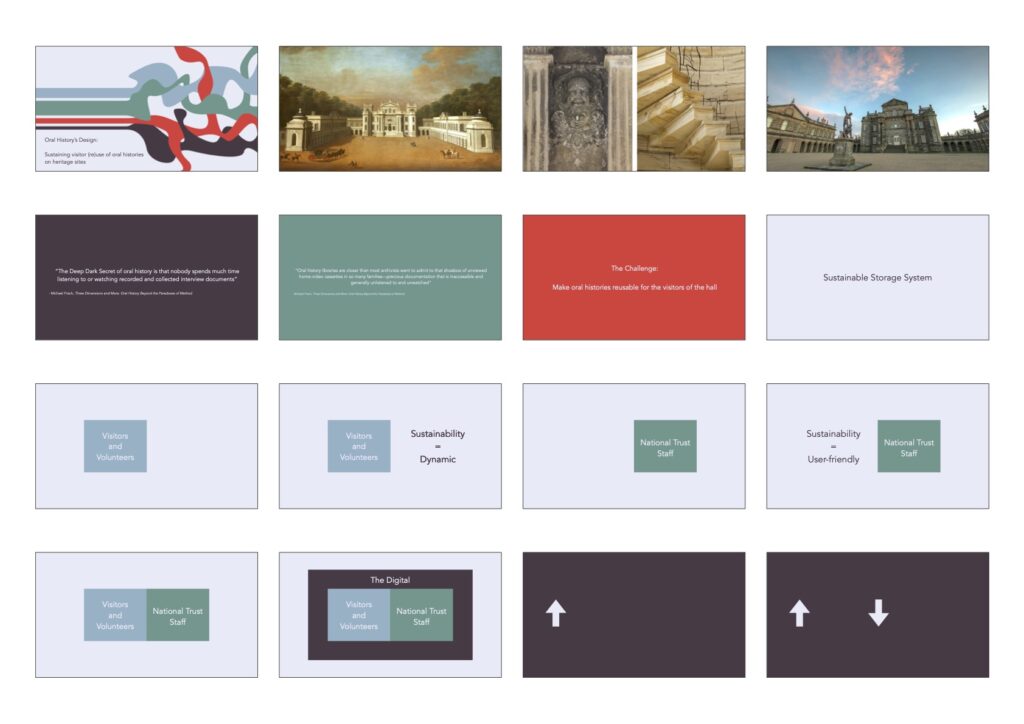
This is Seaton Delaval Hall. Built in the 1720s the hall and its residents, the ‘Gay Delavals’ became renowned for wild parties and other shenanigans. In 1822 the hall went up in flames severely damaging the property. This history is represented very well in the collection that is housed at the hall which is now run by the National Trust. 

What is less represented is the more recent history. The community that looked after the hall after it burnt it down, when it was a prisoner of war camp during both wars and later when the late Lord Hastings invited the local people to parties after its restoration. 

This history lives within the local community. Luckily we have the wonderful field of oral history that allows us to capture this predominately undocumented history.

However oral history has a deep dark secret. After recordings have been made and analysed, they are locked into an archive or into a historians cupboard and never heard from again. They are like a box of unwatched home videos. 

This in the context of Seaton Delaval hall seems sad as its strength as an institution lies within its deep connection with its surrounding area. It would therefore be a shame if the community who gave these histories cannot access them. I also personally think this to be ethical dubious as the lack of access to these oral histories brings up issues of power inequality where an institution like the National Trust happily takes the oral histories but not giving something in return. 

SO this is the challenge: we want to make oral histories reusable for the visitors of the hall. 

To make the rather complex problem more tangible I have focused in on the idea of sustainability:

I would like to point out here that I am using the term storage system instead of archive because I feel that the idea of the archive is very loaded and cultural represented as not particularly accessible to the masses. 

Let’s start with the visitors and volunteers. This particular group, especially the volunteers, are the people who will contribute and donate their oral histories to the hall. Now because of the standard time and financial constraints the period of recording will not be able to capture all the stories. So this system that will house the the initial recordings needs to be dynamic and sustainable enough for the visitors and volunteers to keep adding and reflecting on the history.

For the staff the term sustainability addresses user friendliness. It needs to be easy for a new staff to learn how the system is use and managed. 

This is where I believe the digital can help. 

The digital as we are all fully aware has the amazing capacity to allow people from across world to upload, download, browse all sorts of content. It’s awesome. Also as time goes on more and more people are getting familiar with the digital sphere. Especially with the pandemic which forced to many use it more. This is not just individuals but also the case for most institutions notably those in the culture sector who have been very busy trying stay afloat by working out how they can use all these digital tools to keep their audience. The digital and its tools have become and are increasingly becoming part of everyday life. 

The dynamic and sustainable requirement of the system, where people can easily add information and stories is pretty covered by basic digital systems. 

The user friendliness can be achieved if the staff are involved right at the beginning with the design of the system. Allowing it to mould to the staff’s digital habits and knowledge.

What the digital can also help the staff with is storage. The digital is able to store documents in also sorts of formats and in all sorts of locations. I personally find that the internets ability to duplicate (think memes) might be a possible tool that could help storage issues but that simultaneously brings up all sorts ethical issues around permissions and copyright. 

However what the digital also has done is created this desperate need to record and store everything and therefore also a huge sense of loss when something isn’t captured. Because as you are able to capture and store something you also create a whole bunch of things that arent captured and therefore lost. Technology has always played a huge role in this, just look at the field of oral history which relies completely on the ability to record someone’s voice. So then the question is should we record everything? Do we need to record everything? It’s tempting when you can record everything. But then you have everything and that is also useless because you cannot reuse everything. One of the archivists at the Parliamentary Archives once told me that they had calculated how long it would take for them and their colleague to digitise everything and it was 120 years. This paradox brings up issues around value. What do we value? Whose voices do we value? But an even bigger problem is what will we value?

This one of the bigger I imagine we will be dealing with in the next couple of years. Trying to keep the digital eco system healthy and not complete collapse under its own weight. 

The digital is still very young. Which is proven by what it can do really enthusiastically like record everything and allow everyone to contribute. But it is also proven by the gaps that has. For example many search functions on online archives are difficult to use and don’t deliver that same serendipitous feeling that brick and mortar archive has. A search bar is not close to being the same as an archivist who knows the collection. Robots are not completely ready to replace humans just yet. For now humans will have to fill in the gaps that the digital has. 

A good example of this blend of human and digital is that people who are unable to do their research because they cannot go into archives or the digitisation of the document they are interested in is not good enough. What I have seen many people do now is use their human network to access these documents by ringing people up and asking them take pictures of documents. I thought this was a funny cyborg-y moment where people needed both technology and a human person to achieve their goal. 

So what we are looking at is how the digital can support the needs of humans at Seaton Delaval Hall by adapting to their needs. But at the same the humans are free and able to fill in these gaps that are present in the digital. 

However there is one more layer I would like to add to this challenge of building a sustainable storage system. And that is the environment. Our environment heavily influences whether we can access archives. A pandemic can shut us off from the brick and mortar archives. A power cut can take down the servers where the digital archive stored. Or an earth quake or storm can destroy both completely. 

This in addition to digital gaps is why I do not believe that it is sustainable to solely relay on either a digital or a brick and mortar storage system. A system that floats between these two worlds and at its centre has the humans that are reason for its existence, that I believe is the closest we might get to having something sustainable. Something that will allow Seaton Delaval Hall and its community continue telling stories for generations to come. 


Slides

OHD_LST_0119 words

Acousmatic Sound

Acousmatic sound is sound that is heard without an originating cause being seen. The word acousmatic, from the French acousmatique, is derived from the Greek word akousmatikoi (ἀκουσματικοί), which referred to probationary pupils of the philosopher Pythagoras who were required to sit in absolute silence while they listened to him deliver his lecture from behind a veil or screen to make them better concentrate on his teachings.

Archivism

The act of moving something from the everyday to the space of archive.

Affective Computing

Affective computing is the study and development of systems and devices that can recognise, interpret, process, and simulate human affects. It is an interdisciplinary field spanning computer science, psychology, and cognitive science. One of the motivations for the research is the ability to give machines emotional intelligence, including to simulate empathy. The machine should interpret the emotional state of humans and adapt its behaviour to them, giving an appropriate response to those emotions.

Aufhebung

In Hegel, the term Aufhebung has the apparently contradictory implications of both preserving and changing, and eventually advancement (the German verb aufheben means “to cancel”, “to keep” and “to pick up”). 

Authorised Heritage Discourse

The creation of lists that represent the canon of heritage. It is a set of ideas that works to normalise a range of assumptions about the nature and meaning of heritage and to privilege particular practices, especially those of heritage professionals and the state. Conversely, the AHD can also be seen to exclude a whole range of popular ideas and practices relating to heritage.

Brick and Mortar Archives

A rather more elegant term for archives that are stored in buildings. Because it is important to note that digital archives are also very physical.

Content Drift

When the content of a page has been moved around on the internet causing certain links to no longer be attached to that specific page.

Counter-reading

Counter reading is when you identify the gaps in an archive, analyse why they are exist and combined this with further contextual history in order to fulfil your research.

Data Degradation

Data degradation is the gradual corruption of computer data due to an accumulation of non-critical failures in a data storage device. The phenomenon is also known as data decaydata rot or bit rot.

Disciplinary Upbringing

The separate lenses through which individuals from different fields of work view and approach things like: problem solving, language, and general practice.

Drive By Collaboration

Collaborating but only a trivial amount of time and often to fulfil a funding requirement.

Ego Documents

The word ‘egodocument’ refers to autobiographical writing, such as memoirs, diaries, letters and travel accounts. The term was coined around 1955 by the historian Jacques Presser, who defined egodocuments as writings in which the ‘I’, the writer, is continuously present in the text as the writing and describing subject.

GAFA

Acronym for Google, Apple, Facebook and Amazon. The tech giants.

Historical Imagination

A tool use by historians to put themselves into the shoes of the historical figure they are investigating or imagining themselves in the streets of a certain historical setting. It can be helpful to bring together separate ideas and bring the history back to life as such.

GLAM

GLAM stands for Galleries, Libraries, Archives and Museum.

Link Rot

When the webpage attached to a link can no longer be found when you click on it and instead offers you the message “Page not found”

Liquid Architecture

Liquid architecture is an architecture that breathes, pulses, leaps as one form and lands as another. Liquid architecture is an architecture whose form is contingent on the interest, of the beholder; it is an architecture that opens to welcome me and closes to defend me; it is an architecture without doors and hallways, where the next room is always where I need it to be and what I need it to be.

Marcos Novak in “Liquid architecture in Cyberpace”

Media

Originally coming from the word mediator.

Media Archaeology

Media archaeology or media archeology is a field that attempts to understand new and emerging media through close examination of the past, and especially through critical scrutiny of dominant progressivist narratives of popular commercial media such as film and television. Media archaeologists often evince strong interest in so-called dead media, noting that new media often revive and recirculate material and techniques of communication that had been lost, neglected, or obscured. Some media archaeologists are also concerned with the relationship between media fantasies and technological development, especially the ways in which ideas about imaginary or speculative media affect the media that actually emerge.

Media Literacy

Media literacy encompasses the practices that allow people to access, critically evaluate, and create or manipulate media. Media literacy is not restricted to one medium. Media literacy education is intended to promote awareness of media influence and create an active stance towards both consuming and creating media. Media literacy education is part of the curriculum in the United States and some European Union countries, and an interdisciplinary global community of media scholars and educators engages in knowledge sharing through scholarly and professional journals and national membership associations.

Multivalence

Multi-valents, many values, the holding of different values at the same time without implying confusion, contradiction, or even paradox. (Term coined by Michael Frisch.

Open Access

Open access (OA) is a set of principles and a range of practices through which research outputs are distributed online, free of cost or other access barriers.

Participatory Action Research (PAR)

Participatory Action Research (PAR) has been defined as a collaborative process of research, education and action explicitly oriented towards social transformation. Participatory Action Researchers recognise the existence of a plurality of knowledges in a variety of institutions and locations. In particular, they assume that ‘those who have been most systematically excluded, oppressed or denied carry specifically revealing wisdom about the history, structure, consequences and the fracture points in unjust social arrangements’. PAR therefore represents a counter hegemonic approach to knowledge production.

Post Private

The age of high surveillance which we live in now.

Reference Rot

When links in footnotes on longer are attached to the reference. This is often due to link rot or content drift.

Software Rot

Software rot, also known as bit rotcode rotsoftware erosionsoftware decay, or software entropy is either a slow deterioration of software quality over time or its diminishing responsiveness that will eventually lead to software becoming faulty, unusable, or in need of upgrade. This is not a physical phenomenon: the software does not actually decay, but rather suffers from a lack of being responsive and updated with respect to the changing environment in which it resides.

Taxonomy

The science, laws, or principles of classification.

Vox Pox

Coming from the latin vox populi, it refers to a short interview with a member of the public.

Wikidata

Wikidata is a collaboratively edited multilingual knowledge graph hosted by the Wikimedia Foundation. It is a common source of open data that Wikimedia projects such as Wikipedia, and anyone else, can use under the CC0 public domain license. Wikidata is powered by the software Wikibase.

OHD_PRS_0118 🏛⏳🏺📜: Connecting with history through our screen

This was not a very good paper. I was very busy and I did not put my whole heart in it, which is always a shame. But a learning moment to remember to plan these things better


Slides


Google Gemini Summary of OHD_PRS_0118 - Connecting with history through our screen
[generated 06 / 01 / 2025]

Challenges with Existing Digital Archives: You effectively critique current digital archives, highlighting their limitations in capturing the serendipity and emotional connection often associated with physical archives. Issues such as clunky interfaces, limited search functionality, and the loss of contextual information are identified.

The "Archive-Robot" Metaphor: This is a novel and insightful perspective. By framing digital archives as "archive-robots" still under development, you emphasize the need for ongoing refinement and improvement. It shifts the focus from simply replicating physical archives to exploring new possibilities for digital interaction and engagement.

The Importance of Human Connection: You emphasize the importance of human interaction and the emotional connection to physical archives. You highlight the limitations of purely digital experiences and the need to consider the social and cultural contexts of archival research.

Ethical Considerations: You raise important ethical concerns regarding data privacy, digital inequality, and the environmental impact of digital technologies.

A Call for Innovation: You advocate for a more human-centered approach to digital archives, emphasizing the need for creativity, collaboration, and a willingness to experiment with new technologies and methodologies.

Key takeaways for your PhD research:

Focus on User Experience: Design digital tools that are intuitive, user-friendly, and enhance rather than hinder the research experience.
Embrace Collaboration: Foster close collaboration between oral historians, archivists, technologists, and community members throughout the design and development process.

Prioritize Sustainability: Consider the long-term sustainability of digital technologies, including maintenance, data preservation, and environmental impact.

Explore Innovative Approaches: Experiment with new technologies and methodologies, such as AI and machine learning, while also recognizing the limitations of technology and the importance of human interaction.

Overall, this presentation demonstrates a strong understanding of the challenges and opportunities presented by the intersection of oral history, technology, and heritage management. Your insightful observations and critical thinking will undoubtedly be valuable assets as you embark on this exciting research journey.

Script

Since the start of my PhD in January there are two things I have observed when people talk about archives during COVID.

  1. People complain about the digital archives 
  2. People express how much they missing brick and mortar archives

I, too, hold these opinions. I have recently started digging through the National Trust’s oral history archive which is housed at the British Library and it has not been the most relaxing affair. Every time I clicked on an entry and then wanted to go back to my search results I would have to refresh my page and if I accidentally clicked on any of the names that were hyperlinked in the entry pages I would lose my place in the archive and have to go back to the start. I also have very little experience of actually working in an oral history archive so really need to visit a brick and mortar archive that houses oral history. The only information I do have on listening to oral history in a brick and mortar archive comes from my friend who told me in horror how they had given a CD player and a broken set of headphones. 

What I am going to do for this presentation is dissect these two observations and explore how I can reframe these in order to use them in my work for my PhD.

Point 1! 

Let us start with the digital archives that so many of us have had to rely on over the last year. Digital archives exist because they are following the bigger trend of moving our lives online. But this move from brick and mortar to digital is about a literal as it can get. When I was going through the National Trust’s oral history archive it felt as if the British Library took the index cards that accompanied the recordings and just transcribe them into a webpage. They moved the collection online without thinking about how this new realm could enhance the experience of archive. Other than the fact that this makes going through the archive a bit frustrating and boring you also lose that serendipity that everyone always talks about when they are in brick and mortar archives: the scribble in the margins, the note lost in the pages of a book. These two things: the loss of serendipity and the direct translation is why I believe people are complaining.

So how do we solve this? To start with I suggest a reframing of what we think a digital archive is. As I previously mentioned a digital archive is not the digital equivalent of a brick and mortar archive because we lose that serendipity that we love so much. So what if we view the digital archive as a tool to access the information in the brick and mortar archive. Our computers, browsers and webpages then become the tools that grant us access to the archive, which is a role normally held by archivists. They are the people who usually accompany us in our journey through the brick and mortar archive. But our computers, browsers and webpages are not the same as a fully trained archivist. An archivist is a human who is capable of complex and creative thought. They can solve problems and navigate around barriers, while a computer is only as creative as its database and code allows it to be. So we could view digital archives as a digital alternative to archivists but I believe this would still cause frustration, because within this framing we are still comparing the new digital archives to the old brick and mortar archives and in this fight the brick and mortar archives have the creative upper hand (for now.)

So I would like to propose another way of framing our digital archives. A couple of weeks ago I attended a seminar on AI. During the seminar, Professor Irina Shklovski from the University of Copenhagen presented a paper called AI as Relational Infrastructure. She discussed how the way we view AI is all wrong. We view AI as a tool we can used but Shklovski suggested that we should view it as a relationship, an exchange of skills and knowledge. So I translated this principle onto my work in the National Trust’s oral history archive. This translation made me view my computer, the browser and this British Library portal as an archive-robot that was trying to help me navigate the messiness of the brick and mortar archive on the other side of my screen. However this archive-robot is very new to the archive; we need to remember that digital archives are the new kids on the block and these archive-robots do not know the ways of the archive yet. The way that I currently picture this relationship is as follows. Here we have our archive-robot who has just started their new job at the archive, they do not really know what they are doing, they might have even lied a bit on the CV. Along come a lot of random people who start handing all their documents, notes, and other bits and bobs over to the archive-robot, who and I cannot stress this enough has no idea what they are doing, and expects them to just sort everything out. This is a rather tall order as we already know that archive-robots cannot think as creatively as a human-archivist – yet. What we need to do now as a community that uses these archives is train these new kids in archiving because in the end they will help us in our research. 

I know this sounds like I am advocating robot rights. Maybe I am a bit but what I really trying to say is that instead of viewing digital archives as the digital equivalent of brick and mortar archives, or viewing them as tools to access those archives, you can view them as an archive-robot who is trying to adapt to this new world as much as you are. It might sound like a silly idea but I can tell you from experience it eases the frustration a bit. And most importantly if we view our digital archives like this we put ourselves into a mindset that allows us to seek progress and development in our digital archives and not just settle for this rather crude translation of brick and archives. Digital archives are still in development and I think that if we see them more like archive-robots in training then maybe we can help them help us. 

Point 2!

People miss brick and mortar archives. Other than the fact that we don’t really like digital archives right now, I think there is something deeply emotional about people’s desire to reenter brick and mortar archives. Even though we might have access to certain documents online, people still want to be near the physical document. Just like how people travel to see the Mona Lisa despite the fact that everyone knows what the Mona Lisa looks like. This feeling, this desire, this need to be in the physical space I also see in my mother, who because of the pandemic has not been able to travel to her motherland the Netherlands for nearly a year now. Just like the archive-robots allow us to connect to the brick and mortar archives, my mother has been able to connect to her homeland via her devices be that FaceTime with her sister, watching dutch tv, reading dutch newspapers or listening to dutch radio. But we know it is not the same as physically being there. She wants to connect to the land. She wants to be in that physical environment. And I think this feeling is very similar to people missing brick and mortar archives as if the archive is their motherland.

I think it is necessary to understand the importance of this connection when it comes to research. Connecting with your subject of your research in an emotional way can help one be more responsible in how we handle our archival material. This is especially important in cases where the archival material is from someone who is still alive or has close living relatives, which is something that is very common with oral history. When we use our digital devices to access archival material or in fact do anything that involves interacting with humans dead or alive online we have something I am going to call “digital distance”. 

Through our screens we reduce humans to a handful of pixels, a username and 240 character statements. This is digital distance and the reason why some people do or say bad things because that person to them is not fully human because the way they are presented on our screens is not fully human – you cannot look them in the eye. Now obviously you cannot look the creators of archival material in the eye because most likely they are dead. But their humanity is present in the archives in their bad handwriting, spelling mistakes and doodles. Physically being with the documents, imagining what they smelt, felt and saw when they were creating this document makes us connect on an emotional level. It reminds you that these are not just bits of isolated evidence but actually are part of a wider portrait of someone’s life. You become invested in this ghost type thing and the only way to truly feel their presence is by being in the brick and mortar archive. 

This feeling of closeness that people want to have with the Mona Lisa and feeling of belonging that people have with their motherland they can be found in people desire to go back into brick and mortar archives. It is a connection that is strange and maybe nothing completely logical but very human. I think by reframing this observation as the archive as motherland highlights the importance of the physical in archiving. It is a physical activity and the fact that it is physical plays an important role in responsible researching.  

How does this help me?

For my PhD I have been challenge with building an oral history archive-esque thing at the National Trust property Seaton Delaval Hall in Northumberland. 

So, how can this reframing of observations into the archive-robot and the archive-motherland help me build an archive?

Reframe 1

As I said previously by reframing the frustrations of the digital archive into the naive archive-robot we put ourselves into a position where we want actively want change. We are thinking about what the archive-robot might look like when they grow up. What this reframing allows me to do is start thinking in terms of design-driven innovation. Design-driven innovation is a term used by the design scholar Roberto Verganti in a book by the same name. The idea behind design-driven innovation is seeking to change the meaning of an object or system. For example, corkscrews are there to open my wine but this corkscrew by Alessi “dances” for you and plays on you inner child. Similarly portable music players allowed you to listen to music on the move, but the iPod allowed you to cheaply buy songs from iTunes and then curate them into your own personal soundtrack. 

Here we have two axis: change in technology and a change in meaning both have a scale from incremental to radical change. In the corner we have market pull/user-centered design. Here we have the bubble design-driven innovation, where see radical change in meaning and the bubble technological push where there is radical change in technology. In this yellow part where there is a radical change in meaning but not in technology we find designs like Alessi’s corkscrew. In this blue section we find technologies like the first mp3 player, which was a significant technological upgrade from portable cassette and cd players. Now in this green part we find the iPod. This green part is what Verganti refers to as a technological epiphany. 

Currently our digital archives and archive-robots live here in the blue section where there is an upgrade in technology but not in meaning. As I said using the British Library does feel like they uploaded the index cards. By the way, this is not a just people being silly, human kind always does this when there is a change in technology. The first cars looked like carriages and our save button looks like a floppy disc. We don’t like radical change so we keep the meaning and symbols. But for my PhD I want to do what Apple did in 2001 and also achieve a technological epiphany. I want to upgrade the archive-robot because I think this is the perfect opportunity to do so when everyone is using digital-archives so much and complaining about them. 

Reframe 2

So how will I use this idea of the archive-motherland in my work. As I briefly mention before oral history often deals with people who are still alive so looking after their archival material responsibly is imperative. That is why I do not think it is too much to ask that if you want to take information from the community you should probably think about becoming part of that community. And the only way to do that is to physically go there and look the people in the face. This is not a new idea there are many archives that only allow you to access the oral history recordings if you are in the building where they are stored. This is the case with the National Trust’s oral history archive which you can only listen to if you are in the British Library. Now I think you might be able to predict what my problem with this is. The British Library is in London and quite some miles away from Seaton Delaval Hall in Northumberland. So if I want to keep this principle of connecting to history through physical space I might have to very politely ask the British Library if they could maybe bend the rules for me. 

Conclusion!

I think that what I am trying to get at here is that through these observations and reframing I think I can say that connecting with history is a deeply human process. And the way we do it and the way it is changing because of technology and the pandemic is nothing new to human kind. I think that while we do pursue these new technologies we also need to remember that emotional connection we have within the brick and mortar archives. I do not know for sure what archives will look like in a years time but a lot of it with have started now during the pandemic.

I really want to end on a quick note that I think it is really important to remember that the internet and the servers that the internet is store on use up a truly insane amount of energy and are very bad for the environment and the majority is own by amazon, which is actually a terrifying idea when you think about it. 

OHD_BLG_0039 It’s not my problem

There is a problem within the National Trust’s storage system (SharePoint) that is sadly a consequence of democratisation. SharePoint is a complete mess and no one really knows what is going on or who to ask about what is going on. And although this has a lot to do with the design of SharePoint and the lack of transparency surrounding the structure of folders and such, there is another reason there is so much chaos in the folders and that is control. You see before this chaos took hold it was the collection staff who would have been in charge of the archival and collection material, while others might handle files concerning business. Information would have been kept on people’s shelves in their offices, and so to access this information you would have to go through a human. This might in some cases be really annoying because the person who could grant access wasn’t feeling up for it. But then the internet came along with the main intention to make information free and accessible – a more democratic system. Like everyone else the National Trust also decided to remove its strict system of gatekeepers and adopt the attitude of the internet. And this is where an unforeseen consequence arises because while before one person was responsible for a file, now everyone is responsible for all the files, there are no parameters. And because everyone is in charge of looking after everything it is really easy for the individual to simply hope that the next person will sort out that file. Also because looking after files is maintenance and people do not like doing maintenance. Now do not get me wrong I agree that we should have better access to archives and no has the right to deny someone access, but in a world where everyone is responsible, no one is responsible and the National Trust’s SharePoint proves this.

OHD_BLG_0042 What do you mean not digital?

Whenever I mention my ideas for analogue archiving solutions to anyone the reaction I get is a blank stare shifty follow by a change in subject. When I was venting about this recurring experience to my mother, she did not seem surprised; “what do you except people see the digital as the future?” She is correct this is what people believe but the ‘future’ is a rather nebulous concept and it is important to manage expectations – how far is the ‘future’? If you take what is written in The shock of the old: technology and global history since 1900 then you will quickly understand how far off we are from the future and how slow technology actually moves. The writer approaches the history of technology not through the lens of innovation but from use – a use-based history of technology. This quickly reveals the pace at which humanity really adopts technology through examples like horses being more important in Nazi Germany’s advances than the V2 and the fact that we have never used as much coal as now. We are slow at technology, which is fine but we need to be aware of it. The digital divide is a real thing and it needs to be considered. Note that the digital divide is not across generational lines, yes older people cannot use TikTok, but I have seen children struggle to use a keyboard and a mouse because they are so used to touch screens. The digital divide also means that there is an exclusive group of people who do know how to use this tech and they are in high demand, to the extend that there is little incentive for workers to lend their services to the GLAM sector. Why would you work for less money in a library when you can earn a hundred times more somewhere else. Heritage sites and the wider GLAM sector can in many instance not afford to develop their own technologies mostly because they are unable to maintain them. But they also sometimes struggle to update their bought in systems because moving all their data on their collection round is too much work and effort. And in some cases the software producers are aware of this and shut down the feedback loop because they know their customers can’t leave them. To summaries saying “digital is the future” is an unproductive lie that we tell ourselves to make us feel better and trendy.

Here comes my suggestion otherwise we would be left hanging in a rather sad place. The National Trust is undoubtedly a large organisation and they already run several digital platforms which they have their own maintenance team for. What I suggest is that if people want to create cool snazzy digital interfaces they have to do this at Trust, because the Trust already have the infrastructure in place (to certain extent) to cope with the difficulties of running a digital system. E.G. https://www.rijksmuseum.nl/en/rijksstudio On individual site level however digital platforms cannot be made or maintain and the only option in my eyes is to either to keep it analogue (better for the environment) or DIY digital. By DIY digital I mean word docs and spreadsheets and softwares that are a little more accessible to a wider group of people. These option are more accessible and more maintainable but they are less sexy. When it comes to working with digital you have to know your limits and the people around you and the people who will come after you. It is not exciting but it might just solve your problem.

OHD_BLG_0052 It’s all about the cleaners

I always get frustrated when I clean my fridge. There are so many little ridges that stuff gets into. I even have to have the door of my fridge open a certain way, which is not logical in the day-to-day of opening it but is the only way I can make sure that I am able to take out the shelves to clean them properly. This is an example of people designing a product without thinking about maintenance. The designers were not thinking about the cleaners they were thinking about the users. In a capitalistic and consumer driven world this is not surprising. We want to sell products to the users and cleaners are not important. Cleaning is after all a women’s job and who gives a shit about them. However cleaners are extremely powerful. If cleaners go on strike you have a big problem.

Waste disposal strike during the winter of discontent

However, cleaners do not generally go on strike. They are often women, who are most likely from a minority background and need the money. Striking is a privilege.

But cleaners are extremely powerful and this is proven by the new types of cleaners and maintenance workers. The computer guys. The IT department. The software developers. However unlike domestic cleaners our digital cleaners are mostly privilege educated men. This in combination with the fact the we view digital as our new god, means that we view these new, digital cleaners in a very different light. These types of digital cleaners are a luxury. Don’t get me wrong being able to employ a cleaner to clean your house is also extremely privileged, but this is a whole new level.

Now some might point out that the digital cleaners need way more training but then I would invite them to clean a university building. To be able to clean fast and well, while simultaneously being completely ignored by your fellow humans and having to deal with the disgusting things that come out of these humans, you need to be really good and have a lot of experience. The most elite cleaners, those who work in very fancy hotels, have to under go extreme training. They are different jobs but one is not harder than the other and the difference in pay a shameful.

But what does this have to do with archives, because that is what I am normally talking about. Well, in this article by archivist Charlie Morgan he talks about Mierle Laderman Ukeles’ Manifesto for Maintenance Art 1969!, which is one of my favourite art pieces. With her work Ukeles brings to light the people to who have to maintain the work after it has been created. Morgan writes that as a society we are focused on creation and under value maintenance (not surprising as this is either done by women, or the working class.) This focus has led everyone including archives to become obsessed with collection. GIMME ALL THE STUFF! This is like my fridge completely ignores the maintenance staff. How are we going to look after all this? WHO CARES I WANT IT!

Not helpful. Especially when people are handling sensitive informative which many archives do (so does most of Silicone Valley, but that’s another issue.)

My work is about getting people to reuse oral history, to give purpose to the storing of recordings, but I must NEVER forget about the cleaners. I cannot design any thing extremely complicated because most archives cannot afford the luxury digital cleaners. They have to do all the cleaning themselves. Heck, I was talking to an archivist who said the they currently were not doing any archiving they were doing building maintenance. Archiving is not the job you think it is. Archiving is cleaning. Cleaning up the world’s information.

OHD_BLG_0054 Stay Healthy!

We are cyborgs. We are so dependant on our digital devices that we have become cyborgs. I do not even use my phone that much but I am definitely a cyborg. Someone pointed this out during a seminar. They said, “if you don’t believe that you are a cyborg let me take your phone away and then you will realise that you are a cyborg.”

I just read The Unsustainable Fragility of the Digital, and What to Do About It by Luciano Floridi. In the paper Floridi talks about the fragility of the digital and how we need to make sure that it stays healthy because otherwise viruses can spread fast. Linking this with the cyborg idea I realised that we need to start talking about our own “digital health”. The digital is not going away any time soon, so in order to stop the spread of viruses, which can cause enormous amounts of damage, we need to start thinking about digital health. Now this obviously firstly works on the level of software and cybersecurity companies. They are the healthcare sector, but we as individuals also need to work on this, just like we do with our physical health.

We have our bodies (physical health), our brains (mental health), and our digital extensions (digital health). If we are cyborgs then it only makes sense that we look after the robot part of ourselves. Especially because that robot part is only going to grow over time (sadly).

OHD_BLG_0076 ʇǝɹɔǝs ʞɹɐp ǝɥʇ

In Frisch’s ‘Three dimensions and more’ he discusses the idea of the deep dark secret of oral history being like the unopened shoe box of homemade videos – unwatched. After digesting this idea for the last two years I suddenly realised something. Oral history as a field exists because of technological advancements. The field is completely intertwine with technology: the recording devices used to make the first recordings, the internet now allowing for international zoom interviews, it all depends on technology. This made me think that maybe the deep dark secret is not an oral history problem but in fact a technology problem. It’s not oral history’s fault that much of technology is not particularly focused on sustainable storage. There is focus on speedy communication; phones, text messages, social media and trading; online shopping and targeted advertising. Even accessing knowledge (aka googling) is not based on accuracy but more speed and attention.

Digital storage is a minefield from ‘things that exist on the internet forever’ to link rot and from the now unreadable mini-disc to hard drives that can store two terabytes of data. It is so extreme that it is clear that no has really thought about beyond uploading it. Technology, like many things in capitalist society live solely in the present, so the way it views time extremely 2-dimensional. There is no thought about how this attitude towards storage affects the past or the future. The amount of time and money that is required to keep archives up to date with their digitisation is not covered by the amount of money and time archives actually have. Beyond the archive our day to day interaction and documentation has an unknown future. What are your next of kin going to do with your Facebook page when you die? Or your instagram? Your Snapchat? Your emails? Your iCloud? Your laptop, smart phone, hard drivers and tablets? Currently it is likely that it will either disappear or be inaccessible.

The way we store our data in this blasé way has the potential to create a black hole of information in the timeline of human history. This attitude is completely inefficient when it comes to accessing and reusing. Unless of course you are Facebook, Google or Apple. These mega gods of information are able to mine astronomical amounts of data and use it. But in order to use it they strip every single bit of humanity from the process. The only way to use the truly insane amounts of data is by reducing the human producer so much that literally become zeros and ones. No feelings, no aura, just nothing. Oral history cannot do this because oral history is fundamentally human. Just like home videos that are filled with nostalgia and memory, they take time to watch or listen to because there is so much emotion and memory that needs to be digested while viewing. But the data that is used by big tech is void of this emotion.

In conclusion, due to oral history’s long term yet slightly abusive relationship with technology it has got this deep dark secret of unused archives. But in truth technology does not support what archives are trying to do. The creators of this technology just do not give a shit because that’s the nature of the capitalistic beast. I suggest therefore that we take a reverse attitude towards this relationship. Oral history needs to inform tech what they need in order to make archives work better because clearly tech has no idea what it is doing.

OHD_BLG_0080 The Virtual Rooms

I have just found out about the Baader-Meinhof Phenomenon. Actually that is incorrect I have just googled the “phenomenon where you hear something for the first time and then again” and found out that it is referred to as the Baader-Meinhof Phenomenon (for no particular reason in case you were wondering). The reason I was googling this idea was not just because I was wondering if someone had named this occurrence but because I today I heard about the Clubhouse for the first time and then listened to a podcast where they repeatedly mentioned it. Clubhouse is an exclusive audio social platform app, which you need to be invited to in order to part take in it. It’s basically an app where you can do call in radio sessions and then it deletes everything afterwards. I found it because of a Guardian article about its sudden popularity in China, but it has been around for a while and has already become quite problematic (Elon Musk is a fan).

I started connecting some dots in my head after reading this, because it was only last week that someone I was zooming with mentioned that they sometimes hung out in “online libraries”. These online libraries are literally just people studying in a zoom call together. These online libraries, Clubhouse and my sister’s latest obsessions of minecraft streamers and late night discord games all take place in virtual spaces, but live ones. Not like Reddit or Twitter, even though these can be consumed at some speed you still need to scroll and read to get through everything. But these new(-ish) spaces use audio and video. It seems less filtered and also less monitored.

So I did some googling and sure enough I found a MIT press article that talks exactly about how we might be moving back to using our phones for audio purposes. This is great news for me as this means only more technological advancements in audio text recording. Now to only makes sure my serves don’t fill up with White supremacists and/or very annoying misogynistic Elon Musk types.

OHD_BLG_0102 DIGITAL FORAYS: ARCHIVES & ACTIVATION // ARTISTS AND ACCESS

with Asunción Molinos Gordo (Artist), Mohammad Shawky Hassan (Artist), Diana Allan (McGill University), & Discussant Helga Tawil-Souri (NYU).
In partnership with ArteEast & the Arab American National Museum)
15/10/20

At the start of the talk someone mentioned that they missed the mingling after a talks. Like the coffee houses Steven Johnson talks about.

Then I thought about whether it would be interesting to map these post talk chats by mic-ing people up and tracking their movements and interactions. \

Re-mixing

Just like the previous talk this was mainly about archival work concerning the middle east. Because of this everything (understandably) is coated in this layer of reclaiming ones history. This in combination with artists leads to a re-mixing of archives, putting a new lens on it. In some circumstances this means creating a whole new story. Using bits from the archive and remixing them to such a degree that a (maybe not completely factual) story is created. However the factual accuracy of the story does not really matter. These works are made in the freedom of the artistic space and their main aim is to become some thing that stands against the state archive and tell the story of a minority.

In one particular case during the talk the person was using archive footage from the British Library that had such strict copyright laws that she had to do extensive manipulation in order to even be able to make a film. This brought a lot of frustration since the footage is British colonial propaganda.

This re-mixing and manipulating of state archives in order to create something for a minority reminded me of the streetwear exhibition that I went to in Rotterdam. I see parallels between the practice of mixing and matching clothing the belonged to an elite with tracksuits and sportswear (among other things) order to create this own culture and what these artists create using archival footage. (Especially when you look at issues of copyright.)

In addition to streetwear the discussant Helga Tawil-Souri brought up Dada and how they used collage in order to make sense of a world increasingly filled with information. What the Dada-ist would have made of this age I do not know.

The “dead” .v. “alive”

There was a lot of discussion around resolute-ness of archiving something. By archiving something are you saying that it’s over? Then when do you start archiving a revolution? And when you archive something are you then also “creating” things to not be archived? Is it dead when you archive something? Should it be dead? Do we kill it when we archive it? Does an archive work best when it is alive? When the stories live in the people? Does an archive need a community? Even if they are subject to legend and myth? Why do consider an object truth when some one still has to label the object?

Decentralised Archives

The questions asked in “dead” .v. “alive” are nearly all subject to power structures. Whoever is in charge of the archive can allow new stories to be created or they can kill it, keeping it in its hibernated state. Like copyright. After all “history is written by the winners”.

But how do we break down these power structures?

A lot of people are using social media and other digital platforms but as we slowly realising now that just moves the power over the archive from the state to unelected billionaires (not ideal).

Diana Allan mentioned the idea of exiled archives. Archives created by refugees and those that move around the globe. This might allow the creation of archives that aren’t chained to any state. However this then brings up the issue with copyright and privacy.

Obviously the artists taking part in this talk also challenge the power structures by remixing. But the archives need to be open to this happening. Maybe having regular artist in residence.