
By Dr. Deb Dulson
With winter now in full swing, so too are the ‘winter bugs’ that can cause a number of infections and illnesses, the most common of which being upper respiratory tract infections (URTI) such as cold and flu. Cold and flu are more prevalent during the winter months due to the favourable conditions for these viruses to survive and replicate. While the cold and dry (little moisture/humidity) air during winter is advantageous for pathogens, it is not so great for us or our mucosal immune system (which consists of mucus membranes lining our internal surfaces such as nose, mouth, eyes, lungs etc. that are exposed to the external environment). Cold dry air can lead to the drying of several mucus membranes, causing damage and inflammation to occur.
Add to this, the increased amount of time we spend indoors with other people during winter due to the adverse weather, and it is unsurprising why our risk of illness is significantly higher during winter than other times of the year. Work by my group has shown that the greatest predictor of URTI risk amongst elite athletes was not related to training stressors or wellness indicators, but to household illness. In fact, an athlete’s risk of URTI was increased 3-6 times if a member of their household was ill [1,2]. This finding aligns with broader trends in the general population.

So, how can you reduce your chances of illness this winter?
While the immune system is incredibly complex, there are some straight forward strategies we can implement to give this system the best fighting chance of keeping us healthy this winter. Although the following strategies have been proposed with the immune system in mind [3], many of these will also have beneficial effects on other aspects of our health too (a win-win in my eyes!) and are appropriate for both athletes and the general population.
1. Practicing good hygiene
While not the flashiest strategy to start with, ensuring optimal self-hygiene practices are in place such as washing hands and covering coughs and sneezes (either with a tissue or in the crease of your arm), is key to limiting both the contact and spread of infection, something that COVID-19 highlighted the importance of. Also, avoiding touching areas of your face, such as eyes, nose and mouth (something we tend to do ~9-23 times per hour!) will help to limit self-inoculation/infection.
FACT: Did you know, a sneeze (and its associated nasal droplets) can travel up to ~7-8 m if not covered and stay in the air for ~10 min!
2. Being Physically active & Exercising (with adequate hydration and clothing)
Physical activity and exercise are powerful tools for helping to maintain our immune health. Following the physical activity (PA) guidelines (at least 150 min of moderate-intensity PA throughout the week, or at least 75 min of vigorous-intensity PA) and exercising regularly have consistently been found to reduce our URTI risk, sometimes by as much as 50%. While it is tempting to hibernate during winter, it is still strongly recommended to stay active. When being physically active or exercising outdoors during winter it is important to stay well hydrated, as the cold dry air can not only reduce our drive for thirst but can quickly dehydrate us through increased sweating and fluid loss, which can also lead to damaged mucosal linings. To prevent this from happening it is important to take a drink with you when exercising and to consider wearing clothing that can cover your nose and mouth. There are some great products on the market that do not restrict airflow when covering the face but aid in warming and humidifying the cold dry winter air before reaching the respiratory tract.

3. Prioritising nutrition
A healthy, balanced diet is one of the most effective ways to support your immune health year-round, but it becomes especially crucial during the winter months. Focus on foods rich in vitamins and minerals that help support immune function. Two of my top picks for supporting immune health during winter are Vitamin D and probiotics – both of which have been shown to reduce your URTI risk.
Vitamin D: Since it’s harder to get enough vitamin D from sunlight during the winter, consider incorporating foods like fatty fish (salmon, mackerel), fortified dairy products, and eggs into your diet. If these foods don’t appeal, you could also look to take a Vitamin D3 supplement. Taking around 1000-2000 IU a day during winter is typically advised.
Probiotics: Try incorporating fermented foods like yoghurt, kefir, sourdough and kombucha into your diet this winter. If these foods don’t appeal, you could also look to consume probiotics as a supplement instead. There are various drinks, pills, gummies etc. that are available. Try to look for ones that contain at least 1 billion CFU (colony forming units) and the probiotic strains Lactobacillus and Bifidobacterium.
But what happens if you do catch a URTI such as a cold? Is there anything you can do to limit the illness duration and/or severity?
Even while following the above strategies, it is unrealistic to assume we can completely eliminate the risk of illness this winter. So, is there anything we can do if we end up with a URTI such as the common cold? Thankfully, some of the strategies already discussed (such as probiotic and Vitamin D consumption) can also act to help you better tolerate an illness once infected.
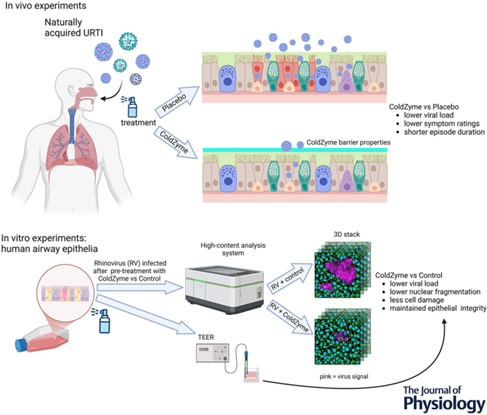
However, are there any over the counter remedies that can help alleviate symptoms of URTI? A recent study I was involved with investigated the use of a commercially available mouth and throat spray (ColdZyme) designed to limit and reduce the symptoms and duration of the common cold. Our group performed both in vivo (monitoring participants over the course of winter to naturally occurring URTI) and in vitro (experimenting on human airway tissue in the lab with rhinovirus) studies using the ColdZyme spray versus a placebo spray [4]. The main findings from this work indicate that ColdZyme spray can reduce both the duration and severity of URTI due to reducing viral load (the amount of virus found in a person’s body fluid), likely due to improved integrity of airway tissue lining and causing less cell damage. As such, this handy travel size mouth and throat spray may be a handy addition to your bag this winter.
Winter doesn’t have to be a season of illness. By adopting a few simple strategies — practising good hygiene, staying active and prioritising nutrition, we can winterproof our immune system and limit our chances of illness.
References
1. Keaney et al., 2021. Household illness is the strongest predictor of upper respiratory tract symptom risk in elite rugby union players. Journal of Science and Medicine in Sport, 24(5), 430-434. doi.org/10.1016/j.jsams.2020.10.011
2. Keaney et al., 2022. Upper respiratory tract symptom risk in elite field hockey players during a dry run for the Tokyo Olympics. European Journal of Sport Science, 22(12), 1827-1835. doi.org/10.1080/17461391.2021.2009041
3. Dulson & Keaney. 2023. Endurance training and athlete immune health. In: I. Mujika (Ed.), Endurance Training – Science and practice. Second Edition (pp. 237-248). Vitoria-Gasteiz, Basque Country: Iñigo MujikaS.L.U. ISBN 978-84-939970-4-5.
4. Davison et al., 2025. ColdZyme reduces viral load and upper respiratory tract infection duration and protects airway epithelia from infection with human rhinoviruses. The Journal of Physiology, 603(6), 1483-1501. doi.org/10.1113/JP288136