Drift velocity of bacterial chemotaxis in dynamic chemical environments – new publication!

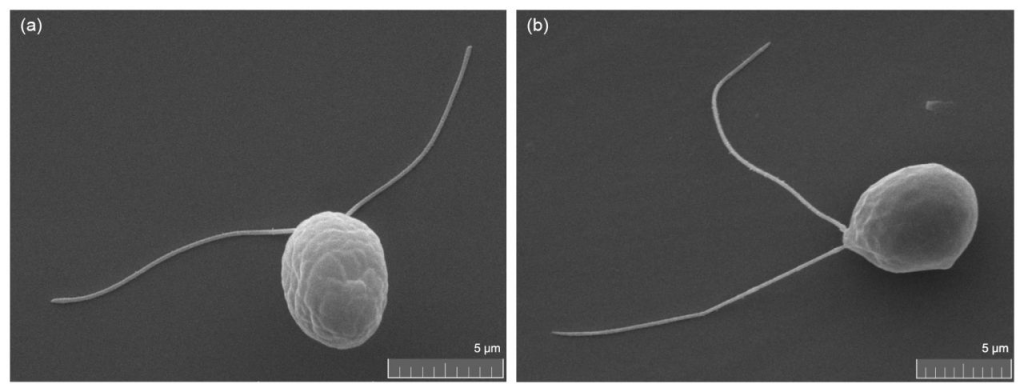
MoLES group members Jason Bains, Prof Andrew Baggaley and Dr Otti Croze have recently published a new model which allows large chemotactic bacterial populations to be simulated at low computational cost. While previous models how described how bacteria can respond to chemical changes in space, the new research shows that changes over time, such as like chemicals appearing or disappearing, can also affect how bacteria move. They use Monte Carlo simulations to infer the drift velocity of a bacterial population when both spatial and temporal gradients are present and explore the consequences of this new effect through a Patlak–Keller-Segel type model applied to single decaying and oscillating pulses of chemoattractant.

Read the Newcastle University Press Release here: New bacterial modelling cuts computational costs for researchers

And the academic publication here: Drift velocity of bacterial chemotaxis in dynamic chemical environments

Diagnostic markers for corneal wound healing – new publication!

The cornea modelling sub-group of MoLES have recently published work exploring quantitative diagnostics for corneal wound healing in patients with limbal stem cell deficiency. This work was conducted by PhD student Patrick Parkinson, and led by MoLES members Dr Laura Wadkin and Prof Anvar Shukurov, in collaboration with leading stem cell scientist Prof Majlinda Lako and expert clinician Prof Francisco Figueiredo.

Their research focuses on harnessing data from cellular images of the corneal epithelium to extract meaningful parameters and quantify the corneal wound healing process in patients who have had a limbal stem cell transplant. They show that cell area is a sensitive and easily accessible marker of corneal epithelial recovery.

Read more here: IVCM image analysis for limbal stem cell deficiency: quantitative diagnostics of the corneal epithelium post-transplant recovery.