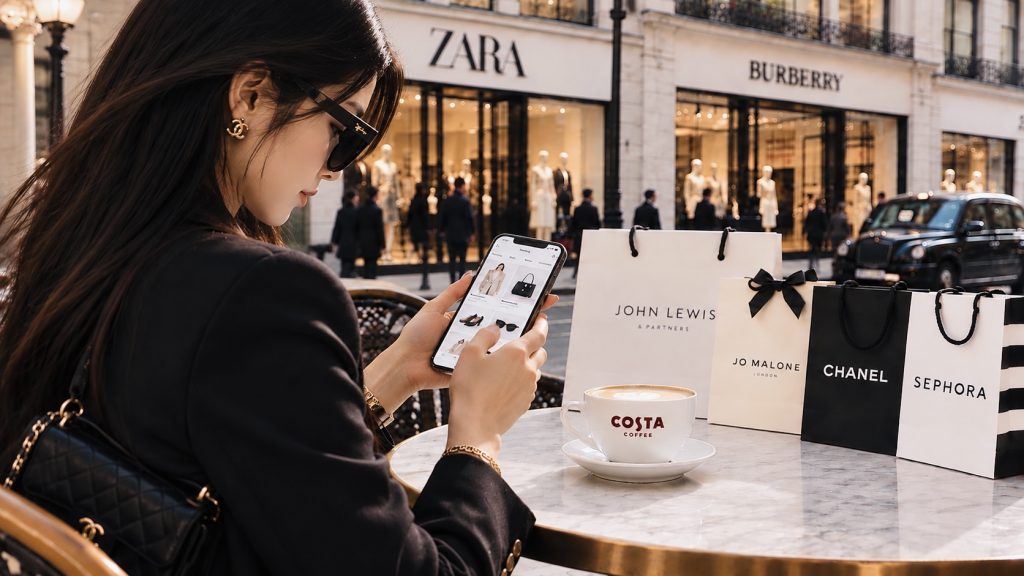
Market research changes how you see everyday business. A shop window, a delivery promise and a customer review all become part of the same question, why would someone choose this brand?
One of the most useful things about market research is that the subject follows you throughout your life and career. You notice how a café presents its menu, why one shop feels welcoming and another feels difficult to navigate. How a beautifully photographed product can leave you reassured about what you are buying.
These small observations reveal something important, marketing begins long before an advert appears, seeing the decision behind the purchase. Researching marketing alongside building a business, gives a broader approach to solving problems, academic ideas help question any assumptions, business decisions make those questions practical.
It is easy to describe a product by its ingredients, features or price. Understanding the customer requires another step.
Someone buying a gift may be thinking about whether it will arrive on time, whether it feels appropriate and what it says about their relationship with the recipient. Someone booking a hotel may want reassurance about staying in a unfamiliar city and help planning their visit.
The purchase has a purpose beyond the product itself, recognising that purpose can make a message more useful and a service more thoughtful, attention needs somewhere to go, digital marketing makes attention visible. We can count views, clicks and reactions. That visibility can be valuable when positioned expertly and professionally, but it can also shape what we prioritise.
A post might attract interest while leaving basic questions unanswered, what does the product cost? Who is it suitable for? How quickly can it arrive?
When we look at a campaign now, we consider what happens after someone responds to it. Does the next step help them? Is the information clear? Does the experience support the promise that caught their attention?
These questions connect digital marketing with brand engagement. Every interaction gives a customer evidence about the business, trust is built in these ordinary moments, a delivery update, an accurate description or a helpful reply may receive less attention than a striking campaign, yet each can influence how someone feels about buying again.
This is where a brand’s ambition becomes a daily responsibility. If a business promises care, that care needs to appear in its processes. If it promises convenience, the customer should experience it when placing an order or resolving a problem.
For a growing business, that creates a useful discipline, make promises the team can support, then examine whether customers experience them as intended.
Bringing learning into practice
Market research gives us the opportunity to step back from the urgency of running a business and ask better questions. What are we assuming about our audience? Which parts of the experience create uncertainty? What evidence would help us make a better decision?
We are learning to treat marketing as a process of observation, decisions and improvement. Creativity matters and so does the work of understanding the person who experiences it.
The question we keep returning to is simple, have we given someone a clear reason to choose us and an experience that makes them glad they did?
Businesses often treat marketing as the final stage of the commercial process. Develop the product. Set the price. Build the website. Then ask marketing to make people want it.
That order is increasingly difficult to sustain commercially.
Some of the most powerful marketing decisions happen long before an advertisement is written. They happen when a business decides what the customer will experience, what problem it will solve, how easily it can be bought, how it will arrive and crucially, what somebody will say about it afterwards.
Marketing, in other words, is not simply the promotion of a business.
It is the design of reasons to choose, as the customer sees one business
Internally, organisations have departments, customers, do not experience them that way.
A customer does not necessarily distinguish between marketing, operations, customer service, technology and logistics. A beautiful advertising campaign followed by a frustrating checkout is simply a frustrating brand. The same applies in reverse.
A remarkably thoughtful delivery, an unexpectedly helpful employee or packaging somebody wants to photograph can communicate more about a company than an expensive advertising campaign.
This is where consumer behaviour becomes commercially important. Businesses understandably concentrate on acquisition, How do we get another customer?
A better question is: What happens after we get them?
If the experience creates satisfaction, recommendation and repeat purchasing, marketing begins to compound. If it disappoints, the company continually has to pay to replace customers it failed to retain.
Distinctiveness matters
Digital commerce has made it easier to launch a business. It has also made businesses remarkably easy to imitate. Competitors can see your prices, products, advertisements, social media and website within minutes. That makes superficial differentiation fragile.
A stronger competitive advantage comes from building something recognisable across multiple points of contact, language, service, product, experience, visual identity and organisational behaviour. The objective is not simply for consumers to recognise the logo.
It is for them to recognise the business without needing to see it.
Data explains what, People explain why.
Modern businesses have access to extraordinary amounts of information. We can measure clicks, conversion rates, abandoned baskets, repeat purchases and customer acquisition costs with increasing precision. Those numbers are indispensable. But a spreadsheet can tell us that somebody abandoned a purchase, it cannot always tell us why.
Was the price wrong? Did delivery feel expensive? Was there insufficient trust? Did the customer intend to return later? Did a competitor simply make the decision easier? Did we adequate Market Research.
That is why quantitative performance data becomes considerably more useful when combined with an understanding of human behaviour.
Numbers tell us what happened. People tell us why.
The strongest commercial decisions need both,
Marketing should create business value. The temptation in digital marketing is to confuse activity with progress. A company can publish every day, accumulate followers and generate millions of impressions without necessarily creating a stronger business.
The more useful measures are often less glamorous, customer retention, recommendation, consideration, conversion, lifetime value and profitability.
Marketing should ultimately make the business easier to choose, easier to remember and more difficult to replace. That requires marketers to understand considerably more than advertising. They need to understand customers, operations, technology, finance, culture and the commercial model surrounding the product.
Perhaps that is the more useful way to think about the discipline.
Marketing does not begin when a business has something to sell.
Marketing begins when a business decides why anybody should care.
The Business of Desire: What Makes Luxury Worth Paying For?
From fashion to food, luxury marketing increasingly depends on something that cannot simply be added to the price tag: belief.
By Nadia Alexander-Khan Fashion Marketing. Luxury Branding. Consumer Behaviour. Brand Strategy. Founder, Alexander Research
There was a time when luxury rarely needed to introduce itself. The address, shop window, service and difficulty of obtaining the product did much of the talking.
Today, luxury arrives on a smartphone. An emerging business can sit alongside a century old fashion house in the same social feed, using equally beautiful photography, sophisticated packaging and polished advertising. The appearance of luxury has never been easier to create.
The harder question is whether consumers believe it.
When everyone looks premium
The language of luxury has spread far beyond fashion. Beauty, hospitality, travel, wellness, food and gifting businesses routinely describe products as exclusive, curated, timeless, artisan or premium.
That creates a problem for marketers. When everybody speaks the language of distinction, the language itself becomes less distinctive.
Recent analysis from Deloitte argues that changing consumer expectations and digital acceleration are redefining what constitutes luxury. Younger consumers increasingly expect experiences that are personal, transparent and culturally relevant. (Deloitte)
Luxury, in other words, cannot simply be declared. It has to be demonstrated.
What are consumers actually buying?
A handbag carries possessions, a watch tells the time, chocolate is eaten, those descriptions are accurate, but commercially they explain very little.
Materials, craftsmanship and design contribute to price, but consumers also attach value to reputation, scarcity, identity, service, presentation and cultural meaning. The customer evaluates not only what a product does, but what owning, experiencing or giving it represents.
That question sits naturally within the work of Newcastle University Business School’s Marketing research community, whose research themes include consumer behaviour and digital marketing. The University’s Marketing Subject Group describes consumer behaviour as the study of consumers’ preferences, decisions and actions when selecting and using products and services. (Newcastle University)
For luxury marketers, that distinction is fundamental. Price tells us what something costs, consumer behaviour helps us understand why somebody believes it is worth paying for.
Fashion’s lesson for the rest of luxury
Fashion has understood this relationship for generations. A successful luxury house does not sell an object in isolation; it constructs an environment around it.
Heritage, stores, campaigns, designers, ambassadors, packaging and service reinforce one another. The physical product remains essential, but it sits within a much larger system of meaning.
Digital media has disrupted that system. Traditional gatekeepers now compete with creators, search engines, recommendation algorithms and online communities for influence over what consumers discover.
Recent reporting by Vogue Business illustrates another important shift, brands are looking beyond enormous follower counts when choosing influencers. Relevance, authenticity, community relationships and meaningful engagement increasingly matter alongside reach. (Vogue) .That should interest businesses far beyond fashion.
From fashion house to chocolate box
The same principles increasingly apply to premium food and gifting.
Chocolate can be an everyday purchase. It can also be an anniversary present, a corporate gift, a thank-you, an apology or part of a celebration. The physical product may remain broadly recognisable, but the context changes what the customer expects from it.
Presentation therefore becomes commercially important. Packaging, photography, ordering, delivery and the moment the recipient opens the box all contribute to perceived value.
This is a question I have considered through studying consumer behaviour and while developing Marble Jar, a British luxury confectionery and gifting brand. The useful question is not: How much can a business charge for a brownie?
It is: What must the product and the experience deliver for a customer to believe the premium is justified? That distinction matters. A higher price can create an expectation of luxury. Only the experience can validate it.
The customer has become part of the media
Social media has made that experience more visible. Packaging was once designed principally for the recipient. Today, an unboxing may also become an Instagram post, TikTok video, review or recommendation seen by thousands of prospective customers. The customer has consequently become part of the brand’s distribution system.
That creates opportunities, but it also creates accountability. A beautifully photographed advertising campaign cannot indefinitely compensate for a disappointing product or poor customer experience when consumers can document the difference publicly. Trust becomes part of the product.
The danger of optimising everything
Algorithms now exert enormous influence over what consumers encounter. Marketers can measure impressions, clicks, engagement and conversions with remarkable precision. But data and creative judgement perform different jobs.
An algorithm may identify what attracted attention yesterday. It cannot necessarily decide what a brand should stand for tomorrow. If businesses continually reproduce whatever already performs well, optimisation can eventually produce sameness rather than distinction.
That is particularly dangerous for luxury.
Luxury requires recognition, but it also requires difference. The objective should not simply be for more people to see a brand, it should be for the right people to remember it.
Luxury cannot be a caption
The appetite for craftsmanship, beauty, indulgence, rarity and status is considerably older than social media. Luxury is not disappearing.
What is becoming less convincing is the idea that businesses can simply call themselves luxurious and expect consumers to agree.
The strongest premium brands prove their positioning through product, presentation, service and consistency. Reputation is the cumulative result.
Technology will continue changing how products are discovered and purchased, but the fundamental marketing question remains remarkably stable: why this one?
Why this handbag, hotel, perfume or box of chocolates when hundreds of alternatives are immediately available? Modern marketing provides extraordinary machinery for generating attention. Businesses can buy it, target it, measure it and optimise it, meaning is harder to manufacture.
And in a marketplace where almost everybody can be seen, perhaps the greater luxury is being remembered.
About the author
Nadia Alexander-Khan writes about marketing, consumer behaviour, fashion, luxury and entrepreneurship, with a particular interest in premium consumer behaviour, brand positioning and the relationship between perception and commercial value.
She is the founder of Marble Jar, a British luxury confectionery and gifting brand.