
Large screens have become increasingly available and affordable for use across different sectors, including academia and industry. This has encouraged research into their potential benefits in various applications. Prior studies have highlighted their usefulness for information consumption, as large screens can display substantial amounts of information without necessarily causing overload or clutter. They have been shown to outperform standard screens in visual navigation tasks, such as searching for information. Large screens are also well-suited to supporting collaboration. However, some studies also suggest limitations: presenting too much information on large displays can challenge human perception and impact cognitive processes.
Control rooms are a well-known environment where large screens are frequently employed. From our visits to a railway control room, we observed that personnel rely heavily on these displays to monitor and analyze train performance. This raises the question of whether large screens provide quantifiable benefits over traditional, smaller screens. To address this question, we approach it from both a controlled experiment and design study perspective.
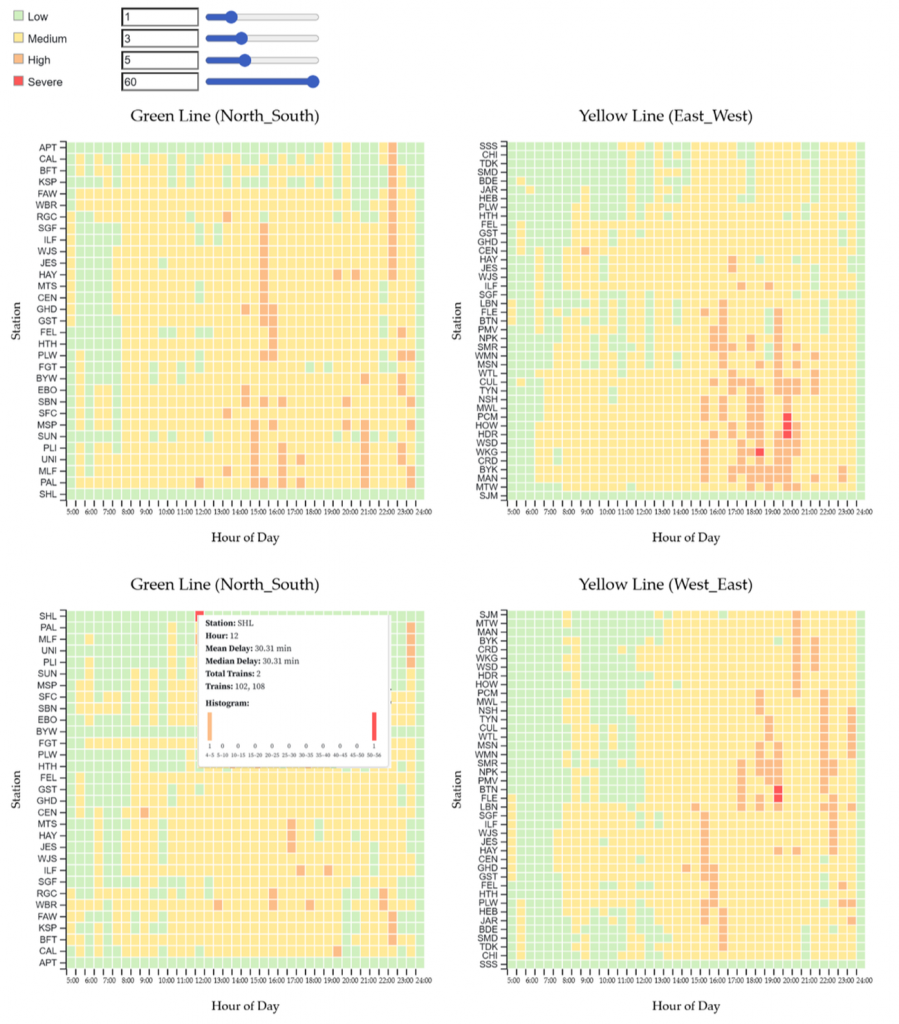
First, we conducted a controlled study and hypothesized that large screens would outperform small screens in railway-related applications. We designed three visualization tasks to evaluate performance across both screen sizes. Our quantitative and qualitative results demonstrate that large screens significantly improve task completion time compared to small screens, without introducing differences in error rates. Then, we further investigated whether time-to-space visualizations on large screens could support operational teams in control rooms. To this end, we carried out a design study in collaboration with railway domain experts, developing a visualization tailored to their needs for understanding delays. The results indicate that the developed visualization is effective in supporting data analysis and exploration, enabling experts to identify insights and situations within their railway network.
Team
- Aljawharah Almajyul (PhD student), Newcastle University
- Prof Daniel Archambault (main supervisor), Newcastle University
- Dr Matthew Forshaw (co-supervisor), Newcastle University
- Dr Tong Xin (co-supervisor), Newcastle University