Utopia and Failure: A Complex Relationship

NUCUSP members – Lisa Garforth and Ruth Houghton – have been part of the AHRC network on Utopia and Failure that ran from 2023-2026 and included a workshop in Newcastle in 2024. The Special Issue from this network has just been published in the European Journal Social Theory.

Special Issue in the European Journal of Social Theory

Garforth, Lisa. “Climate and Failure: For a Weak Utopianism.” European Journal of Social Theory, ahead of print, November 6, 2025. https://doi.org/10.1177/13684310251392829.

Thaler, Mathias, Davina Cooper, and Ruth Houghton. “Introduction: Utopia and Failure: A Complex Relationship.” European Journal of Social Theory, ahead of print, June 2, 2026. https://doi.org/10.1177/13684310261452967.

‘Women in Science Fiction and Fantasy: Navigating Gender and Genre’ conference at Newcastle University

NUCUSP members will be taking part in a roundtable at next week’s conference on Women in Science Fiction and Fantasy.

The Roundtable on Gender and Genre Beyond Literary Studies, will be chaired by Stacy Gillis, and will feature Aislinn Fanning (Newcastle), Lisa Garforth (Newcastle) & Nikki Godden-Rasul (Newcastle)

Dates: June 11-12th 2026
Location: Percy Building, Newcastle University, NE1 7RU
Contact: sciencefictionfantasyncl@gmail.com 

Organisers: Abi Hockaday & Aparna Sivsankar

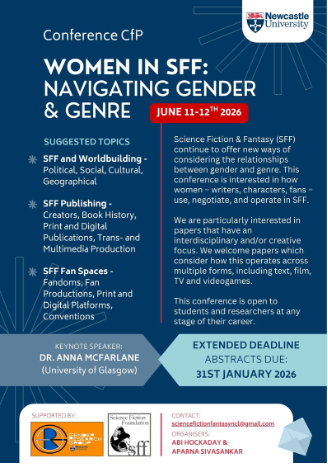
Science Fiction & Fantasy (SFF) continue to offer new ways of considering the relationships between gender and genre. This conference is interested in how women – writers, characters, fans – use, negotiate, and operate SFF. 

The programme is available here.

Thanks to Phil Crockett Thomas

and to everyone who came along to her brilliant creative writing workshop on speculative fiction and imagining different worlds, and to her fantastic sociology seminar on world-building, fictional imaginaries of transformation, and activist practices on May 27th. It was a great day for interdisciplinary conversations!

NUCUSP Members at Gender Research Group’s Spring Conference

The Gender Research Group’s Spring Conference is taking place on Friday, April 24th, 12-3pm in HDB1.09.

NUCUSP members Abi Hockaday and Miranda Iossifidis are presenting their work.

Abi Hockaday (English Literature, Language & Linguistics), “Reading the Technodomestic in Science Fiction” – I consider the relation between gender, the domestic, and technology, through a reading of Femizine, the first British science fiction fanzine written for women, by women, in the 1950s. It is the humour and playfulness that mark what I term the ‘technodomestic’ in the fanzine’s stories which helped create a community of women fans exploring cultural anxieties about women’s place in the home – and in fandom.

Miranda Iossifidis  (Geography, Politics & Sociology), “Resisting Population Control at Home and Internationally: Reproductive Justice and Campaigns against LARCs in the 1970s and 1980s” – I explore the solidarities, networks and tensions in feminist conversations and encounters constellated around resistance to population control, in activism against long-acting reversible contraception (LARCs) in the 1970s and 1980s, considering how activists centred racism, classism, and ableism experienced by women, and how they connected coercive practices, and populationist ideas and interventions in the United Kingdom to global population control policies. I undertake a situated analysis of the activisms, drawing on archival material to show how they are shaped by distinct histories of colonialism, racism, and geographies.

Creative writing workshop 27th May 10.30-12.30pm ARMB.2.49

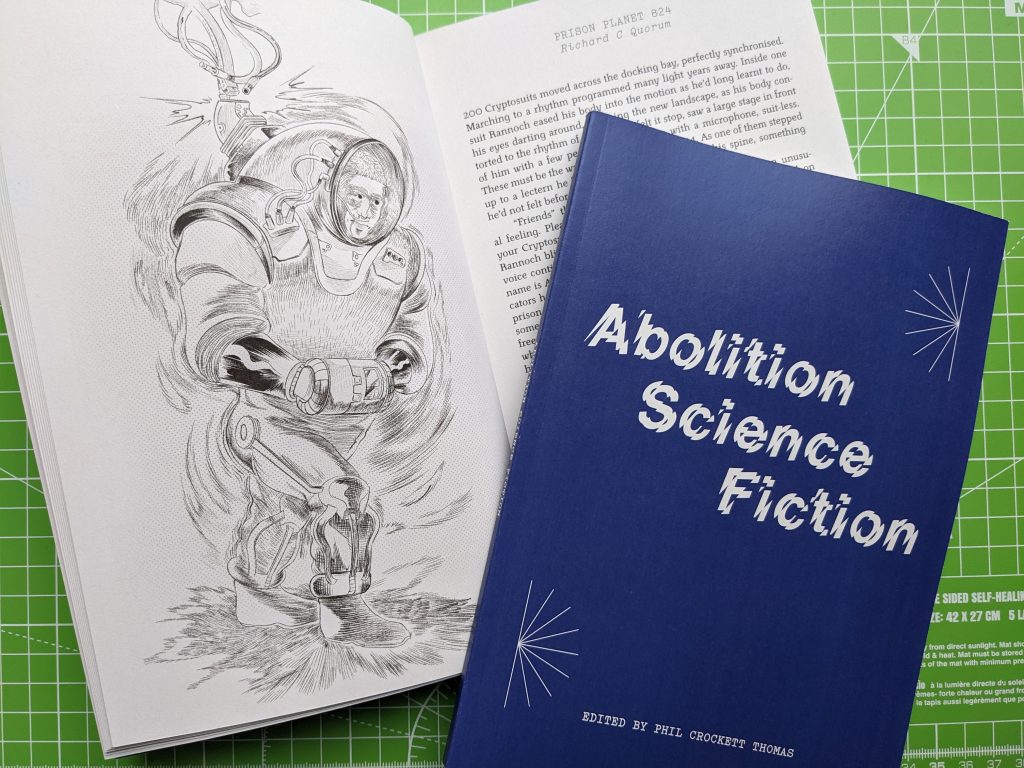
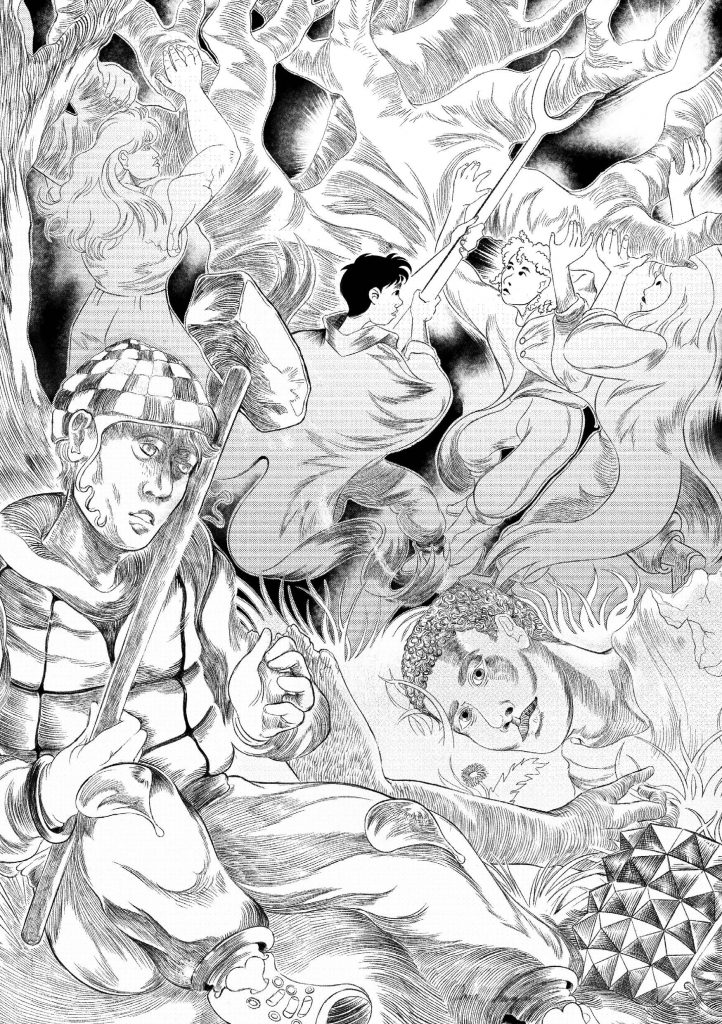
Abolition Science Fiction ed Phil Crockett Thomas; illustration by Nat Walpole.

We are really lucky to have Phil Crockett Thomas joining us for a creative writing workshop as well as a more formal academic talk.

The session will be a space to create and discuss speculative fiction on the theme of more just societies. It draws on Phil’s research on the anti-carceral imagination and her edited book Abolition Science Fiction (2022), written with activists and scholars involved in the movement for prison abolition in the UK. There is no need to be an experienced writer or activist to take part. A small amount of preparatory reading will be shared in advance of the workshop.

Places are limited, please sign up if you want to take part.

NUCUSP reading group: exploring Abensour

We’re meeting on Tuesday April 28th 1-3.30pm HDB.1.04 to talk through a couple of readings linked to Miguel Abensour’s utopian theorising:

Feel free to join us for a discussion of one or both readings – drop in and out as suits.  Bring your own coffee, we’ll provide some snacks.

1.00pm Abensour, Miguel, ‘William Morris: The Politics of Romance’, in Revolutionary Romanticism, ed. and trans. by M. Blechman (City Lights Books, 1999), pp. 125–59. 

2.30pm Holflod, K., Bayne, S., & Nørgård, R. T. (2026). ‘Utopia, hope and desire in education futures.’ Arts and Humanities in Higher Education. Online first.

https://doi.org/10.1177/14740222251412851.

WOMEN IN SFF: NAVIGATING GENDER & GENRE

Abi Hockaday and Aparna Sivasanka are organising this fantastic conference at Newcastle University, June 11th-12th 2026. Panels will explore speculative fiction and relationships between gender and genre, especially how women – as writers, characters, fans – use, negotiate, and operate in science fiction and fantasy.


CONTACT:
sciencefictionfantasyncl@gmail.com

‘Too utopian’: Theories of Utopia in constituent power

In her latest article in Global Constitutionalism, Ruth Houghton explores the relationship between theories of utopia and approaches to constitutional change in theories of constitutional law.

https://www.cambridge.org/core/journals/global-constitutionalism/article/too-utopian-theories-of-utopia-in-constituent-power/0E9DDB1BD03AE971483CBACFFF413DDC?utm_campaign=shareaholic&utm_medium=copy_link&utm_source=bookmark

The abstract of the paper reads: There is something utopian about constituent power, whether this is the unrealisable idea of “the people” or the world-building nature of constitutional change. However, in contemporary constitutional scholarship “utopia” is more often used as a pejorative critique of reform projects that are seen as idealistic ambitious calls for constitutional change, which might fail for being “too utopian”, “too idealistic”, “too unrealistic”. In an attempt to move beyond this critique, this article draws on alternative approaches to utopianism to uncover the temporal assumptions underpinning contemporary approaches to constituent power and highlights the different approaches that can be exposed if theories of utopian-thinking are foregrounded. Both utopia and constituent power are closely aligned with visions of alternative futures, and constitutional scholars agree that there is an intersection between utopian thinking and the subjectivities, temporalities and operationalisation of constituent power. Moving away from utilising utopia as a pejorative label and engaging instead with what it can expose about temporalities, offers alternative approaches to the study of constituent power.