At first glance, you might think a perpetration landscape is the site that’s left behind after something unspeakable has happened – a landscape where there have been perpetrations, and which will carry that association for a long time. At second glance, you might think a perpetration landscape is a landscape that can accommodate bad things we’d sooner not think about… vast isolated places, places with caves or dense forests, fortified and unknowable places, or places where abandonment and dereliction allow for secret spots.
In these two examples, association and accommodation, the landscapes contain something that perpetrates against people (or is perceived to have that potential) – these are important places to understand, but I am interested in perpetration against landscapes: what happens when people damage landscapes, leaving them “spoiled”, “scarred”, or “disturbed”? There is a commonly accepted answer in landscape studies about how that happens, and I argue that it’s an answer that needs more critical attention.
It’s possible that if I asked you to do so now, you could recall a landscape which you think is damaged: perhaps you could even tell me about the thing that damaged it. In academic studies of landscape this kind of damage is often referred to as “encroachment” or “disturbance”, the opposite of “coherence” (see Davoudi and Brooks 2019, 9), in everyday English it might be called “spoiled” or “scarred”. But importantly, regardless of the language used to describe it, there is a persistent idea of what causes the damage: it’s caused by features added to landscapes with indifference. Indifference is a gold-plated explanation for landscape damage: it means that a feature is conceived and built with scant (or no) thought to its coherence with the existing qualities of the landscape, so that it is perhaps too large, or not sympathetically aligned, or not the right shape, texture, or colour. For landscapes to fare well, they have to be accorded with, see Davoudi and Brooks 2019, 9).
And so, when we see a landscape that is spoiled/scarred/encroached/disturbed, we see indifference and thoughtlessness as the perpetrations. And it follows that if certain features had been considered and thought through, the landscape would not have been perpetrated against.
So far it sounds like I’ve just thrown the term “perpetration” in as a rebranding of what landscape theorists already know, and which they already have names for. But this is where perpetration is different, because I want to break the link between perpetration and thoughtlessness.
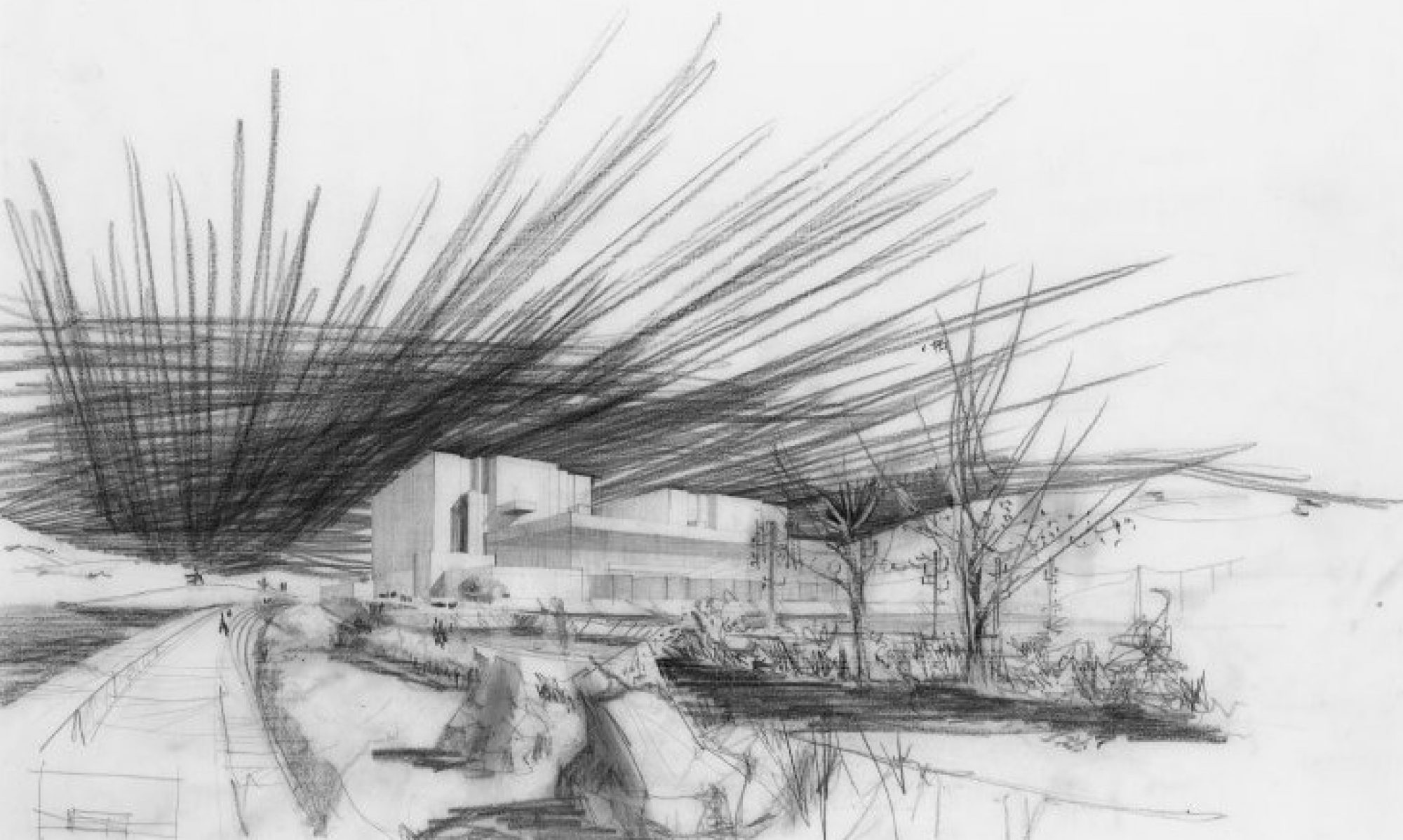
I would like to break that link at Trawsfynydd Nuclear Power Station: it was completed between 1959 and 1965 in the middle of Snowdonia National Park (roughly!) in Gwynedd, North Wales, and it’s widely perceived as a perpetration by locals and visitors (Jones, 2001). It is, after all, a massive, angular structure in the middle of a national park, and in the middle of some key sightlines. It looks thoughtless… it looks as though it perpetrates through its thoughtlessness… but in truth, genuine love and effort was poured into Trawsfynydd. It was actually founded on lengthy thinking, consideration, and debate about its coherence with the landscape around it.
Rich but rarely-touched archives of commissioning and design documents from that time could support a written history of how those involved in Trawsfynydd’s inception understood the landscape and used that understanding to try and accommodate the huge station structures within it. I’d like this history to be woven into subsequent walk-along interviews with people who currently live and work in that landscape (it will be provided to them in advance).
Capturing the understandings from Trawsfynydd’s inception, of the love, effort and thought poured into it, breaks with the idea of indifference.
Capturing the understandings of those who live and work there today taps into their astute perceptions of how their landscape was perpetrated against.
But importantly, interviewees will also be invited to analyse and critique the “original” understandings and approaches, tracing the misplaced assumptions, wrong turns, and compromises (and successes) that led Trawsfynydd to perpetrate.
And this is the difference this project wants to make. Perpetration isn’t a rebranding but a recognition that simply having “indifference” as the smoking gun behind all scarred/spoiled landscapes is critically untenable. A landscape can perpetrate even when it’s laden with love, effort and thought, and it can do so in a way that isn’t simply linear and unidirectional, from people, to landscapes.
In the coming months, more content will be added to this blog which will continue to discuss some of my earlier work on landscapes and how that work leads into Perpetration Landscapes. So please pop back, and please do say hello and ask me things!