OHD_BLG_0034 21st Century Ghost

Have you ever heard of the twenty-first century ghost? You have definitely seen it and heard it. It hides in many places, but its favourite spot is in the pocket of your trousers, next to you on the table or in the palm of your hand. The ghost of the twenty-first century lives in the interactive rectangle that is your smart phone. This ‘digital urn’, as described by Kirsty Logan in the podcast series A History of Ghosts, is filled with your voice, your face, your ideas, your questions, your life. Every day we work on growing our own twenty-first century ghost by feeding it incredibly personal information and preserving it in our digital urn. But our twenty-first century ghosts’ range is not limited to our smart phones, they spread across the world, roaming around social media servers and traveling in the inboxes of other people’s digital devices. The average person has no control over what can be found in their digital urns, what past lives the ghost can expose and havoc it can cause. 

Some people have a different type of ghost, one that is a little more timid and introverted. If you have ever taken part in an oral history project you probably have such a ghost; a recording of your life’s story told by you living in an archive staying put until someone calls on it. In order to put an oral history interview into an archive and create an archival ghost, one has to fill in what seems endless ethical approvals, consent forms and permission slips. These documents are there to highlight the potential “dangers” of having something in an archive: how you privacy might be violated or how someone could misuse your testament and twist your words. Social media sites do a similar thing, only they condense the stacks of paper into one tick box. Clearly the archiving process is more transparent in comparison to the methods use by those in the Silicone Valley, which at best are questionable and at worst violate basic human rights, however transparency does have its drawbacks. 

The reaction people have to this transparency is similar to that when you ask some people to travel by air. People are terrified of flying because they are fully aware of how wrong it can go, but statistically it is a lot safer than walking to the corner shop. Just like the designing an aeroplane, archiving an oral history has to follow certain rules from the start, because those involved, aerospace engineers and oral historians, are fully aware of the chaos and pain it could cause if the systems fail. Having these restrictions is seen as more ethical, but it also inadvertently puts disproportionate emphasis on the dangers of archiving (and flying). In opposition, walking, like the ticking of the terms and conditions box, is easier and it delivers blissful ignorance to the high probability of being hit by a car or having one’s data stolen. Unlike the oral historians and archivists, the developers of the uncomplicated tick box view their users as nothing more than data sets and potential profit. Some could say that this has led them to be dismissive of a human’s right to privacy and be vague when it comes to revealing the true cost of using one of their platforms. However it seems that by not drawing attention to terms and conditions, people have become very happy to hand over their personal information.

The existence of these two ghosts, the restricted and timid archival ghost, and the free and uncontrollable twenty-first century ghost, makes the people’s relationship to their privacy seem incredibly distorted and ill-informed. It seems odd to trap the archival ghost with paperwork in order to protect their corresponding human, when that exact human is completely content with sharing every single part of their lives with strangers on the internet. However, it is this sharing that is key to success of social media. By giving up their privacy the users of social media are granted access to a huge network of listeners and viewers. After all a story is not a story if there is no one to listen to it. By the same logic if the oral history is never reused, the archival ghost is never called upon and the story is never listened to, its very existence becomes void. So this raises the question: should we even bother archiving oral histories in the first place if the paperwork blocks it off from listeners? For the sake of my research we’ll say yes, in which case let’s follow it up with the question: should we be more like Silicone Valley and be a little less pedantic when it comes ethics? 

For now I am going to go with yes and no. The current process around ethical archiving does need updating but because I also fundamentally believe that Silicone Valley is wrong and I think people are starting to catch on. People are becoming increasingly aware of what their twenty-first century ghost might expose. For example, a growing number of people are being ‘cancelled’ because the public have dug through their digital urn and found a tweet they sent when they were twelve and used a term that is now considered very derogatory. There is also a generation of people, who are unhappy with their parents relentless ‘sharenting’. Sharenting is the practice of posting everything your child does online, which results in the child having a data presence before they can even speak and therefore give consent to its existence. This faint atmosphere of mindfulness around posting, uploading and sending is descending over the digital world. People are reflecting on the ghosts they have created and are now trying to do damage control. 

Currently the archival ghost and the twenty-first century ghost are two extremes on the scale of privacy and its corresponding ethics. However, the increased awareness around the rabidness of the twenty-first century ghost is pushing it along the scale in the direction of the archival ghost. I believe it is now the turn the archival ghost to make a similar move towards the centre. There needs to be more innovation when it comes to the ethics of archiving because at present it is stopping people listening back and that is truly a shame. People bond over sharing stories, they create communities around the most random of things and social media proves this. However social media also showcases perfectly the consequences of condensing very complicated ethics into one tick box for the sake of ease. Changes need to be made on both sides of the scale. By observing the current situation on each side, investigating the pitfalls, challenges and opportunities, and reviewing how different people in the respective fields are attempting to solve these problems, we can start seeking an equilibrium and find a balance between private and public. This managing of our ghosts is a strange and distorted process that is only in its infancy, but hopefully by the end we will be able to free the locked up archival ghost and calm the twenty-first century ghost. 
OHD_WKS_0208 NT Oral History Workshop

The overal aim of this workshop is to understand the value of oral history to heritage sites and understand the resources needed to safely store and exhibit these oral histories 

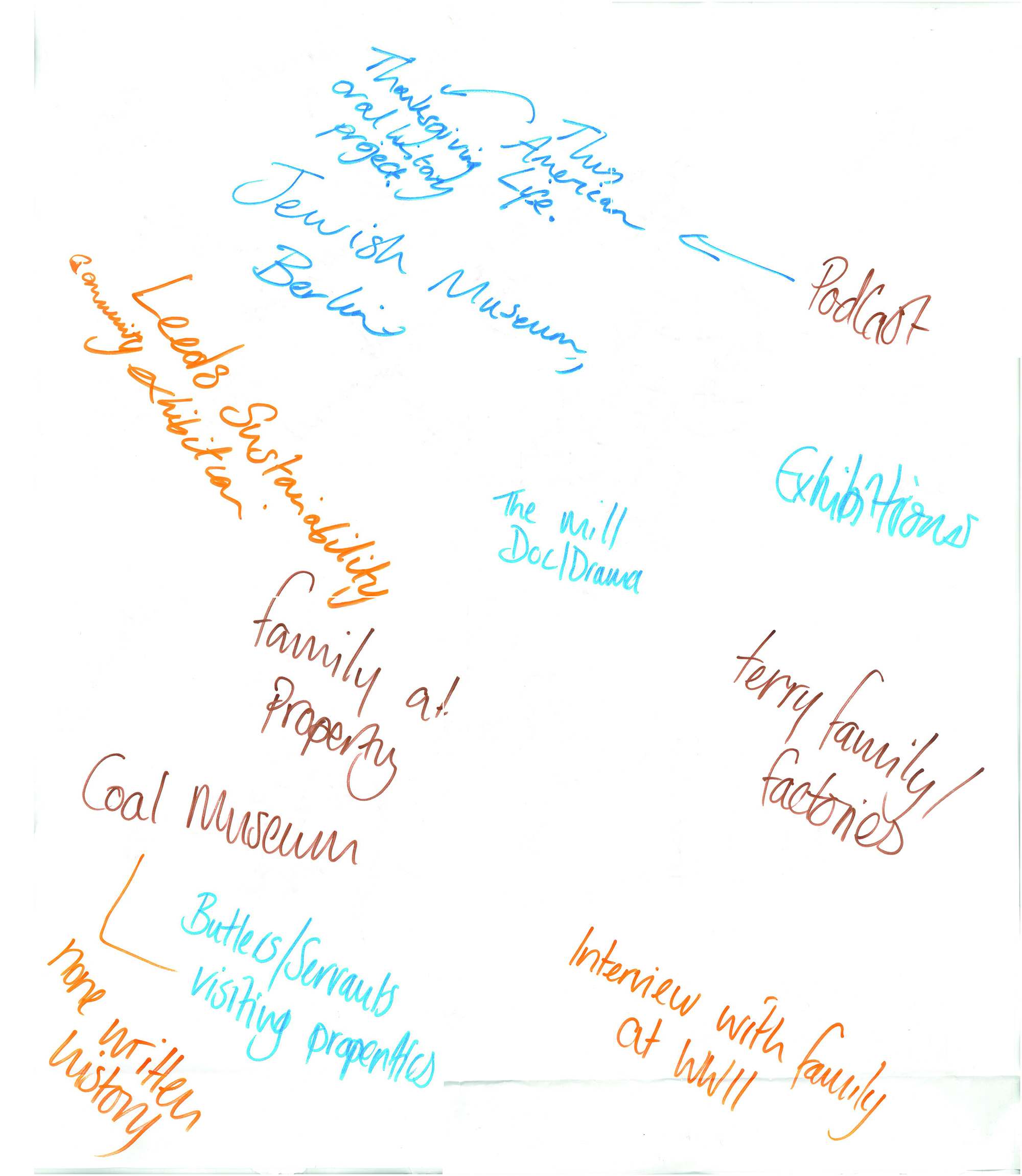
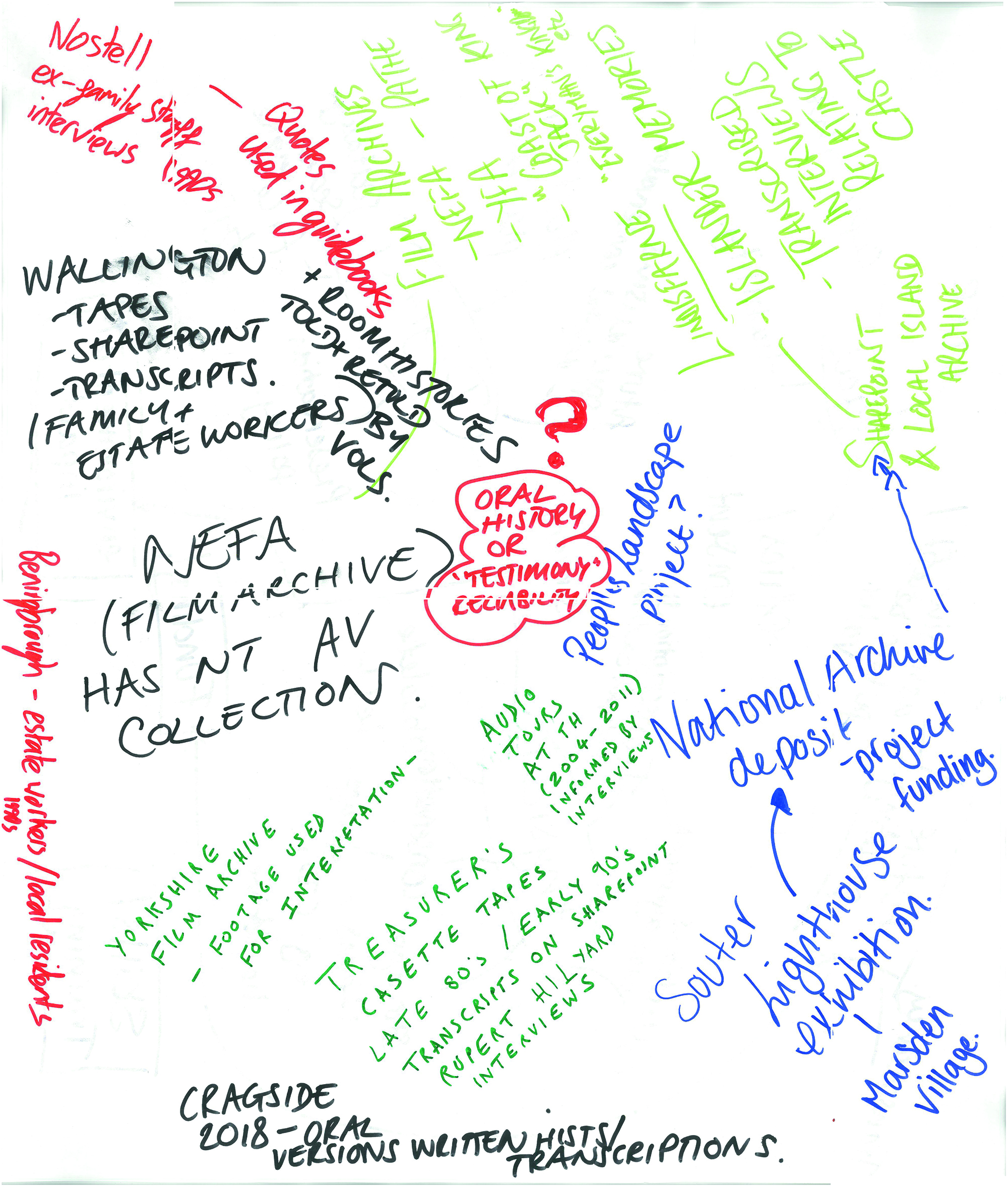
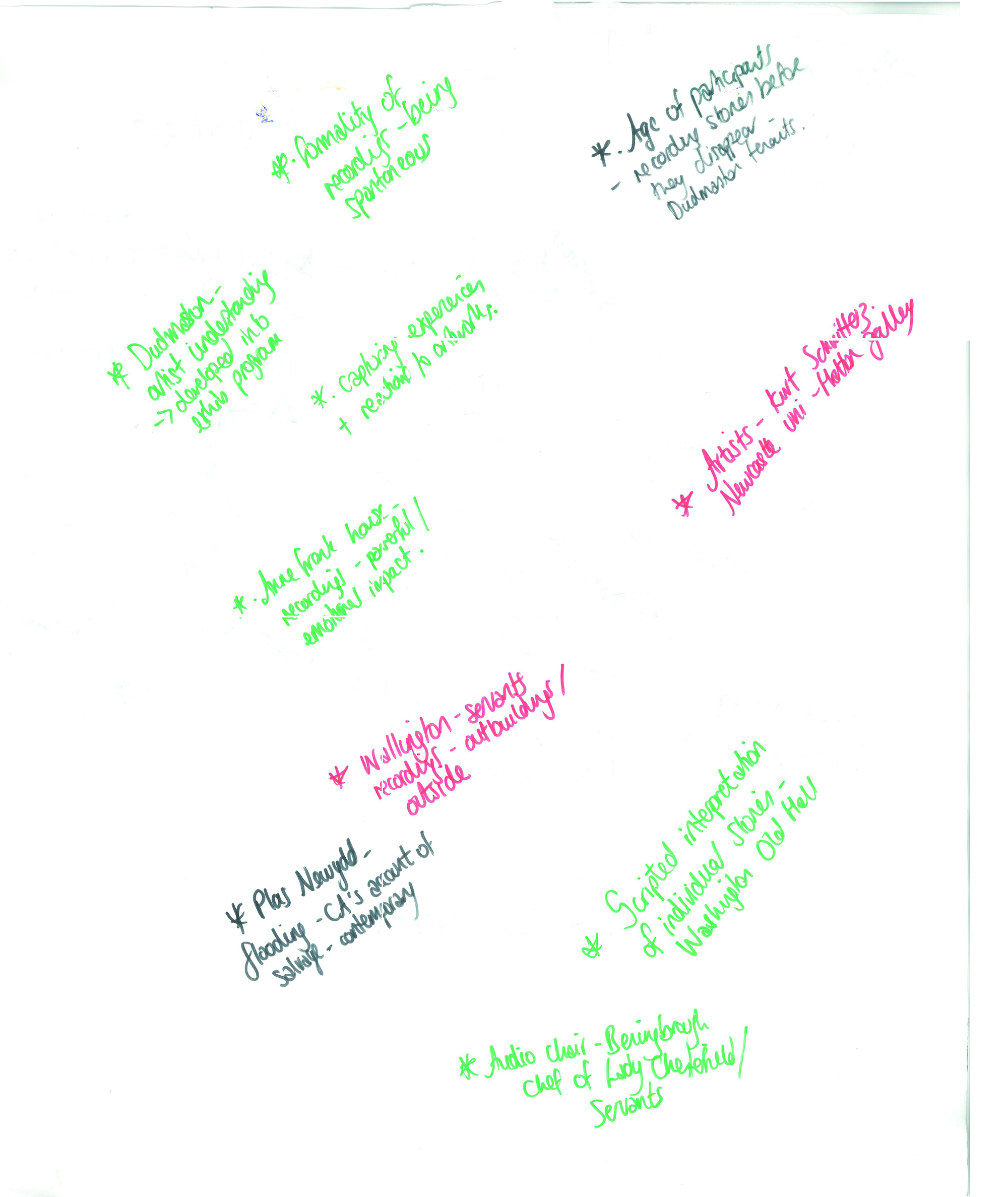
Activity One: Oral History Braindump

Aim: To understand the value of oral history to heritage sites. 

Task: To start with the participants will be asked to “dump” all the times they have listen to an oral history good or bad. They will then pick out the positive or negative feelings they had while experiencing these oral histories in an effort to understand the value of listening to oral history. 

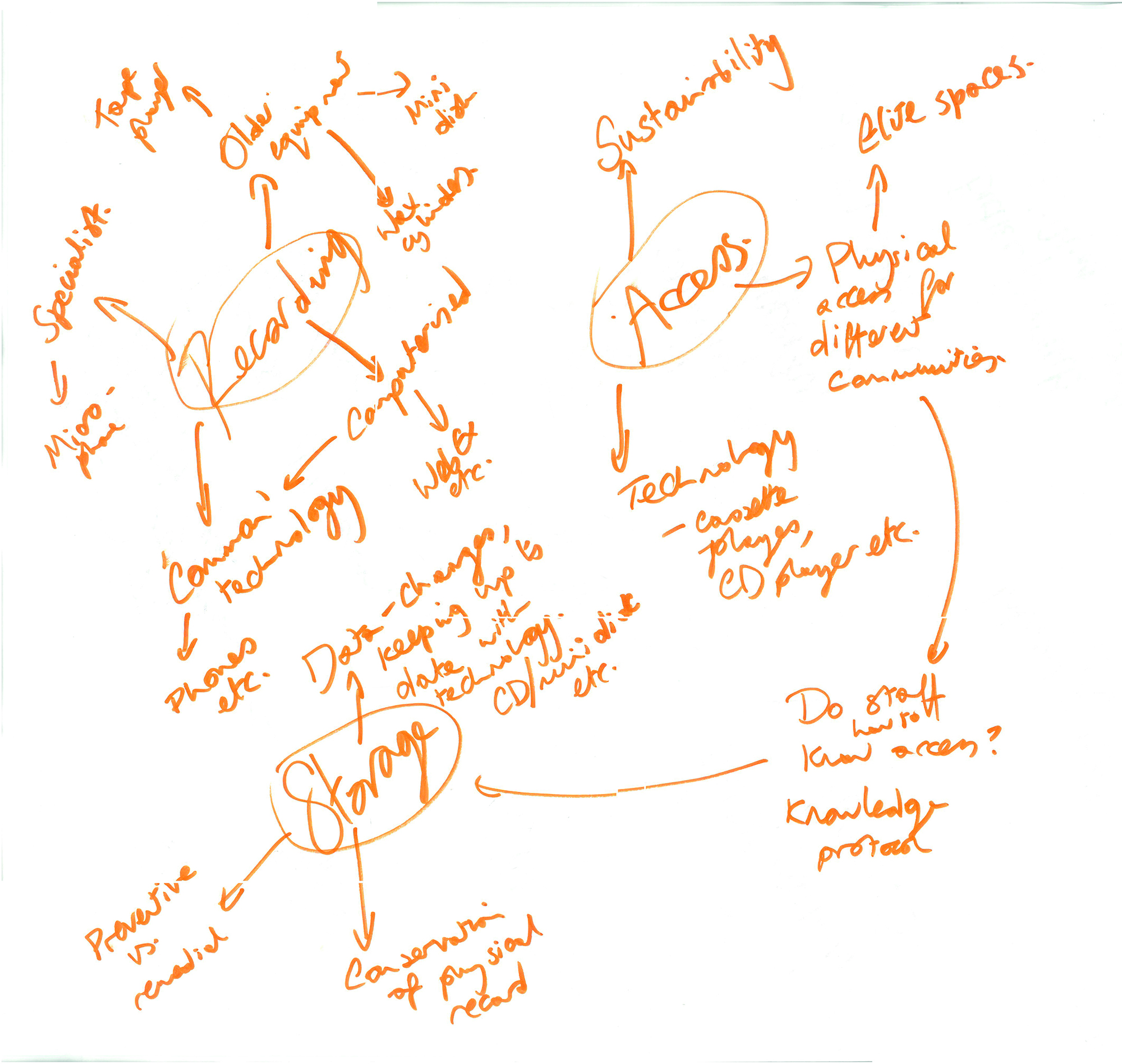
Activity Two: Breaking down an oral history recording 

Aim: To understand what we need to do to make and keep an oral history recordin

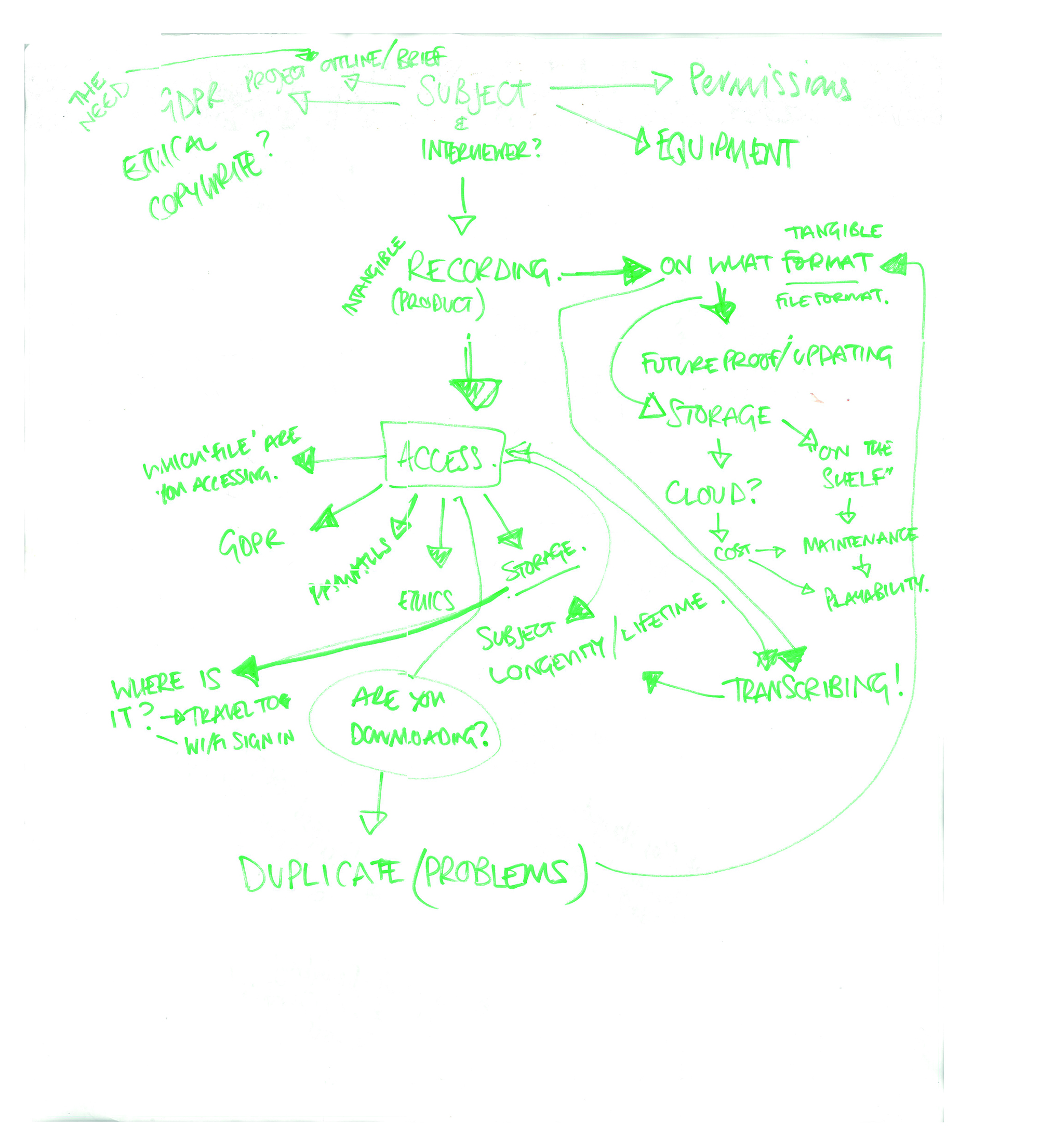
Task: First, the participants will be asked to think about is needed to make an oral history recording. Then they will be asked what is necessary to keep an oral history recording. 

Activity Three: What are we going to make?

Aim: To come up with ideas for the use of oral history by drawing on the two previous activities

Task: The participants are asked to come up with ideas that best display the value of oral history but also consider the resources, labour and ethics that are involved with handling an oral history. 

Activity three was never completed

OHD_WKS_0207 SDH Creative Community Workshop

1st edition

Workshop – Building new knowledge from multiple perspectives. Generating 360 degree interpretation involving communities in telling their stories and sharing their knowledge.  

The community that surrounds Seaton Delaval Hall already shares their stories, so the first step is to capture them, which can be achieve through oral history recordings and other story sharing sessions. But capturing is completely pointless if we do not have a good plan of where we are going to put it and what we are going to do with it. These two questions need to influence each other, there needs to be something that bridges them. 

Items 

  • Cassette 
  • CD
  • SD card
  • QR code
  • Transcript 
  • Hardrive
  • Photographs
  • Postcard
  • Diary entry 
  • (Artifact) – delicate object 
  • Newspaper

Possible idea: Make a table with two columns: Where are we going to put it and where are we going to put it. + no man’s land

Ghost 

  • Box
  • Sketchbook
  • Folder + forms
  • Quilt?

Possible idea: Start with the idea of a no man’s land the space between the museum and the archive. 

Possible idea: Create the rules of no man’s land

Topics

  • Banquets 
  • Flower festivals 
  • Fundraising 
  • Curtain Rises Project 
  • Tearooms
  • Surrounding area 

2nd edition

Workshop – Building new knowledge from multiple perspectives. Generating 360 degree interpretation involving communities in telling their stories and sharing their knowledge.  

This workshop will hopefully allow the participants to make the concept of a “360 degree” history of the hall more tangible and practical, through various hands on fast paced activities. 

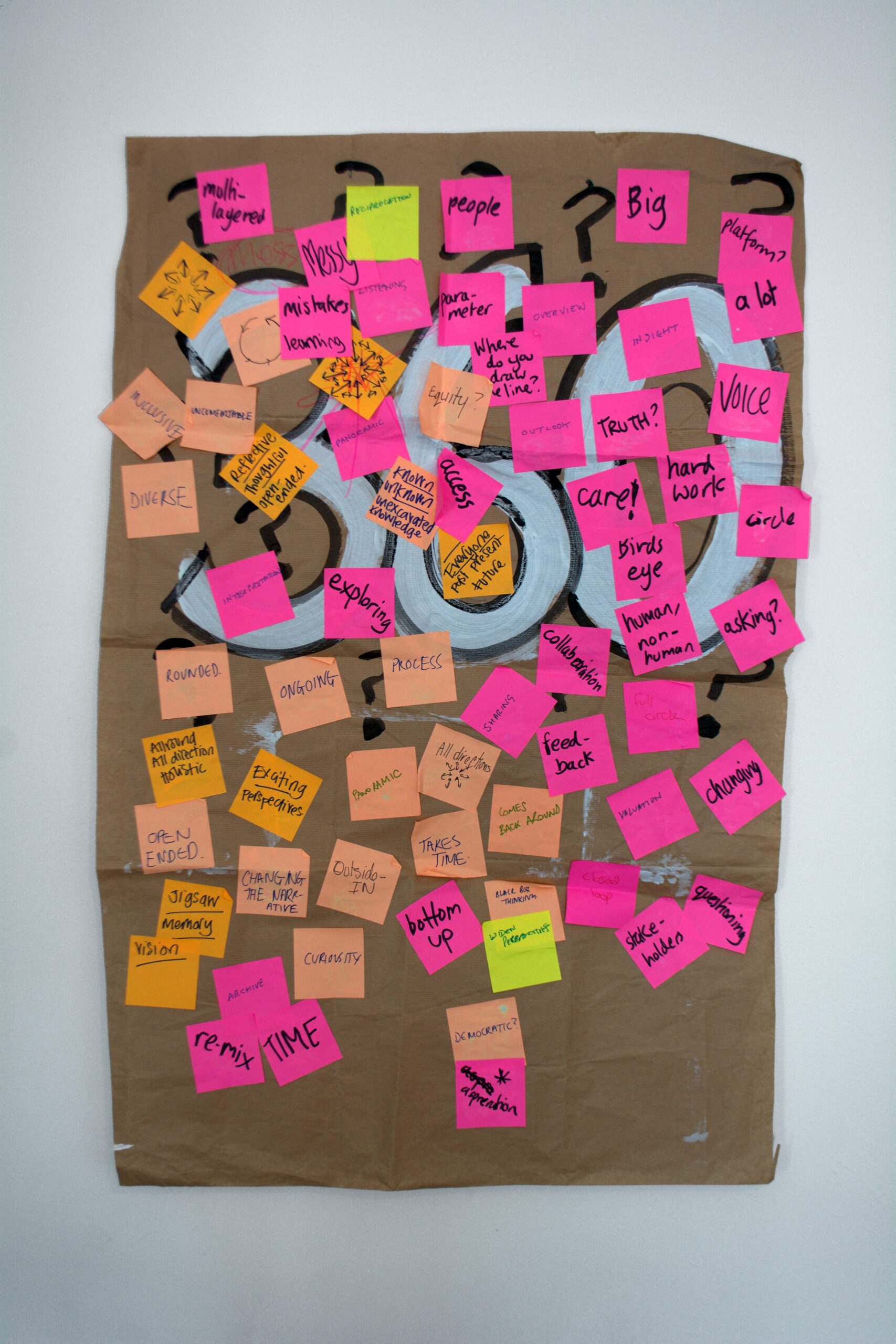
Activity One – Word association 

Task: Do word association with the term “360 degrees”

Aim: Get the participants to break down the idea concept of “360 degrees” into more tangible ideas and warm up their creative thinking. 

OHD_MDM_0011

Activity Two – A 360 space

Task: The group is split into there groups. Each group a assigned a “space” where they have to create their “360 degree” history. The three spaces are a room, a box, and a booklet. The group then comes back together and presents the three spaces to each other. 

Aim: To get the participants to physically create the idea of a “360  degree” history of the hall in a restricted space.

Activity Three – The fourth dimension 

Task: The full group of participants are given newspaper headlines from the future. The participants then have to think how the events in the newspaper affect their space. 

Aim: To get the participants to think about how they need to future proof their spaces within the “360 degree” history. 

Activity Four – Reflection and conclusion

Task: Allow the group to reflect on their work.

Aim: To bring the workshop to a conclusion and have the participants articulate their workshop journey. 

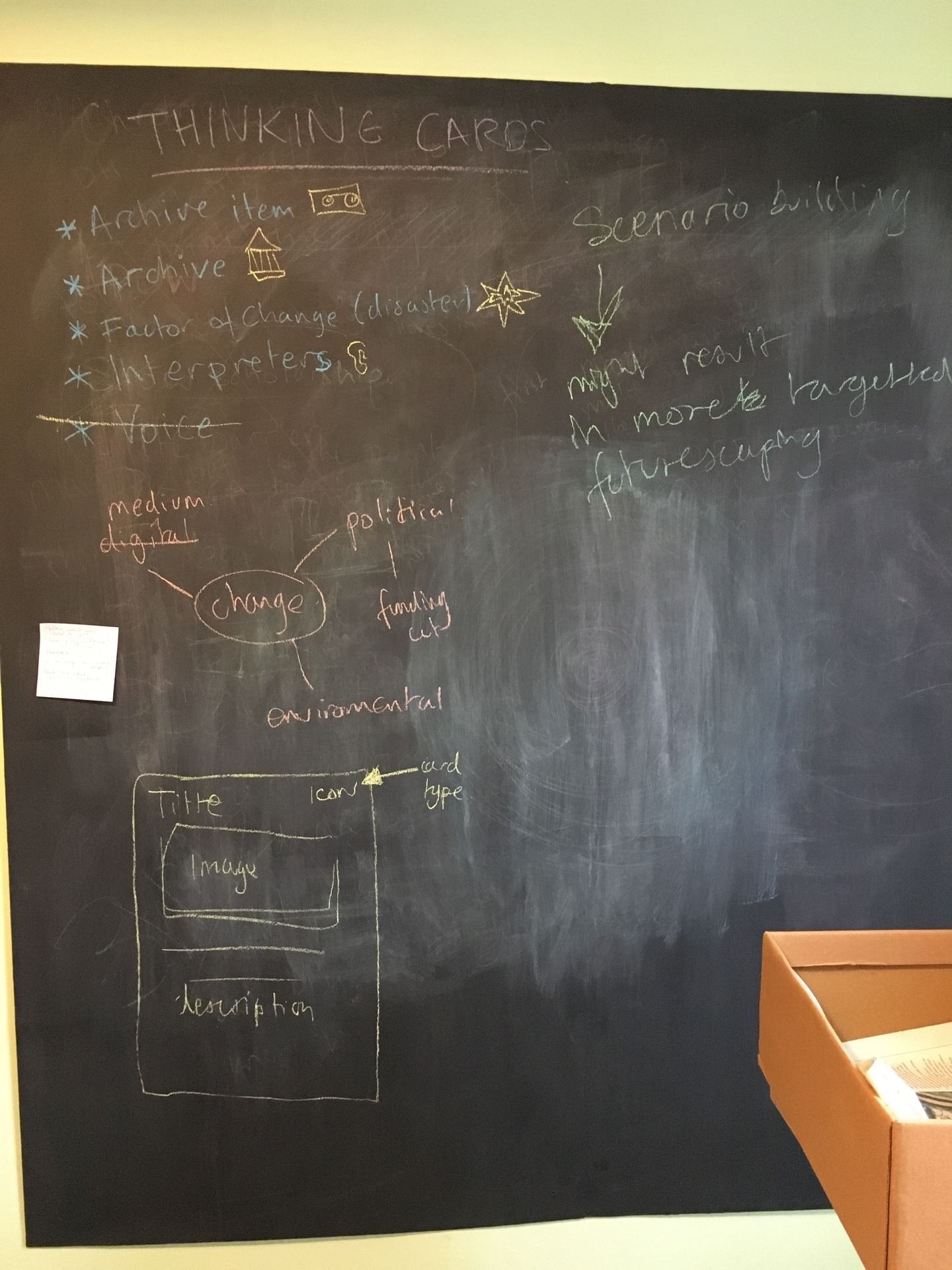
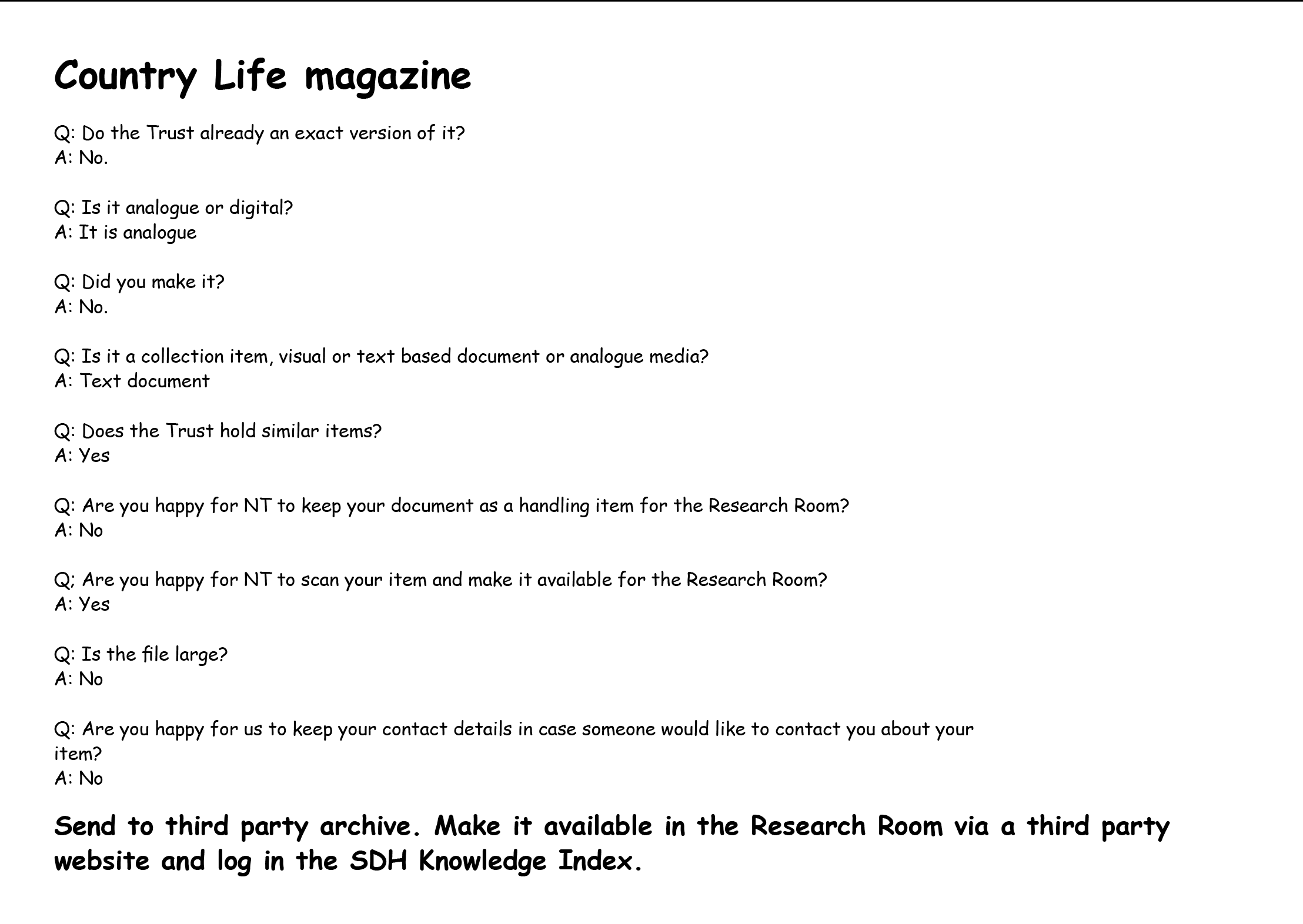
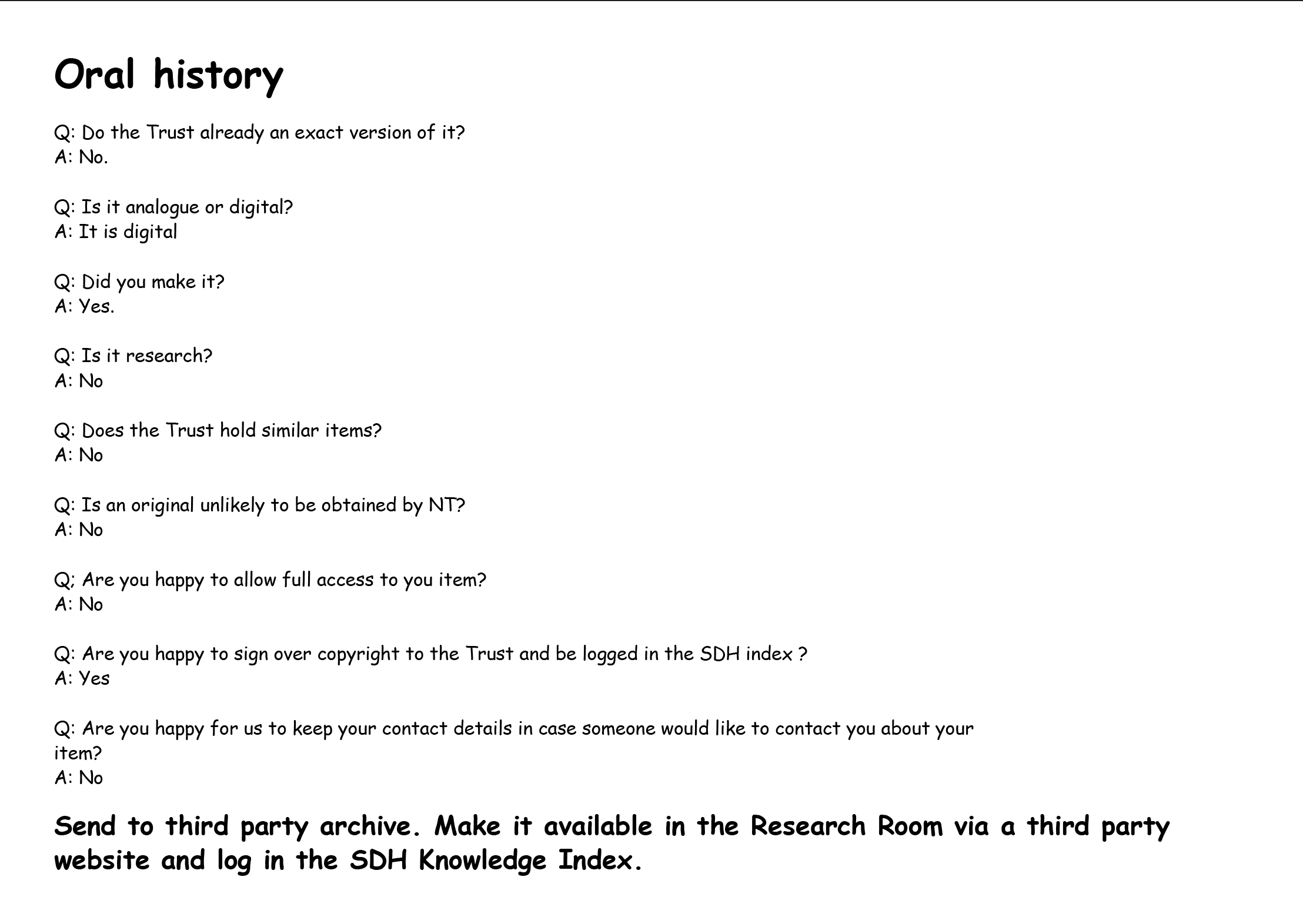
OHD_WKS_0204 THINKING CARDS: How would you archive this?

How would you archive this?

– a interview that is closed off for 30 years but is digital 

– with transcript 

– with photographs analogue

– about gender

– about race

How would you access this?

TASK: 

Start conversations around how we archive things 

AIM:

Collect experts’ opinions on strange archiving situation 

TYPES OF CARDS

ARCHIVE 

– KGB archive 

– British Library 

https://www.alternativetoronto.ca/archive/about

https://creativememory.org/en/archives/

– TWAM

– Black archive  

ARCHIVE ITEM 

– A wax cylinder recording of an aboriginal voice 

– Australian housewives

– Sex workers

– Transperson 

– UN oral history 

– Lady at the races 

– The Edwardians

– With photographs 

CHANGE 

– Terrorism 

– Fire

– Flood

– Earthquake 

– Malware

– Ethnic cleansing 

– 

fire, accidental 

fire, arson 

flooding, from outside flooding, from inside earthquake 

other ‘natural causes’ 

armed conflict 

removed by occupying forces civil disorder 

terrorism 

inherent instability 

bacteria, insects and rodents mould and humidity 

dust 

pollution 

bad storage 

lack of restoration capacity bad restoration 

neglect 

while moving offices administrative order unauthorised destruction theft 

use 

INTERPRETERS

– Podcasters

– Journalist 

– Artist 

– Writers

– Film makers

– Creators 

– Investigators

– Historians

– Family 

– People in search of identity

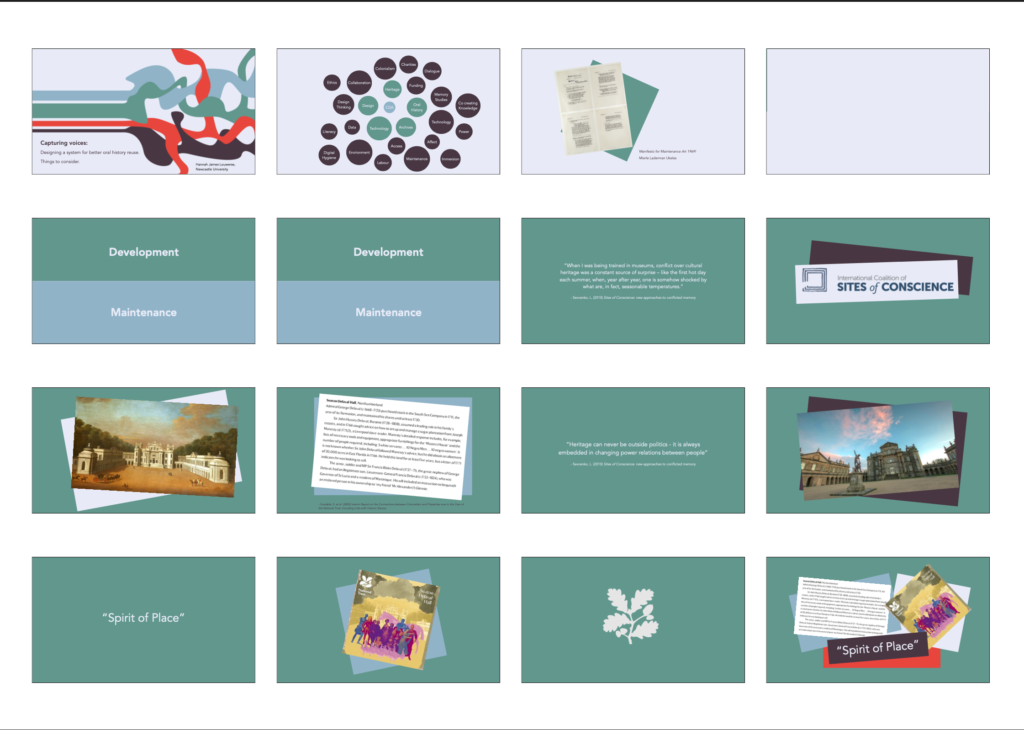
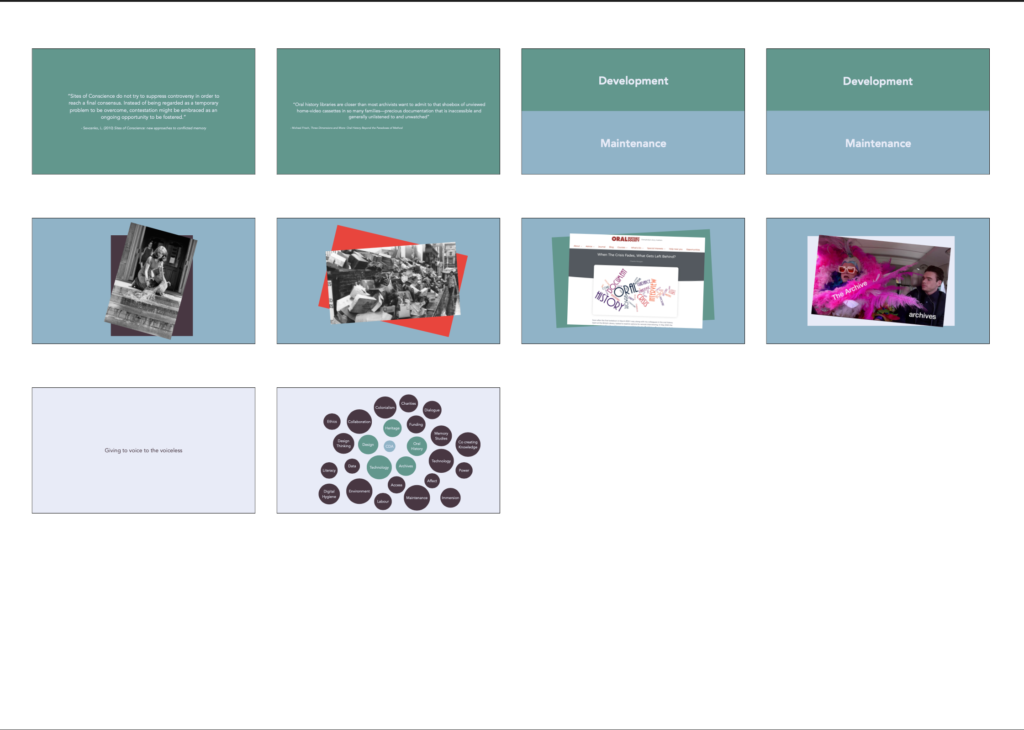
OHD_PRS_0203 Capturing voices: Designing a system for better oral history reuse

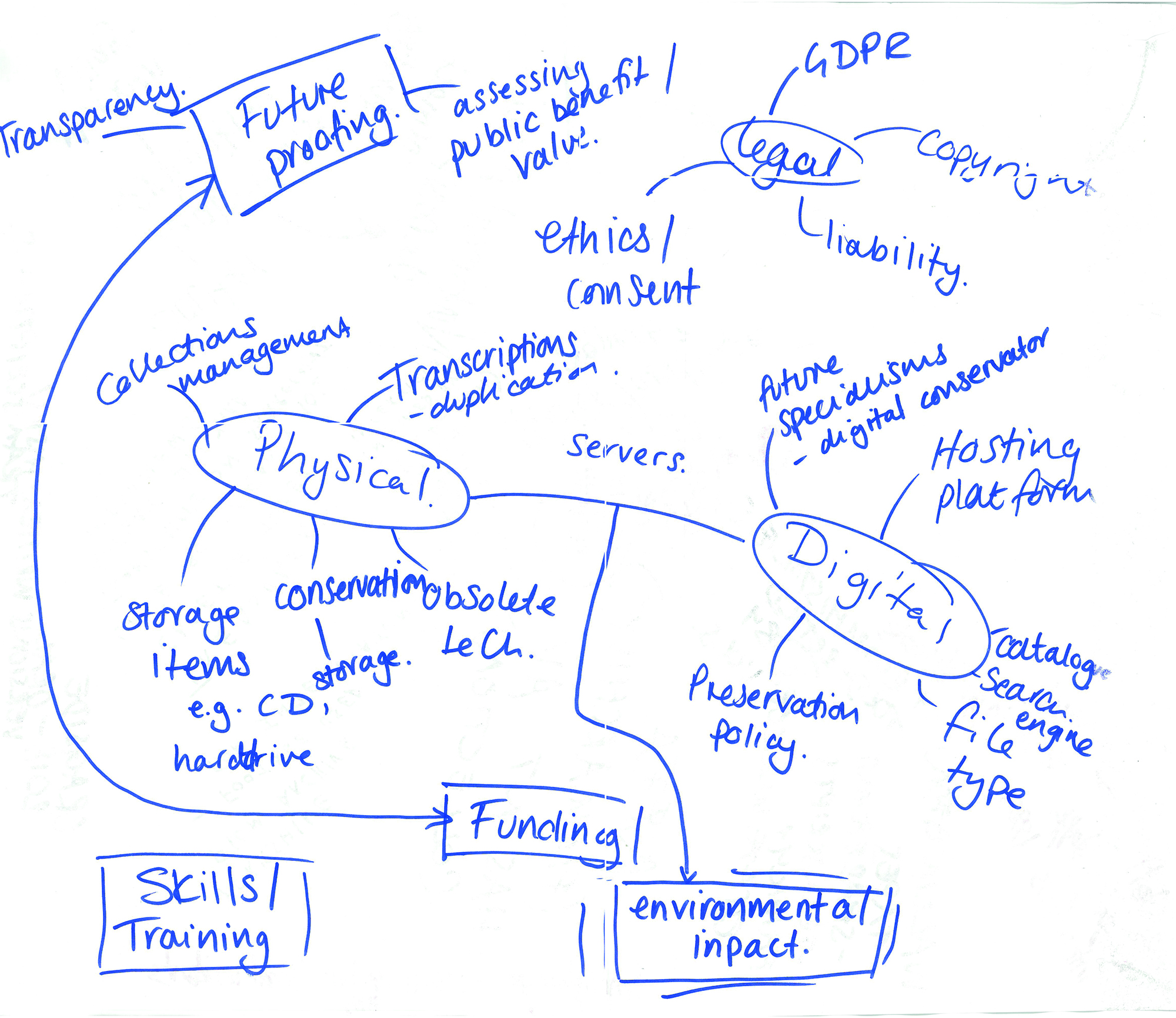
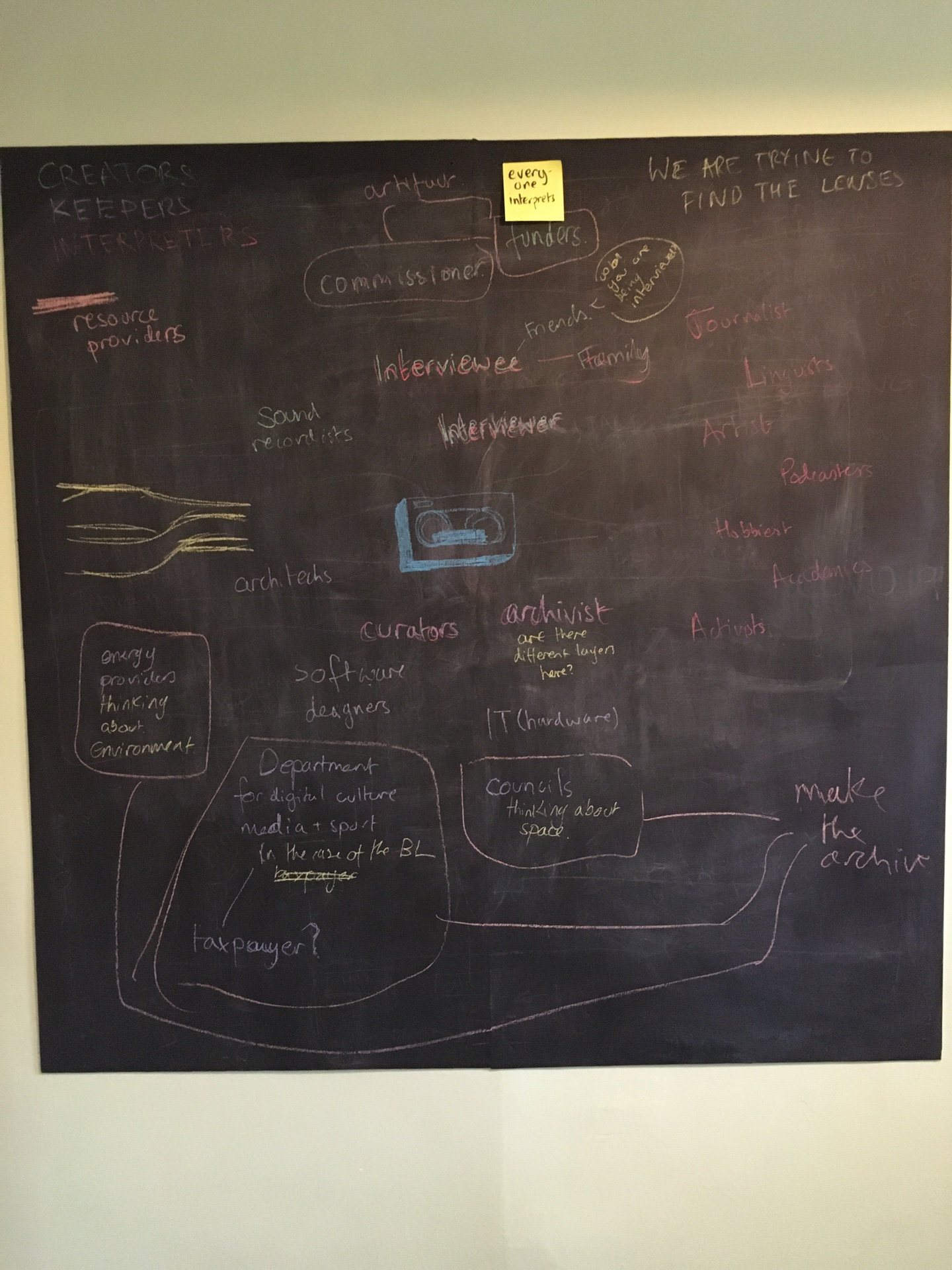
For paper that is title “designing a system for better oral history reuse” I am not going to spend a lot of time talking specifically about oral history or design. The reason for this is because designing a system for better oral history reuse involves a whole bunch of topics, which for the sake of this talk I decided to map for you to give you a better picture of my work. This is a pretty rough map, there are many things I can talk about and I realise that there are also many overlapping and interconnected themes and all of this will probably change in a week. I am not going to spend my precious ten minutes talking you through this whole map. Instead I am going to expand the themes that I am currently interested in at this point of my journey.

In 1969 Mierle Laderman Ukeles published her Manifesto for Maintenance Art 1969!, in which she describes how the world consists of two systems: Development and Maintenance. Development involves the creation of stuff, while Maintenance is about keeping the created stuff in good condition. This theory also applies to Oral History, the Development is recording the oral history and Maintenance is the archiving and reusing of those recordings. Now my research does have a Maintenance focus but in order to do Maintenance you still need to have Development and currently I am doing some development. I am recording oral history interviews with people and I have recently come across a very interesting problem that I am going to talk about first and then I will move on to Maintenance part which is also offers plenty food for thought. 

“When I was being trained in museums, conflict over cultural heritage was a constant source of surprise – like the first hot day each summer, when, year after year, one is somehow shocked by what are, in fact, seasonable temperatures.”

I find this a very amusing comparison by Liz Sevcenko, who was Founding Director of the International Coalition of Sites of Conscience, which is a network of historic sites that foster public dialogue on pressing contemporary issues. The institutes within this coalition are often sites of very intense trauma with many of the sites handling issues like genocide, war, and other atrocities. 

This is Seaton Delaval Hall. Built in the 1720s the hall and its residents, the ‘Gay Delavals’ became renowned for wild parties and other shenanigans. In 1822 the hall went up in flames severely damaging the property. In 2009 after the death of Lord and Lady Hastings the property was taken over by the National Trust. A face value Seaton Delaval Hall is not necessarily like the institutes that make up the Sites of Conscience. It is a National Trust property near the sea, it has a nice rose garden, and a cafe that does excellent scones. But it is also a grand hall built in 1720s in Britain, which can only really mean one thing the Delavals, who were the family that lived in the hall, got some of their income from the British Empire. This is from a report done by the National Trust addressing various properties history with slavery and the British Empire. Sevcenko is right, summers are warmer than winters and there is conflict in all cultural heritage sites no matter how twee they look. 

In a paper about the Sites of Conscience Sevcenko points out “Heritage can never be outside politics – it is always embedded in changing power relations between people”. Seaton Delaval Hall and many other National Trust properties are no exception, however these changing power relations go far beyond the British Empire. 

A couple of weeks ago I meet the child of the old estate manager who, their whole life, lived and worked in the hall until they had to move out of the East Wing due restoration work, I will refer to them as Robin. Robin remembers when a different family the Hastings lives at the hall. Lord and Lady Hastings lived at the hall until their deaths in 2007, nearly also long as the original Delaval family. During their time there, the Hastings opened the hall to the public and regularly threw medieval banquets to raise money for the restoration of the hall. Robin also remembers the German Prisoners of War who were held at the hall during the Second World War. Their whole life Robin has been witness to the changes at the hall seeing it gradually evolve over time. 

But Robin’s history does not really fit with the narrative the National Trust has for the hall. For those who are unfamiliar with the National Trust a lot of the properties are very busy with the idea of “spirit of place.” Seaton Delaval Hall’s spirit of place is deeply connected to the original Delaval family, who were known to be pranksters and excellent party people, think 18th century Gatsby, only with the aforementioned connections to the British Empire. A lot of the hall’s promotional material is built around this and it has functioned as a source of inspiration for various installations. The history that Robin remembers is seemingly under represented at the hall, because it does not really fit with this spirit of place. 

To a certain extent I am trying to solve this particular problem by recording oral histories however in the case of Robin I have come across a problem. Due to their relationship with the National Trust Robin refuses to speak about their history with the National Trust. They will only give me stories from before the National Trust took over. This is because they know that if archived their recording will be donated to the National Trust archive. This means I cannot record the oral history I would like to because of current power structures. 

To recap the political situation of the hall: firstly we have the hall’s connections with the British Empire, which nationally is slowly being addressed with things like the report and yet the hall’s spirit of place I feel is currently not fully considering these connections. And then we have a more recent power dynamic with Robin and the more recent history which clashes with the spirit of place. In case you were wondering Robin is not alone there are some local people who are also not happy with the National Trust. 

Liz Sevcenko concludes in her paper on the Sites of Conscience that: 

Sites of Conscience do not try to suppress controversy in order to reach a final consensus. Instead of being regarded as a temporary problem to be overcome, contestation might be embraced as an ongoing opportunity to be fostered.

The National Trust might decide to stop suppressing the narrative of slavery and move away from the glorification of those who benefited from the crimes of the British Empire, but this does not solve new power dynamics that are appearing, the one blocking Robin from telling their story. In order for Seaton Delaval Hall to become a Site of Conscience, they need to be open to criticism now. They need to open up a dialogue and allow the historical narrative to change and morph over time.

So the Development side of my work is very complicated but it is essential that I do not get to bog down in the Development because that is the reason why I am doing this CDA in the first place. Currently within oral history there is a preference to record over reuse. As the oral historian Michael Frisch describes oral history archives are like “a shoebox of unwatched home videos.” This valuing Development over Maintenance is exactly what Mierle Laderman Ukeles addresses in her manifesto and her art. The big reason for the inequality according to Ukeles is because Maintenance involves tasks that are either seen as domestic and ‘feminine’ or labour done by the working class. 

However, this under valuing of maintenance can have really annoying consequences for example, I always get frustrated when I clean my fridge. There are so many little ridges that stuff gets into it is infuriating. As a designer I know that this problem could easily have been avoided if someone has just asked a cleaner some questions about how they clean a fridge. But they didn’t because people do not value maintenance. But in reality cleaners are extremely powerful, if cleaners go on strike you have a big problem.

Archivists are also part of the Maintenance system. In an article title ‘When The Crisis Fades, What Gets Left Behind?’, a direct quotation from Ukeles’ manifesto, Charlie Morgan, who is the oral history archivist at the British Library, describes how there was a rush to record the varied COVID-19 experience, but little thought was put into how the recorded material will be stored, let alone archived. 

This article reminded me of a meme my friend sent me a couple of months ago, because Morgan did not treat ‘the archive’ as a concept but as a physical institution with staff, coffee machines, and opening times. Shortly after reading this article I had a meeting with the lead archivist at Tyne and Wear Archives Newcastle. They echoed both Morgan and Ukeles when they explained that the reality of being an archivist means you spend the majority of your time on management tasks rather than on the act of archiving. I need to bring these ideas of maintenance and the everyday archive into my development and design of this oral history reuse system. I cannot be like the fridge designers and forget about the person who cleans the fridge, because cleaners are powerful and archivist are the maintenance staff of our history. If archivists stop doing the maintenance then we are in deep trouble. 

Rounding it off. One of the founding ideas behind oral history is that it gives a voice to the voiceless, however this has now become an outdated view as you can see from the things I have outlined here. Firstly, I currently am experiencing a situation where I am unable to give a voice to the voiceless because of the power structures that are present in at hall between people like Robin and the National Trust. And secondly if oral history does give a voice to the voiceless but then does not consider how to keep that voice alive by neglecting ideas around sustainable archiving and maintenance, then that voice is again lost. The aim of my project is to incorporate these ideas into my design for this oral history reuse system that will be housed at Seaton Delaval Hall. 

I hope you enjoyed my little talk on what I am currently obsessed with within my web of topics. If you ask me in a couple of weeks time what I am thinking of it will probably be something completely different. 

OHD_DSN_0197 Research Room Index prototype

Title/File NameDate
YYYY/MM/DD (if possible)
Date Catalogued
YYYY/MM/DD
Catalogued byInformationLocation(s)CopyrightNotes
Title of material
OR file name in SharePoint
When was the item made.
OR if it is a transcript or a copy, this section refers to the creation date of the original.
What date was it catalogued.Who catalogued it.A brief description of the item and any other helpful informationWhere can it be found in the Research Room OR tablet OR Sharepoint
Please see location table for more advice
Add if original is archived at third party archive
Does the National Trust fully own item?
Are there any licensing restrictions?
Has it been used anywhere else?
For example an exhibition or research.
Any additional information

NOTE: the original is an Excel spreadsheet

OHD_FRM_0191 Research Room Donation Acceptance Form

Research Donation Agreement Form

The National Trust is happy to accept your donation for it to be stored and made available in the Research Room. This means your item is not fully protected from damage or lost by the National Trust but does become an important part of Seaton Delaval Hall’s research community.

The purpose of this Agreement is to ensure that both your donated item and personal data is treated in strict accordance with your wishes. This Agreement is made between the National Trustand you.

This relates to the item created on the following (estimated) date/s …………………………………….

Please give a brief description of the material you wish to donate

(Please specific medium of material)

…..……….……….……….……….……….……….……….……….……….……….………..

…..……….……….……….……….……….……….……….……….……….……….………..

…..……….……….……….……….……….……….……….……….……….……….………..

…..……….……….……….……….……….……….……….……….……….……….………..

Full name of donor: ……………………………………………………………………………………………………..

Address: ….……….……….……….……….……….……….……….……….……….………..

…..……….……….……….……….……….……….……….……….……….……….………..

Telephone No: …………………………………………………………………………………………………………….

Email: …………………………………………………………………………………………………………………………

I agree to have my name logged in the Seaton Delaval Hall                                                 YES/NO

Knowledge Index alongside my donated item *

* The National Trust highly recommends for you to allow your name to be logged as it will help expand our research community

Do you give permission for us to store your contact                                                  YES

details in case we need to contact you about your donation? 

Data Protection

How we use your personal data.

The personal data you give us in this Research Room Donation Acceptance Form will be held securely and will not be used for any other purpose other than contacting you about your donation; we will never use it for marketing communications that you haven’t agreed to receive.

How we protect your personal data and how long will we keep it?

Your contact details are stored on a secure place until we no longer require them and they will be securely destroyed.

If you no longer want us to hold your contact details for donation.

At any time you can change your mind about whether you agree to us keeping your contact details, please email seatondelavalhall@nationaltrust.org.uk, or contact us on 0191 237 9100. The personal data in this Research Room Donation Acceptance Form will be securely destroyed.    

“We” and “Us” means the National Trust, charity number 205846, and National Trust (Enterprises) Limited

COPYRIGHT (if applicable)

If you wish to sign over full copyright, please fill in SECTION ONE or if you wish to sign over partial copyright, please fill in SECTION TWO. If you DO NOT hold copyright, go directly to the ACCESS and REUSE section.

SECTION ONE – Full copyright

In respect of……………………………………………………………… [item being donated] made by……………………………………………………………………………………………….. [the donor’s name] being deposited with the National Trust, constituting a literary, dramatic or musical work, a database, an artistic work, a sound recordings or film as defined by the Copyright, Design and Patents Act, 1988.

I …………………………………………………………………………………………………… [the donor’s name], as the present owner of the copyright in the contributor content, confirm that I hereby assign such copyright to the National Trust.

I also hereby waive any moral rights which I presently own in relation to this work on the understanding that third-parties may copy, distribute, display, or perform this licensed material – and works derived from it – for non-commercial purposes only. They must mark or describe any adaptations to my interview in their material. They must reference the National Trust.

The work will be attributed to me, and cannot be used for commercial purposes without the consent of the National Trust. Third-parties wishing to copy, distribute, or display licensed material for commercial use must approach the National Trust.

This Agreement will be governed by and construed in accordance with English law and the jurisdiction of the English courts. Both parties shall, by signing below, indicate acceptance of the Agreement.

Signed by or on behalf of the donor: ……………………………………………………………………………

Name in block capitals: ………………………………………………………………………………………………..

Date: ………………………….

Signed on behalf of National Trust: ………………………………………………………………………………..

Name in block capitals: ………………………………………………………………………………………………..

Date: ………………………….

SECTION TWO – Partial Copyright

In respect of……………………………………………………………… [item being donated] made by……………………………………………………………………………………………….. [the donor’s name] being deposited with the National Trust, constituting a literary, dramatic or musical work, a database, an artistic work, a sound recordings or film as defined by the Copyright, Design and Patents Act, 1988.

I …………………………………………………………………………………………………… [the donor’s name], as the present owner of the copyright in the contributor content, confirm that I hereby give the National Trust permission to use my donated item in the Seaton Delaval Hall Research Room.  

The work will be attributed to me, and cannot be used for non-commercial or commercial purposes without my consent. Third-parties wishing to copy, distribute, or display licensed material for non-commercial or commercial use must approach me.

This Agreement will be governed by and construed in accordance with English law and the jurisdiction of the English courts. Both parties shall, by signing below, indicate acceptance of the Agreement.

Signed by or on behalf of the donor: ……………………………………………………………………………

Name in block capitals: ………………………………………………………………………………………………..

Date: ………………………….

Signed on behalf of National Trust: ………………………………………………………………………………..

Name in block capitals: ………………………………………………………………………………………………..

Date: ………………………….

ACCESS and REUSE

In donating my item, I understand that I am giving the National Trust the right to use and make available the donated item in the following ways:

  • Use in colleges, schools, universities and other educational establishments, including use in a thesis, dissertation or similar research                

YES/NO

  • Public performance, lectures or talks     

YES/NO

  • Use in publications, including print, audio or video – cassettes, DVD, CD–Rom

YES/NO

  • Public Reference purposes in the Seaton Delaval Hall Research Room

YES/NO

  • Use on radio and television

YES/NO

  • Publication worldwide on the Internet/use on social media

YES/NO

If you wish to add any additional access restrictions to the interview – either in full or particular parts for a period of up to 30 years – please specify these conditions in the space provided.

……………………………………………………………………………………………………………………………………

……………………………………………………………………………………………………………………………………

……………………………………………………………………………………………………………………………………

OHD_FRM_0190 Archive Donation Acceptance Form

Archive Donation Agreement Form

The National Trust is happy to accept your donation for preservation and care in an archival setting and for a version to be made available in the Seaton Delaval Hall Research Room.

The purpose of this Agreement is to ensure that both your donated item and personal data is treated in strict accordance with your wishes.

This Agreement is made between the National Trust, …………………………………….…..

….………………..…….. [third-party archive] and you.

With your permission the National Trust will share your personal information and donated item with …………………………………………..………….. [third-party archive] for it to be permanently retained.

This relates to the item created on the following (estimated) date/s …………………………………….

Please give a brief description of the material you wish to donate

(Please specific medium of material)

…..……….……….……….……….……….……….……….……….……….……….………..

…..……….……….……….……….……….……….……….……….……….……….………..

…..……….……….……….……….……….……….……….……….……….……….………..

…..……….……….……….……….……….……….……….……….……….……….………..

Full name of donor: ……………………………………………………………………………………………………..

Address: ….……….……….……….……….……….……….……….……….……….………..

…..……….……….……….……….……….……….……….……….……….……….………..

Telephone No: …………………………………………………………………………………………………………….

Email: …………………………………………………………………………………………………………………………

I agree to have my name logged in the Seaton Delaval Hall                                                 YES/NO

Knowledge Index alongside my donated item *

* The National Trust highly recommends for you to allow your name to be logged as it will help expand our research community

Do you give permission for us to store your contact                                                  YES

details in case we need to contact you about your donation? 

Data Protection

How we use your personal data.

The personal data you give us in this Archive Donation Acceptance Form will be held securely and will not be used for any other purpose other than contacting you about your donation; we will never use it for marketing communications that you haven’t agreed to receive.

How we protect your personal data and how long will we keep it?

Your contact details are stored on a secure place until we no longer require them and they will be securely destroyed.

If you no longer want us to hold your contact details for donation.

At any time you can change your mind about whether you agree to us keeping your contact details, please email seatondelavalhall@nationaltrust.org.uk, or contact us on 0191 237 9100. The personal data in this Archive Donation Acceptance Form will be securely destroyed.    

“We” and “Us” means the National Trust, charity number 205846, and National Trust (Enterprises) Limited

COPYRIGHT (if applicable)

If you wish to sign over full copyright, please fill in SECTION ONE or if you wish to sign over partial copyright, please fill in SECTION TWO. If you DO NOT hold copyright, go directly to the ACCESS and REUSE section.

SECTION ONE – Full copyright

In respect of……………………………………………………………… [item being donated] made by ……………………………………………………………………………………………… [the donor’s name] being deposited with the National Trust and ………………………………………….. ……………………….[third-party archive], constituting a literary, dramatic or musical work, a database, an artistic work, a sound recordings or film as defined by the Copyright, Design and Patents Act, 1988.

I ………………………………………………………………………………………………………… [the donor’s name], as the present owner of the copyright in the contributor content, confirm that I hereby assign such copyright to the National Trust.

I also hereby waive any moral rights which I presently own in relation to this work on the understanding that third-parties may copy, distribute, display, or perform this licensed material – and works derived from it – for non-commercial purposes only. They must mark or describe any adaptations to my interview in their material. They must reference the National Trust.

The work will be attributed to me, and cannot be used for commercial purposes without the consent of the National Trust. Third-parties wishing to copy, distribute, or display licensed material for commercial use must approach the National Trust.

This Agreement will be governed by and construed in accordance with English law and the jurisdiction of the English courts. Both parties shall, by signing below, indicate acceptance of the Agreement.

Signed by or on behalf of the donor: ……………………………………………………………………………

Name in block capitals: ………………………………………………………………………………………………..

Date: ………………………….

Signed on behalf of National Trust: ………………………………………………………………………………..

Name in block capitals: ………………………………………………………………………………………………..

Date: ………………………….

SECTION TWO – Full copyright

In respect of……………………………………………………………… [item being donated] made by……………………………………………………………………………………………….. [the donor’s name] being deposited with the National Trust and ………………………………………………….. ……………….. [third-party archive], constituting a literary, dramatic or musical work, a database, an artistic work, a sound recordings or film as defined by the Copyright, Design and Patents Act, 1988.

I …………………………………………………………………………………………………… [the donor’s name], as the present owner of the copyright in the contributor content, confirm that I hereby give ………………………………………………….. [third-party archive] permission to use my donated item within their reading room and I also give the National Trust permission to use my donated item in the Seaton Delaval Hall Research Room.

The work will be attributed to me, and cannot be used for non-commercial or commercial purposes without my consent. Third-parties wishing to copy, distribute, or display licensed material for non-commercial or commercial use must approach me.

This Agreement will be governed by and construed in accordance with English law and the jurisdiction of the English courts. Both parties shall, by signing below, indicate acceptance of the Agreement.

Signed by or on behalf of the donor: ……………………………………………………………………………

Name in block capitals: ………………………………………………………………………………………………..

Date: ………………………….

Signed on behalf of National Trust: ………………………………………………………………………………..

Name in block capitals: ………………………………………………………………………………………………..

Date: ………………………….

ACCESS and REUSE

In donating my item and assigning my copyright (if applicable), I understand that I am giving the National Trust and ………………………………………………. [third-party archive] the right to use and make available the donated item in the following ways:

  • Use in colleges, schools, universities and other educational establishments, including use in a thesis, dissertation or similar research                

YES/NO

  • Public performance, lectures or talks     

YES/NO

  • Use in publications, including print, audio or video – cassettes, DVD, CD–Rom

YES/NO

  • Public Reference purposes (archive reading room(s) and the Research Room)

YES/NO

  • Use on radio and television

YES/NO

  • Publication worldwide on the Internet/use on social media

YES/NO

If you wish to add any additional access restrictions to the interview – either in full or particular parts for a period of up to 30 years – please specify these conditions in the space provided.

……………………………………………………………………………………………………………………………………

……………………………………………………………………………………………………………………………………

……………………………………………………………………………………………………………………………………