

SCOPE (Study of the utilisation of Clinical skills Of dental nurses, hygienists and therapists in Primary care: realism and Economic evaluation) is a multi-method research study funded by the NIHR Health & Social Care Delivery Research programme.
The project examines how NHS dental practices in England are using the wider dental team, particularly dental hygienists, dental therapists and dental nurses, following recent reforms to the NHS dental contract.
These reforms were designed to improve access by enabling dental hygienists and therapists to see patients for a check-up, but the uptake and implementation of this may vary widely across the country. SCOPE seeks to understand why.
Our work brings together perspectives from dental professionals, commissioners and patients to answer a simple but important question:
How can the full skills of the dental workforce be used to deliver better NHS dental care?
Research Aims
The overall aim of SCOPE is to examine the current and potential utilisation of dental hygienists, dental therapists and dental nurses in NHS primary dental care in England, in order to produce statements, guidance and recommendations that will inform policy and improve access to dental care.
Specifically, the study explores:
- How dental practices utilise hygienists, therapists, and nurses, and the extent to which these roles are deployed creatively and effectively.
- The practice-level characteristics or attributes that influence owners’ or managers’ willingness to adopt direct access.
- The cost-effectiveness of direct access compared with other models of care, including dentist-led care.
- The impact of regional variations in funding or cost allocation on the adoption and use of direct access.
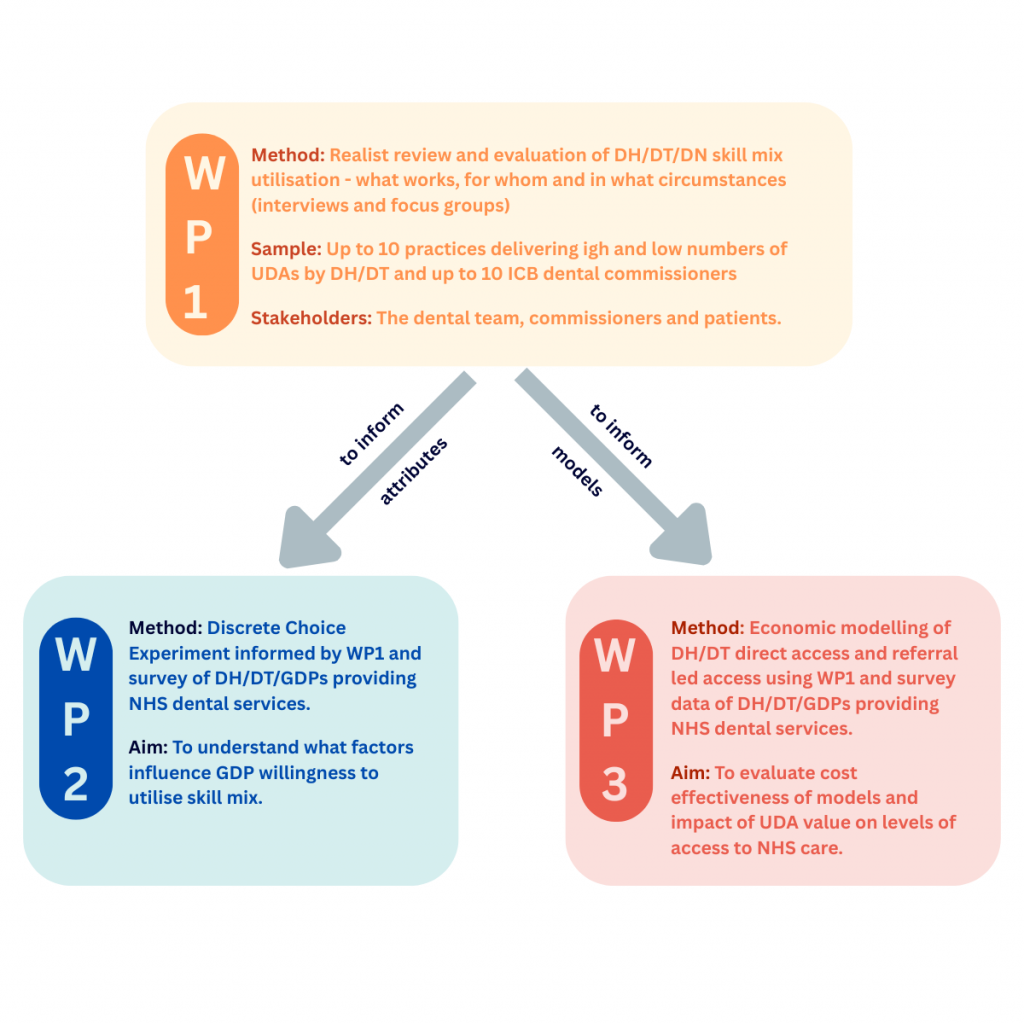
Work Packages (WP)
Work Package 1: Realist Review and Evaluation
This work package uses a process known as a Realist Review and Evaluation to explore how, why and for whom direct access works in NHS dental primary care practices in England.
Aim:
- Develop and refine theories by reviewing existing research to understand how dental hygienists and therapists are used effectively.
- Test these theories in practice by studying NHS dental practices with high and low levels of Direct Access, speaking to dental teams, patients, and commissioners.
- Identify what helps or hinders success by looking at local factors, resources, and decision-making, and using these insights to inform WP2 and WP3.
Work Package 2: Discrete Choice Experiment
This work package will use a type of survey called a Discrete Choice Experiment to find out what makes practice owners and managers willing to adopt Direct Access.
Aims:
- Identify the practice features and incentives (for example pay, training, patient outcomes) that may influence decisions to use dental hygienists and therapists.
- Test these preferences through an online survey, designed and refined with input from stakeholders and pilot-tested for clarity and usability.
- Use the results to predict which skill-mix models are most likely to be adopted and provide key inputs for the economic modelling in WP3.
The findings will help identify which changes are most likely to support sustainable adoption in practice.
Work Package 3: Economic Modelling
This work package will use data from WP1 and WP2 to understand the economic impact of Direct Access (DA) in NHS dentistry.
Aims:
- Compare efficiency: Look at how practices perform under three models—Direct Access (dental hygienist/ dental therapist led), referral-led access, and non dental hygienist/ dental therapist led using metrics like units of dental activity (UDA) delivered, revenue, and profit.
- Examine pricing: Explore whether the value of UDAs affects how many treatments are provided and whether pricing could improve access.
- Assess impact: Model how Direct Access could change NHS dental service provision across England, considering geography, deprivation, and potential uptake, and estimate the cost-effectiveness of different approaches.