Author: Dr Lucy Hatt, Reader in Entrepreneurial Education
Introduction
In May 2025, a quiet Northumberland valley became the unlikely setting for a bold experiment in rethinking value, leadership, and land. This one-day event brought together academics and farmers to use a Design Thinking approach to reshape farming practice.
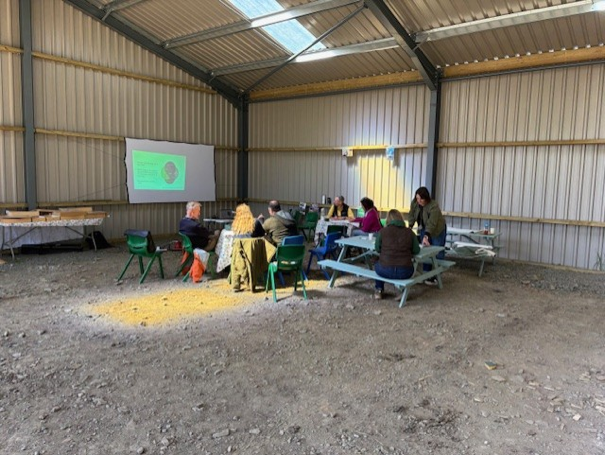
The story of John, one of our post-experience Executive MBA learners, who left traditional farming behind, rediscovered his purpose through international work, and founded a land-based social enterprise, became the catalyst for a day-long exploration of how Design Thinking connects with place, people, and purpose.
This article sets out how design thinking, as a pedagogical practice, can be applied in diverse contexts outside the classroom to build collaborative, human centred and innovative communities in practice.
It all started one evening, at a university event in Autumn 2024, when John Harrison (Executive MBA (EMBA) Graduate) asked Lucy Hatt, “Fancy doing something on Design Thinking with Farmers?”
Design Thinking
Design thinking is commonly used as an umbrella term for a human-centred, iterative and solutions-based approach to innovation and problem solving that draws on how professional designers work. It emphasises empathy with users, collaboration across disciplines, and cycles of exploration and experimentation deliberately iterating between divergent and convergent styles of thinking rather than linear analysis alone (Brown, 2008, PlattnerMeinel and Leifer, 2010).
It is often positioned as a response to ill-structured or “wicked” problems, where neither the problem definition nor the criteria for a “good” solution are stable, and where progress depends on the co-evolution of problem and solution through ongoing inquiry (Cross, 2023).
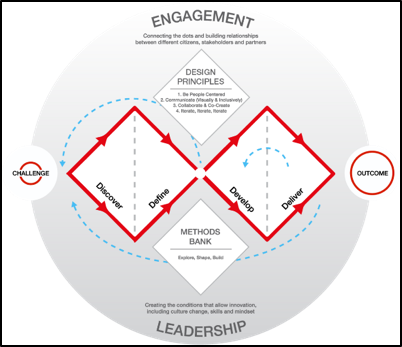
There are numerous popular models such as those of IDEO (2015), IBM (2021) and The Design Council (2023) (see Fig. 2) which help communicate the approach. However, scholars of design practice caution that such representations can be reductionist, masking the messy, non-linear nature of design practice and inviting overconfident claims about its universality (Kimbell, 2015, Cross, 2023).
When using a Design Thinking approach, progress comes through an iterative cycle of building empathy with users and affected groups, reframing the problem based on insights from field engagement, generating and comparing multiple possibilities, and making ideas tangible through prototypes. The approach is typically collaborative and interdisciplinary, valuing abductive reasoning (“what might be?”) alongside analytic reasoning (“what is?”), and it is often described less as a single method than as a family of principles and tools that together support experimentation under uncertainty.
Accordingly, for applications outside the design discipline, it is helpful to specify which tools and techniques and which intended outcomes are meant when invoking “Design Thinking” (Kolko, 2018, Liedtka, 2018) especially as the term is used not used consistently.
Operational Context
Jenny Davidson, (Visiting Fellow) who had been the co-Director of the EMBA with Lucy at the time John was on the programme was swiftly brought on board, and together they successfully applied for some ESRC IAA [1]funding, having helpfully been pointed in that direction by NUBS Director of Impact, Fiona Whitehurst.
Gina Segrt, a final year Biology undergraduate student at Newcastle was recruited through SEOC (Student Employment on Campus) to record activities, and the funding paid for catering, the venue and Gina’s time.
NUBS Alumnus, John Harrison hosted the day on his farm together with his partner, Katie Wheatley. Lucy and Jenny acted as facilitators and process navigators. Gina acted as journalist, photographer, videographer and interviewer. Attendees included Tom Burston (Alwinton Farm), Mary Gough (Hepple Estate), Bridie Melkerts (College Valley), Rachel Henry (Westhills Farm) and Angus Nelless (Thistleyhaugh Farm). Other Newcastle University staff attending were Jeremy Franks and Toby Price (SaGE; Faculty of Science, Agriculture and Engineering) and Melanie Thompson-Glen (NICRE; National Innovation Centre for Rural Enterprise). John was responsible for developing the initial list of invitees, and we all used our conversations with prospective participants to expand the participant list similar to a snowball sampling approach. Melanie Thompson-Glen was particularly helpful, and Gina brought some useful contacts too.
At the heart of the event was the story of Solidarity Farm CIC, founded by John while on the Executive MBA programme and which is based on his 200-acre organic family farm, Coldside Farm. Fully integrated with the day-to-day activities of a regular livestock farm, John offers alternative education and therapeutic support for young people excluded from mainstream education and delivers commissioned services such as 1:1 learning sessions, holiday programmes, alternative education provision such as Forest School, and curriculum-linked visits, funded through local authority contracts and grants.
Solidarity Farm now operates as both a working agricultural space and a therapeutic learning environment for young people struggling with traditional education. John’s mission is to create a psychologically safe space where young people can find meaning, confidence, and connection through nature and responsibility.
The focus for the event was, “Doing Good Though The Land”, and the intended aim was, “To create a space for farmers of Northumbrian family farms and their stakeholders to network, share best practice and collaborate using the principles of Design Thinking to realise the many types of value in their land.”
What Happened on the Day
The day itself was structured as a dynamic and participatory workshop, guided by the principles of Design Thinking and co-creation. The morning opened with introductions and a welcome from Jenny and Lucy; a contextual overview of Design Thinking and the story of how the day had been conceived.
We shared our aims and objectives and our hope that a community or network would form from the participants as a result of the day. Our intention was to support John in getting liked-minded people together to start a conversation around reframing value creation in farming.
We emphasised that we (Jenny and Lucy) were not positioning ourselves as the experts and certainly didn’t have the answers. We weren’t even sure we had the right questions. However, we were excited to use the principles of generative thinking, ideation, and paradigms of abundance, collaboration, opportunity creation and discovery drawn from Design Thinking to start the ball rolling. We were seeking to communicate a message of inter-connected natural resources, and the mutual benefit of thinking in a joined-up way.
Following the general scene setting and wider introductions, John shared his personal and professional journey, grounding the session in his own real-world case study that connected identity, education, and rural enterprise.
Design Thinking approaches were selected for the day to help the group move from a shared understanding to new possibilities. Following John’s presentation of his story, participants were invited to reflect on it in small groups using guided reflection prompts. We were seeking to understand which parts of the story had most resonated with the participants and what it had made them think, how it had made them feel.
- “What did you notice? What resonated? What are your stories of doing things differently?”
Rather than driving toward fixed solutions, this activity helped attendees reframe challenges in farming and community engagement, encouraging divergent thinking.
After a shared lunch from the ever-popular Running Fox John took us on farm tour. Taking a ride in his new trailer (a safe and accessibly way to get close to cows and sheep), walking around his Forest School and experiencing the beauty of the landscape, brought the work of Solidarity Farm to life and helped participants understand the new value that was being created though the land.
The afternoon shifted into a more exploratory conceptual space. Participants in small groups worked through themes such as redefining value, reimagining rural networks, and fostering belonging on farms. Facilitated conversations were interspersed with unstructured moments for connection and informal exchange. We encouraged participants to explore ideas and develop tangible next steps from their reflections, connections and conversations.
We structured this exercise using the 5W+H framework (Who/What/When/Where/Why/How) (LewrickLink and Leifer, 2018) as a disciplined way to deepen understanding and gather context.
To broaden how value was being conceived, we introduced a “more than one kind of value” framing (Lackéus, 2018) and a purpose/Ikigai-style circles sketch activity to help individuals and tables articulate different forms of value and purpose connected to land and identity.
Finally, idea generation was made explicit through the “How Might We…?” technique (LewrickLink and Leifer, 2018) to open multiple possible pathways (“How”), creating permission and psychological safety (“Might”), and emphasising collective problem-solving (“We”).
The event culminated in a full group reflection session, surfacing emerging themes, ideas and action steps for the future.
Capturing the Day: Scholarship Meets Storytelling
A vital part of the event’s success was the deliberate integration of documentation and dissemination activities. Gina took video footage and photographs throughout, as well as periodically inviting individual participants to step away from the group activities to be interviewed and have their own reflections recorded on camera.
These materials were not only valuable for memory and reflection but formed the foundation of a short film and case study destined for the NICRE Innovation Portal Farming for Good – NICRE. This multimedia output serves as an accessible resource for others interested in rural social innovation, Design Thinking in practice, and community-led enterprise models. The presence of a dedicated intern allowed the Jenny and Lucy to maintain the intimacy and spontaneity of the event while ensuring that key learnings were recorded and curated professionally.
Discussion
Learning for Participants
Several themes emerged from the conversations on the day. One was the importance of identity in shaping leadership. John was described as an “un-farmer-y farmer,” and many attendees reflected on the courage it takes to choose differently from the roles that society or heritage assign. His journey prompted a collective re-evaluation of professional identity, particularly in rural contexts where multiple roles (farmer, carer, educator, entrepreneur) often overlap.
Another was the tension between capital investment and operational sustainability. While many rural enterprises can access grants for infrastructure, there remains a gap in revenue funding and support for human capital. John’s creative approach to funding, blending commercial, charitable, and public streams, demonstrated the kind of hybrid thinking we seek to foster in all our learners.
The day resulted in a deeper appreciation among the local community of John’s work on Solidarity Farm. For us, it was more evidence that Design Thinking methodologies can be used in a context far from that of a design studio, to enable a re-framing what farming can be and to create new opportunities for the University in interdisciplinary and partnership working.
Many of the participants commented on the value they felt in the role of the workshop in creating an inclusive sense of community among the farmers in the Coquet Valley and had been surprised by their own willingness to share their thoughts and feelings with each other. By giving people time and space in a facilitated structure to share help, expertise, ideas and support within the group, a network was established, and new contacts were made between those who want to do more than “just farm their farm” and were prepared to re-conceptualise the nature of the value that could be created.
As one participant observed, “He’s not doing this instead of farming. He’s doing farming differently.”
Learning for business school scholars
For business school scholars, the Farming for Good initiative offers several important insights about the nature of scholarship, pedagogy, and impact when academic ideas are enacted through practice. It demonstrates how design thinking can function as a scholarly practice that shapes how academics partner with external stakeholders. The absence of a fixed blueprint for the day allowed the event to remain responsive to participants, place, and emerging insights. It demonstrates how effective practice-based work can be grounded in attentiveness, reflexivity, and intentional facilitation.
The event also provides a concrete illustration of effectual logic (Read et al., 2010) in action. Rather than beginning with predefined outcomes, metrics, or theories to be tested, the initiative started with available means: John’s lived experience, his land, existing relationships, and the curiosity of academics and practitioners willing to explore together.
It also shows academics in the roles of facilitators and process navigators, rather than expert problem-solvers. We explicitly positioned ourselves as co-learners, creating psychological safety for participants and enabling honest discussion of uncertainty, vulnerability, and values. For business school scholars, particularly those working in engaged or impact-oriented research, this raises important questions about academic authority, humility, and the skills required to design and hold spaces where learning emerges relationally rather than transactionally.
The initiative also foregrounds the importance of place-based scholarship. The farm was not a neutral backdrop but an active participant in the learning process. Walking the land, seeing the animals, and experiencing the Forest School setting fundamentally shaped how participants understood value, education, and enterprise.
Conclusions
Scholarship in the Soil
The Farming for Good event was not designed to be a showcase or an educational event in a transactional didactic sense. Instead, it was a working session, serving as an invitation to collectively make sense of a farming and education model that doesn’t fit neatly into existing categories. John’s Executive MBA inspired project was cultivated into a community asset. It is proof that executive education can translate into meaningful rural impact as responsive, embedded practice.
For Newcastle University Business School, this day was an example of scholarship in action. Using Design Thinking approaches, it brought the principles of responsible business and civic leadership directly into the field, demonstrating that innovation does not always require disruption and sometimes it begins by simply listening, digging in, and growing something new.
For Newcastle University Business School, Farming for Good demonstrated how teaching, scholarship and lived practice can coalesce into something quietly radical. It underscored the power of narrative, the value of being embedded in place, and for John, the importance of listening not just to stakeholders, but to the land itself.
Note:
If you would like to learn more about Design Thinking and how you might integrate aspects into your Scholarship practice, please contact lucy.hatt@newcastle.ac.uk who leads the Design Thinking Community of Practice at Newcastle University
References
BROWN, T. 2008. Design Thinking. Harvard Business Review, 86, 84.
CROSS, N. 2023. Design thinking: What just happened? Design Studies, 86.
IBM. 2021. Enterprise Design Thinking, IBM Design [Online]. Available: https://www.ibm.com/design/thinking/page/framework [Accessed].
IDEO.ORG 2015. The Field Guide to Human-Centered Design, San Francisco, USA, IDEO.org.
KIMBELL, L. 2015. Applying design approaches to policy making: discovering policy lab. Brighton: University of Brighton.
KOLKO, J. 2018. The divisiveness of design thinking. Interactions, 25, 28-34.
LACKÉUS, M. 2018. “What is Value?”–A framework for analyzing and facilitating entrepreneurial value creation. Uniped, 41, 10-28.
LEWRICK, M., LINK, P. & LEIFER, L. 2018. The Design Thinking Toolbox: A guide to mastering the most popular and valuable innovation methods (Design Thinking Series), John Wiley & Sons.
LIEDTKA, J. 2018. Why design thinking works. Harvard Business Review, 96, 72-79.
PLATTNER, H., MEINEL, C. & LEIFER, L. 2010. Design thinking: understand–improve–apply, Springer Science & Business Media.
READ, S., SARASVATHY, S. D., DEW, N., WILTBANK, R. & OHLSSON, A. 2010. Effectual entrepreneurship, Taylor & Francis.
THE DESIGN COUNCIL. 2023. The Double Diamond, a universally accepted depiction of the design process [Online]. [Accessed 26_06_2023].
[1] The Economic and Social Research Council (ESRC) offers Impact Acceleration Accounts (IAAs) to UK research organisations of which Newcastle University is one.