
Professor Ian Moss (Group Leader)
My research focuses on the inflationary model of the very early universe, and the various quantum processes responsible for the origin of density fluctuations and other major features of the universe. The inflationary model has become the predominant model of the early universe as, one by one, all of its predictions have been confirmed by observation.
Dr Gerasimos Rigopoulos (Senior Lecturer)
I work on both Early Universe Cosmology (Inflation, quantum theory of inflationary perturbations and its stochastic formulation, quantum fields and implications for quantum gravity) and Late Universe Cosmology (Effective theories of cosmological perturbations, semi-analytic methods for the non-linear regime of structure formation).
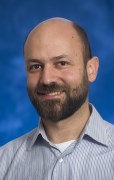
Dr Dani Leonard (Lecturer)
I am interested in testing and constraining extensions to the standard cosmological model, especially alternative theories of gravity and dynamical dark energy. To do this, I use observables which are sensitive to the growth of large-scale structure, in particular weak gravitational lensing and galaxy clustering.

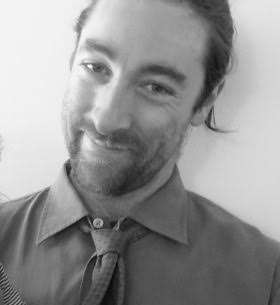
Dr Joachim Harnois-Deraps (Ernest Rutherford Fellow)
I combine simulations and observations of galaxy surveys to measure cosmological parameters. I am the PI of the Scinet LIght-Cone Simulation suites (SLICS), a public series of over 1000 N-body runs ideally suited to estimate the uncertainty about cosmological measurement, including cosmic shear, galaxy-galaxy lensing, galaxy clustering and redshift space distortions — the SLICS were central to 30 journal papers to date. I am now leading the core numerical simulation programme in many international weak lensing collaborations (KiDS, LSST and Euclid). You can find a list of my publications here.
Dr Marika Asgari (Lecturer)
I am a cosmologist and study the large scale structures of the Universe. I’m interested in understanding the nature of dark matter and dark energy through modelling and analysing data from probes of the large scale structures. I am also interested in the interactions and connections between baryons (regular matter) and their dark matter environment.
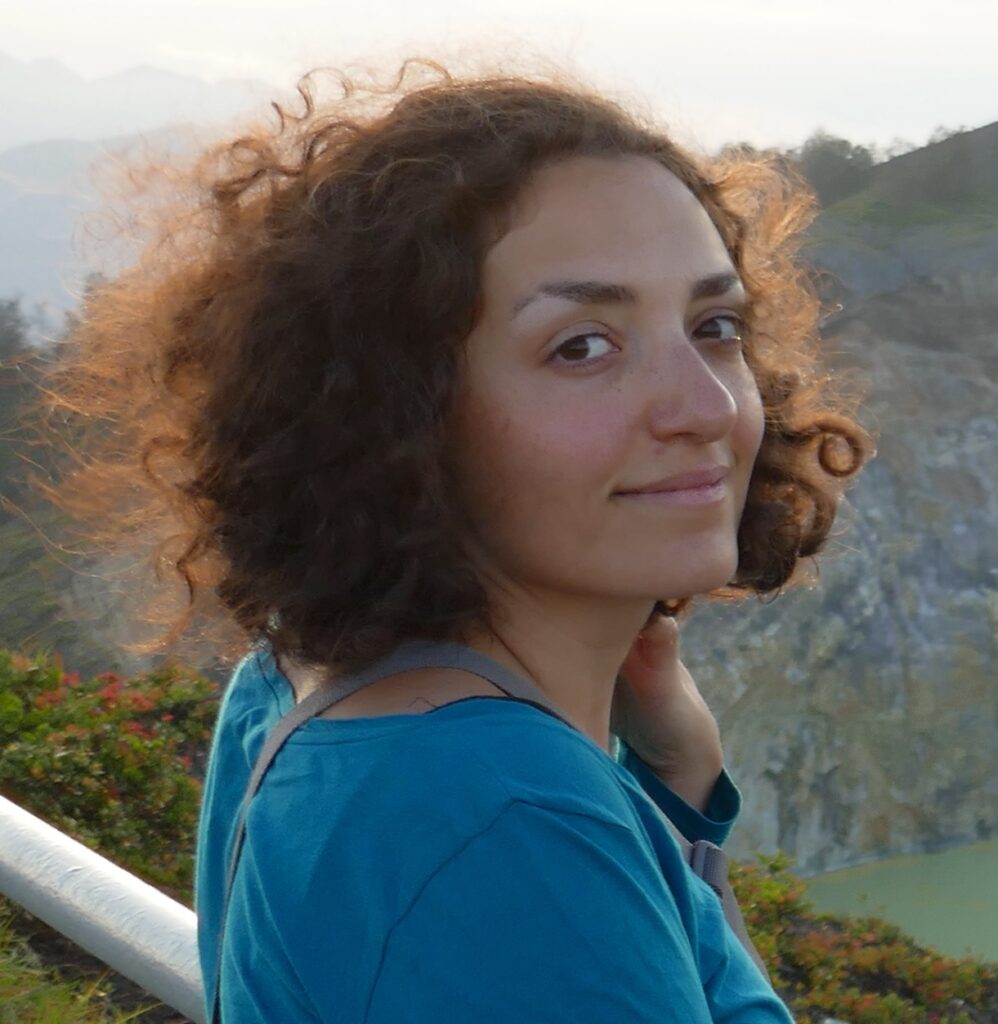
Dr Markus Rau (Lecturer)
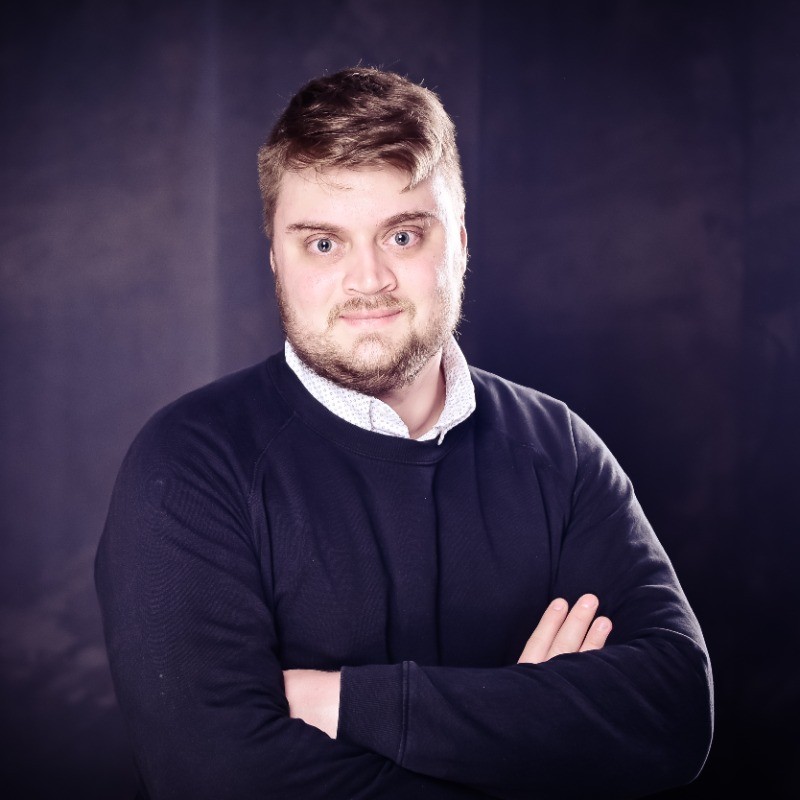
My research combines observational cosmology, astrophysics, and statistics to investigate the formation of cosmic structures and the nature of Dark Energy. To do this, I leverage data from next-generation surveys like the Hyper Suprime-Cam and the Rubin Observatory, which are mapping the cosmos with unprecedented depth and precision. The sheer volume of data from these experiments presents formidable Big Data challenges that demand novel statistical solutions. I specialize in developing scalable inference techniques to address these issues, with a focus on spatial statistics and inverse problems. The central goal is to reconstruct an accurate map of the Universe by correcting for the inevitable distortions introduced by measurement instruments. This computational groundwork is essential for future discoveries, establishing the Universe as a final frontier not only for physics but also for statistics and data science.
James Nightingale (Ernest Rutherford Fellow)
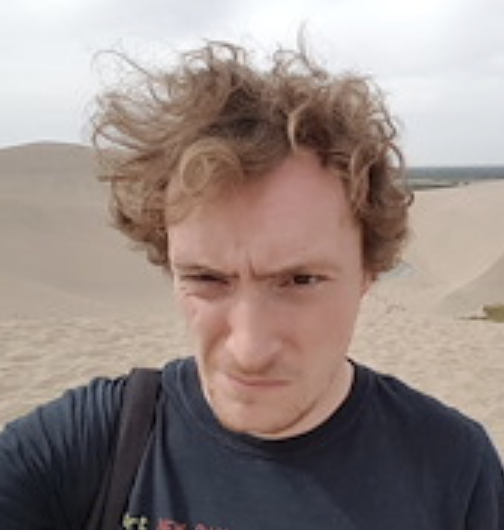
I’m an observational cosmologist and Ernest Rutherford Fellow. My cosmology research uses gravitational lensing to study the most massive black holes, the smallest dark matter clumps and the most distant Universe. I’m the lead developer of PyAutoLens, open source software for analyzing gravitational lenses. I collaborate with healthcare researchers on applying the statistical techniques I developed for Cosmology to improve cancer treatments. This uses the statistics software PyAutoFit that I lead development of. More details are on my website: https://jamesnightingale.net
Dr Cora Uhlemann (Visiting Professor)
I am a theoretical cosmologist working on modelling the cosmic large-scale structure in the nonlinear regime and using it to probe fundamental physics and cosmology. My research focuses on solving the gravitational dynamics of dark matter and developing galaxy clustering statistics. I am now a Professor in Cosmology at Bielefeld University in Germany.

Nisha Grewal (Postdoc)
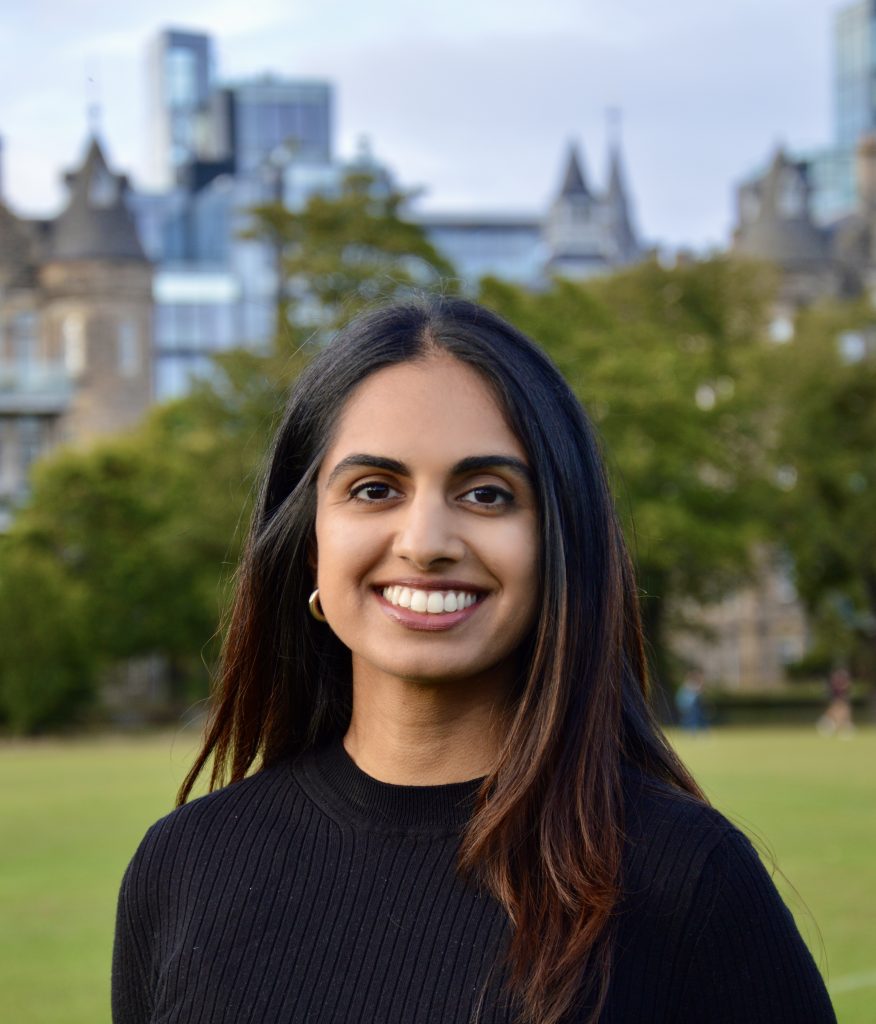
My research focuses on modelling the intrinsic alignment of galaxies in weak lensing analyses to improve our understanding of the dark sector. I am particularly interested in studying small scales of the Universe, where nonlinear effects dominate.
Lina Castiblanco Tolosa (PostDoc)
I am looking for additional large-scale structure probes to improve our understanding of the Universe’s origin and evolution. My current research focuses on the one-point probability distribution function for galaxy clustering and weak lensing. The information content of the one-point PDF is a powerful tool for probing cosmology. I also work on modelling the galaxy bispectrum to extract information about early universe physics. Additionally, I am interested in map-level inference using persistent homology, which allows us to study the topology of cosmic structures and has shown strong potential in constraining primordial non-Gaussianity.
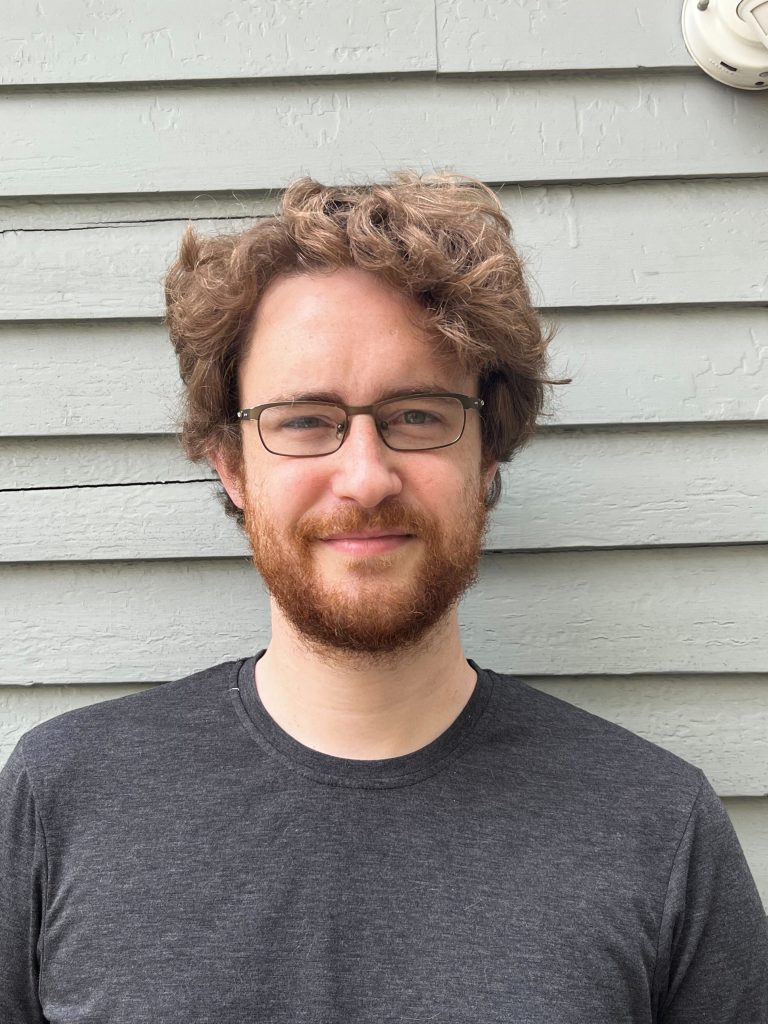
Eske Pedersen (PostDoc)
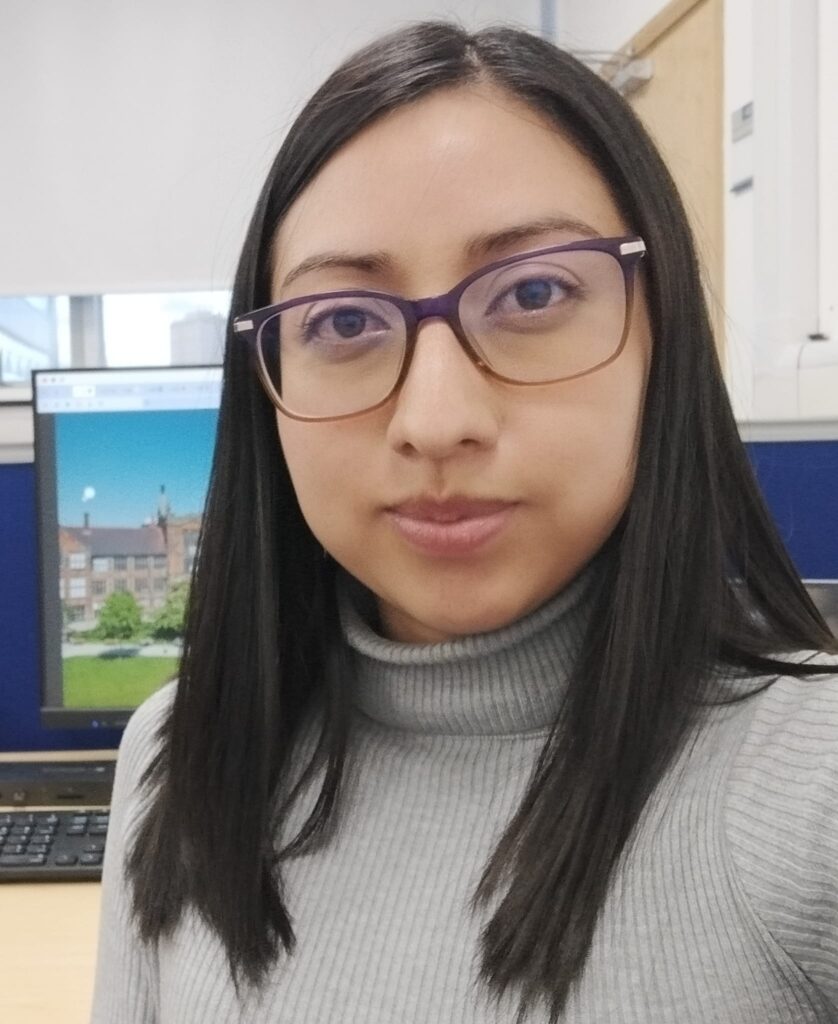
I work on systematic effects that effect mainly gravitational weak lensing, but also other observational probes of cosmology. I am interested in Intrinsic alignment of galaxies and how we can distinguish it. I also have an interest in photometric redshift estimation and atmospheric seeing. My work is mostly related to the Vera C. Rubin Observatory and its upcoming Legacy Survey of Space and Time (LSST). I am also a member of the LSST Dark Energy Science Collaboration (DESC).
Tassia Ferreira (PostDoc)
I am an observational cosmologist focusing on using weak gravitational lensing to understand the nature of dark matter and dark energy. I am particularly interested in using cross-correlation techniques to combine multi-wavelength observations to obtain information on astrophysical systematics and push weak lensing analyses to smaller scales. As part of this work, I recently discovered a correlation between cosmic shear and the diffuse X-ray background, which can be used to constrain baryonic feedback!

Beth Gould (PhD student)
My research interests are generally in cosmology and its relation to fundamental physics. For my PhD, I’m working on the formation of the cosmic large-scale structure, dark matter dynamics, and using theoretical techniques to extract information about fundamental physics from the late-time matter distribution.

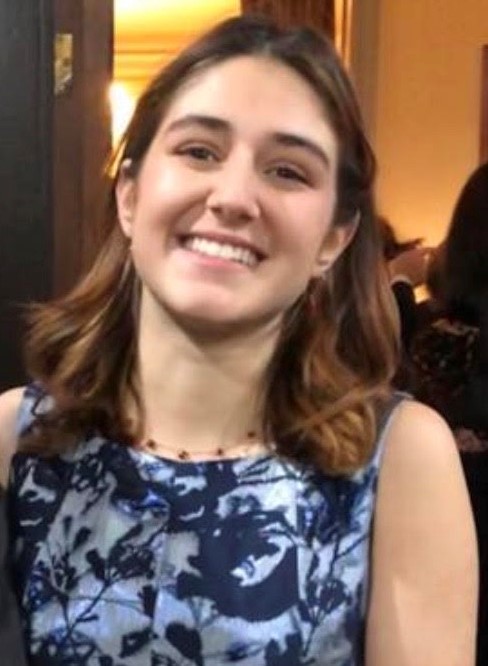
Carola Zanoletti (PhD student)
My research involves testing gravity on cosmological scales by using agnostic parametrisations for modified gravity. This involves exploring parameter estimations from different observational probes and testing data by considering specific alternative theories of gravity. I will also be studying degeneracies between gravitational parameters to find accurate physical interpretations of true descriptors of theories.
Charlie MacMahon (PhD student)
My PhD is focused on developing a novel method for measuring the intrinsic alignment systematic effect in weak lensing surveys, in order to reduce the uncertainty on their cosmological constraints. To do this, I am investigating the different measurement methods used in weak lensing surveys and how they can be modified to extract high signal-to-noise intrinsic alignment measurements. With these measurements we can then test and constrain intrinsic alignment models for data processing in future lensing surveys.
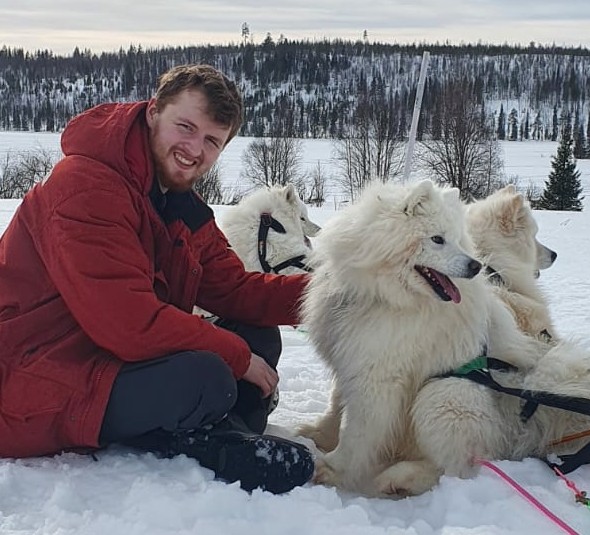
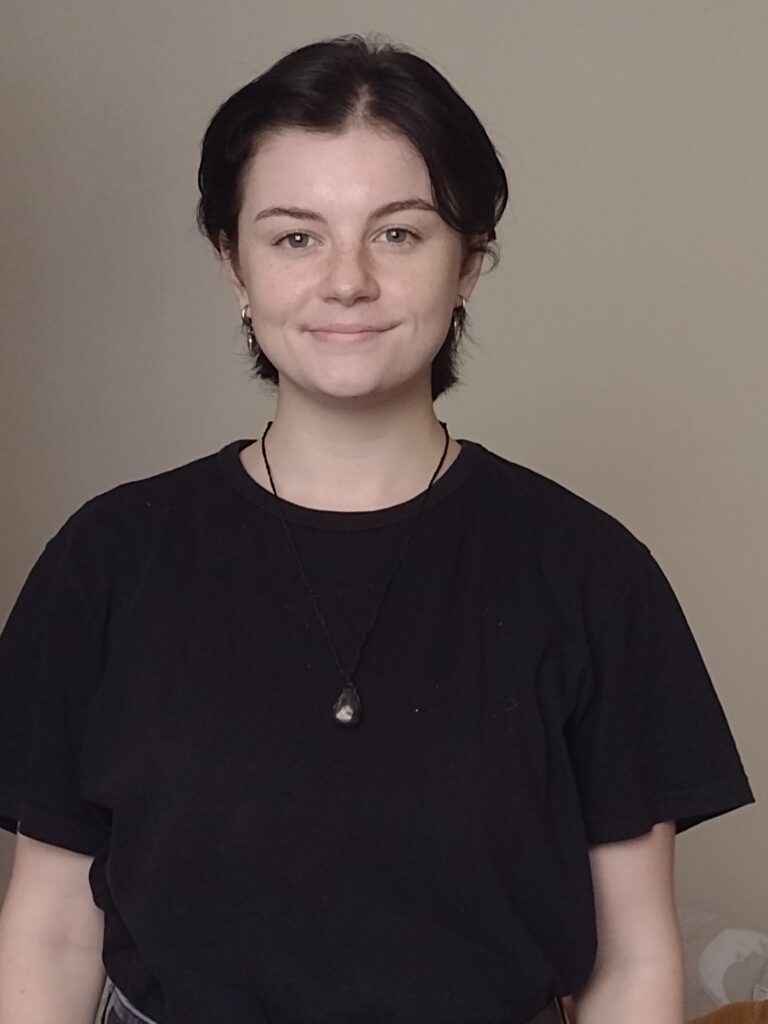
Carolyn Mill (PhD student)
My PhD project focuses on how the interactions between systematic biases in our analysis of weak lensing and galaxy clustering will impact our measurements in upcoming surveys. Due to the high accuracy of these surveys, systematic uncertainties no longer hidden by statistical noise may limit our ability to constrain cosmological parameters. My project aim is to identify what combinations of systematics may cause these limitations, starting with the 3x2pt correlation function between weak lensing and galaxy clustering.
Antoine Vauterin (PhD student)
My research interests are in fundamental physics and theoretical cosmology. Specifically, I am interested in the very early universe and inflation. For my PhD, I am studying the mathematical structure of inflationary correlators using tools from holography, scattering amplitudes and conformal field theory.

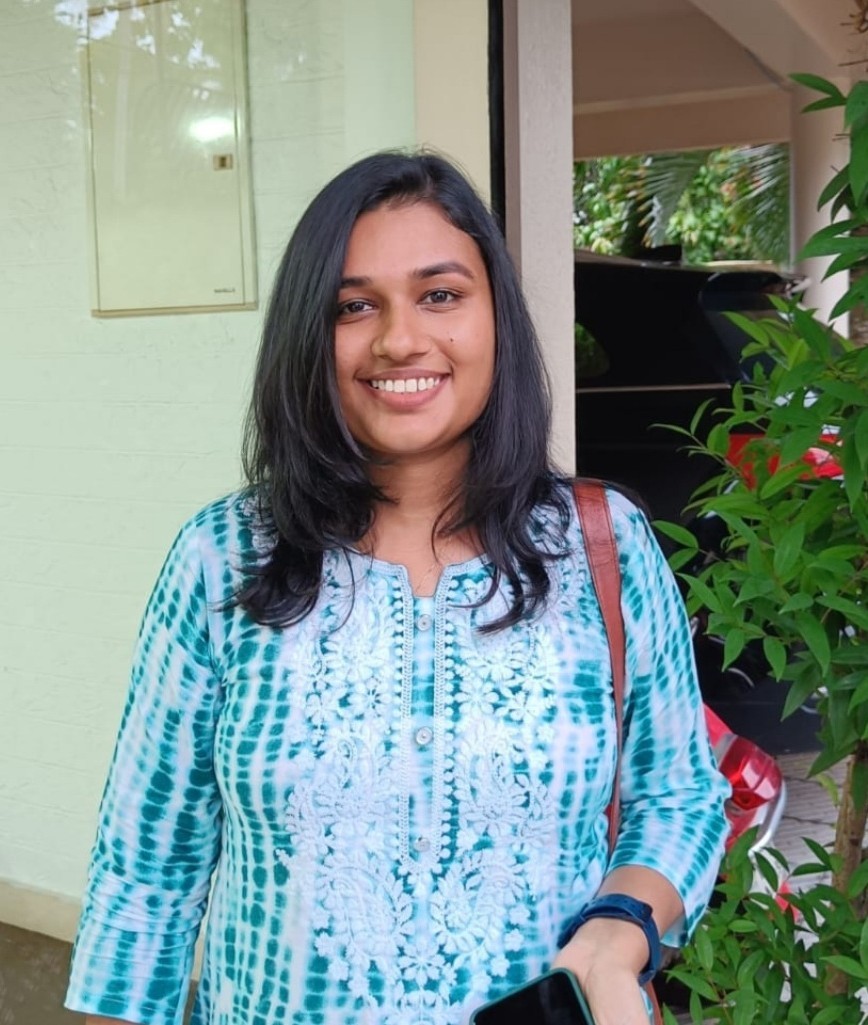
Karthika Bhuvanendran (PhD student)
My research interests are in weak gravitational lensing, one of the most compelling probes of cosmology. Weak lensing measures the distortions on the shape of background galaxies by the foreground cosmic web. Specifically, I am interested in improving our understanding of the dark side of our Universe via cosmic shear analysis by deploying newly developed simulation-based analysis methods. In my research I will specialise in some of these novel analysis techniques. First, I will validate the methods on simulations, then apply the findings on the KiDS legacy data, and subsequently on the first data release of the LSST.
Rintaro Kanaki (PhD student)
My Ph.D. focuses on the intersection of Bayesian statistics and large-scale structure cosmology. In cosmology, we often deal with regression problems, and by using observabes from the late-time universe, such as cosmic shear or galaxy distribution, we need to address the non-Gaussianity generated by non-linear gravitational structure formation. To tackle this, employing both modern techniques like simulations and AI, alongside analytical modeling, can be a powerful approach to improve our understanding of our universe in a Bayesian manner. I am excited to begin my first year of Ph.D. at the new place, which even has a castle.

Elliot Scott (PhD student)
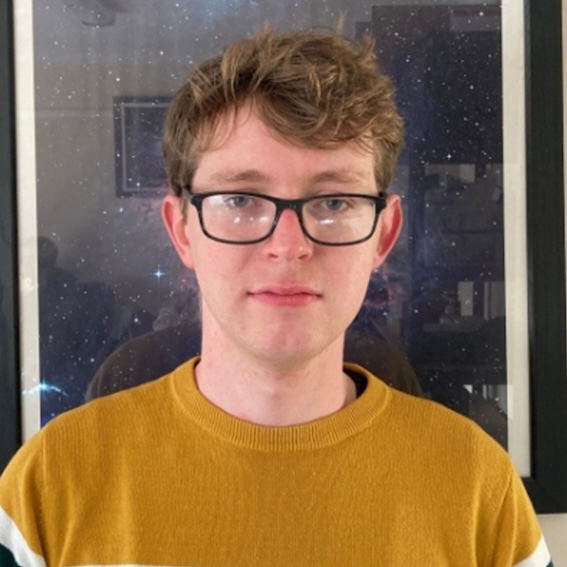
My research focuses on understanding the distribution of baryonic matter used for tracing large-scale dark matter structure, working with the FLAMINGO hydrodynamic simulations and using data science and machine learning techniques to combine larger and smaller scale simulations, and then to apply this to data such as from KiDS.
Aditya Verma (PhD student)
My research involves developing a hybrid Dark Matter (DM) model that combines the existing Cold Dark Matter (CDM) model with a “Fuzzy” Dark Matter (FDM) model and treats DM as a cosmological superfluid. While the existing DM model is extremely successful at a macroscopic level (Large-Scale Structure Formation), discrepancies start to arise at galactic-halo scales, and FDM aims to tackle these. The goal is to perform high end non-linear simulations for such a model, to attain a richer phenomenology that can confront results of galaxy surveys and allow for refined constraints on the physical parameters that govern these models. The aim is to achieve this by focusing on stellar trajectories in FDM halos and how these would translate to observable rotation curves.
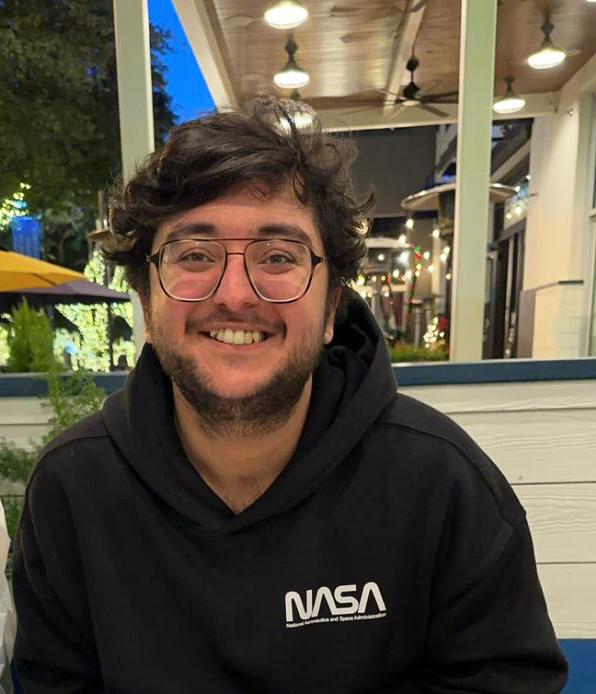
Niek Wielders (PhD student)
My research focuses on strong gravitational lensing. I use the PyAutoLens software to model group-scale lenses, systems of 2-10 galaxies in close proximity whose large masses provide high magnification and allow us to probe some of the earliest galaxies in cosmic history. I also study double source plane lenses, where three galaxies align so that the most distant one is lensed twice. These rare systems offer a means to constrain cosmological parameters, particularly, the dark energy equation of state and the matter density.