OHD_PPR_0012 Print out of Michael Frisch’s chapter Three Dimensions and More.
Leave a Reply
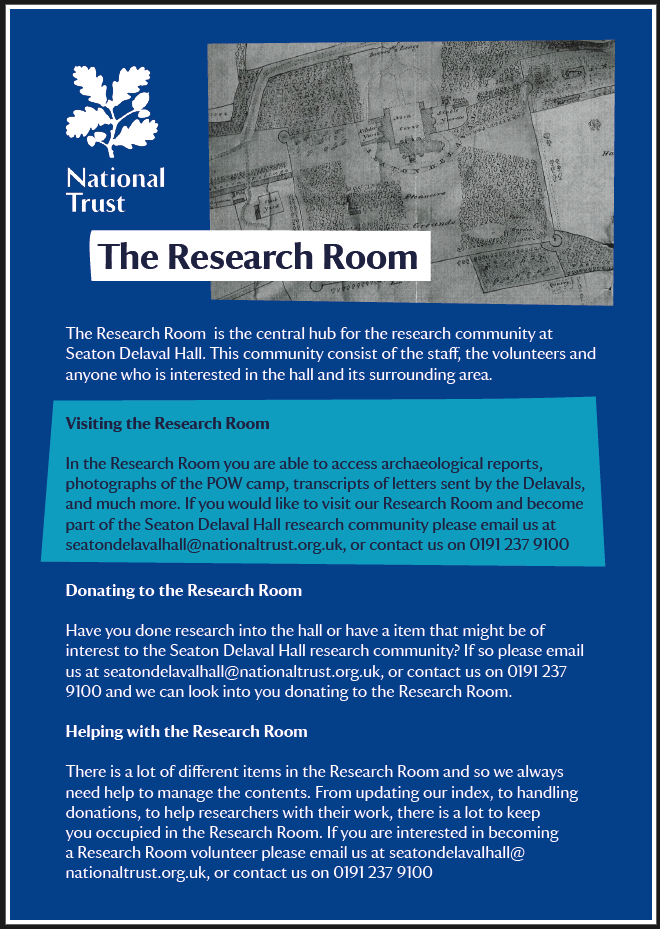
The Research Room digital infrastructure is set up in this way
The Research Room digital infrastructure is not there to support permeant preservation. It is possible that we might need to build in a system where the contents of the research room is reviewed in order to keep the volume of contents under control
1. SharePoint
This is where files go where the National Trust does not have full copyright. In order to access these files you need to contact a National Trust member of staff. These cannot be very large files, for carbon neutrality reasons.
2. Secure SD cards
These are SD cards or hard drives which hold files where the National Trust does not have full copyright. In order to access these files you need to contact a National Trust member of staff. These can be very large files.
3. Research Room SD cards
These are SD cards or hard drives which hold files where the National Trust does have full copyright. You can access these files by putting them into a device available in the research room. These can be very large files. Moving stuff onto these SD cards is not smooth yet.
4. Third Party Websites
This is where files go where the National Trust does have full copyright and is happy for a wider audience to have access. These can be very large files and because they are not part of the national trust network they do not effect the trust’s carbon neutral aims. Ethically questionable. Moving stuff onto these website is not smooth yet.
5. Research Room devices (tablets)
This is where smaller files go and larger more popular files where the National Trust does have full copyright. For the easiest of access. Moving stuff onto these on these devices is not smooth yet.
—————————————————
Research Room volunteer training programme
Every one goes through the process but you dont have to do all of it
| Title/File Name | Date YYYY/MM/DD (if possible) | Date Catalogued YYYY/MM/DD | Catalogued by | Information | Location(s) | Copyright | Notes |
| Title of material OR file name in SharePoint | When was the item made. OR if it is a transcript or a copy, this section refers to the creation date of the original. | What date was it catalogued. | Who catalogued it. | A brief description of the item and any other helpful information | Where can it be found in the Research Room OR tablet OR Sharepoint Please see location table for more advice Add if original is archived at third party archive | Does the National Trust fully own item? Are there any licensing restrictions? | Has it been used anywhere else? For example an exhibition or research. Any additional information |
NOTE: the original is an Excel spreadsheet
Placement Report
Seaton Delaval Hall
2nd Aug to 4th Nov
Hannah James Louwerse
The aims of the placement at Seaton Delaval Hall were to help set up a Research Room, continue conducting oral history interviews, and generally experience day-to-day life on a National Trust site in order to see how the systems and process of the National Trust will impact my designs.
The first aim, help set up a Research Room, resulted in a collection of outputs, which make up a foundation for the staff at the hall to build on in the future. It included: drafts of different forms, an indexing system, and a guide to the Research Room and its processes. The development of the Research Room and my outputs started with me looking into the possible storage options. However due to current developments within the National Trust’s IT systems I was slightly restricted and settled on creating a temporary solution that fits easily within the current IT system but can easily be adapted should the IT situation develop. Moving on from storage systems, I created a spreadsheet which functioned as a basic index for all the material the Trust holds outside of the collection. However, it quickly became apparent that filling in the index and moving material the Research Room was not possible without the correct paperwork. As the name suggests the Research Room is meant to hold, among other things, research. Research is a creative product, meaning whoever made it holds its copyright. For this reason, I created a series of forms that will assist in making the material accessible under copyright law, protecting both the original creator and the National Trust. In addition to copyright law, I also became familiar with the National Trust’s data protection policies as the forms I was making included the collecting of personal data. By the end of my placement, I gained a good base knowledge of data protection and copyright law, which I believe will be useful to have in situations beyond my PhD.
As for the second aim of continuing to collect oral history, because I was at the hall four days a week the staff got to know me and my work better, I believe this led to them actively helping me in finding more participants. I was therefore able to do four more interviews. I also created a prototype sound walk out of the oral history interviews, which takes you all around the property.
The third aim of simply experiencing the day-to-day life of a National Trust property was enlightening and led to some radical changes to my PhD. Most significantly I realised how different the collection of oral history on heritage sites is in comparison to academic oral history and community oral history. While academic and community oral history focus on the recording and analysing of people’s life stories, oral history on heritage sites is simply another thing they need to collect and maintain alongside everything else. This realisation impacted the framing of my PhD and has given me the opportunity to develop design solutions better tailored to fit the wider National Trust eco system.
A brainstorm document about an alternative GLAM space. It was interactive but that made it too big to upload.
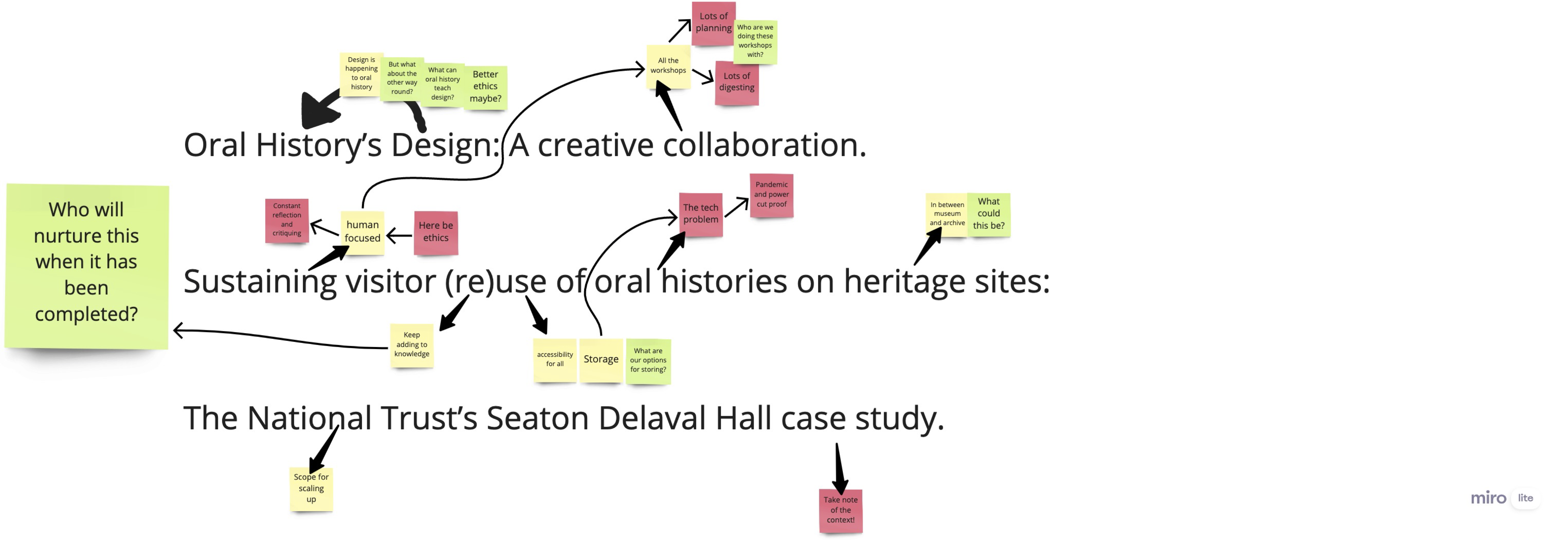
In an attempt to create order in the chaos of my mind I thought that it would be helpful to also write all the ideas I have thoughout this process alongside all the questions, insights I have.
This idea came to me while I was doing a podcasting workshop (26/04/21 – 27/04/21). Combining the Last Archive podcast and the book Imaginary Museum and then ripping them off, I decided to make the Shelter for Phantom Voices: home of oral history. I thought it would be a good idea to used different oral history projects to illustrate the various challenges and opportunities that can be found in the field of oral history.
I don’t know whether I’ll make it into a podcast or just keep it as a mind palace for myself but either way it is a fun way to think about it.
I was zooming with Emma because we need our bi-weekly PhD vent. She had been busy with ethics forms which was driving her crazy and I had been thinking about reusing archives (duh). This combination led us to brain storm how you can make an archive pandemic and power-cut proof, while also sticking to GDPR regulations. Our conclusion, a pop-up archive where you can simply hear the oral histories live from the people without any recording. You see if there isn’t a document you do not need to worry about GDPR, power cuts or pandemics because the archive lives within the people. Inspired by oral tradition of Anansi the histories live within the generations through pop up archives. No collection, no storage problems.
Since my roots lie with fine art and I am a strong believer in art as a frontier of exploration, I find it fitting that I should start this project with some type of collaboration with art students. I imagine this would involve me commissioning artists to create pieces that explore the ideas of: sustainability, audience participation, legacy, evolution, story telling, manipulation etc. Should be fun.
Continuing this idea but expanding it to software developers and architects.
I am currently (21/07/20) watching the drama series Mrs. America, which is about the ERA (equal right amendment) in 1970s America and the women who are both for and against it. The drama demonstrates perfectly how difficult it is for feminist unity because everyone has different life experiences. Women of colour have a different story to white women, young and old differ, lesbians and straights, rich and poor. It is a mess and the exact reason that when my brother asks why can’t women do what #blacklivesmatter protesters do, I reply with it’s just too complicated.
However what this particular situation offers is an extreme situation and extreme situations are very helpful in the case of designing something (Tim Brown, Change by Design). With this in mind I believe that an experiment involving the various opinions of a diverse group on the topic of feminism could provide an exceptional interesting source of footage. Something that could possibly be edited to fit any point of view.
I therefore imagine collecting this in a Photo Booth set up on, lets say, the university grounds and then later inviting people to create their own interpretation of the footage.
I think the aim of the experiment would be to see if you can edit any footage to fit your opinion even if you have collected a wide range of opinions.
Alternatively…
I could make a set up where you can answer a question and leave a question. Like a chain of opinions. Completely random. Could be a website or an installation of some kind.
The second conference paper I presented. This one went better than the first one so that is positive.
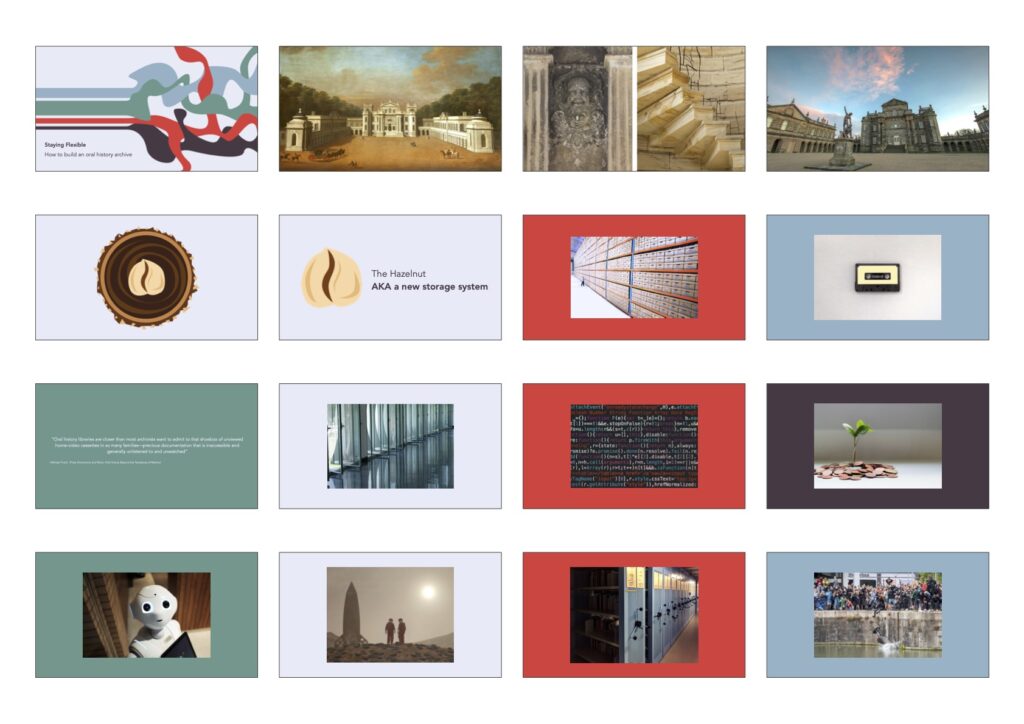
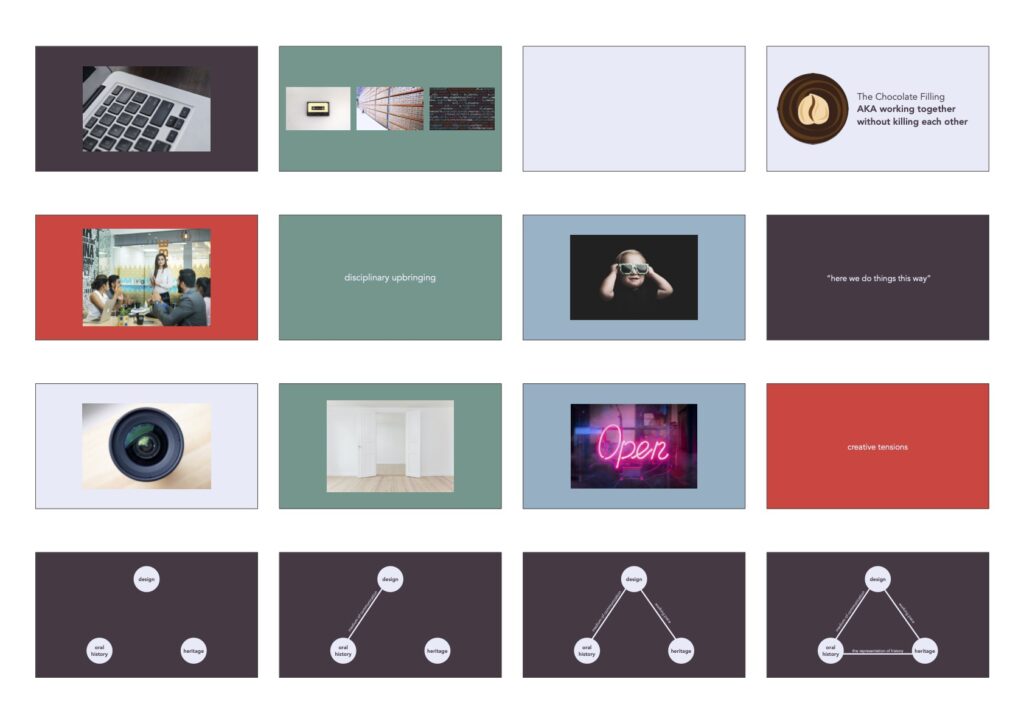
[slide two]
This is Seaton Delaval Hall. This National Trust property can be found in Northumberland just up the coast from Newcastle. Built in the 1720s the hall and its residents, the ‘Gay Delavals’ became renowned for wild parties and other shenanigans.
[slide three]
In 1822 the hall went up in flames severely damaging the property. This history is well represented in the collection that is housed at the hall.
[slide four]
What is less represented, however, is the hall’s more recent history: the community that looked after the hall after it burnt it down, the prisoner of war camps, and the medieval themed parties that the late Lord Hastings threw after the hall’s restoration.
For my PhD I will attempt to solve this issue of missing history by building an oral history archive. Oral history is a tool that has been employed many times to help represent the underrepresented in history. The challenge however is to build an archive with these oral histories. To help me explain how I am approaching this challenge I will use a metaphor.
[slide five]
This is a Ferrero Rocher. Through this yummy treat I will attempt to explain my project and the various layers of the process that need to be considered and analysed in order to be able to build an affective oral history archive.
[slide six]
The Hazelnut AKA a new storage system
The metaphorical hazelnut and core of this project is this storage system that will hold the oral histories I record. Why do I call it a storage system and not archive? I say this for three reasons, firstly because archives and oral history recordings are not the best of friends.
[slide seven]
The original framework that we use to structure and build archives is, and has always been, based around archiving mostly written documents. Searching through this type of material is easy because their content is visually apparent. These days you can, if they have been digitise, word search the documents very easily.
[slide eight]
Oral histories recordings (not the transcripts) struggle to fit into this framework, because their content can only be accessed if you sit down and listen to them. Listening back to these recordings can take a lot of time and can be hindered by outdated technology. This mismatch between the material and the place where it is stored often discourages people to reuse oral histories.
[slide nine]
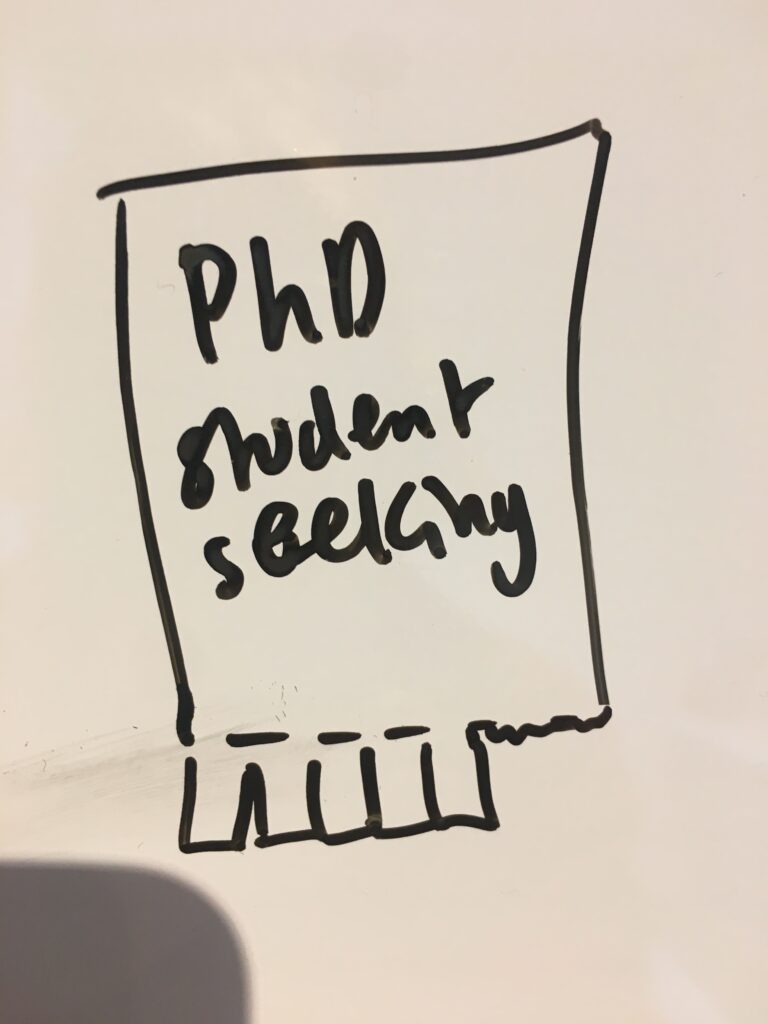
I think the oral historian Micheal Frisch puts it best when he called oral history archives “a shoebox of unwatched home videos.” The content is there but the viewing a specific moment is an arduous task. Mining the hall’s community for stories and throwing them into a shoebox is exactly what I want to avoid with this PhD.
[slide ten]
At Seaton Delaval Hall I want to create a storage system that broadens access to and actively encourages reuse of the oral histories, in order to support the community that has looked after the hall for so many years.
The second reason I say storage system instead of archive is ….
[slide eleven]
because currently archives are struggling with adapting to advancing technology. In recent years there has been a push to digitise archives with the COVID-19 pandemic giving this process an exceptional boost.
[slide twelve]
However, this digitisation requires a lot of resources like money, time and manpower that many archives, especially smaller ones, simply do not have.
[slide thirteen]
In addition, what this push to digitise does, which it does in many sectors, is attempt to replace a human with a robot, who in my opinion is simply not up to the task. Typing into a search bar is not the same as asking an archivist for help.
[slide fourteen]
While a search bar is a tool one uses when researching, the archivist becomes a fellow researcher, making room for far more flexible and creative exploration.
[slide fifteen]
Thirdly, archives are rather static in comparison to the world outside of their brick and mortar walls.
[slide sixteen]
Especially in the last year there has been increasing pressure to review how we present our history as a society. This dynamic debate is not reflected in the way we store our historical documents.
[slide seventeen]
This limited reviewing and updating of our archives actually makes it harder to do research. The most obvious instance being how certain keywords become outdated over time, which is something that is especially prominent in the archiving of minorities’s histories such as LGBTQA+ and Black history.
[slide eighteen]
The way we traditionally build an archive does not fit with contemporary society. Archives were initial set up to preserve one view of history in one type format. They did not leave room for new technologies and new points of view. Now, archives are attempting to change this by rather awkwardly moving into the digital space without truly questioning how these digital tools affect the archiving process and researching in archives.
In order to create a new storage system I wish to let go of these traditions, these symbols and languages that we use to navigate oral histories, archives and the digital.
[slide nineteen]
I want to start with a blank canvas and build a storage system that not only reflects the technology and views found in society but also makes room for any further developments in these areas. Now, the next question is: how we might go about building this new system?
[slide twenty]
The chocolate filling AKA working together without killing each other
[slide twenty-one]
AKA collaborating! A truly fabulous buzzword that works very well in funding applications but in reality is really difficult to do. Why? Well, every field of research has its own type of
[slide twenty-two]
‘disciplinary upbringing.’
[slide twenty-three]
When I say ‘disciplinary upbringing’ I am referring to the lens that each field views things like language and methods of work through. In other words the
[slide twenty-four]
‘here we do things this way’ attitude.
[slide twenty-five]
When people collaborate across disciplines they bring this lens, this disciplinary upbringing, with them so when the work starts everyone is viewing the challenge through separate and different lenses. This can lead to a lot clashes and plenty confusion.
So how do you solve this?
[slide twenty-six]
You could just say that people should leave their disciplinary upbringing at the door but that never works.
[slide twenty-seven]
Instead I intend on using these disciplinary upbringings to the advantage of the creative process by encouraging people to be open about them and in some cases even exaggerate them a bit. What this does is bring to light the various
[slide twenty-eight]
‘creative tensions’ that are present in the collaboration.
[slide twenty-nine]
For example in the context of this project where we have a collaboration between the fields of oral history, design and heritage you can find many creative tensions that are the consequence of differing disciplinary upbringings.
[slide thirty]
Between oral history and design there is the tension of the medium of communication; historians like writing and designers love a good visual.
[slide thirty-one]
I can tell you from experience that design and heritage work at dramatically different speeds. One of design’s key philosophies is “fail fast”, which is definitely not something would be mentioned in a National Trust meeting.
[slide thirty-two]
Finally, between oral history and heritage we find possibly the most challenging of creative tensions, which is differing opinions on the representation of history.
[slide thirty-three]
It is important to identify these creative tensions because they highlight issues that might have otherwise gone unseen if everyone had just been polite and kept their mouth shut.
[slide thirty-four]
Once they have been determined they function as a great source of information. This information needs to be drawn out through thorough questioning. It is essential to discover why the tension exists and how it might inform the creative process.
[slide thirty-five]
This does however mean that sometimes you might have to ask what seem like silly and obvious questions, because your disciplinary upbringing to begin with blocks you from fully understanding where other people are coming from. To complete the questioning to its fullest potential it is necessary to unpack any confusion no matter how small or trivial they might seem.
[slide thirty-six]
However the most fundamental thing within this chocolate filling of collaboration is — listening. One must always remember that you are not there to defend your disciplinary upbringing, you are there to solve a collective problem. When identifying and questioning creative tensions everyone must listen to all of those collaborating.
[slide thirty-seven]
Overall the chocolate filling represents something that can be very difficult, but with open minds, questioning and listening can be exceptionally fruitful.
[slide thirty-eight]
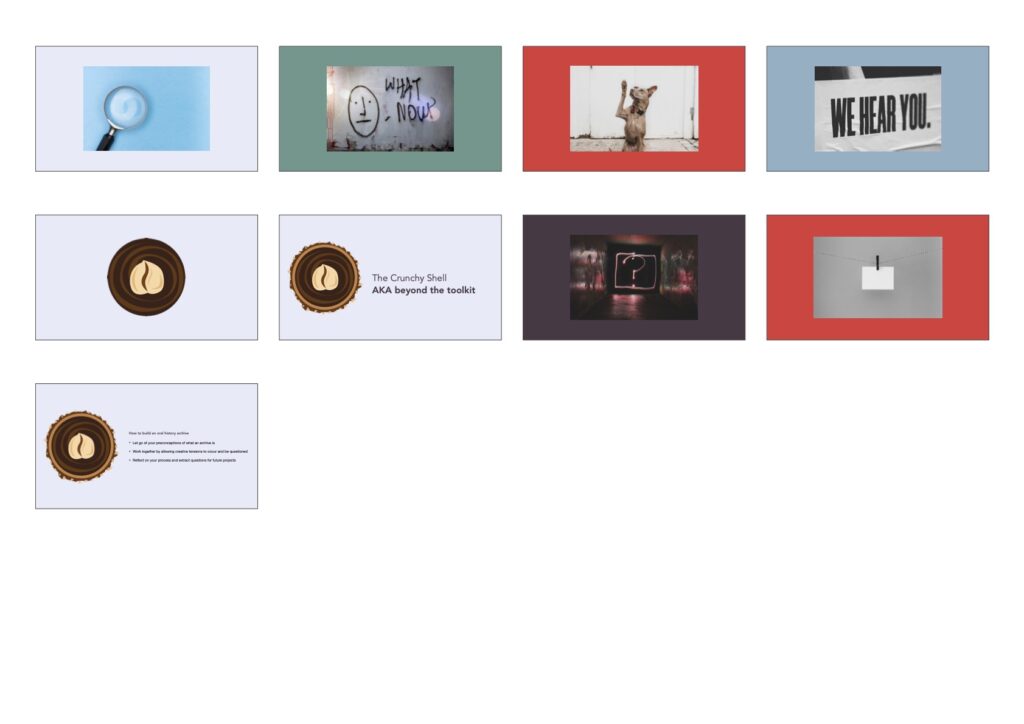
The Crunchy shell aka beyond the toolkit
A Ferrero Rocher is not complete without its crunchy shell and neither would this project. The crunchy shell in this context represents the legacy of the project. It is important to me that the project and the storage system does not end with the completion of this PhD.
[slide thirty-nine]
In order to avoid this I and everyone involved in the project shall thoroughly question and analyse the process of building this storage system. We need to reflect on what worked and what didn’t work. This questioning needs to be beyond which workshop activity was fun and whether we had enough time.
[slide forty]
What we need to do is extract questions that will help someone else set up a similar project. So instead of creating a rigid set of instructions with painfully particular processes, we offer future oral history projects questions that they must ask themselves before, during, and after the project. This hopefully will allow them to adapt the process to their needs and encourages them to think more creatively.
[slide thirty-nine]
Conclusion
Now I completely recognise the irony of me slamming the idea of a rigid sets of instructions and then ending on a how-to guide, but in my defence I had the title before I fully wrote the paper so please forgive me.
How to build an oral history archive
The true aim of this how-to is to make sure that we do not end up in the same position we are now, where our archives no longer reflect society. The world is only going to get more complicated so if we do not leave room for questioning and change, archives are always going to be behind. This would be a disaster as archives on a macro scale are the keepers of our history and (in theory) hold the foundations of our collective identities as a people. On a more micro scale I have personally always found comfort in how archives keep documents that show everyday humanity, like a postcard to a fellow artist or a writer’s note to a partner.
So here is my how-to on making an oral history archive. Take it with you, try it out, tell me if it worked. I am going to do the same and probably change it many times in the next three years.
Acousmatic sound is sound that is heard without an originating cause being seen. The word acousmatic, from the French acousmatique, is derived from the Greek word akousmatikoi (ἀκουσματικοί), which referred to probationary pupils of the philosopher Pythagoras who were required to sit in absolute silence while they listened to him deliver his lecture from behind a veil or screen to make them better concentrate on his teachings.
The act of moving something from the everyday to the space of archive.
Affective computing is the study and development of systems and devices that can recognise, interpret, process, and simulate human affects. It is an interdisciplinary field spanning computer science, psychology, and cognitive science. One of the motivations for the research is the ability to give machines emotional intelligence, including to simulate empathy. The machine should interpret the emotional state of humans and adapt its behaviour to them, giving an appropriate response to those emotions.
In Hegel, the term Aufhebung has the apparently contradictory implications of both preserving and changing, and eventually advancement (the German verb aufheben means “to cancel”, “to keep” and “to pick up”).
The creation of lists that represent the canon of heritage. It is a set of ideas that works to normalise a range of assumptions about the nature and meaning of heritage and to privilege particular practices, especially those of heritage professionals and the state. Conversely, the AHD can also be seen to exclude a whole range of popular ideas and practices relating to heritage.
A rather more elegant term for archives that are stored in buildings. Because it is important to note that digital archives are also very physical.
When the content of a page has been moved around on the internet causing certain links to no longer be attached to that specific page.
Counter reading is when you identify the gaps in an archive, analyse why they are exist and combined this with further contextual history in order to fulfil your research.
Data degradation is the gradual corruption of computer data due to an accumulation of non-critical failures in a data storage device. The phenomenon is also known as data decay, data rot or bit rot.
The separate lenses through which individuals from different fields of work view and approach things like: problem solving, language, and general practice.
Collaborating but only a trivial amount of time and often to fulfil a funding requirement.
The word ‘egodocument’ refers to autobiographical writing, such as memoirs, diaries, letters and travel accounts. The term was coined around 1955 by the historian Jacques Presser, who defined egodocuments as writings in which the ‘I’, the writer, is continuously present in the text as the writing and describing subject.
Acronym for Google, Apple, Facebook and Amazon. The tech giants.
A tool use by historians to put themselves into the shoes of the historical figure they are investigating or imagining themselves in the streets of a certain historical setting. It can be helpful to bring together separate ideas and bring the history back to life as such.
GLAM stands for Galleries, Libraries, Archives and Museum.
When the webpage attached to a link can no longer be found when you click on it and instead offers you the message “Page not found”
Liquid architecture is an architecture that breathes, pulses, leaps as one form and lands as another. Liquid architecture is an architecture whose form is contingent on the interest, of the beholder; it is an architecture that opens to welcome me and closes to defend me; it is an architecture without doors and hallways, where the next room is always where I need it to be and what I need it to be.
Marcos Novak in “Liquid architecture in Cyberpace”
Originally coming from the word mediator.
Media archaeology or media archeology is a field that attempts to understand new and emerging media through close examination of the past, and especially through critical scrutiny of dominant progressivist narratives of popular commercial media such as film and television. Media archaeologists often evince strong interest in so-called dead media, noting that new media often revive and recirculate material and techniques of communication that had been lost, neglected, or obscured. Some media archaeologists are also concerned with the relationship between media fantasies and technological development, especially the ways in which ideas about imaginary or speculative media affect the media that actually emerge.
Media literacy encompasses the practices that allow people to access, critically evaluate, and create or manipulate media. Media literacy is not restricted to one medium. Media literacy education is intended to promote awareness of media influence and create an active stance towards both consuming and creating media. Media literacy education is part of the curriculum in the United States and some European Union countries, and an interdisciplinary global community of media scholars and educators engages in knowledge sharing through scholarly and professional journals and national membership associations.
Multi-valents, many values, the holding of different values at the same time without implying confusion, contradiction, or even paradox. (Term coined by Michael Frisch.
Open access (OA) is a set of principles and a range of practices through which research outputs are distributed online, free of cost or other access barriers.
Participatory Action Research (PAR) has been defined as a collaborative process of research, education and action explicitly oriented towards social transformation. Participatory Action Researchers recognise the existence of a plurality of knowledges in a variety of institutions and locations. In particular, they assume that ‘those who have been most systematically excluded, oppressed or denied carry specifically revealing wisdom about the history, structure, consequences and the fracture points in unjust social arrangements’. PAR therefore represents a counter hegemonic approach to knowledge production.
The age of high surveillance which we live in now.
When links in footnotes on longer are attached to the reference. This is often due to link rot or content drift.
Software rot, also known as bit rot, code rot, software erosion, software decay, or software entropy is either a slow deterioration of software quality over time or its diminishing responsiveness that will eventually lead to software becoming faulty, unusable, or in need of upgrade. This is not a physical phenomenon: the software does not actually decay, but rather suffers from a lack of being responsive and updated with respect to the changing environment in which it resides.
The science, laws, or principles of classification.
Coming from the latin vox populi, it refers to a short interview with a member of the public.
Wikidata is a collaboratively edited multilingual knowledge graph hosted by the Wikimedia Foundation. It is a common source of open data that Wikimedia projects such as Wikipedia, and anyone else, can use under the CC0 public domain license. Wikidata is powered by the software Wikibase.
On Monday 11th April 2022 I attended and ran a workshop at the Seaton Delaval Hall Community Research Day. It was an exceptionally interesting affair and mostly certain did not go the way I imagined. If I had to sum it up I would describe it as engaging but impractical. To say that it got deep real quick would be an understatement but the to which it went was fascinating. It was also great to just bounce ideas off people. However it felt like whenever I attempt to move the conversation to getting to more practical solutions people rather stayed in philosophical and imaginary realm or they would just explain why it would not be possible to change that.
Maybe I am too much of a designer, wanting to think of solutions instead of sticking to the status quo. Or maybe this is exactly what I should be doing, building a bridge between the imaginary realm and the real world. Maybe this is the point that Verganti talks about when he discusses ‘Interpreters’. The people in that room on Monday were my interpreters, the people I can draw on for inspiration and ideas…
If this is the case it is now my job to turn the “multi-verse” of history that we kept talking about into reality. No pressure….