Working in the Human Nutrition & Exercise Research Centre (HNERC), it might be assumed that nutrition and exercise are two things I have completely mastered. The truth is, that (presumably) unlike many of my colleagues, these are things I continue to struggle with.
Exercise for instance; whilst I love being physically active, going on long dog walks, being outdoors in the fresh air, exercise itself – the planned structured part such as going to the gym – is something I have a long and complicated relationship with.
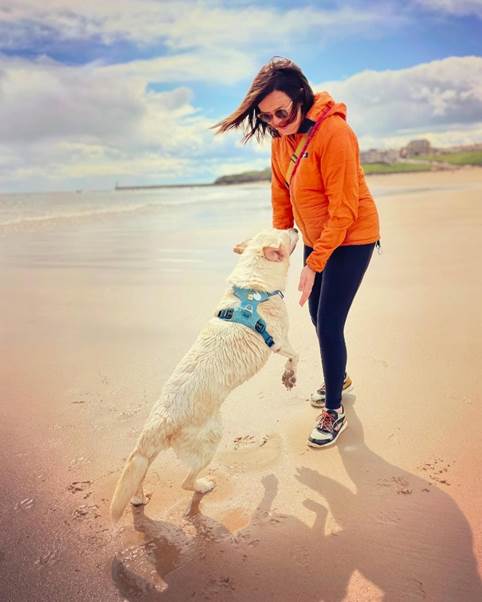
On the surface, it seems simple: ‘move more’ and ‘just do it’. But for me, it rarely feels that straightforward. My brain has an impressive ability to overthink every decision. I weigh up the pros and cons, wonder how difficult it will be, whether it will fit into my routine (and my dog’s!), whether I’ll enjoy it, and whether I’ll still be doing it in six months’ time. I’ve spent hours researching gyms, comparing exercise classes, and creating carefully thought-out plans.
Sometimes those plans work—for a while. Then life happens. I get injured, work gets busier, the gym membership no longer feels affordable, or routines in the house change. Suddenly I’m back to where I started, asking the same questions: What should I do? Where should I do it? When and how will I fit it in?
It really shouldn’t feel this difficult, but for the most part it does.
So, why do I spend so long trying to establish a more consistent relationship with exercise and why do I spend a large part of my time researching physical activity and exercise?
The answer is that ‘exercise is medicine’; it has enormous potential to improve long-term health, reduce the risk of future illness, and enhance quality of life.
The importance of physical activity and exercise became particularly clear to me when carrying out research into the survivorship of childhood and adolescent cancer here at Newcastle University and in collaboration with PanCare (a European society and charity for childhood cancer survivors). Through this work, I learnt about the long-term effects of cancer treatment – often called late effects – which are health conditions that can develop months or even years after the cancer treatment has finished. For example, some chemotherapy treatments, called anthracyclines can increase the young person’s risk of heart problems later in life. Physical activity and exercise have been identified as a key strategy which could help these young people protect and maintain their heart health (among lots of other benefits) but research indicates that the majority of these young people are insufficiently active.
Feeling strongly that these young people should be supported to look after their health, led to a project called BEACON1 (BEing Active after ChildhOod CaNcer) in which we reviewed existing evidence,2 and spoke to survivors of childhood cancer aged 10-24 years old about physical activity, with the aim of specifically identifying what helps and hinders them to be active and understanding what support could help them to be active in their everyday lives.
Likewise for a project I am currently working on with women who have had breast cancer (PURE-EX),3 there is a lot of evidence supporting the role physical activity and exercise can play in reducing the risk of the cancer returning and improving survival and other important health outcomes such as emotional wellbeing and fatigue. But again, we know this is a group who struggle to be active.
So, if we know the value that physical activity and exercise can offer people in general, and those who have been treated for cancer, what is the issue? Well, part of the issue lies with one common misconception: that knowledge alone will change behaviour.
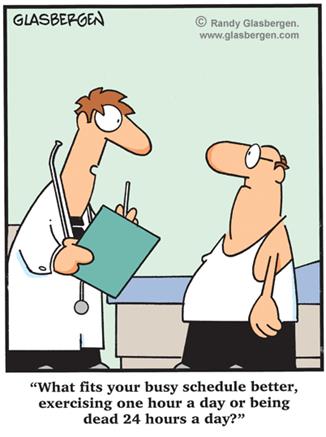
Cartoon from: https://www.glasbergen.com/ngg_tag/what-fits-your-busy-schedule-better/
That is something I have learnt not only personally, but also professionally through studying health psychology. Health psychology explores how biological, psychological and social factors influence health and illness and can help us to answer the question: if we know something is good for us, why is it often so difficult for us to actually do?
We all face barriers when it comes to adopting important health behaviours such as exercise, and good dietary habits (and hopefully avoiding/giving up harmful health behaviours like smoking and vaping), and those barriers deserve understanding rather than judgement. Although human behaviour seems like it should be something what we should be able to understand with ease, some people state that rocket science is in fact easier to understand.4 Whilst rockets follow clear laws from maths and physics which allow us to predict what should happen each time, human behaviour results from a whole array of influences (e.g., beliefs, emotions, past experiences, the people and environments around us, culture and society) which makes it extremely complex and at times, unpredictable.
And when an illness like cancer is involved, it can throw up even more challenges. Muscles become weaker, new aches and pains appear, and energy levels fall with fatigue often becoming an ongoing struggle. At the same time, people are often adjusting psychologically, emotionally and socially to the trauma of cancer. Many describe feeling as though they are living in a body they no longer fully recognise, trust or feel comfortable in. They are often unsure of what they are now capable of doing, and whether it is safe or not. Starting—or restarting—physical activity in that context is about much more than just knowledge.
Whilst research can often focus on generating evidence about what people should do, my work is about understanding how we can support people to do it in ways that acknowledge the challenges they face and ultimately help them live well after cancer. For both the BEACON and PURE-EX projects we hope our work will result in better support and real change for patients, helping them to feel encouraged and able to be physically active and exercise in a way which will be sustainable and which will help them to feel better mentally and physically.
I’m excited to continue that work here at HNERC, alongside colleagues who share a passion for improving health through research. And who knows—perhaps by helping others overcome barriers to exercise, I’ll become a little better at overcoming my own.

References
- Brown MC, Araújo-Soares V, Skinner R, Glaser AW, Sarwar N, Saxton JM, Montague K, Hall J, Burns O, Sharp L. Using qualitative and co-design methods to inform the development of an intervention to support and improve physical activity in childhood cancer survivors: a study protocol for BEing Active after ChildhOod caNcer (BEACON). BMJ Open. 2020 Dec 21;10(12):e041073. doi: 10.1136/bmjopen-2020-041073. PMID: 33371034; PMCID: PMC7754664.
- Brown MC, Podmore M, Araújo-Soares V, Skinner R, Sharp L. Childhood cancer survivors’ perceptions of the barriers and facilitators to physical activity: a systematic review and thematic synthesis of qualitative evidence using the theoretical domains framework. Health Psychol Rev. 2023 Jun;17(2):277-300. doi: 10.1080/17437199.2022.2032795. Epub 2022 Feb 14. PMID: 35081866.
- Orange ST, Brown MC, Hallsworth K et al. Co-development of a programme to improve physical activity support for women after breast cancer treatment: a pre-protocol for PURE-EX [version 1; peer review: 1 approved with reservations]. NIHR Open Res 2025, 5:3 (https://doi.org/10.3310/nihropenres.13773.1)
- Sarvadi, P. Human behaviour would be easier if it was rocket science. Accessed 30 July 2026 from https://www.forbes.com/sites/forbesbooksauthors/2019/11/13/human-behavior-would-be-easier-if-it-was-rocket-science/?sh=2fde0d6557cb.