By Dr Dan Eaves
For many people recovering from stroke, physically repeating a movement hundreds of times can be difficult or, in some cases, impossible. But physical movement is not the only way that we can engage the brain systems involved in movement.
We can also rehearse actions mentally, without physically performing the movement.
Mental practice has been studied in stroke rehabilitation for several decades and is now recommended within stroke rehabilitation guidance in the UK and internationally (Lin et al., 2025).
The 2023 National Clinical Guideline for Stroke for the UK and Ireland, for example, recommends that people with stroke who are able and motivated to participate in mental practice should be offered training and encouraged to use it alongside their usual therapy.
So, the question is no longer “Should we use mental practice?”
Instead, clinicians are asking “How can I deliver mental practice effectively in my stroke care pathway?”
Yet there remains surprisingly little practical guidance to help clinicians answer this question.
When we think about mentally practising a movement, we might immediately think of motor imagery: imagining ourselves performing an action without physically moving.
But there are other ways of mentally rehearsing movement too.
Watching a movement provides the brain with a rich source of visual information about what the movement should look like, and this can also activate the observer’s motor system (Binks et al., 2025). Imagining the same movement requires the person to generate much more of that representation internally themselves.
Following a stroke, that distinction can matter enormously.
Stroke can affect vision, attention, memory, executive function, perception and the ability to generate or manipulate mental images, alongside its more obvious effects on movement. A mental practice technique that works well for one patient may therefore be difficult or inappropriate for another.
This problem has led us to develop the Mental Practice Variants (MPV) Model.
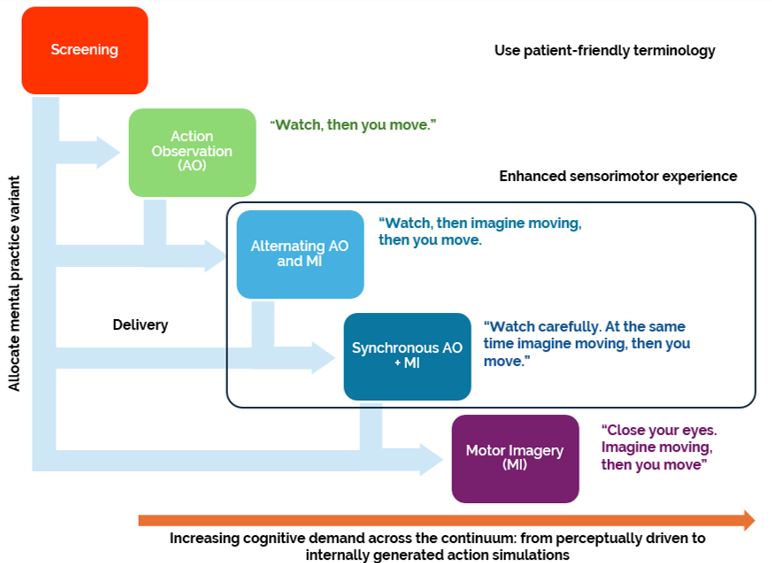
Rather than treating mental practice as a single intervention, our model distinguishes four related ways of mentally rehearsing movement:
→ Action Observation
→ Alternating between Action Observation + Motor Imagery
→ Synchronous Action Observation + Motor Imagery
→ Motor Imagery
Across these variants, the emphasis shifts from externally provided visual information towards increasingly internally generated representations of movement, and this is associated with increases in cognitive demand.
Instead of asking whether a patient can or cannot do mental practice, we can now ask which form of mental practice is most appropriate for that patient, at that point in their recovery.
Closing the gap between guidelines and practice
If mental practice is to fulfil the potential reflected in stroke rehabilitation guidelines, clinicians need practical ways of translating guideline recommendations into individualised treatment.
Our recent work at Newcastle University has therefore focused increasingly on this translation (Lin et al., 2026).
Alongside developing the MPV model from the scientific literature, we have been working with healthcare professionals involved in stroke rehabilitation to understand the practical questions that arise when mental practice moves from a research paper into a clinical setting.
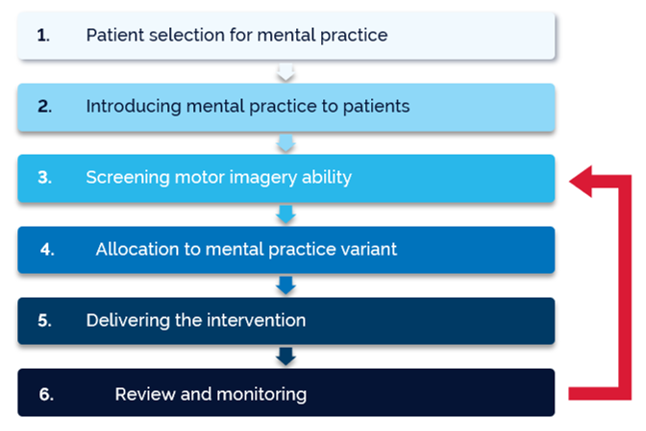
This has led us to develop a six-step framework covering patient selection, introducing mental practice, screening, allocation to an appropriate variant, delivery, and ongoing review and monitoring.
The aim is not to replace clinical judgement with an algorithm. Quite the opposite. It is to give clinicians a clearer framework within which that judgement can be applied.
A patient may begin with one form of mental practice and later move towards another. Another patient may remain with the approach that is most accessible and useful to them. Patient preference, cognitive and perceptual abilities, movement goals and response to the intervention can all inform those decisions.
In this sense, mental practice becomes less about prescribing a single technique and more about having a toolkit of related approaches that can be matched to the individual.
From knowing we should, to knowing how
This autumn, we are taking another step towards addressing this implementation gap through a new Newcastle University continuing professional development course for healthcare professionals working in stroke rehabilitation.
The course has been co-designed with NHS staff and will introduce the Mental Practice Variants Model and provide practical experience of selecting, delivering, adapting and progressing different mental practice approaches.
The course will initially be delivered face-to-face, with online provision also being developed to make the training more widely accessible.
From our perspective, putting mental practice into guidelines is only part of the job. The next step is making it easier to put it into practice, so that it can ultimately benefit patients.
To support this work, we are also preparing to launch a new Newcastle University supported website, which will act as the first online hub for a wide range of mental practice materials and how to resources.
Please sign up here to receive updates: https://mentalpractice.org/sign-up
References
J. A. Binks, R.P.W. Kenny, P. van Schaik, C. J. Wilson, D. Lin, T. J. Binks & D. L. Eaves (13 Nov 2025): The effects of combined action observation and motor imagery (AO + MI) practice on motor learning: a systematic review, International Review of Sport and Exercise Psychology, DOI: 10.1080/1750984X.2025.2575511
Lin D, Eaves DL, Gibbons T, Aquino MRJ, Edwards MG, Poliakoff E, Bek J, & Emerson JR (2026). Perspectives of stroke survivors and informal caregivers on home-based mental practice for upper limb recovery after stroke: a qualitative co-design study, Neuropsychological Rehabilitation, 36:6, 1122-1161, DOI: 10.1080/09602011.2025.2577376
Lin D, Eaves DL, Franklin JD, Robinson JR, Binks JA and Emerson JR (2025). Combined action observation and motor imagery practice for upper limb recovery following stroke: a systematic review and meta-analysis. Frontiers in Neurology. 16:1567421. doi: 10.3389/fneur.2025.1567421